

Most people ask, “Do rich snippets help SEO?” The answer is absolutely yes, and the evidence behind that answer is both compelling and well-documented. While rich snippets are not a direct ranking factor that moves your page from position seven to position two overnight, their impact on click-through rate, user engagement, organic traffic, and search visibility is significant enough that any website serious about SEO performance should be implementing them.
Studies consistently show that pages with rich results earn 20 to 30 percent higher click-through rates compared to standard blue link results at the same ranking position, with some case studies reporting CTR improvements as high as 82 percent. This guide covers everything you need to know about what rich snippets are, how structured data powers them, what the different implementation formats mean, and exactly how they contribute to your overall SEO success.
What Are Rich Snippets in SEO
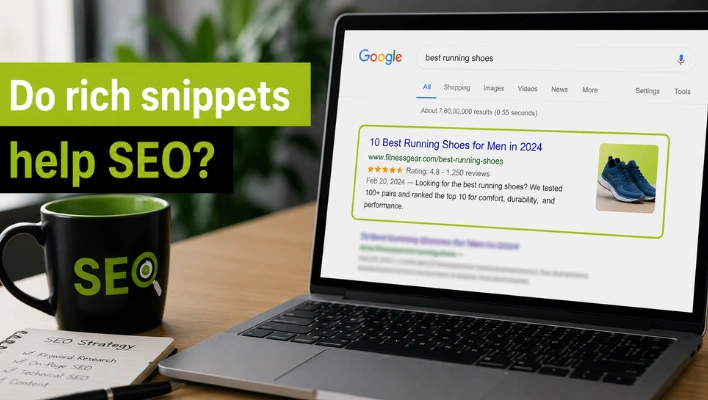
Rich snippets in SEO are enhanced search results that display additional information beyond the standard title, URL, and meta description. When you search on Google and see a result with star ratings, product prices, recipe cooking times, FAQ answers, event dates, or video thumbnails displayed directly in the search results page, what you are looking at is a rich snippet.
The core distinction between a standard search result and a rich snippet is the amount of information visible before the user clicks. A standard result gives a title and a brief description. A rich snippet gives that same information plus structured context that helps users make a more informed decision about whether to click. This additional context is what makes rich snippets so valuable from a marketing and SEO perspective. They transform a plain text listing into something closer to a visual advertisement that communicates relevance and trust at a glance.
Rich snippets appear for a wide range of content types. Product pages can display pricing, availability, and aggregate star ratings. Recipe pages can show preparation time, calorie count, and user reviews. Event pages can display dates, venues, and ticket availability. FAQ sections can expand directly in search results, with users able to read answers without visiting the page. Article pages can show author information, publication dates, and featured images. Each of these enhanced displays serves the same fundamental purpose: giving users more confidence to click on a specific result.
What Is Structured Data in SEO
Structured data in SEO is code added to a webpage that communicates the meaning and context of that page’s content directly to search engines in a language they can efficiently read and interpret. Regular HTML tells search engines what is on a page through text and tags. Structured data goes further by telling search engines what the content actually means.
Consider the difference between a page that contains the text “4.8 stars from 312 reviews” and a page that uses structured data to label that same text as an AggregateRating property with a ratingValue of 4.8 and a reviewCount of 312. Without structured data, Google might read that text but has to infer its meaning from context. With structured data, Google immediately understands it is looking at a standardized rating property and can use that information to display star ratings directly in search results.
This is the fundamental value of structured data for SEO. It bridges the gap between how humans read web content and how search engines process it. By making your content machine-readable in a standardized way, you help Google understand your pages more accurately, which improves the efficiency of indexing and opens the door to rich result eligibility.
Google’s official documentation confirms that structured data helps it understand web pages and gather information about the web and the world in general. When Google can understand your content at this deeper level, it can surface your pages for more relevant queries and represent them more accurately in search results.
What Is Structured Data Markup in SEO
Structured data markup in SEO refers to the specific coded annotations you add to your webpage to implement structured data. The term markup describes the process of annotating content with labels that identify what each piece of information represents. When you mark up your page with structured data, you are essentially tagging content elements with standardized labels from a shared vocabulary so that search engines can read those labels consistently across the web.
The most widely used vocabulary for structured data markup is Schema.org, a collaborative project maintained by Google, Bing, Yahoo, and Yandex. Schema.org defines hundreds of content types, called schema types, and thousands of properties that describe the specific attributes of those types. When you implement structured data markup using Schema.org vocabulary, you are drawing from a shared language that major search engines understand and actively use to power rich results.
Structured data markup sits in the technical SEO category because it requires adding code to your pages. However, its impact extends well beyond technical optimization into user experience and conversion rate, because the rich results it enables directly influence how many people choose to click on your search listing.

What Is Structured Data for SEO: The Three Core Formats
There are three accepted formats for adding structured data to a webpage: JSON-LD, Microdata, and RDFa. Each format achieves the same goal of making your content machine-readable, but they differ in how they are implemented and maintained.
JSON-LD is Google’s recommended format and the most widely adopted choice across the SEO industry. JSON-LD stands for JavaScript Object Notation for Linked Data. It is placed in a script tag in the head or body of your page, completely separate from your visible HTML content. This separation makes JSON-LD clean, easy to implement, easy to maintain, and straightforward to validate. Because it does not interweave with your page’s existing HTML structure, adding or editing JSON-LD markup carries no risk of affecting your page’s visual layout or rendering.
Microdata is a format that embeds structured data attributes directly within the HTML elements of your visible page content. It uses attributes like itemscope, itemtype, and itemprop added to existing HTML tags to annotate content. Microdata was widely used in the earlier years of structured data adoption and remains supported by all major search engines, but it is more complex to implement and maintain than JSON-LD because any changes to the page’s HTML structure require corresponding updates to the microdata attributes woven throughout it.
RDFa, which stands for Resource Description Framework in Attributes, is another format that embeds structured data attributes in HTML elements, similar in approach to Microdata but using a different syntax. RDFa is less commonly used than either JSON-LD or Microdata in modern SEO implementations and is generally considered the most complex of the three formats for most website owners.
For the majority of websites and SEO implementations, JSON-LD is the right choice. Google recommends it explicitly, it is the easiest to implement correctly, and it produces the same rich result eligibility as the other formats.
What Is JSON-LD in SEO
JSON-LD in SEO is the code format used to implement structured data markup on a webpage. It stands for JavaScript Object Notation for Linked Data and functions as a standardized way to package information about a page’s content into a format that search engines can quickly read and understand.
A JSON-LD block begins with a script tag in the page’s HTML and contains a structured description of the page’s content using Schema.org vocabulary. Here is a simple example of what JSON-LD looks like for an article page:
<script type=”application/ld+json”> { “@context”: “https://schema.org”, “@type”: “Article”, “headline”: “Do Rich Snippets Help in SEO”, “author”: { “@type”: “Person”, “name”: “Your Author Name” }, “datePublished”: “2025-06-28” } </script>
This block tells Google that the page is an Article, provides the headline, identifies the author as a Person with a specific name, and specifies when it was published. Google can then use this information to display the article more richly in search results, potentially including the author’s name, publication date, and featured image in the search listing.
The power of JSON-LD for SEO extends beyond individual page optimization. It connects your content to Google’s Knowledge Graph, which is the database of entities and relationships that powers many of Google’s search features. When your content is well-marked up with JSON-LD, it becomes more legible to Google’s AI systems, including AI Overviews, which increasingly draw from structured, machine-readable content when generating their responses. This means that well-implemented JSON-LD serves a dual purpose in 2025: earning visual enhancements in traditional search and improving your visibility within AI-powered search experiences.
Related Topic: What is Meta Description in SEO
What Is Microdata in SEO
Microdata in SEO is one of the three formats for implementing structured data on a webpage. Unlike JSON-LD, which is placed in a separate script block, microdata is embedded directly within the HTML elements that display your visible content. It uses HTML attributes to annotate content with structured meaning.
For example, if your page displays a product review, microdata implementation would involve adding attributes directly to the HTML elements showing the product name, the rating value, and the reviewer’s information. Each relevant element receives attributes like itemscope, itemtype, and itemprop that tell search engines what each piece of content represents within the Schema.org vocabulary.
While microdata is fully functional and supported by all major search engines, including Google, Bing, Yahoo, and Yandex, it is generally considered more difficult to implement and maintain than JSON-LD. The primary reason is that microdata tightly couples your structured data annotations with your visible HTML. When the design or structure of a page changes, microdata attributes throughout the page may need to be updated simultaneously. This interdependence adds maintenance overhead that JSON-LD avoids entirely by keeping the structured data in a separate, self-contained script block.
For websites migrating from older structured data implementations, converting from microdata to JSON-LD is a common technical SEO task that simplifies ongoing maintenance without affecting rich result eligibility.
What Are Rich Results in SEO
Rich results in SEO is the broader, more current term that Google uses to describe the range of enhanced search experiences made possible by structured data. The terms rich snippets and rich results are often used interchangeably, though rich results is the preferred terminology in Google’s official documentation.
Rich results encompass every type of enhanced search listing that goes beyond the standard title, URL, and description. They include the visual star rating displays powered by Review and AggregateRating schema, the expandable FAQ answers powered by FAQPage schema, the step-by-step instructions powered by HowTo schema, the product details, including price and availability, powered by Product schema, the cooking and preparation information powered by Recipe schema, the event details powered by Event schema, and the video thumbnails and metadata powered by VideoObject schema.
What rich results in SEO represent, at the broadest level, is Google’s commitment to making search results more useful and informative for users before they click. Every type of rich result serves the same core purpose: providing enough context about a page’s content that users can make a confident, well-informed decision about whether that page is what they are looking for. This pre-click information delivery is exactly why rich results consistently earn higher click-through rates than standard results at equivalent ranking positions.
Do Rich Snippets Help SEO: The Data-Backed Answer
The answer to “do rich snippets help SEO” is yes, meaningfully and measurably, through a chain of effects that begin with improved visual presentation and culminate in stronger long-term organic performance.
Rich snippets are not a direct ranking signal. Google has confirmed this consistently through official statements and documentation. Adding structured data to a page will not cause Google’s algorithm to move that page up in rankings as a direct consequence. This distinction matters because it sets accurate expectations about how rich snippets contribute to SEO success.
What rich snippets do is make your existing ranking position work significantly harder. A page at position four with a rich snippet showing star ratings, pricing, and availability will almost always outperform a page at position three with a standard plain text listing in terms of actual clicks earned. The visual enhancement that rich results provide draws the eye, communicates relevant details at a glance, and builds trust before the user ever visits your page.
The data supporting this is clear. Industry research consistently shows that rich results earn between 20 and 30 percent higher click-through rates compared to standard listings at the same ranking position. Featured snippets, which represent the most prominent type of rich result, can achieve click-through rates as high as 42.9 percent. A well-known case study from Nestlé measured that pages showing as rich results had an 82 percent higher click-through rate than their non-rich result pages. An e-commerce retailer implementing product schema with pricing, availability, and rating information typically sees its CTR increase by 15 to 30 percent over the same pages without that enhancement.
The mechanism through which this CTR improvement supports SEO is behavioral signal reinforcement. When your page consistently earns more clicks than other results at the same ranking position, Google interprets that as evidence that your page is the most satisfying answer to that query. Over time, sustained high CTR relative to ranking position is a positive signal that can contribute to ranking stability and gradual improvement. The chain reaction runs from structured data implementation to rich result display to higher CTR to stronger user engagement signals to better long-term ranking performance. Book a Call with Skills Heaven for reliable SEO Services.
Does Structured Data Help SEO Beyond CTR
Structured data helps SEO in several important ways that extend beyond the direct CTR benefit of rich result display.
Content comprehension at scale. Structured data helps Google understand the meaning and context of your content more accurately and efficiently. When Google can clearly identify what type of content a page contains, who created it, when it was published, and what specific properties it has, the indexing process becomes more efficient, and the page becomes more likely to surface for semantically relevant queries beyond just exact keyword matches.
Knowledge Graph integration. Well-implemented structured data connects your brand, content, and entities to Google’s Knowledge Graph, the vast database of entities and relationships that powers knowledge panels, entity-based search results, and AI-powered answers. Strong Knowledge Graph integration strengthens your brand’s presence across a wider range of search experiences beyond standard organic results.
AI Overview visibility. Google’s AI Overviews, which appeared on approximately 13 percent of searches by mid-2025, increasingly draw from pages that use structured data to organize information clearly. A well-marked-up FAQ section, product comparison table, or how-to guide is more likely to be cited within an AI-generated answer than an equivalent page without structured data. This means that structured data now serves a dual purpose: earning visual enhancements in traditional search results and feeding the machine-readable content layer that powers generative search experiences.
Qualified traffic improvement. Rich snippets do not just increase the number of clicks a page receives. They attract more qualified clicks because users arrive with a clearer understanding of what they will find. A product listing that shows a 4.7-star rating, a price of $49, and an “In Stock” status before the click attracts visitors who are already familiar with the key decision factors and more ready to convert. This pre-qualification effect produces better engagement metrics across the board, including lower bounce rates, longer session durations, and higher conversion rates.
Competitive differentiation in the SERP. On a search results page where most listings are plain text, a single rich result with star ratings, pricing, or expandable FAQ answers commands a disproportionate share of user attention. The visual space occupied by a rich snippet is often double the pixel height of a standard result, which means it physically dominates the page in a way that plain listings cannot match. This visibility advantage is particularly powerful in competitive niches where multiple strong pages are competing for the same audience.
Types of Rich Snippets That Deliver the Strongest SEO Value
Not all rich snippet types deliver the same level of SEO benefit. The most valuable types for most websites are the following.
Review and AggregateRating snippets display star ratings and review counts directly in search results. These are among the most visually compelling rich result types because star ratings immediately communicate social proof and quality at a glance. They are widely applicable to product pages, service pages, local businesses, apps, and courses.
Product snippets display price, availability, and ratings for product pages. For e-commerce websites, product schema is one of the highest-return structured data investments available because the additional information it surfaces directly addresses the key questions a shopper is asking before deciding which result to click.
FAQ snippets expand questions and answers directly in search results, allowing users to read answers without clicking through to the page. While this may seem counterintuitive, FAQ schema typically increases CTR by establishing strong topical relevance before the click. Users who do click through after seeing FAQ results are highly qualified because they already know the page addresses their specific questions.
HowTo snippets display step-by-step instructions with time estimates and materials, making them particularly effective for instructional content. They communicate at a glance that your page contains structured, actionable guidance rather than general discussion.
Article snippets can display author name, publication date, and featured image in search results, which contributes to trust signals, particularly for informational and news content.
VideoObject snippets display a thumbnail, duration, and upload date for video content, significantly increasing visibility and click appeal compared to standard listings.
LocalBusiness snippets display business hours, ratings, contact information, and location details, making them essential for any business with a physical location serving local customers.
BreadcrumbList snippets display the hierarchical path to a page within your website structure, which helps users understand where a page sits within a site and can increase click confidence, particularly for deeper pages within large websites.
How to Implement Structured Data for Rich Snippets
Implementing structured data for rich snippet eligibility follows a straightforward process regardless of your website platform.
The first step is identifying the correct schema type for each page you want to mark up. The schema type should match the primary content type of the page precisely. A product page uses Product schema. A recipe page uses the Recipe schema. A business information page uses the LocalBusiness schema. An article uses the Article schema. Choosing the wrong schema type or applying a type that does not match the visible content on the page violates Google’s structured data guidelines and can result in the markup being ignored or, in serious cases, a manual action penalty.
The second step is implementing the JSON-LD markup for the chosen schema type. This involves writing a script block that uses Schema.org vocabulary to describe your page’s content with the required and recommended properties for your chosen schema type. Required properties must be present for Google to consider a page eligible for the corresponding rich result. Recommended properties are optional but typically improve the richness and usefulness of the displayed result.
The third step is validating the implementation using Google’s Rich Results Test, which is the official tool provided by Google for testing whether structured data is correctly implemented and whether a page is eligible for rich result display. The Rich Results Test identifies any missing required properties, syntax errors, or guideline violations that would prevent rich results from appearing.
The fourth step is monitoring performance through Google Search Console, which provides an Enhancements section showing the structured data types Google has detected across your website, any errors affecting rich result eligibility, and performance data for pages with active rich results. Tracking CTR changes before and after structured data implementation in Search Console is the most reliable way to measure the direct impact of your rich snippet optimization efforts.
For WordPress websites, SEO plugins like Yoast SEO and Rank Math include built-in structured data functionality that generates JSON-LD markup automatically for common content types, making implementation accessible without requiring direct code editing. For Shopify and other e-commerce platforms, dedicated schema apps and extensions provide similar automated markup generation for product pages.
Common Structured Data Mistakes That Prevent Rich Results
Several common implementation mistakes prevent rich snippets from appearing even when structured data has been added to a page.
Marking up content that is not visible on the page is one of the most serious violations of Google’s structured data guidelines. All information described in your structured data must be visible to users reading the page. Adding a rating to your JSON-LD markup when no ratings are displayed on the page, or describing prices that users cannot see without clicking further, is considered deceptive and risks a manual action penalty from Google’s webspam team.
Missing required properties is one of the most common reasons structured data is implemented, but rich results do not appear. Each schema type has required properties that must be present for Google to consider the page eligible. A Product schema without an offers property including pricing information, or an AggregateRating schema without a ratingValue and ratingCount, will not generate the corresponding rich result even if all other aspects of the implementation are correct.
Syntax errors in the JSON-LD block prevent Google from reading the structured data entirely. A single missing comma, unclosed brace, or incorrect quotation mark can invalidate the entire markup block. Always validate using the Rich Results Test before considering an implementation complete.
Using conflicting schema types on the same page creates ambiguity that reduces rich result eligibility. Each page should implement one primary schema type aligned with the page’s core content. Adding multiple unrelated schema types, such as Product and Article markup on the same page, sends mixed signals to Google about what the page primarily represents.
Failing to monitor and update structured data after site changes is a maintenance mistake that causes rich results to disappear over time. Template changes, CMS updates, content revisions, and design changes can all break structured data implementations that were previously working correctly. Scheduled audits of structured data health through Google Search Console’s Enhancements reports are an important part of ongoing SEO maintenance.
Rich Snippets vs Featured Snippets: Understanding the Difference
Rich snippets and featured snippets are two distinct types of enhanced search results that are frequently confused with each other. Understanding the difference between them is important for setting accurate expectations about what structured data implementation can achieve.
Rich snippets are enhancements to your standard organic listing. Your page appears in its usual ranking position, but with additional visual information displayed alongside the title, URL, and description. Star ratings, prices, cooking times, and FAQ answers are all examples of rich snippet enhancements to an existing ranking position.
Featured snippets are a separate SERP feature entirely. A featured snippet appears above the standard organic results at what is commonly called position zero. It extracts a specific answer, definition, list, or table from a well-ranking page and displays it prominently at the top of the search results page, typically in a distinct box with the page title and URL beneath the extracted content.
The mechanisms that earn each type of result are different. Rich snippets come from structured data implementation that makes your content machine-readable and eligible for enhanced display. Featured snippets come from exceptional content clarity and relevance, where Google identifies that a specific passage from your page represents the most direct, useful answer to a query.
A page can earn both types simultaneously. A recipe page might display as a rich snippet in organic results with its star ratings and cooking time while also being featured as the top snippet for a specific query about that recipe. But the structured data that earns the rich snippet is not what earns the featured snippet position. Both are valuable and complementary, but they require different optimization strategies to achieve.
Related Topic: Is AI Generated Content Good for SEO?
Structured Data and AI-Powered Search: Why It Matters More in 2026
The SEO value of structured data and rich snippets has expanded significantly in 2025 with the growth of AI-powered search experiences. Google’s AI Overviews, which generate synthesized answers to complex queries, increasingly draw from content that is clearly structured and machine-readable.
When your pages use structured data to explicitly identify entities, relationships, and content attributes, AI systems can extract and attribute information from your content more accurately and efficiently. A product comparison table marked up with structured data, an FAQ section with proper FAQPage schema, or a step-by-step guide with HowTo markup are all more likely to be cited within AI-generated answers than equivalent content without structured data.
This dual benefit makes structured data implementation one of the most forward-looking investments in technical SEO available today. It earns visual enhancements in traditional search results through rich snippet display, and it positions your content for visibility within the AI-powered search experiences that are rapidly becoming a larger share of how people interact with Google. Websites that implement structured data well in 2025 are building a competitive advantage that will compound as AI search features continue to expand.
Final Thoughts: Do Rich Snippets Help in SEO
Rich snippets help in SEO in ways that are measurable, meaningful, and increasingly important as the search landscape evolves. They are not a shortcut to higher rankings, and they should not be positioned as a replacement for the fundamental work of creating high-quality, original content. But as a layer added on top of content that already deserves to rank, structured data and rich snippets represent one of the highest-return technical SEO investments available to any website.
The implementation cost is low. The potential impact on click-through rate, organic traffic, user engagement, and long-term authority is high. And in an era where AI-powered search is growing rapidly, and competition for search visibility is more intense than ever, the websites that give Google the clearest, most structured picture of their content are the ones that will earn the most from every ranking position they hold.
Do rich snippets help in SEO? Every data point, case study, and industry analysis point to the same answer. Yes, and every page on your website that could be eligible for a rich result and is not yet marked up is an opportunity that your competitors may already be taking advantage of.
Frequently Asked Questions About Rich Snippets in SEO
Do rich snippets help SEO rankings?
Rich snippets are not a direct ranking factor. Google has confirmed this officially. However, they significantly improve click-through rate, which sends positive behavioral signals to Google over time. Consistently higher CTR relative to competing pages at the same ranking position can contribute to long-term ranking improvement.
What is structured data in SEO?
Structured data in SEO is code added to a webpage that communicates the meaning of your content to search engines in a standardized, machine-readable format. It uses Schema.org vocabulary to label content elements so Google can understand what each piece of information represents and potentially display it as a rich result.
What is JSON-LD in SEO, and why does Google prefer it?
JSON-LD is Google’s recommended format for implementing structured data. It sits in a separate script tag, completely independent of your page’s visible HTML, making it clean, easy to implement, and simple to maintain. Unlike Microdata, it does not require changes to your existing HTML structure.
What is the difference between rich snippets and rich results?
Rich results is the broader, more current term Google uses in its official documentation. Rich snippets is the older, commonly used term. Both refer to the same thing: enhanced search listings that display additional information such as star ratings, prices, FAQs, or event details alongside the standard title and description.
What is microdata in SEO?
Microdata is one of three formats for implementing structured data, alongside JSON-LD and RDFa. It embeds structured annotations directly within a page’s HTML elements rather than in a separate script block. While fully functional, it is more complex to maintain than JSON-LD and is generally considered the least preferred format for modern SEO implementations.
Does structured data guarantee rich results will appear?
No. Structured data makes a page eligible for rich results, but Google decides whether and when to display them. Factors, including page content quality, technical health, search query type, and guideline compliance, all influence whether Google shows enhanced results for a given page.
Which types of rich snippets provide the strongest SEO benefit?
Review and AggregateRating snippets, Product snippets, FAQ snippets, and HowTo snippets consistently deliver the strongest CTR improvements. The right type depends on your content. Product and review schema excel for e-commerce, FAQ schema works well for informational content, and LocalBusiness schema is essential for businesses serving specific geographic areas.
How do I know if my structured data is working correctly?
Use Google’s Rich Results Test to validate your JSON-LD markup and confirm eligibility before publishing. After implementation, monitor Google Search Console’s Enhancements section for any errors, warnings, or coverage issues. Compare CTR performance in Search Console’s Performance report before and after implementation to measure the actual impact on your search listings.

Atif Khan is a highly experienced Local SEO Expert and Strategic SEO Consultant who helps businesses turn their websites into powerful lead-generating assets. With hands-on experience optimizing and ranking over 100 websites across competitive industries, he specializes in building data-driven SEO systems that improve local search visibility, attract qualified traffic, and convert visitors into customers. His expertise spans Google Business Profile optimization, technical SEO, keyword research, content strategy, and conversion-focused website optimization, ensuring every project is aligned with measurable business outcomes. Atif focuses on creating complete local search ecosystems, combining website authority, relevance, and trust signals to help businesses dominate in their target locations. Beyond rankings, he develops scalable growth strategies that drive calls, inquiries, and long-term revenue. His approach is rooted in ethical, white-hat SEO practices, continuous optimization, and performance tracking, ensuring sustainable results. As a consultant, he works closely with businesses and agencies to align SEO with revenue goals, improve digital presence, and build long-term organic acquisition systems.