
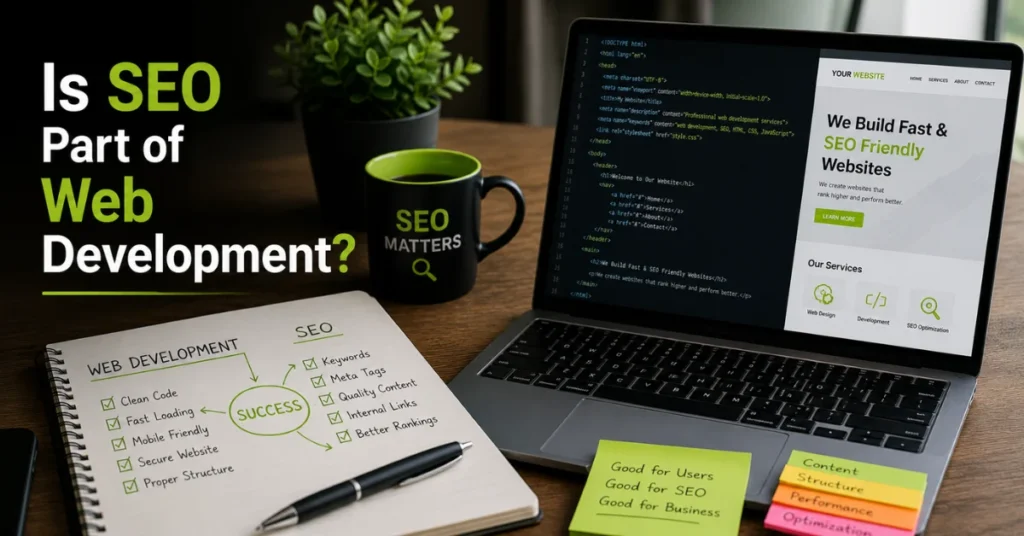
Is SEO part of web development? It’s a very common question, and the answer is yes, any website built without search engine optimization embedded into its foundation is already working against itself. We build SEO-integrated websites from the ground up, ensuring every page is structured to rank, perform, and convert from the moment it goes live.
What Is SEO in Web Development?
What is SEO in web development? It is the practice of making decisions during the website build process that allows search engines to efficiently crawl, index, and rank every page on the site. Search Engine Optimization in web development covers everything from the way URLs are structured to the way pages load on a mobile device.
Every decision a web developer makes carries an SEO consequence. The choice of heading tags, the quality of the code, the speed of the server response, the handling of internal links, and the configuration of metadata all influence how search engines evaluate and rank a website. When developers build with search intent in mind, the website earns visibility from its very first day online rather than spending months catching up.
SEO in web development is not a plugin or a one-time task. It is a discipline that runs through every stage of the project, from the initial site architecture planning phase all the way through to the post-launch performance monitoring process.
What Does SEO Stand For in Web Design and Development?
What does SEO stand for in web design and development? SEO stands for Search Engine Optimization. In the context of web design and development, it is the complete process of making a website easy for search engines to understand, trust, and recommend to users who are actively searching for relevant services or information.
In web design, SEO shapes decisions about visual hierarchy, content placement, image optimization, and user experience flow. In web development, SEO governs code quality, site architecture, crawlability, structured data implementation, and technical infrastructure. Both disciplines serve the same shared outcome: placing the right content in front of the right person at exactly the right moment in a Google search.
When web design and web development operate in isolation from SEO strategy, the result is a visually appealing website that search engines struggle to understand and rank. When all three work together from the start of the project, the website becomes a consistent source of organic traffic that grows over time.
The Direct Relationship Between SEO, Web Design, and Development
Understanding how to do SEO in web design and development begins with recognizing that these three disciplines are not separate departments with separate goals. They are a single, interconnected workflow with one shared outcome: a website that users find valuable and search engines reward with strong rankings.
Google evaluates websites using hundreds of ranking signals. A large portion of those signals is determined entirely during the web development phase. Core Web Vitals, which Google uses as confirmed ranking signals, are controlled by front-end engineering decisions. Image compression formats, JavaScript execution time, layout stability, and server response speed are all development-layer decisions that directly determine where a page ranks.
Site architecture, the way pages are organized and connected across the website, is a web development decision that controls how efficiently search engine bots can discover and access content. Mobile responsiveness, evaluated by Google through its mobile-first indexing system, is implemented at the code level by developers. Semantic HTML structure, which communicates the meaning and hierarchy of content to search engines, is written by web developers.
All of these elements are part of what SEO is in web development. None of them can be delegated to a marketing team after the website is already built without a high additional cost and risk.
Related Topic: What is E-Commerce Web Development
Is SEO Built Into the Website or Done After Launch?
This is one of the most important questions business owners need to understand clearly. The answer has two distinct parts.
Technical SEO is built into the website during the development phase. Crawlability configuration, URL architecture, heading structure, page speed optimization, structured data markup, redirect setup, and canonical tag management are all code-level decisions. Changing these elements after a website is live requires reopening the codebase and, in many cases, doing a partial rebuild. This makes build-time technical SEO significantly more cost-effective than retrofitting it afterward.
Ongoing SEO, which includes content creation, keyword targeting, link acquisition, and performance monitoring, runs continuously after the website goes live. This component of SEO has no defined endpoint. It continues for as long as a business wants to maintain and improve its position in competitive search results.
Both parts are required for a website to rank well. Technical SEO creates the infrastructure. Ongoing SEO fills that infrastructure with content and authority that compounds over time. When a business understands this distinction, it becomes clear why treating SEO as part of web development from the beginning of a project is the most strategically sound approach.
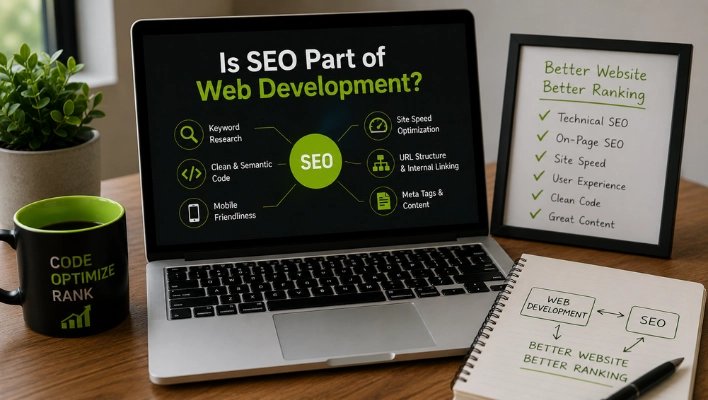
How to Do SEO in Web Design and Development
Knowing how to do SEO in web design and development means implementing the right practices at the right stage of every project. The following are the core areas that a development team must address during the build process.
Build a Logical and Crawlable Site Architecture
Site architecture refers to the way pages are organized and connected across the entire website. A well-planned architecture allows search engine bots to reach every important page within three clicks from the homepage. It supports both user navigation and search engine crawling through a clear hierarchy, consistent internal linking, and descriptive URL structures.
URL slugs should be short, keyword-relevant, and free of unnecessary parameters. Navigation menus should reflect content priority. Every page should have a defined relationship to other pages through a clear parent-child hierarchy.
Use Semantic HTML With a Proper Heading Structure
Semantic HTML means using HTML elements for their intended purpose rather than for visual styling convenience. Heading tags should follow a strict hierarchical order with one H1 per page, followed by H2 subheadings and H3 supporting headings as needed.
The H1 heading of every page should include the primary keyword that the page is targeting. Proper heading hierarchy helps search engines understand the content framework of every page and directly supports accessibility standards that Google factors into its quality evaluation.
Optimize Page Speed and Core Web Vitals
Page speed is a confirmed Google ranking factor with a direct impact on both organic rankings and user retention. Development teams should compress images using modern formats such as WebP and AVIF, minify CSS and JavaScript files, implement browser caching, utilize a content delivery network for static assets, and eliminate unnecessary third-party scripts.
Core Web Vitals include Largest Contentful Paint, Cumulative Layout Shift, and Interaction to Next Paint. All three are determined by development decisions and should be measured, tested, and optimized before any page goes live. A website that passes Core Web Vitals thresholds has a measurable ranking advantage over a competing website that does not.
Design and Develop With Mobile as the Priority
Google uses mobile-first indexing, which means the mobile version of a website is the primary version evaluated for ranking purposes. Development teams should build responsive layouts beginning from the smallest screen size and progressively enhance the experience for larger viewports.
Touch targets should be large enough for comfortable interaction on mobile devices. Text must be readable without zooming. Content layout should adapt seamlessly across all screen sizes without causing horizontal scrolling or broken functionality. In 2026, mobile-first development is a baseline requirement for organic search success, not an optional enhancement. Book a Call now for SEO services.
Implement Structured Data Markup Across Key Pages
Structured data, also known as schema markup, is a form of code that communicates to search engines exactly what type of content a page contains and how it should be interpreted. Implementing a schema for organization details, services, FAQs, reviews, breadcrumbs, and local business information gives a website the greatest opportunity to appear in rich results and featured snippets in Google search.
Structured data is a development task. It is most effective when planned during the build process and implemented consistently across all relevant page types from launch day.
Align Content Strategy With Keyword Intent From Day One
Content and development decisions must work together from the beginning of every project. Each page should have a defined primary keyword, a clear search intent, and a content structure designed to answer the specific questions users are typing into Google.
Meta titles should include the primary keyword and be written within the character limit that displays fully in search results. Meta descriptions should be compelling and informative, earning the click from users who see the page in search results. Image alt text should describe images accurately while including keyword-relevant context where appropriate. Internal anchor text should use descriptive, keyword-relevant phrases rather than generic labels like “click here.”
Why Integrating SEO Into Web Development Matters for Business Growth
Businesses that treat SEO as an afterthought face the same consistent outcome. Their website launches with near-zero organic traffic, requires expensive code-level changes to become search-friendly, and loses ground to competitors whose websites were built with search visibility in mind from the start.
When SEO is embedded into the web development process, a website earns a technical head start. It launches with clean code, fast load times, correct heading hierarchy, a crawlable architecture, and properly configured metadata. These advantages build and compound over time as content and authority are developed on top of a reliable technical foundation.
Integrating SEO into web development is also more financially sound. Retrofitting a poorly built website for search engines consistently costs more than building it correctly in the first place. It also introduces risk by requiring live code changes on a website that users may already be visiting.
Related Topic: What is Front End in Web Development
Technical SEO vs. Ongoing SEO – Understanding What Belongs Where
Technical SEO is the portion of search engine optimization that lives entirely within the code of a website. It includes crawlability settings, page speed configuration, structured data markup, URL architecture, canonical tag setup, redirect management, and mobile optimization. These elements are established during the web development process and form the infrastructure on which all other SEO work is built.
Ongoing SEO is the continuous effort of creating content that matches search intent, earning backlinks from authoritative and relevant websites, refreshing outdated pages, and monitoring performance through tools like Google Analytics and Google Search Console. This work begins after the website is launched and continues without a defined endpoint.
Both components are required for strong search rankings. Technical SEO creates the conditions for success. Ongoing SEO delivers that success and sustains it over the long term. A business that invests in only one component will consistently underperform a competitor that invests in both.
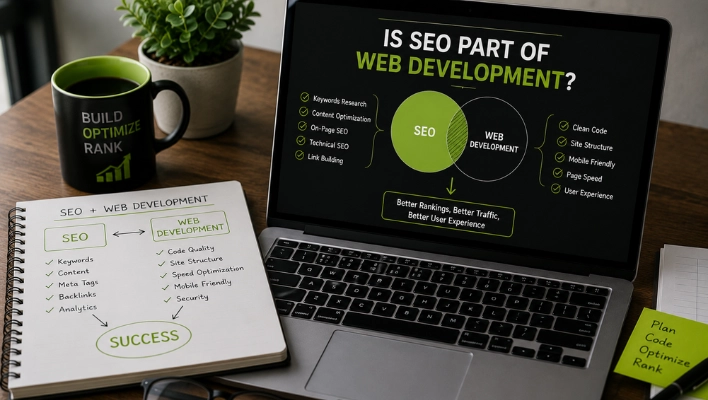
What a Search Ready Website Built for Rankings Looks Like
A website built with SEO as part of web development shares a consistent set of characteristics that separate it from websites where search visibility was treated as an afterthought.
Its pages load within Google’s recommended performance thresholds. Its URLs are short, descriptive, and aligned with target keywords. Its navigation is intuitive and logical, allowing users to find what they need quickly. Its content is organized with proper heading hierarchy and includes relevant entities and semantic terms that reinforce the topic to search engines. Its images are compressed, formatted correctly, and carry descriptive alt text. Its metadata is crafted for both search engines and the human readers who will decide whether to click.
Beyond the technical elements, a search-ready website is built around user intent. Every page answers a specific question or serves a specific purpose that aligns with what users are actively searching for. This alignment between user intent and page content is precisely what search engines reward with consistent, growing rankings.
Related Topic: What is Web Developer vs Web Designer
Our SEO-Integrated Web Development Services
We deliver SEO-integrated web development services for businesses that need a website built for both performance and long-term search visibility. Every project we complete includes technical SEO built into the foundation as a standard part of the development process, not as an optional add-on.
Our team addresses site architecture planning, semantic code development, Core Web Vitals optimization, structured data implementation, mobile-first responsive design, and metadata configuration as core deliverables in every web build. When your website goes live, search engines can discover every page, understand every piece of content, and begin the ranking process without delay.
Whether you are launching a new website, redesigning an existing one, or looking to improve the search performance of your current site, we combine strong web development with smart SEO strategy to deliver measurable, lasting results. Is SEO part of web development? With our team, it always has been.
Frequently Asked Questions
Is SEO part of web development?
Yes. Technical SEO elements including site architecture, page speed, semantic HTML, URL structure, and structured data, are all built during the web development phase. Ongoing content and link-building work continues after launch as a separate but equally important effort.
What does SEO stand for in web design and development?
SEO stands for Search Engine Optimization. In web design and development, it refers to the practices that make a website easy for search engines to crawl, index, understand, and rank for the search queries most relevant to a business.
What is SEO in web development?
SEO in web development is the technical foundation that enables search engines to access, read, and rank a website effectively. It covers crawlability, page speed, heading structure, URL architecture, mobile responsiveness, and structured data markup, all implemented at the code level.
Can SEO be added to a website after it is already built?
Yes, but it is significantly more effective and cost-efficient to build SEO into the website from the start. Retrofitting technical SEO after launch often requires substantial changes to the codebase and may involve rebuilding core structural elements.
How does page speed affect SEO rankings?
Page speed is a confirmed Google ranking factor. Slow-loading websites rank lower in search results and produce higher bounce rates. Core Web Vitals metrics, including LCP, CLS, and INP, all measure aspects of load and interaction performance that Google evaluates directly.
What is technical SEO in web development?
Technical SEO in web development refers to code-level optimizations that help search engines crawl and index a website efficiently. This includes page speed, mobile responsiveness, structured data, clean URL architecture, crawlability configuration, and canonical tag management.
How do you do SEO for web design and development?
Begin with a logical and crawlable site architecture, implement semantic HTML with proper heading hierarchy, optimize Core Web Vitals before launch, develop for mobile first, implement structured data markup across key pages, and align all content with keyword-driven search intent from the very start of the project.
Does web design directly affect Google rankings?
Yes. Web design decisions, including page layout, image formats, navigation clarity, visual hierarchy, and mobile responsiveness, all influence Google rankings through Core Web Vitals performance, user experience signals, and crawlability. Design and SEO function as two sides of the same discipline.

M. Awais Khan is a Business Development and Digital Growth Strategist at SkillsHeaven, specializing in SEO, local search optimization, and performance-driven digital marketing. With experience supporting 100+ businesses, he develops and implements data-driven strategies that help companies increase online visibility, generate qualified leads, and drive sustainable revenue growth. His expertise spans Local SEO, Google Ads, social media marketing, and conversion-focused website optimization, ensuring every project is aligned with measurable business outcomes and long-term success.