
Local citation building impacts SEO by strengthening three core ranking signals search engines use to evaluate local businesses: relevance, prominence, and trust. Every time your business name, address, and phone number appear consistently across directories, review platforms, and industry websites, search engines gain more confidence that your business is real, active, and worth recommending. That confidence translates directly into better visibility in the Google Maps 3 Pack, stronger organic local rankings, and improved appearance in AI generated search answers.
We help businesses build citation profiles that search engines actually trust, and this guide breaks down exactly why citations matter, how they influence ranking algorithms, what a smart citation strategy looks like in practice, and how to avoid the mistakes that quietly undo all that work. For a wider view of how this fits into your overall plan, our local SEO services cover the complete system citations are part of.
What Local Citation Building Actually Means
A local citation is any online mention of your business that includes your core identity details, commonly known as NAP: Name, Address, and Phone number. These mentions can appear on business directories, review sites, social media platforms, local blogs, chambers of commerce, and industry specific websites. Some citations include a clickable link back to your website. Many do not. Either way, both formats contribute to how search engines verify and rank your business.
Citation building is the ongoing process of creating, claiming, and correcting these mentions across the web. It is not a one time task. Directories update their formatting, businesses move locations, phone numbers change, and old listings linger long after they should have been removed. A strong citation profile is something you maintain, not something you build once and forget. It helps to think of citations as a web of corroborating evidence. No single listing carries your ranking on its own. Instead, search engines look at the cumulative pattern across dozens or even hundreds of sources to decide how confident they should be in your business identity. The more that pattern lines up, the easier it becomes for your business to surface in the exact moment someone is searching for what you offer.
How Local Citation Building Impacts SEO Rankings
Search engines rank local businesses using three interconnected pillars: relevance, distance, and prominence. According to Google’s own guidance on improving local ranking, these three factors work together to determine which businesses appear for a given search. Local citation building plays a direct role in two of these three pillars, which is why it remains a foundational part of any local search strategy, even as algorithms grow more sophisticated.
Citations Build Prominence
Prominence reflects how well known and well regarded your business appears across the web, independent of what your website itself says. A business with consistent listings across dozens of reputable directories sends a clear signal that it is established and legitimate. Search engines interpret this spread of verified mentions as a form of digital reputation, similar to how word of mouth works for a community. The wider and more authoritative this footprint becomes, the more weight your business carries when it competes for the same search query as another local provider.
Citations Establish Relevance
When your business is listed under the correct category and your NAP details match what is on your Google Business Profile, search engines can match your listing to the right search queries with far more accuracy. A roofing contractor listed across home improvement and contractor specific directories will rank for relevant searches more effectively than one with scattered, generic listings. This is also where industry specific citations outperform broad, general ones. A handful of niche, highly relevant directories often carries more ranking weight than a large volume of unrelated submissions, because each one reinforces the specific category your business belongs to.
Citations Reinforce Trust and Entity Verification
Search engines cross reference your business information across multiple independent sources to confirm that your business is a distinct, verifiable entity. This process is sometimes called entity verification, and it has become increasingly important as AI driven search results rely on structured, cross checked data rather than a single source. When your NAP data lines up across Google Business Profile, Yelp, Bing Places, Apple Maps, and other authoritative platforms, search engines can confidently treat your business as a confirmed, trustworthy entity rather than an ambiguous or duplicate listing.
Citations Influence Indexing Speed
A less discussed benefit of citation building is how it affects how quickly new business information gets recognized. A new Google Business Profile listing that already has corroborating mentions on a handful of established directories tends to gain trust faster than one appearing in isolation. This matters most for new businesses, recent relocations, or rebrands, where speed of recognition can make a meaningful difference in early visibility. Our Google Business Profile optimization guide goes deeper into setting up this listing correctly from day one.
Structured Versus Unstructured Citations
Not all citations look the same, and understanding the difference helps explain why a varied citation profile performs better than a narrow one.
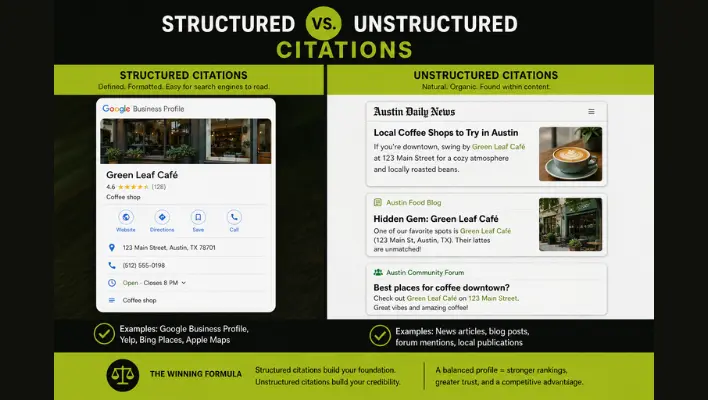
Structured citations appear in a defined format, almost always presented as a business profile with separate fields for name, address, phone number, hours, and category. Google Business Profile, Yelp, and Bing Places are classic examples. These are easy for search engines to parse because the data is clearly labeled.
Unstructured citations appear within ordinary content rather than a formatted profile. A local news article that mentions your business name and address in a sentence, a blog post referencing your shop, or a community forum thread are all unstructured citations. These carry less weight individually but still contribute supporting context, especially when they come from genuinely authoritative, locally relevant sources. One mention from a respected local publication can often outweigh a dozen generic directory listings.
A balanced citation profile includes both types. Structured citations build the backbone of your local presence, while unstructured citations add organic, naturally occurring credibility that is harder for competitors to replicate.
Citations Versus Backlinks
It is worth separating citations from backlinks, since the two terms get used interchangeably even though they serve different purposes. A backlink is a link from another website pointing to yours, and it primarily builds domain level authority that helps your site rank in standard organic results. A citation is a mention of your NAP details, and it primarily builds local trust and prominence, whether or not a clickable link is attached.
For traditional organic rankings, backlinks generally carry more weight. For the Local Pack and Google Maps specifically, citations often carry a more direct influence, because the local algorithm is evaluating physical business legitimacy rather than general page authority. The two are complementary rather than competing priorities, and the strongest local SEO strategies build both at the same time rather than treating one as a replacement for the other.
Why NAP Consistency Is the Foundation of Citation Building
NAP consistency means your business name, address, and phone number appear in the exact same format everywhere they are mentioned online. This does not require obsessive uniformity down to every comma, but your core identity should remain stable and recognizable across every platform.
Inconsistent NAP data creates confusion for search engines. If one directory lists “Suite 200” and another lists “Ste 200,” or if an old phone number is still floating around on a forgotten listing, search engines may interpret these as two different businesses rather than one. This uncertainty can suppress your visibility in local search results and slow down how quickly new listings get indexed and trusted.
A periodic citation audit is the most reliable way to catch these inconsistencies before they quietly damage your rankings. Reviewing your top listings, searching your business name and phone number in different formats, and correcting outdated information should be a recurring part of any local SEO routine, not a one time cleanup.

What Typically Breaks NAP Consistency
A few patterns show up again and again across businesses of every size. Old suite numbers or former addresses remain live on directories nobody remembers submitting to. Abbreviations drift, so “Street” becomes “St.” on one platform and stays spelled out on another. Disconnected phone numbers linger on aggregator sites long after a business switches providers. Duplicate listings get created when staff or third party marketers submit a business more than once without realizing a profile already exists. Each of these seems minor in isolation, but together they erode the consistency search engines depend on.
Citation Quality Matters More Than Citation Quantity
It is tempting to think that more citations automatically means better rankings, but quality has become far more influential than sheer volume. A smaller set of accurate, relevant, and authoritative citations will consistently outperform a large pile of low quality directory submissions that add little context about what your business actually does.
When prioritizing where to build citations, focus on three tiers:
Foundational platforms such as Google Business Profile, Bing Places, Apple Maps, and Facebook, since these feed data to many smaller directories and carry the most overall weight.
Industry specific directories relevant to your field, since these add contextual relevance that generic platforms cannot provide.
Local community sources such as chambers of commerce, local news mentions, and neighborhood association listings, which strengthen your geographic relevance within your specific market.
A useful way to evaluate any potential citation source before submitting your information is to check its general domain authority and look for signs of spam, since low quality or irrelevant directories can dilute your profile rather than strengthen it. Moz’s overview of Domain Authority is a helpful, free reference if you want to understand how that scoring works before choosing where to submit.
The Role of Data Aggregators
Data aggregators are companies that collect business information and redistribute it across hundreds of directories, mapping platforms, and apps simultaneously. Getting your NAP data correctly listed with a major aggregator can multiply your citation footprint far more efficiently than submitting to each individual site by hand.
The tradeoff is that aggregators also redistribute errors at the same scale. If your information is wrong at the aggregator level, that mistake can propagate to dozens of smaller directories automatically, which is exactly why fixing your canonical NAP record before engaging with aggregators saves significant cleanup work later. Many citation management tools include aggregator submission as part of their service, which is often the most efficient way to handle this layer of your strategy.

How Schema Markup Reinforces Your Citation Profile
Citations do not operate in isolation from the technical side of your website. Local Business schema markup, a form of structured data added to your site’s code, tells search engines explicitly what your business name, address, phone number, hours, and category are, rather than leaving search engines to infer that information from ordinary text. The official Schema.org LocalBusiness reference documents the full set of properties available if you want to see exactly what can be marked up.
When the data inside your schema markup matches your citation data exactly, search engines gain another layer of confirmation that your business identity is accurate and consistent. When there is a mismatch, even a small one, it can introduce the same kind of uncertainty that inconsistent NAP data creates across directories. Pairing clean schema implementation with a well maintained citation profile is one of the more effective ways to reinforce entity confidence across both traditional search and AI generated answers.
This does not require advanced technical skill. Many website platforms offer plugins or built in tools that generate Local Business schema automatically, and Google’s Rich Results Test is a free way to confirm that the markup is implemented correctly once it is live.
How Citation Building Supports AI Powered Local Search and Voice Search
Search behavior has shifted, and AI generated answers increasingly pull business recommendations from structured, consistent data rather than ranking pages the traditional way. When an AI powered assistant is asked to recommend a nearby service provider, it cross references citation data from multiple trusted sources to determine which business to surface with confidence.
Inconsistent or sparse citation data creates uncertainty for these systems, and uncertain data tends to get excluded from AI generated recommendations entirely. This means local citation building is no longer just a traditional ranking factor. It has also become a direct input into how visible your business is within AI driven search experiences, voice search results, and conversational answer engines.
Voice search adds another layer to this. When someone asks a voice assistant a question like “find a dentist open now,” the assistant typically reads back a single answer rather than a list of options. That answer is pulled from the most consistent, well corroborated data available, which means a clean citation profile directly increases the odds that your business is the one selected and read aloud. Writing your business descriptions in natural, conversational language across your most important listings can further support how well your business matches these spoken, question style queries.
Common Citation Building Mistakes That Hurt Local SEO
Even well intentioned citation building efforts can backfire when a few recurring mistakes go unaddressed.
Duplicate listings. Multiple profiles for the same business, often created accidentally by different staff members or past marketing vendors, split your reviews and confuse search engines about which listing is authoritative.
Outdated information. A changed address or phone number that never gets updated across older directories creates the exact inconsistency that undermines trust signals.
Keyword stuffing in the business name field. Adding extra descriptive terms to your business name on directories, rather than using your real, registered name, violates most platform guidelines and can trigger suppression rather than improvement.
Ignoring niche directories. Focusing exclusively on broad, general platforms while skipping industry specific directories leaves an easy relevance signal on the table.
Treating citation building as a one time project. Directories change their formatting, get acquired, or shut down. A citation profile that is never revisited tends to decay quietly over time.
Avoiding these pitfalls is often more valuable than chasing additional citation volume, since fixing existing problems tends to produce a faster, more noticeable improvement than building new listings on top of an inconsistent foundation.
Tools for Managing and Auditing Citations
Manually tracking citations across dozens of platforms is realistic for a small, single location business, but it becomes difficult to manage at scale without some help. A handful of categories of tools make this process far more manageable.
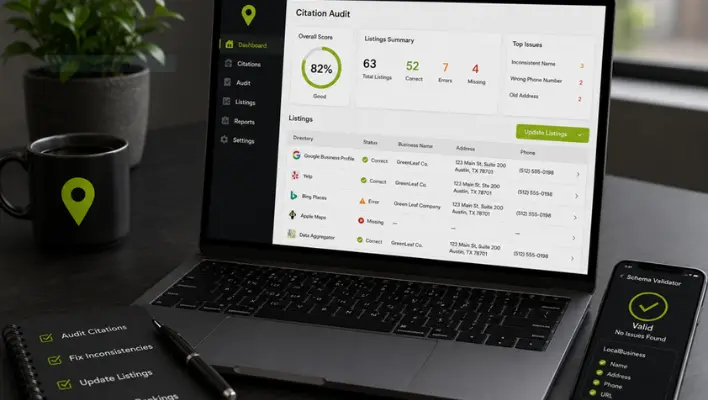
Citation audit and tracking tools scan major directories and aggregators to flag where your NAP data is missing, outdated, or inconsistent, giving you a prioritized list of what to fix first.
Listing management platforms allow you to push corrected information out to multiple directories from a single dashboard, which saves significant time compared to updating each listing individually.
Schema validators confirm that your Local Business markup is implemented correctly and matches your live citation data, closing the loop between your technical setup and your off site listings.
Choosing the right combination of tools depends on how many locations you manage and how competitive your local market is, but even a basic quarterly audit using free tools can catch the majority of consistency issues before they affect rankings.
How to Measure the Impact of Your Citation Strategy
Because citations rarely move rankings on their own, it helps to track a few specific indicators rather than expecting an immediate, isolated spike in traffic.
Track your visibility in the Google Maps 3 Pack for your most important search terms before and after a citation cleanup, since this is one of the more direct places citation signals show up. Monitor how quickly newly created or corrected listings get indexed and verified, since a clean, well corroborated profile tends to be recognized faster. Keep an eye on calls, direction requests, and website clicks originating from your Google Business Profile insights, since these behavioral signals often shift alongside improved citation consistency. Finally, periodically search your own business name and phone number to catch new duplicates or outdated listings before they accumulate again.
A Complete Local Citation Building Strategy
Building citations effectively comes down to a repeatable process rather than a one time push.
- Start with a citation audit to identify existing listings, duplicates, and inconsistencies.
- Correct your NAP data on the highest authority platforms first, since errors here have the widest ripple effect.
- Implement or update your Local Business schema markup so your website data matches your citation data exactly.
- Expand into industry specific and local community directories to build topical and geographic relevance.
- Write natural, conversational business descriptions where directories allow it, to support voice search and AI generated answers.
- Monitor your citation profile regularly, since directories change formatting and duplicate listings can resurface unexpectedly.
- Pair your citation work with broader on page optimization and a steady review acquisition strategy, since citations work best as part of an integrated local search system rather than in isolation.
Frequently Asked Questions
Does local citation building still matter in 2026?
Yes. Citation signals, including NAP consistency, continue to rank among the more influential factors for both the Local Pack and organic local search, and their role has expanded further as AI search systems lean on the same structured, corroborated data.
Do citations need a backlink to help SEO?
No. While some citations include a clickable link to your website, many valuable citations are simply accurate mentions of your business name, address, and phone number. Both formats contribute to your prominence and trust signals.
How many citations does a business actually need?
There is no fixed number. A smaller set of accurate, relevant, and authoritative citations consistently outperforms a much larger set of low quality, generic submissions.
How often should citations be audited?
A quarterly review is a reasonable baseline for most businesses, with a deeper audit at least once a year or any time your business name, address, or phone number changes.
Bringing It All Together
Local citation building impacts SEO by reinforcing the exact signals search engines rely on to decide which businesses deserve visibility: consistent identity data, contextual relevance, and verifiable trust across the web. It supports your Google Business Profile, strengthens your standing in the Maps 3 Pack, and increasingly shapes how confidently AI systems recommend your business in voice search and conversational answers. Local citation building is not a flashy or glamorous part of search optimization, but it remains one of the most dependable, foundational investments a local business can make in long term visibility.
If your business has uneven listings, outdated contact details, or a citation profile that has never been audited, now is the right time to fix that foundation before building anything else on top of it. Our local SEO services can walk you through getting that foundation right.

Wali Shah is the Founder and CEO of SkillsHeaven, a digital growth agency specializing in Local SEO, Google Ads, and conversion-focused website development. With over 8+ years of experience, he has helped scale 170+ businesses, including 93+ limousine companies globally, by building structured, lead-generating digital systems. His expertise spans local search optimization, paid media strategy, and high-performance website development, all aligned with measurable business growth. Known for a data-driven and ethical approach, Wali focuses on creating scalable marketing systems that increase visibility, generate qualified leads, and drive long-term revenue for service-based businesses.