
SEO and GEO are not rivals fighting for the same job, and businesses that treat them as opposites usually lose ground in both. SEO earns your business a strong position in traditional search results, while GEO earns your business a mention inside the AI generated answers that ChatGPT, Gemini, and Google’s AI Overviews now serve to millions of searchers every day. The honest answer to which is more important, SEO or GEO for businesses, is that they work best as one connected system rather than two separate campaigns.
This question comes up constantly right now because search behavior itself is shifting. A growing share of people no longer type a short keyword into Google and scroll through ten blue links. Instead, they ask a full question to an AI assistant and expect a direct, summarized answer. That shift does not mean traditional search is fading away. It means businesses now need to be visible in two places at once, and understanding how those two places connect is the real starting point for any modern marketing plan.
What SEO Still Does for Businesses
Search Engine Optimization has been the backbone of online visibility for over two decades, and it remains the foundation that everything else, including GEO, is built on. SEO covers technical site health, keyword targeting, backlink building, page speed, and content structure. When a business ranks on page one, it earns steady, measurable organic traffic, and that traffic tends to convert because the searcher chose to click after comparing several options.
SEO also gives a business something GEO cannot fully replace on its own, which is direct control over the customer journey. A well ranked page brings a visitor onto the website, where the business can guide them through services, pricing, testimonials, and a clear call to action. That level of control still matters enormously for businesses that rely on booked appointments, form submissions, or online purchases.
A well optimized website also strengthens local visibility. Businesses that invest in structured local SEO services typically see more consistent Google Maps rankings, better call volume, and stronger long term brand presence. This groundwork matters because AI systems draw heavily on the same signals that make a site rank well in the first place, including clean site structure, authoritative backlinks, and content that clearly answers real questions. In other words, a strong SEO foundation is rarely wasted effort, even for businesses planning to invest heavily in GEO down the road.
Core Elements That Make SEO Work
A handful of factors consistently separate businesses that rank well from those that struggle to gain traction.
- Keyword relevance. Content that matches what customers are actually typing into search engines earns more qualified traffic.
- Technical performance. Fast loading pages, mobile friendly design, and clean site architecture all support stronger rankings.
- Backlink authority. Links from reputable, relevant websites signal trust to search engines.
- Content depth. Comprehensive pages that fully answer a topic tend to outperform thin, surface level content over time.
- User experience. Search engines increasingly reward sites that keep visitors engaged rather than bouncing away quickly.
These same factors, as you will see below, quietly support GEO performance as well.

What GEO Means for Modern Businesses
Generative Engine Optimization is the practice of shaping content so AI tools can understand it, trust it, and quote it inside their generated responses. Instead of competing for a blue link on a results page, GEO aims to get a business named, summarized, or recommended directly inside an AI answer. According to Google’s own documentation on AI features in Search, AI generated summaries now appear across a wide range of queries, which means a business can be cited by name even when the searcher never visits the website.
GEO rewards clarity over keyword density. Content written in a natural question and answer format, backed by verified facts and clear expertise, tends to earn more citations from AI models than content written purely to rank. AI systems are essentially trying to answer a simple question of their own before they cite anyone: is this source accurate, well organized, and trustworthy enough to quote confidently? Content that reads like a genuine, complete answer, rather than a page stuffed with keywords, tends to win that evaluation.
Why GEO Is Gaining Attention So Quickly
A few forces are driving businesses to pay closer attention to GEO this year.
- AI assistants are becoming a normal first stop for research, product comparisons, and local recommendations.
- Many AI generated answers now appear directly above traditional search results, changing what a searcher sees first.
- Being cited by an AI tool builds brand credibility, even in cases where the searcher does not click through immediately.
- Businesses that appear consistently in AI answers often see an increase in branded searches later, as people remember the name and look it up directly.
None of this replaces the value of a strong website. It simply adds a new layer of visibility on top of the work SEO already does.
Which Is More Important, SEO or GEO for Businesses?
This is the real question business owners are asking, and the honest answer depends on what stage a business is in. A brand new website with weak technical foundations gains more from strengthening SEO first, because AI tools generally pull from sources that already carry authority and trust. A business with an established, well ranking site gains more from layering GEO on top, since the foundation is already there to build on.
So when people ask which is more important, SEO or GEO for businesses, the most accurate answer is that SEO earns the trust and structure that GEO depends on, and GEO extends that trust into the new spaces where customers are now asking questions. Neither replaces the other. A resource from Semrush on GEO vs SEO strategy makes a similar point: the practices share the same core foundation of quality content, technical soundness, and demonstrated expertise.
It helps to think of SEO and GEO as two stages of the same customer journey rather than two competing budgets. SEO gets a business discovered. GEO gets a business recommended. A customer might first hear about a company through an AI generated answer, then later search for that company by name on Google to learn more, book a service, or read reviews. Both channels feed each other, and businesses that understand this connection tend to plan smarter, more efficient marketing strategies overall.

How the Two Strategies Work Together
Businesses that succeed in both channels usually follow a few shared principles.
Build Content That Answers Real Questions
Both search engines and AI models reward content that directly answers a specific question early, then supports that answer with detail. Structuring pages with clear subheadings, FAQ sections, and concise answers helps both a human reader and an AI system extract the information quickly. Long paragraphs packed with vague statements tend to underperform for both goals, while clear, direct writing tends to earn better placement in both traditional results and AI summaries.
Strengthen Trust Signals Across the Web
AI systems evaluate a business based on more than just its website. Customer reviews, citations, and third party mentions all contribute to how confidently an AI model will recommend a business. Knowing how customer reviews influence local rankings helps business owners understand why review volume and rating quality now shape visibility across both search engines and AI platforms. A business with consistently positive reviews across Google, industry directories, and social platforms sends a strong signal of reliability that both systems recognize.
Keep Business Information Consistent Everywhere
Accurate, matching business details across directories, the Google Business Profile, and the website itself give both search engines and AI tools confidence in a business. Many business owners underestimate how much citation building strengthens overall SEO, yet consistent citations are one of the clearest trust signals both systems rely on. When a business name, address, and phone number match across the web, search engines and AI models alike treat that consistency as a strong indicator of legitimacy.
Use Structured, Well Organized Content
Clear headings, short paragraphs, bullet points, and schema markup make content easier for AI systems to parse and easier for readers to scan. This benefits rankings and citation potential at the same time. Structured data in particular gives search engines and AI crawlers a precise, machine readable summary of what a page covers, which increases the odds that the right information gets pulled into an answer accurately.

Signs a Business Should Prioritize SEO First
- The website has thin content or weak technical performance
- Organic traffic and keyword rankings are low or inconsistent
- Local visibility on Google Maps needs improvement
- Backlink profile and domain authority are still developing
- The business has limited online reviews or directory presence
Signs a Business Should Prioritize GEO Alongside SEO
- The website already ranks well for its core keywords
- The industry involves complex questions customers ask AI tools directly
- Competitors are already appearing in AI generated answers
- The business wants to build long term brand authority beyond clicks
- Customers frequently research decisions through conversational search before buying
Common Mistakes Businesses Make When Choosing Between the Two
A few patterns show up repeatedly among businesses that struggle to gain traction with either strategy.
Treating GEO as a separate project. Businesses sometimes hire a team to handle SEO and a completely different team to handle GEO, which leads to inconsistent messaging and duplicated effort. A single, coordinated content strategy almost always performs better.
Rewriting content that already ranks well. A page that already earns strong organic traffic does not need a complete overhaul to become GEO friendly. Adding clearer headings, an FAQ section, or updated statistics is usually enough. A full rewrite can actually disrupt rankings that were already working.
Chasing AI visibility while ignoring the website experience. Even if a business earns a mention inside an AI answer, a slow, outdated, or confusing website will still lose the visitor once they arrive. Both channels ultimately depend on a strong, welcoming website behind them.
Skipping the basics of trust and consistency. Reviews, citations, and accurate business information take time to build, and skipping this groundwork limits how far either SEO or GEO can go.
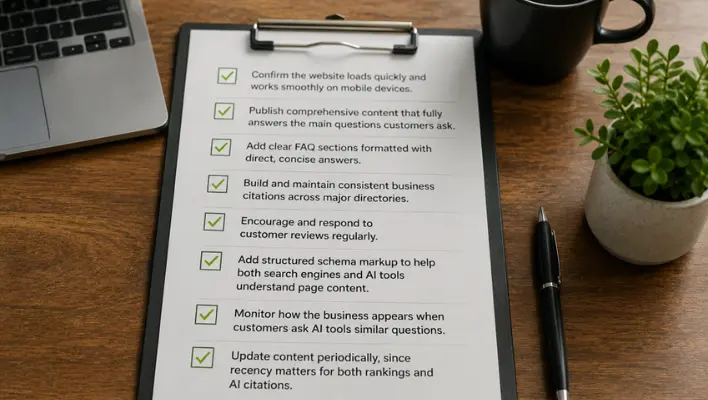
A Simple Checklist to Cover Both Strategies
Businesses looking for a practical starting point can work through the following steps.
- Confirm the website loads quickly and works smoothly on mobile devices.
- Publish comprehensive content that fully answers the main questions customers ask.
- Add clear FAQ sections formatted with direct, concise answers.
- Build and maintain consistent business citations across major directories.
- Encourage and respond to customer reviews regularly.
- Add structured schema markup to help both search engines and AI tools understand page content.
- Monitor how the business appears when customers ask AI tools similar questions.
- Update content periodically, since recency matters for both rankings and AI citations.
Building One Strategy That Covers Both
The most efficient approach is a single content strategy that satisfies both systems at once. Comprehensive, well researched pages that target real search intent naturally serve SEO through keyword relevance and backlinks, while also serving GEO by giving AI models accurate, citation worthy information. Businesses do not need two separate content teams or double the budget to achieve this. They need content built with both audiences, human searchers and AI systems, in mind from the start.
This approach also scales well over time. As AI search tools continue to evolve, the businesses best positioned to adapt will be the ones that already built a strong, trustworthy foundation rather than chasing every new platform individually. A business that consistently publishes clear, accurate, well organized content earns benefits in both traditional rankings and AI visibility, often without needing an entirely separate strategy for each.
Frequently Asked Questions
Which is more important, SEO or GEO for businesses right now?
Both matter together. SEO builds the ranking foundation and trust signals that GEO depends on, so businesses get the strongest results by strengthening SEO while layering GEO on top rather than choosing one over the other.
Can a business succeed with GEO alone, without SEO?
It is unlikely. AI models pull much of their information from well established, authoritative websites, so a business without strong SEO fundamentals has fewer sources for an AI system to cite in the first place.
Does GEO replace traditional search engine optimization?
No. GEO adds a new layer of visibility inside AI generated answers, while SEO continues to drive organic traffic, rankings, and direct website visits. They complement each other rather than compete.
How long does it take to see results from GEO?
Businesses often notice early AI citations within a few months of publishing clear, well structured content, though building strong, consistent AI visibility tends to follow a similar timeline to organic SEO growth.
What should a business focus on first, SEO or GEO?
A business with weak site fundamentals should strengthen SEO first. A business with strong existing rankings can begin layering GEO techniques, such as FAQ formatting and clearer factual content, right away.
Do small businesses need to worry about GEO as much as large brands?
Yes, and arguably even more so. Smaller businesses have an opportunity to earn AI visibility through clear, well organized content, since AI systems reward accuracy and clarity rather than sheer brand size or advertising budget.
Final Thoughts
The debate over which is more important, SEO or GEO for businesses will keep coming up as AI search grows, but the practical answer stays the same: strong SEO builds the authority AI systems trust, and GEO extends that authority into the conversations happening on AI platforms. Businesses that invest in both, guided by clear strategy and consistent execution, position themselves to be found everywhere their customers are searching, today and as search continues to evolve.

Wali Shah is the Founder and CEO of SkillsHeaven, a digital growth agency specializing in Local SEO, Google Ads, and conversion-focused website development. With over 8+ years of experience, he has helped scale 170+ businesses, including 93+ limousine companies globally, by building structured, lead-generating digital systems. His expertise spans local search optimization, paid media strategy, and high-performance website development, all aligned with measurable business growth. Known for a data-driven and ethical approach, Wali focuses on creating scalable marketing systems that increase visibility, generate qualified leads, and drive long-term revenue for service-based businesses.