If you’ve invested in local SEO and you’re still asking “is this actually working?” you’re not alone. Most local SEO content tells you what to do (optimize your Google Business Profile, get reviews, fix your citations) without explaining why those actions turn into paying customers. If you’re looking for professional local SEO services, understanding this connection is what separates rankings from real business growth.
This guide breaks the chain wide open how local SEO increases qualified leads and revenue by filtering traffic for proximity, urgency, and intent, then converting it through trust signals you can directly control. You’ll get a framework for thinking about this, a way to score your own leads, and a method for tracking the dollars.
What Is Local SEO (and Why “Qualified” Leads Matter More Than Volume)
Quick answer: Local SEO increases qualified leads and revenue by improving visibility for high-intent, geographically relevant searches, then increasing the likelihood those searchers convert through trust signals like reviews, proximity, and accurate business information.
Local SEO is the practice of optimizing a business’s online presence so it appears prominently when people search for products or services near a specific location think “emergency plumber” or “dentist open now.” It differs from traditional SEO mainly in scope instead of competing for broad, national visibility, you’re competing to be the obvious answer for someone standing in your service area right now .Businesses that follow a structured local SEO strategy are more likely to attract customers who are ready to contact and buy.
Not all leads are equal. A qualified lead matches your service offering, sits within your service area, has a real need (not just curiosity), and is close enough to a buying decision to be worth your sales time. An unqualified lead might click your listing but live three states away, want something you don’t offer, or just be browsing.
Local search traffic skews qualified because the searcher has already done three filtering steps before they click: they typed a service, implied a location, and often signaled urgency (“near me,” “open now,” “emergency”) unlike a generic blog visitor with no immediate buying signal.
The Local SEO Revenue Funnel: How Visibility Becomes Revenue
This is the core mechanism, and it’s where most competitor content stops short. Visibility alone doesn’t generate revenue it passes through distinct stages, each with its own local SEO lever.
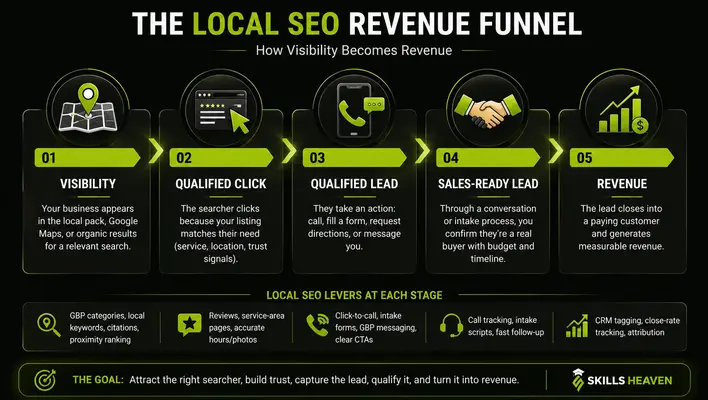
The Local SEO Revenue Funnel:
- Visibility Your business appears in the local pack, Maps, or organic results for a relevant search.
- Qualified Click The searcher clicks because your listing matches their need (service, location, trust signals).
- Qualified Lead They take an action: call, fill a form, request directions, message you.
- Sales-Ready Lead Through a conversation or intake process, you confirm they’re a real buyer with budget and timeline.
- Revenue The lead closes into a paying customer.
| Funnel Stage | Local SEO Lever |
| Visibility | GBP categories, local keywords, citations, proximity ranking |
| Qualified Click | Reviews, service-area pages, accurate hours/photos |
| Qualified Lead | Click-to-call, intake forms, GBP messaging, clear CTAs |
| Sales-Ready Lead | Call tracking, intake scripts, fast follow-up |
| Revenue | CRM tagging, close-rate tracking, attribution |
The mistake most businesses make is stopping their thinking at “Visibility.” Each handoff between stages can leak leads a great ranking with a clunky GBP profile loses qualified clicks; a strong click with no clear call button loses qualified leads.
Why Local Search Traffic Converts at Higher Rates
Local search traffic converts better than broader channels because of the local trust stack: proximity, category relevance, and social proof compounding to lower the perceived risk of choosing you.
- Proximity reduces friction. A nearby business feels more accessible and accountable than one far away.
- Immediate need shortens the decision cycle. Someone searching “AC repair near me” in July wants it fixed today, not researched for next year.
- Reviews substitute for personal referrals. A cluster of recent, detailed reviews does the trust-building work a friend’s recommendation would otherwise do.
These factors don’t work in isolation. A nearby business with no reviews and a generic listing won’t outperform a slightly farther business with a strong trust stack which is why the ranking factors below need to be treated as one connected system, not separate checklist items.
The Ranking Factors That Drive Qualified Visibility
Google’s local ranking weighs three core factors: proximity, relevance, and prominence.
| Ranking Factor | What It Means | Tactic | Funnel Stage Impacted |
| Proximity | Distance between searcher and business | Service-area definition, GBP address accuracy | Visibility |
| Relevance | How well your profile matches the search | GBP categories, services list, local keywords | Visibility, Qualified Click |
| Prominence | How well-known and trusted you appear | Reviews, citations, backlinks, engagement | Qualified Click, Qualified Lead |
A common mistake is chasing prominence (more reviews, more links) while ignoring relevance meaning you show up more often, but for searches that don’t actually match what you do. That produces volume without quality.
Optimizing Google Business Profile for Lead Quality, Not Just Visibility
Your Google Business Profile (GBP) is often the first and sometimes only touchpoint before someone decides to contact you. That’s why Google Business Profile optimization plays a major role in improving both visibility and lead quality. Treat it as a conversion asset, not just a ranking signal.
- Categories and services: Be specific. “Emergency Plumber” attracts a different, often more urgent searcher than the generic “Plumber” category alone.
- Photos: Real photos of your team, vehicles, and completed work build more trust than stock imagery.
- Posts and Q&A: Use these to pre-answer common objections (pricing ranges, service-area boundaries, response times) so unqualified inquiries self-select out before they ever contact you.
- Hours and messaging: Inaccurate hours generate frustrated, low-quality contacts from people who showed up or called at the wrong time.
A well-optimized GBP doesn’t just rank better it filters the right people in and the wrong people out before they reach your phone.
Reviews, Reputation, and the Trust Stack
Star rating alone is a weak signal. What matters more is the content of your reviews and how recently they were posted. A review that says “fixed our burst pipe at 11pm, fast and professional” does more pre-qualifying work than a five-star rating with no detail because it gives the next searcher proof you’ve handled their exact situation before.
Two things competitors consistently get wrong:
- They treat all reviews as equally valuable, when recent, detailed reviews carry more weight with both searchers and Google’s algorithm.
- They ignore negative reviews instead of responding to them a thoughtful, professional response often builds more trust than the absence of negative feedback, since it shows how you handle problems.
Local Content and Service-Area Pages That Attract Buyer-Ready Searchers
If you serve multiple neighborhoods or cities, dedicated service-area pages can capture intent that a single homepage can’t. The key is avoiding thin, duplicate pages that just swap out a city name.
Each page should answer a real question: What do you offer in this specific location? What’s unique about serving this area (response times, local regulations, nearby landmarks)? Pages built this way attract searchers closer to a decision, rather than padding your site with low-value content that both readers and search engines quickly recognize as filler.
Citations, NAP Consistency, and Local Link Building
Citations are mentions of your business Name, Address, and Phone number (NAP) across directories, industry sites, and local publications. Consistency matters for two reasons: it reinforces your legitimacy to Google’s algorithm, and it prevents the kind of confusion wrong phone number, outdated address that quietly kills leads before they reach you.
Local link building getting mentioned by local news sites, community organizations, or industry directories adds a layer of authority that’s hard to fake and signals genuine local presence.
Measuring ROI: Tracking Leads from Click to Closed Revenue
This is the section most competitor content skips entirely, and it’s where the business case actually gets made.
What to set up:
- Call tracking (a dedicated tracked number on your GBP and website) to attribute calls back to local search.
- Form tracking through Google Analytics 4, tagging form submissions by source. Combining this data with regular SEO performance reporting helps identify which local SEO efforts generate qualified leads and revenue
- GBP Insights to monitor calls, direction requests, and website clicks generated directly from your profile.
- CRM tagging so every lead is marked with its source and tracked through to a closed deal.
The cost-per-qualified-lead (CPQL) formula:
CPQL = Total Local SEO Spend ÷ Number of Qualified Leads
A simple structure to maintain in a spreadsheet or CRM view:
| Metric | Example |
| Clicks from local search | 400 |
| Calls/form fills | 60 |
| Qualified leads | 38 |
| Closed deals | 12 |
| Average deal size | $650 |
| Attributed revenue | $7,800 |
The Lead Qualification Scorecard: Is This Lead Actually Qualified?
Use this scorecard to rate each incoming lead from local search, 1–5 on each criterion:
| Criterion | 1 (Weak) | 5 (Strong) |
| Proximity match | Outside service area | Inside core service area |
| Service match | Wrong service entirely | Exact service requested |
| Urgency signal | “Just researching” | “Need this today” |
| Budget signal | No budget mentioned/clearly mismatched | Budget aligns with your pricing |
A lead scoring 16–20 is sales-ready. A lead scoring under 10 likely needs nurturing or isn’t a fit at all. Tracking this over time tells you whether your SEO is attracting the right searchers not just more of them.
Local SEO vs Other Channels: Cost and Lead Quality Compared
| Channel | Cost Per Lead | Lead Intent | Time to Results |
| Local SEO | Lower long-term (after initial investment) | High — searcher-initiated, intent-matched | 3–6 months to build momentum |
| Google/Local Services Ads | Higher, ongoing | Moderate-high | Immediate |
| Social Ads | Variable, often lower intent | Lower — interruption-based | Immediate |
Local SEO and paid ads aren’t strictly either/or. Many businesses run paid ads for immediate volume while local SEO builds a durable, lower-cost-per-lead asset over time.
A Worked Example: From Search to Closed Revenue
A roofing company in a mid-sized metro area ranked in the local pack for “roof repair [city].” One searcher, dealing with storm damage, clicked the listing, read three recent reviews mentioning fast storm response, and called the tracked number on the GBP profile.
The call was logged in the CRM as a qualified lead proximity match, clear service need, visible urgency. A technician followed up within the hour, quoted the job, and closed an $8,000 roof replacement two days later. The entire chain search, click, call, close was traceable because call tracking and CRM tagging were in place from the start.
Without that tracking, this $8,000 job would have been an anonymous data point. With it, it became proof that justified continued local SEO investment.
Common Mistakes That Sabotage Local SEO Lead Quality
- Treating all GBP traffic as equal. A profile view isn’t a lead; a tracked call from a service-area match is.
- Letting NAP details drift out of sync across directories, creating confusion and lost trust.
- Disconnecting GBP data from your CRM. Without this link, you can’t actually prove ROI.
- Optimizing for rankings, not for the call/form experience. A top ranking with a confusing contact process still loses the lead.
Is Local SEO Right for Your Business? A Quick Decision Framework
- Single-location business with steady local demand? Local SEO is almost always worth prioritizing.
- Multi-location or franchise? Worth it, but requires a location-by-location strategy rather than one generic approach.
- High competition density in your market? Expect a longer ramp-up; pair with paid ads short-term while SEO builds.
- Service-area business without a storefront? Still highly relevant — service-area settings and content can be optimized in GBP even without a physical location.
Getting Started: A Step-by-Step Local SEO Action Plan
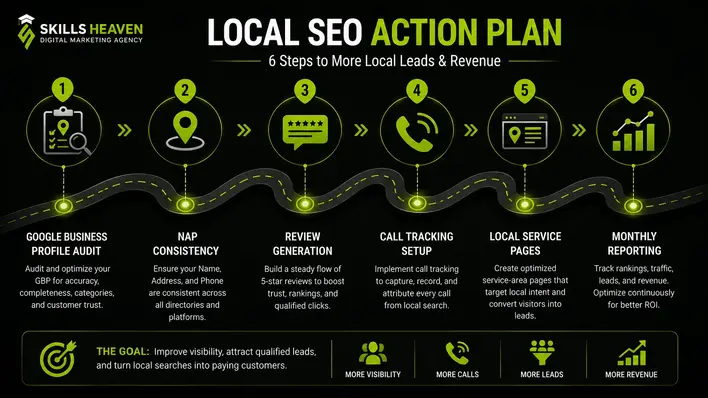
Step 1: Audit Your Google Business Profile
Review your current GBP profile for completeness and accuracy.
Step 2: Fix NAP Inconsistencies
Ensure your Name, Address, and Phone Number are consistent across all major directories.
Step 3: Build a Review Generation System
Create a process for requesting customer reviews after every completed service.
Step 4: Set Up Lead Tracking
Connect call tracking and website forms with your CRM.
Step 5: Optimize Service-Area Pages
Create unique, location-specific pages without duplicate content.
Step 6: Review Performance Monthly
Use the Lead Qualification Scorecard to measure lead quality and identify opportunities for improvement.
FAQ
Is local SEO worth it for small businesses?
Yes, for most businesses with a physical location or defined service area — it tends to produce a lower cost-per-qualified-lead over time compared to ongoing paid ad spend, though it takes longer to build momentum.
How long does local SEO take to generate leads?
Most businesses start seeing meaningful movement within three to six months, depending on competition density and how complete the existing profile and citation base are.
How do you measure local SEO ROI?
By connecting call tracking, form tracking, and CRM data to local search traffic, then calculating cost-per-qualified-lead and attributed revenue from closed deals.
What’s the difference between local SEO and traditional SEO?
Local SEO targets geographically-anchored, high-intent searches (often tied to Google Business Profile and the local pack), while traditional SEO targets broader organic visibility regardless of location.
Does local SEO work for service-area businesses without a storefront?
Yes Google Business Profile supports service-area settings, allowing businesses without a public storefront to still appear in relevant local searches.
How many reviews do you need to rank in the local pack?
There’s no fixed number; review velocity, recency, and detail tend to matter more than hitting a specific count.
Conclusion
Understanding how local SEO increases qualified leads and revenue comes down to one idea: visibility is only the first step. The real value comes from what happens after someone sees your listing — whether your trust signals, conversion path, and follow-up process turn that visibility into a sales-ready lead and, eventually, closed revenue.
Treat each stage of the funnel as something to optimize on its own, track the numbers from click to close, and use lead quality not just lead volume as your real measure of success. Businesses looking to accelerate results can also benefit from professional Local SEO Services in Dubai tailored to their market and competition

M. Awais Khan is a Business Development and Digital Growth Strategist at SkillsHeaven, specializing in SEO, local search optimization, and performance-driven digital marketing. With experience supporting 100+ businesses, he develops and implements data-driven strategies that help companies increase online visibility, generate qualified leads, and drive sustainable revenue growth. His expertise spans Local SEO, Google Ads, social media marketing, and conversion-focused website optimization, ensuring every project is aligned with measurable business outcomes and long-term success.