
Digital marketing is the practice of promoting products, services, or brands using internet based channels and technologies, including search engines, social media, email, and paid advertising, to reach and engage potential customers. Unlike traditional marketing methods like television, print, or billboards, digital marketing relies entirely on digital platforms, which makes it measurable, targeted, and adjustable in real time. Whether it’s called digital marketing, online marketing, or internet marketing, the core idea stays the same: using the internet to connect a business with the people most likely to buy from it.
This guide covers everything worth knowing about digital marketing in depth, from how it actually works and which channels matter most, to a full breakdown of the process, real world examples, budgeting, team structure, and the genuine benefits it brings to businesses of every size. Given how broad this topic is, expect a thorough, complete walkthrough rather than a surface level overview.
What Is Digital Marketing? A Complete Definition
At its core, digital marketing is any marketing effort that uses an electronic device or the internet to reach an audience. Businesses use digital channels such as search engines, social media platforms, email, and websites to connect with current and prospective customers.
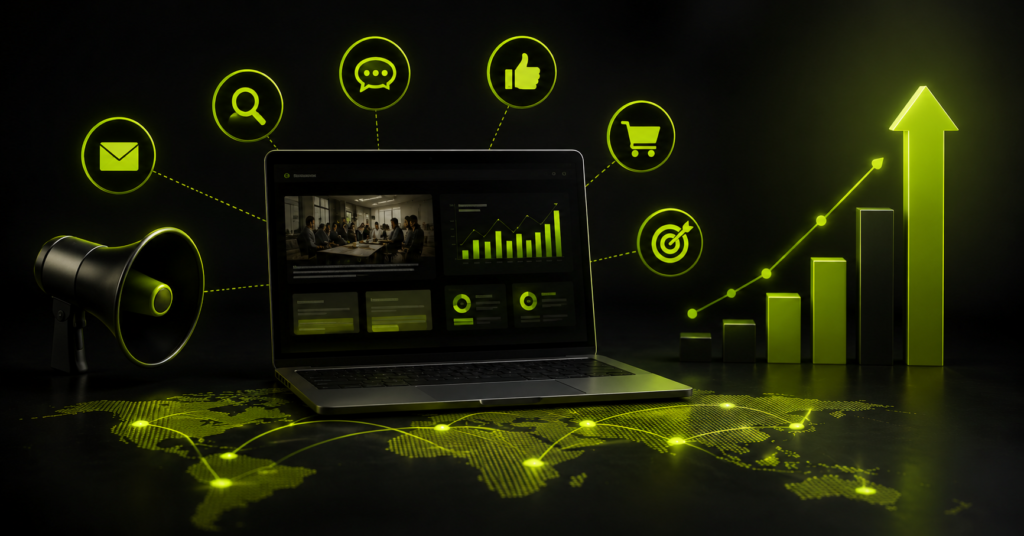
What separates digital marketing from traditional marketing is measurability. A billboard can generate awareness, but there’s no reliable way to know exactly how many people saw it or acted on it. A digital ad, on the other hand, can be tracked down to the exact click, the exact conversion, and the exact cost per result. This level of detail is what allows digital marketing to be refined constantly, campaign by campaign, rather than relying on guesswork.
Digital marketing also spans the entire customer journey, from the moment someone becomes aware of a brand, through the research and consideration stage, all the way to the actual purchase and beyond into retention and loyalty. A single business might use SEO to get discovered, social media to build familiarity, email to nurture the relationship, and paid ads to close the sale, all working together as one connected system rather than isolated efforts.
Digital Marketing vs Online Marketing vs Internet Marketing vs Digital Advertising
These terms get used interchangeably so often that it’s worth clarifying the subtle differences, even though in everyday conversation they mean roughly the same thing.
Online marketing and internet marketing are essentially older, slightly narrower terms that predate “digital marketing” becoming the standard industry phrase. Both generally refer to promotional activity that happens specifically through internet connected platforms, which today overlaps almost entirely with digital marketing itself.
Digital marketing is the broader, more modern umbrella term. It technically includes any marketing done through a digital device or channel, which today mostly means the internet, but could also include things like SMS marketing or digital signage that don’t require a live internet connection.
Digital advertising is more specific still. It refers only to the paid side of digital marketing, things like search ads, display ads, and paid social campaigns. Digital advertising is a subset of digital marketing, not a replacement for it, since digital marketing also includes free, organic activities like SEO and content creation that digital advertising doesn’t cover.
In practice, most people use these four terms without worrying about the technical distinctions, and that’s generally fine. What matters more is understanding the individual channels and strategies that make up the discipline as a whole.
A Brief History of How Digital Marketing Evolved
Understanding where digital marketing came from helps explain why it works the way it does today. In the early days of the internet, marketing online mostly meant simple banner ads and basic email blasts, with very little targeting or personalization involved.
As search engines like Google grew in prominence, search engine optimization and pay per click advertising became central pillars of the discipline, since businesses realized that showing up when someone actively searched for a solution was far more valuable than interrupting people with generic ads. The rise of social media platforms in the following years added an entirely new dimension, letting brands build ongoing relationships and communities rather than just running one off campaigns.
More recently, artificial intelligence and automation have reshaped how digital marketing operates at every level, from how ad platforms decide who sees a campaign to how search engines interpret and rank content. Search itself has expanded beyond a simple list of links, now including AI generated summaries and conversational answers, which means digital marketing today has to account for how both people and machines interpret content.
Why Digital Marketing Matters for Businesses Today

The benefits of digital marketing go well beyond simply “being online.” A few stand out as genuinely transformative for how businesses operate and grow.
Precise targeting. Digital marketing allows a business to reach a very specific audience based on location, interests, behavior, and even purchase intent, rather than broadcasting a generic message to everyone.
Measurable results. Every click, impression, and conversion can be tracked, which means businesses know exactly what’s working and can adjust quickly instead of waiting months to see results.
Cost efficiency. Compared to traditional advertising, digital marketing often delivers a lower cost per result, especially for smaller businesses that can’t afford large scale television or print campaigns.
Two way engagement. Unlike traditional media, digital channels let customers respond, comment, ask questions, and share content, creating a genuine dialogue rather than a one directional broadcast.
Wider and more flexible reach. A single digital campaign can reach a local neighborhood, an entire country, or a global audience, depending entirely on how it’s configured, with no fixed geographic limitation the way a local newspaper ad would have.
Better customer experience. With access to real data on customer behavior and preferences, businesses can personalize messaging, product recommendations, and offers in ways that feel relevant rather than generic.
Together, these advantages explain why digital marketing has become the default growth strategy for businesses of nearly every size and industry, from local service providers to global enterprises.
The Core Marketing Channels Used in Digital Marketing
Digital marketing isn’t a single tactic, it’s an umbrella covering several distinct channels, each with its own strengths, timelines, and use cases. Understanding each one individually makes it much easier to build an effective overall strategy.
Search Engine Optimization (SEO)
SEO is the process of improving a website so it ranks higher in organic, unpaid search engine results. When someone types a question or product into Google, SEO determines whether your business shows up on the first page or gets buried several pages down where almost nobody looks.
SEO typically involves three core areas: technical optimization, which ensures a site is fast, crawlable, and mobile friendly, on page optimization, which involves writing content that matches what searchers are actually looking for, and off page optimization, which mainly involves earning backlinks and mentions from other credible sites. SEO tends to take longer to show results compared to paid channels, often several months, but the traffic it generates tends to be more sustainable and cost effective over the long run. For businesses trying to build genuine topical depth rather than thin, keyword stuffed pages, understanding how keyword clustering and semantic coverage work is one of the more overlooked parts of doing SEO well.
Pay Per Click Advertising (PPC)
PPC advertising is a model where businesses pay a fee each time someone clicks their ad. The most recognizable form is search engine advertising, like Google Ads, where ads appear above or alongside organic search results for relevant keywords.
PPC advertising offers something SEO can’t: immediate visibility. A brand new website with zero search rankings can still appear at the very top of search results the moment a PPC campaign goes live, provided the budget and bidding strategy support it. This makes PPC particularly valuable for time sensitive promotions, product launches, or businesses in highly competitive markets where organic growth would take too long on its own. Getting the most out of a Google Ads budget also depends on using assets like sitelinks and structured snippets correctly, since a well built ad with the right assets can outperform a competitor’s higher bid without spending more per click.
Social Media Marketing
Social media marketing involves using platforms like Instagram, Facebook, LinkedIn, TikTok, and X to build brand awareness, engage an audience, and drive traffic or sales. It splits into two main approaches: organic social media, which involves posting content and building a community without paying for distribution, and paid social media, which involves running targeted ad campaigns to reach specific audience segments.
Social media marketing works particularly well for building brand personality and trust over time, since it allows for direct, ongoing interaction with an audience rather than a single transactional message. Short form video content in particular has become one of the most effective formats across nearly every major platform.
Content Marketing
Content marketing focuses on creating valuable, relevant content, blog posts, guides, videos, or downloadable resources, that answers real questions your target audience is asking. Rather than directly pitching a product, content marketing builds trust and authority first, which naturally supports other channels like SEO and social media.
This channel tends to work slowly at the start but compounds significantly over time, since a single well ranked piece of content can continue generating traffic and leads for years after it’s published.
Email Marketing
Email marketing involves sending targeted messages directly to a list of subscribers who have opted in to hear from your business. It remains one of the highest return channels in all of digital marketing, since it reaches an audience that has already shown interest, without needing to pay for distribution the way paid ads do.
Email works well across the entire customer journey, from welcoming new subscribers and nurturing leads, to announcing new products, sharing valuable content, and re-engaging past customers who haven’t purchased in a while.
Affiliate and Influencer Marketing
Affiliate marketing involves partnering with other websites or individuals who promote your products in exchange for a commission on resulting sales. Influencer marketing works similarly but relies specifically on individuals with an engaged following on social media or content platforms to promote a brand authentically to their audience.
Both channels let a business reach new audiences without the upfront cost of traditional advertising, since payment is often tied directly to actual results rather than simple exposure. It’s also worth understanding the mechanics of how dofollow and nofollow links work when running an affiliate program, since most affiliate links need to be marked appropriately to stay compliant with search engine guidelines.
Video Marketing
Video marketing spans everything from YouTube content and video ads to short form clips on social platforms. Video tends to communicate more information faster than text alone and often drives stronger engagement, particularly for product demonstrations, tutorials, and brand storytelling.
Owned, Earned, and Paid Media Explained
A useful way to organize all these channels is through the lens of owned, earned, and paid media, a framework that applies across nearly every digital marketing strategy.
Owned media refers to assets a business fully controls, like its website, blog, email list, and social media profiles. These are the foundation of most strategies since they don’t disappear if an ad budget runs out or a platform changes its algorithm.
Earned media refers to exposure a business gains without directly paying for it, things like organic social shares, media mentions, reviews, and word of mouth. Earned media tends to carry a high degree of trust since it comes from other people rather than the business itself. Reviews specifically deserve extra attention here, since how reviews impact rankings and trust goes well beyond simple star ratings and feeds directly into how prominently a business appears in local search results.
Paid media refers to any form of paid promotion, including search ads, social ads, and sponsored content. Paid media delivers speed and scale that owned and earned media can’t match on their own, making it especially useful for launches, promotions, or filling gaps while organic channels are still building momentum.
The strongest digital marketing strategies typically use all three together: owned media as the foundation, earned media for long term credibility, and paid media for immediate reach and testing.
Digital Marketing Examples From Real Businesses
Seeing digital marketing in action often makes the concept click faster than any definition alone. A few common, real world patterns illustrate how businesses actually use these channels.
An outdoor apparel brand might send regular emails showcasing new products alongside video content featuring real customers using their gear outdoors, combining email marketing with content and video marketing in one connected campaign.
A language learning app might rely heavily on short form social media content across TikTok, Instagram, and LinkedIn, meeting potential users exactly where they already spend their time rather than trying to pull them elsewhere.
A product review website might publish detailed, independent testing content and earn a commission through affiliate links whenever a reader makes a purchase based on their recommendation, blending content marketing with affiliate marketing.
A local service business, like a plumbing or home repair company, often combines local SEO with Google Business Profile optimization and customer reviews to appear prominently when nearby customers search for urgent help.
An ecommerce store launching a new product might run a coordinated campaign combining PPC ads for immediate visibility, retargeting ads for people who visited but didn’t purchase, and email sequences to past customers, all pointing toward the same launch.
Each of these digital marketing examples shows the same underlying principle: the channels work best when they reinforce each other rather than operating as isolated, disconnected efforts.
The Digital Marketing Process Step by Step
Every effective digital marketing effort follows a general process, even if the specific tactics vary by business and industry.
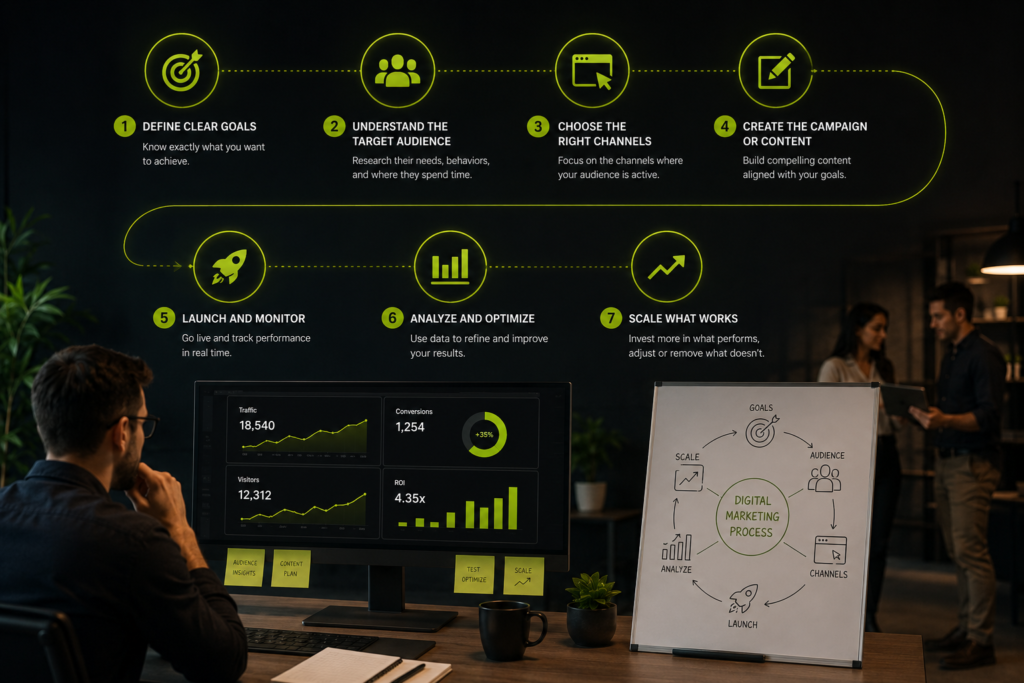
Step 1: Define clear goals. Before choosing any channel, a business needs to know exactly what it’s trying to achieve, whether that’s brand awareness, lead generation, direct sales, or customer retention. Vague goals lead to scattered, unmeasurable efforts.
Step 2: Understand the target audience. This involves researching who the ideal customer actually is, what problems they’re trying to solve, where they spend time online, and what kind of messaging resonates with them.
Step 3: Choose the right channels. Rather than trying to be everywhere at once, effective digital marketing focuses on a handful of channels where the target audience is genuinely active, executed consistently and well.
Step 4: Create the campaign or content. This is where the actual ads, blog posts, social content, or email sequences get built, always tied back to the goals and audience insights established earlier.
Step 5: Launch and monitor. Once live, campaigns need ongoing monitoring rather than a set it and forget it approach, since early data often reveals what’s working and what isn’t.
Step 6: Analyze and optimize. Using analytics and performance data, marketers refine targeting, messaging, and budget allocation to improve results over time, treating each campaign as a starting point rather than a finished product.
Step 7: Scale what works. Once a channel or campaign proves effective, resources shift toward scaling it further, while underperforming efforts get adjusted or phased out.
This digital marketing process isn’t strictly linear either, since most businesses cycle through these steps continuously as they launch new campaigns, enter new markets, or respond to changes in customer behavior.
Inbound Marketing vs Digital Marketing: How They Relate
Inbound marketing and digital marketing often get confused, but they represent slightly different concepts. Digital marketing refers to the specific tools and channels used to reach an audience online, while inbound marketing is a broader philosophy focused on attracting customers through valuable, relevant content rather than interrupting them with traditional advertising.
In practice, inbound marketing typically relies heavily on digital marketing channels, particularly content marketing, SEO, and email, to draw people in naturally rather than pushing a message out to everyone. Outbound tactics, like cold calling or unsolicited display ads, technically fall under digital marketing too, but they don’t align with inbound principles the way SEO or content marketing does.
Most modern digital marketing strategies lean heavily inbound, since audiences today tend to trust content and search results they found themselves far more than ads they were interrupted by. That said, a balanced approach often blends both, using paid, more outbound style channels to accelerate results while inbound channels build sustainable, long term growth.
Digital Marketing for Online Business and Ecommerce
For an online business specifically, digital marketing isn’t optional, it’s essentially the entire growth engine, since there’s no physical storefront driving passing foot traffic. Online business marketing typically leans on a combination of SEO to capture people actively searching for products, paid advertising to accelerate visibility, and email marketing to build repeat purchases from existing customers.
Ecommerce businesses in particular benefit from retargeting campaigns, which show ads specifically to people who visited a product page but didn’t complete a purchase, along with abandoned cart email sequences that recover sales that would otherwise be lost entirely. Reviews and social proof also play an outsized role for online businesses, since customers can’t physically examine a product before buying, making trust signals a critical part of the overall marketing approach. None of this works, though, without a fast, well built website behind it, which is why web development and digital marketing are usually planned together rather than treated as separate projects.
Digital Marketing for Local Businesses
Local businesses, restaurants, clinics, home service companies, and similar operations, face a slightly different version of digital marketing than a purely online business does, since their goal is usually driving foot traffic, calls, or bookings from people nearby rather than shipping products nationwide.
For this type of business, local SEO typically becomes the highest priority channel, since it captures the exact moment someone nearby searches for a relevant service. This includes optimizing a Google Business Profile, building accurate citations across local directories, and encouraging a steady flow of genuine customer reviews. Paid local ads, geo targeted social campaigns, and location specific landing pages usually round out the rest of the strategy. A local business investing heavily in national SEO tactics while ignoring local SEO fundamentals is one of the more common and costly digital marketing mistakes small business owners make.
Digital Marketing Budgeting: How Much Should a Business Spend
One of the most common questions business owners ask is how much to actually budget for digital marketing, and the honest answer is that it depends heavily on industry, competition, and growth goals. That said, a few general frameworks help set a reasonable starting point.
Many small to mid sized businesses allocate somewhere in the range of a moderate percentage of overall revenue toward marketing, with a meaningful portion of that going specifically toward digital channels given how measurable and targeted they are compared to traditional options. Businesses in highly competitive industries, or those pursuing aggressive growth targets, often need to allocate more heavily toward paid channels initially, since organic channels like SEO and content take longer to build momentum.
A practical approach for a newer business is splitting budget across a small number of channels rather than spreading it too thin. For example, a new local service business might commit the bulk of its budget to local SEO and Google Business Profile optimization first, since this channel tends to deliver strong, sustainable returns for a relatively modest ongoing investment, then layer in paid search once the budget allows for it.
Budget should also flex over time based on performance. Channels producing a strong return relative to their cost should generally receive more investment, while consistently underperforming channels should be scaled back or restructured rather than continuing purely out of habit.
In House Team vs Agency vs Freelancer for Digital Marketing
Once a business decides to invest seriously in digital marketing, a natural question follows: who should actually do the work. Each option carries different tradeoffs.
An in house team offers the deepest familiarity with the business and the most direct day to day control, but building a capable team internally, covering SEO, paid ads, content, and design, requires significant hiring investment and usually only makes sense once a business has reached a certain scale.
A freelancer can be a cost effective option for a narrow, specific task, like writing blog content or managing a single ad campaign, but coordinating multiple freelancers across different channels can become difficult to manage cohesively as needs grow.
An agency typically offers a full team of specialists across multiple channels under one point of contact, which works well for businesses that want a coordinated strategy without building an internal team from scratch. The tradeoff is less day to day control compared to an in house hire, and the quality difference between agencies can be significant, which is exactly why knowing what to ask before hiring one matters so much before signing a contract.
Many growing businesses actually use a hybrid model, keeping strategic oversight and brand voice decisions in house while outsourcing specialized execution, like technical SEO or paid ad management, to an agency or specialist freelancer.
Customer Acquisition Through Digital Marketing
Customer acquisition, the process of gaining new customers, sits at the heart of why most businesses invest in digital marketing in the first place. Each channel plays a distinct role in the acquisition process.
SEO and content marketing tend to acquire customers who are already searching for a solution, meaning they arrive with strong intent already established. PPC advertising accelerates this by putting a business in front of that same intent based audience instantly, without waiting for organic rankings to build. Social media marketing often acquires customers earlier in their journey, building awareness before someone even realizes they have a specific need. Referral and affiliate programs acquire customers through trust transferred from someone they already follow or know.
A well built digital marketing strategy usually doesn’t rely on a single acquisition channel. Instead, it builds a mix where different channels acquire customers at different stages of awareness and intent, then works together to move them toward a purchase decision through consistent, coordinated messaging.
Customer acquisition cost, often shortened to CAC, is one of the most important metrics tied to this process, since it tells a business exactly how much it’s spending, on average, to gain each new customer. Comparing this figure against customer lifetime value helps determine whether a given acquisition channel is genuinely profitable or simply generating traffic without sustainable returns.
How to Build a Digital Marketing Strategy From Scratch
Building an effective digital marketing strategy involves pulling together everything covered so far into one coordinated plan.
Start by setting specific, measurable goals rather than vague ambitions like “get more customers.” A goal like increasing qualified leads by a defined percentage within a specific timeframe gives the entire strategy direction and a way to measure success.
Next, build a clear picture of the target audience, including their demographics, pain points, and where they spend time online. This research directly informs which channels deserve the bulk of attention and budget.
From there, allocate resources across a focused mix of channels rather than spreading effort too thin across everything at once. A small business, for example, might focus primarily on local SEO, a strong Google Business Profile, and a modest social media presence, while a larger ecommerce brand might invest heavily across PPC, email, content, and paid social simultaneously.
Set a realistic budget and timeline for each channel, recognizing that SEO and content marketing typically need months to show meaningful results, while PPC and paid social can generate faster, though often more expensive, results.
Finally, build in regular reporting and review cycles. A strategy built once and never revisited quickly becomes outdated as customer behavior, platform algorithms, and competitive landscapes shift.
Digital Marketing Metrics That Actually Matter
With so much data available, it’s easy to get distracted by vanity metrics that look impressive but don’t actually reflect business impact. A few metrics consistently matter more than the rest.
Conversion rate measures the percentage of visitors who take a desired action, whether that’s a purchase, a form submission, or a sign up, and reflects how effectively your marketing actually turns interest into results.
Cost per acquisition tracks how much it costs, on average, to gain a single customer through a specific channel or campaign, making it essential for comparing channel efficiency.
Return on ad spend measures how much revenue is generated for every unit of currency spent on advertising, giving a direct read on paid campaign profitability.
Customer lifetime value estimates the total revenue a business can expect from a single customer over the entire relationship, which helps put acquisition costs into proper context.
Organic traffic growth tracks how effectively SEO and content efforts are compounding over time, independent of any paid spend.
Focusing on these core metrics, rather than surface level numbers like raw impressions or social media followers, gives a far more accurate picture of whether a digital marketing strategy is actually working.
Common Mistakes Businesses Make in Digital Marketing
A handful of recurring mistakes hold back digital marketing results across businesses of every size.
Trying to be everywhere at once. Spreading a limited budget and team across too many channels usually means none of them get executed well enough to actually perform.
Ignoring mobile experience. With the majority of internet browsing happening on mobile devices, a slow or poorly designed mobile site quietly undermines every other marketing effort pointing traffic toward it.
Focusing only on acquisition, not retention. Many businesses pour resources into gaining new customers while neglecting email nurturing, loyalty programs, or retargeting that could turn existing customers into repeat buyers.
Not tracking the right metrics. Celebrating high traffic or follower counts without connecting them to actual conversions or revenue leads to strategies that feel productive but don’t move the business forward.
Treating channels as isolated silos. SEO, social media, email, and paid ads perform best when they reinforce each other as part of one connected strategy, rather than being managed as completely separate, disconnected efforts.
A Quick Digital Marketing Glossary
A few frequently used terms are worth defining plainly, since they come up throughout any deeper discussion of digital marketing.
Impressions: the number of times an ad or piece of content was displayed, regardless of whether anyone clicked it.
Click through rate (CTR): the percentage of people who saw an ad or link and actually clicked it.
Bounce rate: the percentage of visitors who leave a page without taking any further action or visiting another page.
Retargeting: showing ads specifically to people who already visited your site or engaged with your brand, rather than a brand new audience.
Domain authority: an estimated score reflecting how likely a website is to rank well in search results, based largely on its backlink profile and overall trust signals.
Attribution: the process of determining which channel or touchpoint deserves credit for a resulting conversion, particularly important when a customer interacts with multiple channels before purchasing.
The Future of Digital Marketing
Digital marketing continues to shift as technology evolves, and a few trends are already shaping where the discipline is heading. Artificial intelligence now plays a role across nearly every channel, from automated ad targeting and budget allocation to AI assisted content creation and personalization at scale.
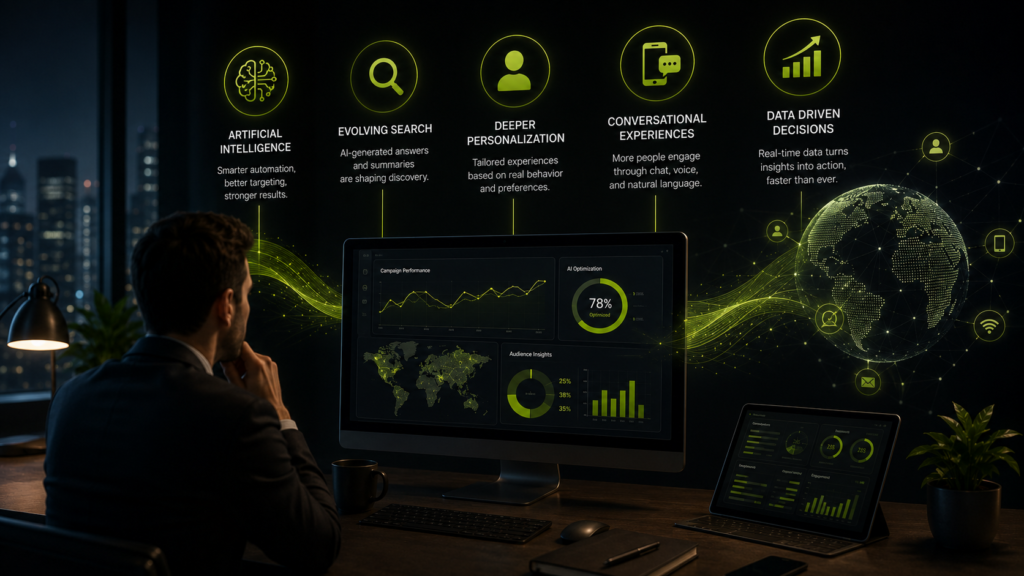
Search itself is evolving beyond a simple list of links, with AI generated summaries and conversational answers becoming a bigger part of how people find information, which means content increasingly needs to be structured clearly enough for both readers and AI systems to interpret and reference accurately.
Personalization continues to deepen as well, with businesses using behavioral and purchase data to tailor messaging at an individual level rather than relying on broad audience segments. Despite all this change, the core principle behind digital marketing remains constant: understanding your audience deeply and meeting them with relevant, valuable messaging wherever they naturally spend their time.
Frequently Asked Questions
Is digital marketing the same as social media marketing?
No. Social media marketing is just one channel within the broader field of digital marketing, which also includes SEO, PPC, email, content marketing, and more.
How long does digital marketing take to show results?
It depends heavily on the channel. PPC and paid social can show results within days, while SEO and content marketing typically take several months to build meaningful traction.
Do small businesses really need digital marketing?
Yes. Digital marketing often costs significantly less than traditional advertising and allows small businesses to compete for attention in ways that were previously only accessible to larger companies with big advertising budgets.
What’s the difference between digital marketing and digital advertising?
Digital advertising refers specifically to paid promotional efforts, while digital marketing is the broader term covering both paid and unpaid activities, including SEO, content, and organic social media.
Which digital marketing channel delivers the best return?
There’s no single universal answer, since it depends on the business, industry, and audience. Email marketing and SEO are often cited for strong long term returns, while PPC and paid social deliver faster, though often costlier, results.
Should a business handle digital marketing in house or hire outside help?
It depends on scale and budget. Smaller businesses often start with a freelancer or agency for specific channels, while larger businesses may build an in house team once digital marketing becomes central enough to justify the investment.
Final Thoughts
Digital marketing is the umbrella term for every way a business promotes itself using internet based channels, spanning SEO, PPC advertising, social media, content, and email, among others, all working together as part of one connected strategy rather than isolated tactics. Whether it’s called digital marketing, online marketing, or internet marketing, the fundamentals stay the same: understand your audience, choose the right mix of channels, execute consistently, and refine based on real data. Businesses that treat digital marketing as an integrated system, rather than a checklist of separate activities, are consistently the ones that turn it into sustainable growth and reliable customer acquisition over time.
If you’d rather have this entire system built and managed for your business, our digital marketing services in Dubai cover SEO, paid ads, and social media under one coordinated strategy, or you can book a free strategy call to talk through where your business stands today.

Wali Shah is the Founder and CEO of SkillsHeaven, a digital growth agency specializing in Local SEO, Google Ads, and conversion-focused website development. With over 8+ years of experience, he has helped scale 170+ businesses, including 93+ limousine companies globally, by building structured, lead-generating digital systems. His expertise spans local search optimization, paid media strategy, and high-performance website development, all aligned with measurable business growth. Known for a data-driven and ethical approach, Wali focuses on creating scalable marketing systems that increase visibility, generate qualified leads, and drive long-term revenue for service-based businesses.