Most UAE businesses are not failing at email marketing because of bad products or boring brands. They are failing because they apply global email playbooks inside a market that runs by completely different rules.
Dubai alone has over 200 nationalities. Prayer times affect when inboxes get checked. Ramadan flips consumer behavior for a full month. Arabic-speaking audiences respond differently to tone, imagery, and offer framing compared to expat communities. None of this shows up in a standard email marketing guide written for a Western audience.
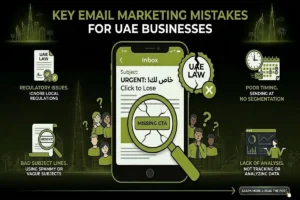
If your open rates are low, your campaigns land in spam, or you get clicks but no conversions, there is a strong chance you are making one or more of the eight mistakes below. Skills Heaven works with UAE brands daily and these are the exact issues that come up again and again.
Mistake 1: Sending English-Only Emails in a Bilingual Market
This is the single most overlooked email marketing mistake in UAE, and it is actively costing brands revenue every month.
The UAE audience is fundamentally split. Government professionals, real estate buyers, and a large share of retail consumers prefer Arabic. Meanwhile, the expat community, which makes up roughly 88 percent of the population, operates primarily in English.
Sending one version of every email to both groups is not efficient. It missed revenue. Well-executed Arabic campaigns that use a natural, culturally relevant tone consistently outperform direct translations by a significant margin. A translated email still reads like a translated email.
What to do instead: Segment your subscriber list by language preference at the point of sign-up. Build two separate email flows with content written natively for each audience, not translated from one to the other. This one structural change can dramatically improve email open rates UAE-wide because messages feel written for the reader rather than broadcast at them.
Mistake 2: Copying Subject Lines That Work in the US or UK Into UAE Campaigns
The subject line is the first and often the only thing a subscriber reads before deciding to open or delete. In the UAE, that decision is shaped by cultural expectations that are fundamentally different from Western markets.
Urgency-driven subject lines like Last Chance, Ends Tonight, or Do Not Miss Out are standard practice in US email marketing. In the UAE, where trust and relationship carry more weight than pressure, these phrases read as pushy rather than persuasive.
They trigger scepticism rather than action, particularly among Arabic-speaking audiences and longer-term residents who have learned to tune them out entirely.
The problem runs deeper than tone. UAE inboxes are among the most competitive in the world. Dubai professionals receive marketing emails in English, Arabic, and sometimes both simultaneously. A subject line that does not immediately signal relevance to this specific person in this specific market gets skipped in under a second.
What to do instead: Write subject lines that lead with context and relevance rather than urgency and pressure. For Arabic-speaking segments, use subject lines written natively in Arabic and tested separately from English versions.
Reference UAE-specific contexts where relevant, such as a local business quarter, a regional event, or an industry trend specific to Dubai or Abu Dhabi. Keep English subject lines under 45 characters for full mobile display.
Test at least two subject line variations per campaign and let engagement data guide your language choices over time, rather than importing assumptions from other markets.
Mistake 3: Buying Email Lists Instead of Building Them
This shortcut is more common in the UAE market than most agencies will admit, and it causes serious long-term damage to deliverability.
Purchased lists contain contacts who never agreed to hear from you. They will not recognise your sender name. They will not open. They will report. Every spam complaint that follows damages your sender reputation and makes it harder to reach even the subscribers who genuinely want your emails.
In 2026, inbox providers use engagement signals as a primary trust indicator. A list full of cold, unresponsive contacts tells Gmail and Outlook that your emails are unwanted, and they act accordingly. This is one of the most direct causes of why emails go to spam in the UAE.
What to do instead: Build your list through genuine opt-in mechanisms. Offer a meaningful lead magnet relevant to your specific audience, such as a Dubai property market report, a Ramadan meal planning guide, or an exclusive subscriber discount. Zero-party data collected with consent consistently outperforms purchased data in both deliverability and conversion rate.
Mistake 4: Not Optimising for Mobile Where UAE Inboxes Actually Live
More than 70 percent of email opens in the UAE happen on smartphones. If your email does not render well on a mobile screen, it is effectively invisible to most of your audience.
The typical UAE subscriber checks email between tasks, during commutes, or after evening prayers on a phone. Long paragraphs that look fine on a desktop become walls of text on a 6-inch screen. Images that load slowly get skipped. Buttons that are too small to tap with a thumb lose the click entirely.
Mobile optimisation is not a bonus feature in the UAE. It is the baseline requirement for any campaign that wants to perform.
What to do instead: Use responsive email templates that collapse cleanly on mobile. Keep subject lines under 45 characters so they display in full on phone screens. Make your primary call-to-action button large enough to tap comfortably. Test every campaign on an actual phone before sending, not just in a desktop email preview.
Mistake 5: Using Spam-Trigger Language Without Realising It
Some brands write emails that feel natural to a human reader but look like spam to an inbox algorithm. The gap between what you intend and what the filter sees can be surprisingly wide.
Subject lines with ALL CAPS words, strings of exclamation marks, phrases like FREE, LIMITED TIME OFFER, or ACT NOW, and emails built almost entirely from images with very little text are all common spam triggers. In 2026, inbox filters are more sophisticated than ever. They analyse sender reputation, content patterns, engagement history, and authentication records simultaneously.
A single high-volume campaign with aggressive language patterns can suppress your deliverability for weeks, which means future campaigns to your engaged subscribers also suffer.
What to do instead: Write subject lines the way a trusted contact would. Test emails through a deliverability checker before sending. Maintain a balanced ratio of text to images. Ensure your domain has SPF, DKIM, and DMARC records correctly configured. These technical steps are skipped by most UAE businesses, and they explain a large share of deliverability problems.
Mistake 6: Treating All UAE Subscribers as One Audience
The UAE has locals, Arab expats, South Asian professionals, Western executives, high-net-worth investors, and first-time online shoppers all in the same market. A luxury real estate investor in Abu Dhabi and a first-time ecommerce buyer in Sharjah do not respond to the same message.
Sending one campaign to everyone on your list guarantees that most people receive something that feels irrelevant to them. Irrelevant emails get ignored. Ignored emails damage engagement metrics. Damaged engagement metrics reduce future deliverability.
Segmentation is not a complex technical undertaking. It is a decision to treat different subscribers differently based on what you already know about them.
What to do instead: Segment by at minimum three variables: language preference, purchase or engagement history, and location or industry. Someone who bought last week needs a different email than someone who signed up six months ago and never converted. These are not the same relationship and should not receive the same message.
Quick Reference: Mistake vs Fix vs Impact
Use this table to identify which mistakes apply to your current campaigns and prioritise which to fix first.
| Mistake | Core Fix | Expected Impact |
|---|---|---|
| English-only emails | Build bilingual flows by language segment | Higher open rates among Arabic audience |
| Copying Western subject lines | Write UAE-localised, native Arabic subject lines | Higher open rates across both language segments |
| Buying email lists | Collect zero-party data with opt-ins | Improved deliverability and inbox placement |
| Poor mobile optimisation | Responsive templates, short subject lines | Fewer drop-offs on mobile opens |
| Spam-trigger language | Natural copy, SPF/DKIM/DMARC setup | Reduced spam folder placement |
| No audience segmentation | Segment by language, behavior, location | Higher relevance and conversion rate |
| Over-relying on AI copy | Human review layer, native Arabic editing | Better tone and emotional connection |
| Email as a standalone channel | Connect email to WhatsApp and retargeting | Higher overall campaign conversion |
Mistake 7: Over-Relying on AI-Generated Content Without a Human Layer
AI tools have made email production faster. They have also made it much easier to send emails that feel hollow, generic, and disconnected from any real brand voice.
This matters especially in the UAE, where relationship and trust are foundational across cultures. An email that reads like a tool produced will not build the kind of connection that drives repeat purchases or referrals. Subscribers recognise the pattern quickly.
There is also a practical risk specific to this market. Arabic AI output requires uncompromising human review. Errors in dialect, formality level, or cultural nuance can cause real damage to brand perception. An automated Arabic translation that uses the wrong register for your audience can undermine trust instantly and those subscribers rarely come back.
What to do instead: Use AI for structure, drafts, and subject line testing. Then apply a human editor who understands both your brand voice and your specific UAE audience. For Arabic content, always have a native speaker review the copy before it is sent. This step is non-negotiable if Arabic-speaking subscribers are part of your customer base.
Mistake 8: Running Email as a Standalone Channel
Email does not exist in isolation in the UAE. Your subscribers are also seeing your brand on Instagram, receiving messages on WhatsApp, and searching for you on Google. Brands that only send emails and never connect those campaigns to other touchpoints are leaving significant conversion opportunities behind.
A subscriber who gets an email, then a WhatsApp follow-up the next day, then sees a retargeting ad three days later is far more likely to convert than one who receives a single email that goes unread. Omnichannel flows reinforce messages across platforms without requiring a massive increase in content production.
This is one of the clearest trends in high-performing email marketing strategy Dubai businesses are adopting in 2026. The brands seeing the strongest ROI are not sending more emails. They are connecting their emails to a broader, smarter customer journey.
What to do instead: Map a simple connected journey. Email for awareness and education. WhatsApp for time-sensitive follow-up. Retargeting ads for subscribers who opened but did not click through. This does not require an enterprise marketing budget. It requires a clear strategy and tools that share data with each other.
Why These Mistakes Stack and Compound Over Time
It is rarely one mistake that kills an email programme. It is usually four or five stacking on top of each other in a way that makes the root cause difficult to identify.
Poor list quality reduces deliverability. Reduced deliverability drops open rates. Lower open rates mean less engagement data. Less data leads to bad timing decisions. Bad timing during Ramadan sends English-only emails with AI-written copy to an Arabic-speaking audience at 9 AM. That is not one mistake. That is a system failure.
The businesses that see consistent results from email marketing in the UAE treat it as a system, not a series of one-off campaigns. They build clean lists, segment properly, optimize for mobile, test send times, review Arabic content with native speakers, and connect email to their wider marketing channels.
How Skills Heaven Helps UAE Brands Fix These Mistakes
Skills Heaven has spent years working inside the UAE market, building email programmes for businesses across Dubai, Abu Dhabi, and beyond. The agency does not apply imported global frameworks. It builds strategies around how this specific market actually behaves.
That means bilingual segmentation built into the list architecture from the start. It means Ramadan campaign planning that adjusts timing, tone, and language rather than just adding a holiday graphic. It means technical deliverability audits that identify SPF, DKIM, and DMARC gaps before they suppress a campaign.
When businesses partner with Skills Heaven, they are not just getting email templates. They are getting a full system that connects email to WhatsApp, retargeting, and the wider customer journey, built by a team that understands what UAE audiences actually respond to.
Ready to Build an Email System That Works in the UAE?
Skills Heaven builds bilingual, mobile-first, conversion-focused email strategies for UAE brands. Stop sending campaigns that disappear into inboxes.
Start Your Email Strategy with Skills Heaven
The Real Reason Most UAE Email Campaigns Underperform
Most UAE businesses blame the channel when results are poor. They assume email marketing no longer works, switch to paid social, and end up with a more expensive problem.
Email still delivers one of the strongest returns of any digital marketing channel available. Well-executed campaigns in the UAE can return significant multiples on every dirham invested. The channel is not broken. The execution is.
The businesses generating real returns from email in 2026 are not sending more frequently. They are sending with more precision. Tighter segmentation. Clearer intent. Better timing. And they are supported by agencies that know the difference between a global email strategy and a UAE email strategy.
Conclusion
Email marketing in the UAE is not failing because the channel has lost its power. It is underperforming because most businesses are applying the wrong strategies in a market with very specific rules.
Fixing bilingual segmentation, adjusting for Ramadan, building clean opt-in lists, optimising for mobile, removing spam triggers, connecting email to other channels, and adding a human layer to AI content are not complicated changes. But they do require intentional effort and local knowledge.
The brands generating consistent results from email in 2026 are not lucky. They are building systems, not sending campaigns. And many of them are doing it with support from agencies that understand the UAE market at a ground level.

Atif Khan is a highly experienced Local SEO Expert and Strategic SEO Consultant who helps businesses turn their websites into powerful lead-generating assets. With hands-on experience optimizing and ranking over 100 websites across competitive industries, he specializes in building data-driven SEO systems that improve local search visibility, attract qualified traffic, and convert visitors into customers. His expertise spans Google Business Profile optimization, technical SEO, keyword research, content strategy, and conversion-focused website optimization, ensuring every project is aligned with measurable business outcomes. Atif focuses on creating complete local search ecosystems, combining website authority, relevance, and trust signals to help businesses dominate in their target locations. Beyond rankings, he develops scalable growth strategies that drive calls, inquiries, and long-term revenue. His approach is rooted in ethical, white-hat SEO practices, continuous optimization, and performance tracking, ensuring sustainable results. As a consultant, he works closely with businesses and agencies to align SEO with revenue goals, improve digital presence, and build long-term organic acquisition systems.