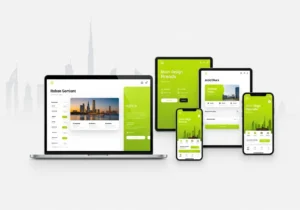
UI/UX Design Trends in Dubai and UAE are critical as seventy three percent of customers across the Middle East say that the experience they receive from a brand is the deciding factor when choosing between two competitors. That single statistic, from a PwC study of regional consumer behaviour, captures everything a UAE business owner needs to understand about the importance of UI/UX design in 2026.
Dubai and the wider UAE have become one of the most digitally demanding markets in the world. With 99 per cent of the population using the internet daily and mobile penetration rates among the highest globally, consumers here interact with digital products constantly, and their expectations are not average.
They expect fast, intuitive, visually premium, and culturally relevant experiences every time they open an app or visit a website.
The result is that UI/UX design has shifted from being a creative consideration to a core business strategy. Companies that invest in thoughtful, research-backed digital experiences are seeing measurable returns in conversion rates, customer retention, and brand loyalty.
Those that do not are losing ground to competitors who do. In 2026, the gap between the two groups is wider than it has ever been.This guide from Skills Heaven covers the top UI/UX design trends shaping Dubai and the UAE in 2026, the industries most affected, what the design process looks like in practice, realistic costs in UAE dirhams, and the answers to the questions UAE business owners ask most frequently when evaluating a UI/UX investment.
What Is UI/UX Design and Why Do UAE Businesses Need to Invest in It?
In the UAE market, modern web development is closely connected to local SEO success because websites that are fast, mobile-friendly, and user-focused consistently perform better in search results.
Before diving into trends, it is worth establishing a clear definition. UI and UX are two related but distinct disciplines that are frequently grouped together and occasionally confused.
UI Design vs UX Design: The Difference Explained
UX, or user experience design, is concerned with the overall journey a user takes when interacting with a digital product. It asks questions like: Is this process easy to complete? Does the user know where to go next? Are there moments of confusion or friction that cause drop-off?
UX designers work with research, user journey maps, wireframes, and prototypes to design flows that are logical, efficient, and satisfying.UI, or user interface design, is concerned with the visual and interactive layer of the product. It covers the layout of each screen, the colour palette, typography, button design, icon style, spacing, and every visual detail that the user sees and touches.
A UI designer takes the structural foundation created by UX work and brings it to life as a visually compelling, brand-consistent interface.In practice, most successful digital products require both. A beautifully designed interface built on a poor user journey will frustrate users despite looking impressive.
A well-structured user journey wrapped in a poorly executed visual design will fail to build the trust and brand perception that UAE consumers expect. The two disciplines work together, and the best results come from agencies that treat them as an integrated process.
Why Strategy Must Come Before Aesthetics
One of the most common mistakes UAE businesses make when approaching a UI/UX project is treating it as a visual exercise. They arrive with a request for a new look, a modern design, or something that feels more premium. These are valid goals, but they are outcomes, not starting points.
Effective UI/UX design in the UAE begins with research. Who are the users? What are they trying to achieve? Where do they currently experience friction? What does the data from existing platforms tell us about how people actually behave versus how we assume they behave?
The answers to these questions shape every design decision that follows, from the information architecture and navigation structure to the specific wording on a call to action button. Businesses that invest in research-driven UI/UX design consistently outperform those that invest in aesthetics alone.
Research backed design aligns the product with actual user behaviour, reduces the risk of costly post-launch revisions, and produces measurable improvements in the metrics that matter most to business owners in Dubai and across the UAE.
Top 10 UI/UX Design Trends Shaping Dubai and the UAE in 2026
The UAE’s digital landscape is evolving rapidly and the design expectations of its users are evolving with it. Here are the ten most significant UI/UX trends that businesses in Dubai, Abu Dhabi, Sharjah, and across the Emirates need to understand and act on in 2026.
Trend 1: Mobile-First Performance and Sub-Two-Second Load Speed
Mobile devices account for between 60 and 64 percent of all global web traffic, and in the UAE that figure is higher. The country’s smartphone penetration rate exceeds 100 percent, meaning there are more active SIM cards than there are people. Google’s mobile first indexing policy means that search engines evaluate and rank websites based on their mobile experience first, making mobile performance a direct SEO factor alongside its user experience implications.
The performance benchmark that UAE businesses should target in 2026 is a page load time of under two seconds. Research consistently shows that even a one-second delay in load time leads to measurable drops in conversion rates, higher bounce rates, and reduced session duration.
For e-commerce sites in the UAE, where cart abandonment is already a significant challenge, load speed directly translates to lost revenue at every moment the site is slow. Achieving sub-two-second performance requires a combination of technical measures: image compression and optimisation, lazy loading for off screen content, content delivery network configuration, minimised HTTP requests, and effective browser caching. These are not cosmetic design choices. They are engineering decisions that must be built into the project specification from the beginning.
Trend 2: AI-Powered Personalisation and Smart Interfaces
Artificial intelligence is no longer an experimental feature in digital design. It is becoming a standard component of competitive digital products in the UAE market.
AI driven personalisation analyses user behaviour patterns, browsing history, purchase data, and real time session signals to dynamically adapt the content and layout a user sees. The result is an experience that feels relevant and tailored rather than generic.
In practical terms for UAE businesses, this means product recommendation engines that surface items relevant to each individual user, dynamic landing pages that adjust messaging based on the traffic source or returning visitor history, and AI chatbots that can converse fluently in both Arabic and English with appropriate cultural tone.
Platforms like Noon have pioneered this approach in the UAE e-commerce market, and the expectation of personalised experiences is spreading to other sectors including real estate, healthcare, and professional services.
AI personalisation is not mandatory for every UAE website, but it is becoming a meaningful competitive advantage. Businesses with a digitally mature audience, significant traffic volumes, or high value conversion goals stand to benefit most from integrating intelligent personalisation into their UI/UX strategy in 2026.
Trend 3: Bilingual RTL First UX for Arabic and English Audiences
Arabic is the official language of the UAE and the first language of Emirati nationals and a large portion of the Arab resident and expat community. Any digital product that does not offer a genuine, well-executed Arabic experience is effectively turning away a significant proportion of potential users before the first interaction.
The critical word here is genuine. A bilingual website is not simply a translated version of the English site with Arabic text inserted. Arabic reads and flows from right to left, which means the entire layout of every page must mirror when switching to Arabic.
Navigation menus, icon positions, button alignments, progress indicators, form fields, and even image placement all behave differently in RTL mode. Implementing this correctly requires dedicated Arabic-specific CSS rules, thorough cross-browser and cross-device testing, and design review by someone who reads Arabic natively.
Arabic typography is a separate discipline from English typography. The font families used for English content are not compatible with Arabic script. Popular choices for UAE digital products include Cairo, Tajawal, Almarai, and Noto Sans Arabic, each with distinct characteristics at different sizes and weights. The choice of Arabic font affects both legibility and the cultural register of the brand’s visual communication.
UAE government websites are the benchmark for bilingual digital experiences in the country. They switch between Arabic and English seamlessly without any disruption to the user experience or visual hierarchy. For private sector businesses in Dubai, Abu Dhabi, and Sharjah, meeting this standard is not only a UX best practice but a signal of market seriousness and cultural respect.
Trend 4: Immersive Visuals, Micro Interactions, and Motion Design
In a market where luxury, innovation, and premium branding carry significant weight, visual sophistication is a genuine differentiator. UAE consumers, particularly those interacting with brands in hospitality, real estate, retail, and lifestyle sectors, have high expectations for the quality and character of the visual experiences they encounter online.
The leading approach to visual design in UAE digital products in 2026 combines high-quality imagery and video with purposeful micro-interactions and carefully designed motion elements. Micro-interactions are the small, responsive animations that occur when a user hovers over a button, completes a form field, adds an item to a cart, or receives a confirmation. When designed well, they communicate responsiveness and quality without drawing attention to themselves.
When absent, interfaces can feel static and unfinished. Story based scrolling, where the content and visuals animate in response to the user’s scroll position, is increasingly used by real estate developers, hospitality brands, and luxury retailers in Dubai to create narrative driven experiences that engage users beyond a simple page view.
This approach increases time on site, deepens emotional connection with the brand, and provides a natural framework for communicating complex information in digestible stages.
Trend 5: UAE Optimised Checkout and Payment UX
For e-commerce businesses and any UAE digital platform that processes transactions, the checkout experience is the most consequential section of the entire user journey. Cart abandonment remains a persistent challenge across UAE online retail, and the majority of abandonments occur at the payment stage due to friction, unfamiliar payment options, or a lack of trust signals.
The payment landscape in the UAE has specific characteristics that designers must account for. Cards remain the most common payment method at 49 percent of transactions, but digital wallet adoption has reached 53 percent of UAE consumers. Buy Now Pay Later platforms Tabby and Tamara have achieved strong consumer recognition and are increasingly expected as checkout options, particularly for purchases above AED 500.
Apple Pay and Google Pay are widely used for mobile checkout and should be prominently displayed.Beyond payment options, the checkout UX itself must be optimised for the UAE mobile user.
This means minimising the number of form fields, offering autofill for common fields, enabling guest checkout without mandatory account creation, displaying security trust badges prominently, and ensuring that the entire checkout flow is fully functional and visually correct in both Arabic and English. Each of these decisions has a measurable impact on transaction completion rates.
Trend 6: Data Privacy and UAE Compliance Ready Design
The UAE has implemented increasingly strict data protection and privacy regulations, and businesses operating digital platforms must ensure their UI/UX design reflects these legal requirements. Privacy first UX is no longer only a concern for healthcare or fintech companies. It applies to any business collecting user data, processing payments, or managing customer accounts online.
In practical design terms, compliance ready UX includes clearly visible consent banners that explain what data is being collected and why, opt-in flows that are genuinely voluntary rather than pre checked by default, transparent privacy policy pages that are written in plain language and available in both Arabic and English, and cookie management interfaces that give users meaningful control over their data preferences. Healthcare and fintech websites in the UAE are already setting the standard for this approach, and other sectors are following.
Hosting decisions also carry compliance implications. Businesses handling sensitive UAE consumer data should evaluate whether their hosting infrastructure meets UAE data residency requirements and whether their cloud providers operate data centres within the country or the broader GCC region.
Trend 7: Progressive Web Apps for App Like Experiences
Progressive web apps, commonly referred to as PWAs, are web-based applications that deliver an experience comparable to a native mobile app without requiring the user to download anything from the App Store or Google Play.
They can be accessed through a standard browser, can be saved to the home screen, and can operate offline or in low-connectivity environments through advanced caching mechanisms.
For UAE businesses targeting mobile first audiences, PWAs offer a compelling combination of reach and performance. They load faster than traditional websites, send push notifications directly to the user’s device, consume no storage space, and can be updated without requiring the user to download an update.
Brands including Starbucks and Alibaba have used PWAs to achieve significant increases in mobile engagement and conversions, and the adoption of this approach is accelerating among UAE businesses in retail, food delivery, and service industries.
The cost efficiency of PWAs compared to native app development is also significant. A well-built PWA can serve the same mobile audience as a native app at a fraction of the development and maintenance cost, making it particularly attractive for UAE startups and growing SMEs that want an app-like experience without the full app development budget.
Trend 8: Voice Search and Zero UI Design
The widespread adoption of voice assistants including Alexa, Google Assistant, and Gemini is changing how users search for information and interact with digital services. In the UAE, where smartphone usage is near universal and consumers are early adopters of smart home technology, voice search is a growing channel that website and app designers must account for in their content and interaction architecture.
Voice search queries are structurally different from typed queries. They are longer, more conversational, and often phrased as complete questions. This means that content written to rank for voice search must use natural language, answer specific questions directly, and be structured in a way that allows search engines to extract and present the answer as a spoken response.
FAQ sections, structured data markup, and conversational content formats are all relevant tools for voice search optimisation.Zero UI design takes this concept further by designing interfaces that operate without traditional visual elements like buttons and forms. Voice commands, gesture controls, and ambient computing interfaces are all part of this emerging design space.
For most UAE businesses in 2026, zero UI is an awareness level consideration rather than an immediate implementation priority, but understanding its direction helps inform content and interaction design decisions made today.
Trend 9: Headless Architecture and Scalable Design Systems
Headless architecture separates the content management layer of a digital platform from the presentation layer. In a traditional website, content and design are tightly coupled within the same system. In a headless setup, content is stored and managed in a headless CMS and delivered via API to any front-end presentation layer, whether that is a website, a mobile app, a digital kiosk, a smart TV interface, or any other digital touchpoint.
For UAE businesses with omnichannel ambitions, headless architecture provides the flexibility to deliver consistent, up to date content across multiple channels without duplicating effort.
A large retail brand in Dubai can manage a single content repository and deliver it simultaneously to the website, the mobile app, the in store digital screens, and any future channel. Updates to products, pricing, or promotions propagate across all touchpoints at once.
Design systems are the UI/UX parallel to headless architecture. A design system is a documented library of reusable design components, patterns, and guidelines that ensures consistency across every screen and interaction in a digital product.
For UAE businesses managing multiple digital properties or working with multiple agencies, a well-built design system reduces design debt, speeds up future development, and maintains brand consistency without requiring constant creative review.
Trend 10: Accessibility and Inclusive Design
Web accessibility ensures that digital products can be used by the full range of people who encounter them, including those with visual, auditory, motor, or cognitive impairments. In the UAE, where the population includes a large and diverse resident community alongside Emirati nationals, and where government digital transformation initiatives emphasise inclusive access, accessibility is becoming a design priority that extends beyond compliance.
The international standard for digital accessibility is the Web Content Accessibility Guidelines, known as WCAG, currently at version 2.1. Key requirements at the AA compliance level include sufficient colour contrast ratios between text and background, text alternatives for all non-text content, keyboard navigation support for all interactive elements, and captions for video content.
Screen reader compatibility, which requires semantic HTML structure and ARIA label implementation, is the most technically demanding element of accessibility compliance.
Beyond compliance, accessible design is simply better design. Interfaces with clear visual hierarchy, high contrast, legible typography, and logical navigation work better for all users, not just those with specific access needs.
Search engines also reward accessibility best practices, as the signals that make content accessible to screen readers overlap significantly with the signals that make content comprehensible to search engine crawlers.
UAE UI/UX Trend Priority Overview at a Glance
| UI/UX Trend | What It Means for UAE Businesses | Priority Level |
| Mobile-First Performance | Sub-2-second load, touch-optimised layouts | Critical |
| AI Personalisation | Dynamic content, smart chatbots Arabic/English | High |
| Bilingual RTL UX | Full Arabic layout mirror, native RTL typography | Critical for UAE |
| Micro-Interactions | Subtle animations, story-based scrolling | High |
| Payment UX | Tabby, Tamara, Apple Pay, guest checkout | Critical for E-commerce |
| UAE Compliance Design | Privacy-first UX, data consent, compliant hosting | High |
| Progressive Web Apps | App-like offline access, no download needed | High |
| Voice Search / Zero UI | Natural language content, conversational UX | Medium |
| Headless Architecture | Scalable CMS, omnichannel content delivery | High for Enterprise |
| Accessible Inclusive Design | WCAG compliance, screen reader support | Medium to High |
How UI/UX Design Directly Impacts SEO Performance in the UAE
In the UAE, UI/UX design plays a critical role in local SEO performance because Google prioritizes mobile-friendly, fast-loading, and location-relevant websites for “near me” searches.
The relationship between UI/UX design and search engine optimisation is closer in 2026 than it has ever been. Google’s ranking systems have evolved to measure user experience signals directly, meaning that design decisions have a measurable impact on search rankings, not just on the experience of users who are already on the site.
Core Web Vitals and Design Performance
Google’s Core Web Vitals are a set of performance metrics that measure specific aspects of user experience directly attributable to design and development decisions. Largest Contentful Paint measures how quickly the main content of a page loads. Cumulative Layout Shift measures how much the page elements move around as the page loads, which is a frequent problem when images load without defined dimensions.
Interaction to Next Paint measures how quickly the page responds to user interactions. All three metrics are influenced by design and development choices made during the build process, and all three are confirmed ranking factors.
For UAE businesses, this means that a website redesign or new digital product build should explicitly target Core Web Vitals compliance as part of the technical specification, not as an afterthought once the design is live.
Skills Heaven UAE incorporates Core Web Vitals targets into the technical scope of every UI/UX and web design project we undertake.
Mobile First Indexing and UX
Google’s mobile first indexing means the search engine primarily uses the mobile version of a website to determine its ranking position. A website that delivers a poor mobile experience, even if the desktop version is excellent, will be ranked based on that poor mobile experience. This makes mobile UX a direct SEO factor, connecting the work of UI/UX designers directly to the organic traffic outcomes that businesses care about.
In the UAE market, where mobile accounts for the majority of web traffic, a poor mobile UX affects both the direct user experience and the organic search visibility of the business simultaneously. Investing in mobile-first UI/UX design therefore delivers a compounding return: better direct conversion rates from existing traffic and improved search rankings that bring in additional traffic.
Industry Specific UI/UX Design Considerations for UAE Businesses
Modern UAE agencies combine UI/UX design with digital marketing and local SEO execution within the same workflow, ensuring that websites are both user-friendly and optimized for location-based search performance across Dubai, Abu Dhabi, and Sharjah.
Different industries in the UAE have distinct UI/UX requirements shaped by their user expectations, regulatory environment, and the specific actions they need digital products to drive. Here is how the leading trends apply across the key sectors.
E-Commerce and Retail
E-commerce businesses in the UAE need to prioritise checkout UX, product discovery, and mobile performance above all other design considerations. The competitive pressure from platforms like Noon and Amazon.ae means that user experience is frequently the deciding factor between completing a purchase on a brand’s own website versus defaulting to a marketplace.
The specific e-commerce UX investments that deliver the clearest returns in the UAE market are: streamlined mobile checkout with Tabby, Tamara, Apple Pay, and Google Pay integration; advanced product search with Arabic and English keyword support; high quality product imagery with zoom and where appropriate 360 degree views; and personalised product recommendations powered by browsing and purchase history.
WhatsApp integration for customer service and order updates is an additional expectation from UAE consumers that should be treated as a standard feature rather than an enhancement.
Real Estate and Hospitality
Real estate and hospitality businesses in Dubai and Abu Dhabi have some of the highest visual expectations of any sector. Potential property buyers and hotel guests make high-value decisions based on the quality of the digital experience they receive, and a visually underwhelming or poorly designed platform communicates something negative about the quality of the product itself.
The UI/UX priorities for these sectors are immersive visual design, map based property search with advanced filtering, virtual tour integration, storytelling based scroll experiences that guide users through properties or destinations, and bilingual Arabic and English support for a market that serves both local and international audiences simultaneously.
Premium branding cues, including refined typography, ample white space, and high-production photography, are table stakes in the Dubai real estate and hospitality digital space.
Healthcare and Fintech
Healthcare and fintech platforms in the UAE operate under the highest level of design scrutiny because they handle sensitive personal and financial information. Users in these sectors must trust the platform completely before sharing data or completing transactions, and trust is communicated through design as much as through words.
The UI/UX priorities for healthcare and fintech are data privacy compliance visuals including prominent consent flows and security indicators, clear and simple navigation that reduces cognitive load during stressful or complex tasks, accessibility compliance to serve the full range of users, and Arabic and English bilingual support with careful attention to the translation of technical and medical terminology.
Clarity and simplicity are the governing design principles, with visual sophistication taking a secondary role to functional reliability.
The UI/UX Design Process: What to Expect When You Work With an Agency
Understanding what a professional UI/UX design process looks like helps UAE business owners set realistic expectations and evaluate agency proposals with greater confidence. A well-structured UI/UX project follows clear phases.
Discovery and Research
The project begins with a structured discovery phase. The design team conducts stakeholder interviews to understand business goals, reviews existing analytics and user data if available, studies the competitive landscape, and defines the target user personas. This phase produces a research brief that informs every design decision that follows. Rushing this phase or skipping it to save cost is the most common reason UI/UX projects fail to deliver measurable results.
Wireframing and Information Architecture
Wireframes are low-fidelity structural blueprints of each screen or page. They establish the layout, the information hierarchy, the navigation structure, and the placement of key interactive elements without introducing any visual design.
Wireframes are the most efficient point in the process to identify structural problems and test different approaches to user flows before investing time in high fidelity design. Skills Heaven UAE presents wireframes to clients for review and approval before beginning visual design work.
UI Design, Prototyping, and Testing
Once wireframes are approved, the UI design phase begins. Visual design mockups for every screen are created in Figma, applying the brand identity including colour palette, typography, imagery style, and iconography to the approved structural framework.
Interactive prototypes are then built, linking the screens together so that users can navigate through the design as if it were a live product. These prototypes are used for usability testing with real users, producing feedback that informs refinements before development begins.
UI/UX Design Costs in the UAE for 2026: Realistic AED Pricing
Cost is one of the most common questions UAE businesses ask when approaching a UI/UX project. The honest answer is that it depends significantly on the scope, complexity, and the number of screens or user flows involved. Here is a realistic breakdown of current UAE market rates.
| Service Type | Estimated Cost (AED) | Best Suited For |
| Basic UX Audit | AED 1000 to AED 3000 | Startups, existing websites |
| UI Design Only (Static) | AED 1500 to AED 4500 | Landing pages, small business sites |
| Full UI/UX Design Project | AED 6,000 to AED 8,000 | SMEs, e-commerce, corporate |
| Mobile App UI/UX Design | AED 7,000 to AED 12,000 | Startups, fintech, retail apps |
| Enterprise / Custom Platform | AED 20,000 to AED 150,000+ | Large enterprises, portals, SaaS |
These ranges reflect the current UAE market for professional UI/UX design from established agencies. Freelancer rates can be lower, but carry higher risk in terms of quality consistency, project management, and post delivery support. Enterprise grade projects involving multiple platforms, bilingual design, and complex integrations sit at the upper end of these ranges.
Beyond the design fee, businesses should budget for development costs if the designs need to be built into a live product, ongoing maintenance retainers, and annual costs for design system updates as the product evolves and the brand grows.
Contact Skills Heaven UAE today to discuss how UI/UX design, digital marketing, and local SEO can help your business grow in Dubai and across the UAE.
Frequently Asked Questions
Design, Prototyping, is bilingual (Arabic/English) design mandatory?
While not a legal requirement for all, it is essential for businesses targeting the local market. For government entities and regulated sectors, bilingual design is a baseline standard to ensure accessibility and market commitment.
What is the cost of a UI/UX redesign in 2026?
Redesign costs typically range from AED 15,000 for small sites to over AED 150,000 for enterprise platforms. Most SMEs spend between AED 20,000 and AED 45,000 for a professional, bilingual UI/UX overhaul.
How does UI/UX impact SEO?
UX directly influences rankings through Core Web Vitals, mobile usability, and speed. Positive user signals like lower bounce rates and longer sessions tell search engines your site is valuable, leading to higher organic visibility.
PWAs vs. Native Apps: Which is better?
For most UAE startups and SMEs, Progressive Web Apps (PWAs) offer better value. They are cost-effective, work across all devices without downloads, and support push notifications. Native apps are reserved for high-performance needs or complex hardware access.
How long does a project take?
Timelines generally span 4 to 12 weeks. Small sites take about a month, while complex, bilingual e-commerce or enterprise platforms require 8 to 12 weeks for research, wireframing, and final delivery.

Wali Shah is the Founder and CEO of SkillsHeaven, a digital growth agency specializing in Local SEO, Google Ads, and conversion-focused website development. With over 8+ years of experience, he has helped scale 170+ businesses, including 93+ limousine companies globally, by building structured, lead-generating digital systems. His expertise spans local search optimization, paid media strategy, and high-performance website development, all aligned with measurable business growth. Known for a data-driven and ethical approach, Wali focuses on creating scalable marketing systems that increase visibility, generate qualified leads, and drive long-term revenue for service-based businesses.