
Most UAE businesses are not failing at content. They are failing at measurement.
Page views, follower counts, and impressions are not KPIs. They are vanity metrics that grow without producing any commercial return.
A business with 50,000 monthly visitors and zero leads is not succeeding. It is running an expensive traffic experiment.
According to research from AI Digital, businesses that actively track campaign performance are 2.3x more likely to exceed revenue goals. In the UAE, where digital ad spend is projected to hit AED 4.5 billion, disciplined measurement is what separates profitable content programs from perpetual underperformers.
Without the right content marketing KPIs in place, it becomes impossible to know whether content is genuinely moving the business forward or simply consuming budget.
This guide from Skills Heaven provides a complete framework for measuring content marketing performance in the UAE, built around real benchmarks and adapted for the specific dynamics of this market.
Why UAE Requires Its Own KPI Framework
Standard global measurement frameworks do not fully apply in the UAE. Three market-specific factors demand a tailored approach.
Bilingual Performance Splits
English and Arabic content attract different audiences, rank for different keywords, and convert at different rates. Aggregating both languages into one report produces misleading averages that hide critical strategic information.
Skills Heaven builds bilingual dashboards for UAE clients so each language can be optimized independently based on its actual results.
Platform Diversity
UAE audiences are distributed across WhatsApp, TikTok, Instagram, LinkedIn, YouTube, and Snapchat. Each platform carries a distinct audience segment and requires its own native metrics.
Applying a single universal measurement across all channels produces numbers that tell you nothing useful about how content is actually performing on each one.
Cultural Calendar Effects
Ramadan, UAE National Day, and Eid cause sharp shifts in content consumption patterns, email open rates, and organic search behavior.
KPI benchmarks for the UAE must account for these seasonal variations rather than treating every month as equivalent. Performance during Ramadan should always be benchmarked separately from non-Ramadan periods.
The Three-Tier KPI Hierarchy
Not all metrics carry equal commercial weight. Skills Heaven organizes content marketing KPIs into three tiers based on their relevance to business outcomes.
| Tier | Category | Role in Reporting |
|---|---|---|
| Tier 1 | Revenue and Pipeline KPIs | Primary success indicators tied directly to business outcomes |
| Tier 2 | Engagement and Conversion KPIs | Diagnostic metrics that explain why Tier 1 numbers are high or low |
| Tier 3 | Reach and Visibility KPIs | Context only, never used as primary success measures |
Most UAE businesses measure only Tier 3 and report it as proof of success. Skills Heaven restructures reporting to center Tier 1 metrics, use Tier 2 as diagnostics, and treat Tier 3 as background context only.
Tier 1: Revenue and Pipeline KPIs
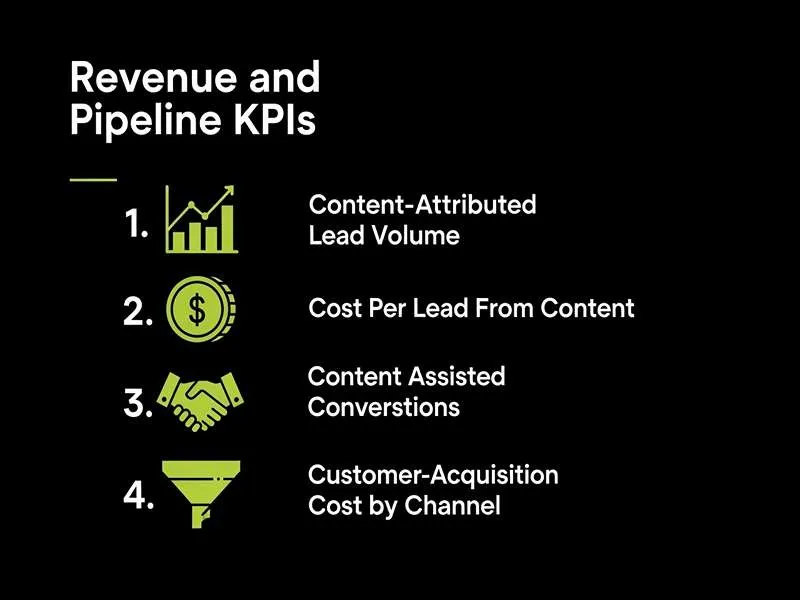
1. Content-Attributed Lead Volume
The most direct measure of content performance is the number of qualified leads traced back to a content interaction, whether through organic search, a downloaded guide, a webinar registration, or a blog CTA click.
Accurate tracking requires GA4 source tracking, UTM parameters on all distribution links, and CRM integration that records how each contact first engaged with the business. Without this infrastructure in place, content lead attribution is guesswork.
UAE Benchmark: 10 or more qualified leads per month at the 6-month mark. 30 to 50 leads per month by month 12 for an actively managed program.
2. Cost Per Lead From Content
Monthly content investment divided by leads generated produces a cost-per-lead figure that can be compared directly against paid search or paid social CPL. Research confirms content marketing produces 3x more leads at 62% lower cost than traditional outbound advertising.
In the UAE, where PPC clicks in real estate, finance, and healthcare can cost AED 50 to AED 200 per click, content-generated leads at a fraction of that cost represent a compelling return on investment argument for any UAE business owner.
3. Content-Assisted Conversions
Not every piece of content produces a direct conversion. But content frequently plays a critical role across a multi-touch buyer journey that eventually results in a sale. A prospect might read a blog post, download a guide, attend a webinar, and then, six weeks later, submit an inquiry. If attribution only credits the last touch, all earlier content interactions appear to have generated zero value.
Assisted conversion reports in GA4 and most CRM platforms reveal the full commercial contribution of content across the entire buyer journey. This metric is especially important for justifying early-stage content investment to UAE business owners who do not see immediate lead generation from awareness-level content.
4. Customer Acquisition Cost by Channel
Customer Acquisition Cost measures total investment per new paying customer through the content channel, including production costs, distribution, and sales time. Comparing content CAC against paid advertising CAC over a 12-month period reveals the true financial efficiency of content as a growth channel.
Skills Heaven tracks CAC by channel for UAE clients over rolling 12-month periods. The data consistently shows content marketing delivers lower CAC after the 6-month maturation period, even in markets where paid channels appear more cost-efficient in the early months before organic reach compounds.
Tier 2: Engagement and Conversion KPIs
5. Organic Search Traffic and Keyword Rankings
Organic traffic is the primary long-term distribution KPI for content marketing. Sustained growth in organic visitors signals that the content strategy is building topical authority and that Google is rewarding the website with improved rankings for target keywords.
Google holds over 98% of UAE search engine market share, which makes Google rankings the only organic search rankings that matter for UAE content programs.
Skills Heaven tracks keyword positions separately for English and Arabic content, reporting on ranking movement monthly with year-over-year comparisons that show the compounding effect of consistent content investment.
UAE Benchmark: 20 to 40% month-over-month organic traffic growth in months 3 to 6, stabilizing into steady growth as domain authority accumulates.
6. Engaged Sessions and Time on Page
GA4 defines an engaged session as one lasting more than 10 seconds, involving a conversion event, or including two or more page views.
A visitor who spends 45 seconds on a page and bounces has consumed almost no content and is unlikely to convert. A visitor who reads for 4 minutes and clicks a CTA is a genuinely warm lead.
UAE Benchmark: Target an engaged session rate of 55% or higher. Average time on page for long-form UAE educational content should reach 3 to 5 minutes. Below 2 minutes for long-form content points to a topic-audience mismatch or content quality issue.
7. Email Engagement Rate
For UAE businesses distributing content through email newsletters, open rate, click-through rate, and click-to-open rate are the core KPIs to monitor. UAE email audiences average a 28% open rate, above the global average of 21%.
One important caveat: Apple Mail Privacy Protection artificially inflates reported open rates for approximately 50 to 60% of recorded opens. For English-speaking expat audiences, click-through rate and click-to-open rate carry more reliable signals than open rate alone.
UAE Benchmark: 25 to 30% open rate minimum. 3 to 5% CTR on average, with 8% or above considered excellent performance.
8. Social Media Engagement Depth
Standard social metrics like likes, shares, and follower growth belong in Tier 3. The Tier 2 social KPIs that actually matter are comment sentiment, save rate, DM shares, and profile visit rate. These indicate genuine content resonance rather than passive scroll-by interaction.
In the UAE, where Instagram reaches 67.8% of the population and TikTok reaches 123.1% of adults, social platforms are meaningful content distribution channels. But with organic reach on Facebook averaging 1.37% and Instagram ranging from 1.52 to 2.58%, engagement depth matters far more than reach volume as a measure of content quality.
9. Backlink Velocity and Domain Authority Growth
Every quality backlink earned from another website transfers search authority to the publishing domain. Over time, a UAE content program that consistently produces original research, data-driven guides, and authoritative educational content will accumulate domain authority that makes every subsequent piece rank faster and higher.
Backlink velocity, meaning the rate of new quality links earned per month, is a reliable leading indicator of content quality and distribution effectiveness.
Skills Heaven monitors backlink velocity using Ahrefs and SEMrush, identifying high-performing content pieces for increased production investment and flagging underperformers for strategic review.
Tier 3: Reach and Visibility KPIs
These metrics provide useful context but should never function as primary success indicators:
- Total website sessions across all channels
- Social media reach and impressions
- Social media follower growth
- Email list growth rate
- Total content pieces published
- Brand search volume over time
An increase in impressions without a corresponding lift in engaged sessions, lead volume, and conversion rate is not a result. It is a distribution exercise that proves nothing about commercial performance.
UAE Content Marketing KPI Benchmarks at a Glance
| KPI | UAE Target Benchmark | Review Frequency |
|---|---|---|
| Content-attributed leads | 30 to 50 leads per month (month 12+) | Monthly |
| Cost per lead from content | 50 to 70% lower than paid CPL | Monthly |
| Organic traffic growth | 20 to 40% MoM (months 3 to 6) | Monthly |
| Engaged session rate | 55%+ of total sessions | Monthly |
| Email open rate | 25 to 30% minimum | Per campaign |
| Email CTR | 3 to 5% average; 8%+ excellent | Per campaign |
| Average time on page | 3 to 5 minutes for long-form content | Monthly |
| Keyword ranking growth | 5 to 15 new top-10 rankings per month | Monthly |
| Backlink velocity | 10+ quality links per month at month 6 | Monthly |
| Lead-to-opportunity rate | 15 to 25% for content leads | Monthly |
Building the Right Tracking Infrastructure
Google Analytics 4 is the foundational platform for UAE website performance measurement. Proper configuration includes enabling enhanced measurement for scroll depth, outbound clicks, file downloads, and video engagement.
Setting up conversion events for form submissions, phone calls, WhatsApp initiations, and lead magnet downloads; and creating separate audience segments for English and Arabic visitors to allow bilingual performance comparison.
CRM Integration is what connects content activity to revenue. GA4 shows what visitors did on the website. CRM data shows how many of those visitors became paying customers.
Without this integration, the relationship between content investment and closed revenue cannot be demonstrated with precision. Skills Heaven integrates GA4 with HubSpot, Salesforce, or Zoho for UAE clients depending on the system already in use.
Google Search Console and Keyword Tracking provide data on which keywords the website ranks for, at what position, and how many clicks each generates.
Combined with SEMrush or Ahrefs, this shows exactly how the content program is building organic search value over time and which pieces are generating the most return.
Four KPI Mistakes UAE Businesses Consistently Make
These four KPI mistakes should not be ignored by businesses in the Middle East.
- Tracking too many metrics. Monitoring 25 different figures produces reporting overload that paralyzes decision-making. A focused set of 5 to 7 KPIs tied directly to revenue and lead generation, with secondary metrics reviewed quarterly rather than monthly, produces far better strategic clarity.
- Using a 30-day attribution window for long sales cycles. B2B sales cycles in the UAE typically span 3 to 9 months in sectors like real estate, enterprise software, and professional services. Measuring content performance against a narrow 30-day window systematically undercounts content’s commercial contribution for these businesses.
- Aggregating English and Arabic performance. A business whose English content generates 80% of leads and Arabic content generates 20% needs to see that split clearly to make informed investment decisions. Hiding it in a combined average produces a single misleading number and erases the strategic clarity needed to act on it.
- Treating social vanity metrics as business KPIs. Follower count and post likes are not business outcomes. Engaged sessions, lead volume, and content-assisted conversion rates are. Reporting on the former while ignoring the latter creates a false picture of program health.
Skills Heaven builds complete KPI measurement frameworks for UAE content marketing clients, covering initial analytics and CRM configuration, monthly performance reporting with strategic commentary, and quarterly reviews where data findings directly shape the content plan for the next quarter.
If your current content program is measured in page views and social media likes rather than leads and pipeline, the measurement framework is the problem. And it can be fixed.
Frequently Asked Questions
What are the most important content marketing KPIs for a UAE business to track?
Content-attributed lead volume, cost per lead from content, and content-assisted conversion rate are the three metrics that connect content activity most directly to business revenue.
How long does it take for content marketing KPIs to show meaningful improvement in the UAE?
Engagement KPIs respond within 2 to 4 weeks of publishing improved content. Organic traffic and keyword rankings take 3 to 6 months to show significant movement. Lead generation takes 4 to 8 months to reach meaningful volume.
Should UAE businesses use a separate KPI framework for Ramadan content?
Yes. Content performance during Ramadan should be benchmarked separately because audience behavior, engagement timing, and conversion patterns all shift significantly.
What tools should UAE businesses use to track content marketing KPIs?
The essential stack includes Google Analytics 4, Google Search Console, SEMrush or Ahrefs for keyword ranking data, a CRM platform such as HubSpot or Zoho for lead attribution, and the native analytics tools of each social and email platform used for distribution.

Wali Shah is the Founder and CEO of SkillsHeaven, a digital growth agency specializing in Local SEO, Google Ads, and conversion-focused website development. With over 8+ years of experience, he has helped scale 170+ businesses, including 93+ limousine companies globally, by building structured, lead-generating digital systems. His expertise spans local search optimization, paid media strategy, and high-performance website development, all aligned with measurable business growth. Known for a data-driven and ethical approach, Wali focuses on creating scalable marketing systems that increase visibility, generate qualified leads, and drive long-term revenue for service-based businesses.