Email marketing is consistently described as the highest-ROI channel in digital marketing. That claim is backed by global data, but the question UAE business owners and marketing managers ask more specifically is: does it work here, in this market, with this audience?
This guide answers that question directly. It covers what email marketing ROI looks like in the UAE context, what benchmarks to use, what makes the UAE audience respond differently than global averages, and what strategies have produced documented results for businesses in Dubai, Abu Dhabi, and across the Emirates.
There are no estimates in the statistics used here. Every data point is sourced from research published between 2024 and 2026.
Understanding Email Marketing ROI: The Global Baseline
Before examining the UAE specifically, it is important to understand the global performance data that establishes why email marketing deserves investment in the first place.
Email marketing generates between $36 and $40 for every dollar spent, according to multiple industry research sources including Omnisend and Litmus. That translates to a return of 3,600% to 4,000% on investment, which outperforms most other digital marketing channels by a significant margin. For Omnisend’s US merchant base specifically, the average ROI reached $76 for every dollar spent.
The reason email produces these returns is structural. Email is a channel businesses own. Unlike social media, where algorithms determine reach and organic visibility can drop to under 5% of followers on some platforms, every email delivered reaches the recipient’s inbox directly. The audience relationship belongs to the brand, not to a platform.
In 2024, global email open rates rose for the fifth consecutive year, reaching 30.7% on average for campaigns and 38% for automated emails. Automated emails also drove 37% of all email-generated sales in 2024 despite representing only a fraction of total sends.
What Email Marketing ROI Looks Like in the UAE Specifically
The UAE digital market has characteristics that make email marketing perform differently than the global average, and in several cases, stronger.
Higher-Than-Average Open Rates
According to regional studies cited by Pella Global and Datamysite, email open rates in the UAE average between 25% and 30%, which is consistently higher than the global average for campaign emails.
The explanation lies in the composition of the UAE audience. Corporate employees, students, freelancers, international expatriates, and government workers all rely heavily on email as a primary communication channel in both professional and personal contexts.
Email delivers returns ranging from AED 20 to AED 120 per dirham spent for UAE businesses, according to documented benchmarks from regional marketing data. That range reflects the significant variation between campaigns that use basic bulk sending versus those that leverage segmentation, automation, and personalization.
Mobile-First Consumption
The UAE has among the highest mobile internet penetration rates globally. According to Statista data from 2024, 58% of global email opens happen on mobile devices, and in the UAE that number trends higher due to mobile-first consumption habits among the population.
This means email marketing in the UAE that is not optimized for mobile is structurally underperforming before a single subject line is tested.
Multicultural Audience Complexity
The UAE is home to over 200 nationalities. A single email list for a UAE business may contain recipients who prefer English, Arabic, Hindi, Tagalog, or other languages. This is not a nuance that can be ignored.
Skills Heaven recognizes that audience complexity is one of the defining challenges of UAE email marketing, and it is also one of the greatest opportunities. Businesses that segment by language and cultural preference consistently outperform those sending a single version to their entire list.
The Role of Automation in UAE Email ROI
The most significant gap between businesses achieving strong email ROI and those seeing average results is not in the quality of their creative or the frequency of their sends. It is in whether they use automation effectively.
Globally, automated emails accounted for just 2% of total email sends in 2024 but drove 30% of all email-generated revenue, earning 16 times more per send than scheduled campaign emails, according to Omnisend research.
This ratio is not unique to Western markets. It reflects the fundamental advantage of behavioral triggering over broadcast messaging.
Welcome Sequences
Automated welcome emails in e-commerce had a conversion rate of nearly 3% in 2024 globally. For UAE businesses, the welcome sequence is particularly important because it sets the tone for how a brand communicates with a culturally diverse subscriber base.
A real estate firm in Dubai that sends a personalized welcome email in both English and Arabic, referencing the subscriber’s stated property interest, immediately differentiates itself from competitors using generic broadcasts.
Abandoned Cart Recovery
Automated cart abandonment emails achieved approximately 2% conversion rates globally in 2024. In the UAE e-commerce market, which is on track to reach $17 billion by 2025, even a fractional improvement in cart recovery rates produces significant revenue impact.
The most effective cart abandonment sequences in the UAE market include culturally timed follow-ups, with the Ramadan period requiring adjustments to messaging tone and timing.
Behavioral Trigger Sequences
Emails triggered by specific user actions, such as viewing a product page, downloading a guide, or attending a webinar, consistently outperform broadcast emails because they arrive when the recipient is already demonstrating interest.
Skills Heaven, as an educational platform, uses content downloads as behavioral triggers to segment subscribers by topic interest and deliver follow-up content sequences tailored to each learning focus area.
Segmentation: Why UAE Email Lists Cannot Be Treated as Homogeneous
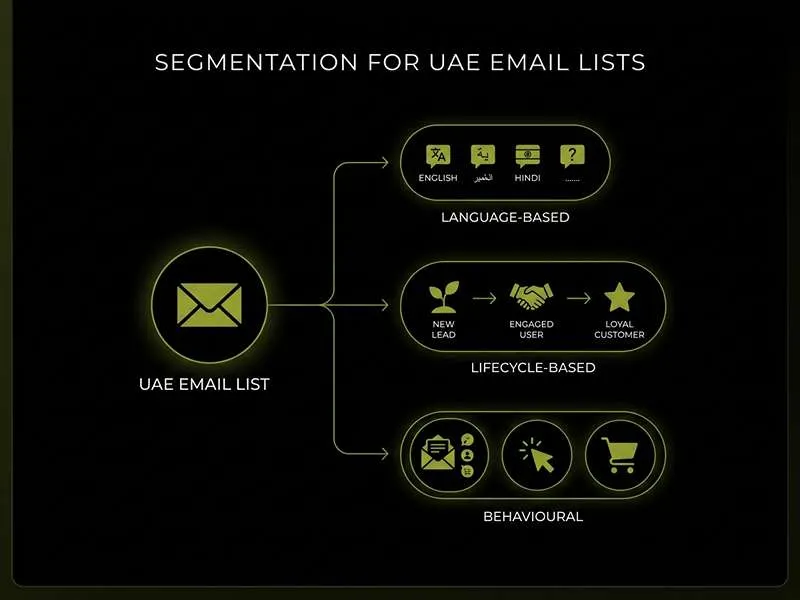
Segmentation is the practice of dividing an email list into sub-groups based on shared characteristics and sending each group content that is relevant to their specific profile. In most markets, segmentation improves performance. In the UAE, it is mandatory for strong ROI.
Studies cited by Digidesire show that 80% of consumers globally are more likely to purchase from brands that deliver personalized experiences. In the UAE specifically, where multicultural audiences expect contextual relevance rather than generic messaging, this percentage is likely higher.
A single email campaign sent to a list that includes UAE nationals, South Asian expats, and Western professionals without segmentation will underperform all three segments.
Language-Based Segmentation
Bilingual campaigns in English and Arabic often outperform English-only campaigns in the UAE for real estate, healthcare, government services, and financial products.
Arabic campaigns sent by UAE companies should use natural, culturally relevant language rather than software translation. The distinction matters to Arabic-speaking recipients and affects both open rates and trust.
Lifecycle-Based Segmentation
Segmenting by where a subscriber sits in the customer lifecycle, new lead, active buyer, lapsed customer, or long-term advocate, enables messaging that is appropriate to the relationship. A lapsed customer in Dubai who has not purchased in six months should not receive the same email as someone who purchased last week. Email marketing platforms like Mailchimp, HubSpot, and ActiveCampaign all support lifecycle segmentation, and UAE businesses using these platforms have access to the same tools as global brands.
Behavioral Segmentation
Behavioral segmentation groups subscribers by what they have done: which pages they visited, which emails they opened, which products they browsed, and which offers they clicked. Behavior-based and lifecycle-driven segmentation significantly outperforms generic campaigns and directly impacts revenue and engagement, according to Digidesire’s analysis of UAE email marketing best practices.
Personalization in UAE Email Marketing: Beyond First Names
Personalization in modern email marketing extends far beyond inserting a recipient’s first name into a subject line. True personalization involves delivering content that reflects the individual’s demonstrated interests, position in the buying journey, language preference, and cultural context.
Brands using AI-driven personalization report up to 42% higher revenue, with click-through rates exceeding 13%, according to research from the email marketing ROI analysis published by verified.email. This lift alone can improve overall email ROI by nearly 20%.
For UAE businesses, personalization has an additional cultural dimension. Acknowledging events like Eid Al Fitr, Eid Al Adha, UAE National Day, and Ramadan in relevant communications is not just good marketing. It signals that the brand understands and respects the audience’s cultural calendar. A UAE-based real estate firm that sends a personalized Eid greeting alongside a financing offer, customized in both Arabic and English for appropriate segments, does something a generic global email template cannot replicate.
Skills Heaven recommends that UAE businesses build personalization into their email platform setup from day one, including language preference fields, cultural interest indicators, and lifecycle stage tagging, rather than attempting to retrofit personalization onto an existing undifferentiated list.
Timing and Frequency: UAE-Specific Considerations
The optimal timing of email sends in the UAE differs from global recommendations because of the UAE’s distinct workweek and cultural calendar.
Workweek Timing
The UAE workweek runs from Monday to Friday. Research cited by regional email marketing practitioners including Infobahn Consultancy and Meerastech indicates that emails sent mid-morning on weekdays, typically between 9am and 11am, perform best for UAE business audiences.
Early evening sends, around 6pm to 8pm, also perform well for consumer-facing campaigns, as this is when many UAE residents check personal email after work.
Ramadan Adjustments
During Ramadan, email behavior shifts significantly. Open rates often rise after sunset, when Iftar is completed and recipients turn to devices. Campaigns that account for this timing shift and adjust content to reflect the spirit of Ramadan consistently outperform those using standard schedules.
The tone of communications during this period should reflect cultural sensitivity, with promotional messaging balanced against community and value-focused content.
Frequency
Weekly or biweekly email frequency works for most UAE audiences, according to regional practitioners. Sending too frequently risks elevated unsubscribe rates and spam complaints, which damage sender reputation and reduce future deliverability.
The UAE’s Anti-Spam Law requires clear consent mechanisms and easy unsubscribe options in all commercial emails, making frequency discipline both a strategic and legal requirement.
Email Marketing Benchmarks UAE Businesses Should Track
| Metric | Global Benchmark (2024-25) | UAE Context |
| Average Open Rate (Campaign) | 30.7% | 25-30% (often exceeds global avg) |
| Automated Email Open Rate | 38% | Higher with bilingual triggers |
| Average Bounce Rate | 2.33% (ideal: below 2%) | List hygiene critical in UAE |
| Click-to-Conversion Growth (2024) | +27.6% YoY | Mobile-optimized CTAs amplify this |
| Global Average ROI per $1 spent | $36 to $40 | AED 20-120 per dirham (varies by strategy) |
How UAE Businesses Can Build Quality Email Lists
The quality of an email list is the most important variable in email marketing ROI. A list of 5,000 highly engaged, segmented subscribers will consistently outperform a list of 50,000 unqualified contacts.
In the UAE, where the Anti-Spam Law prohibits unsolicited commercial email and requires clear opt-in consent, list quality is also a compliance requirement.
Permission-Based List Building
The foundation of UAE-compliant email marketing is explicit opt-in consent. Every subscriber on a UAE business email list must have actively agreed to receive marketing communications. This means avoiding purchased lists entirely and focusing on building audiences through lead magnets, gated content, event registrations, website sign-up forms, and in-store opt-in programs.
Lead Magnets That Work for UAE Audiences
Effective lead magnets for UAE audiences include practical guides on topics with high local search demand, free consultations for service businesses, exclusive discount codes for retail and e-commerce, webinar invitations targeting specific professional segments, and property market reports for the real estate sector.
The lead magnet should be specific enough to qualify the subscriber as a relevant prospect and general enough to attract sufficient volume.
Zero-Party Data Collection
Zero-party data refers to information that customers intentionally share with a brand. Rather than generic pop-ups asking only for an email address, leading UAE brands now use preference forms that allow subscribers to indicate their language preference, topic interests, budget ranges, and communication frequency preferences at the point of sign-up.
This data enables accurate segmentation from the first email onward.Skills Heaven applies this principle in its own audience development, asking new subscribers to indicate their learning focus and experience level so that content sequences can be calibrated from day one rather than defaulting to a generic nurture path.
The WhatsApp Integration Factor in UAE Email Strategy
One element of UAE email marketing that has no direct equivalent in most global markets is the integration of WhatsApp as a companion channel.
The UAE has one of the highest WhatsApp penetration rates in the world, and for many businesses in the region, customer relationships that begin through email frequently move to WhatsApp for ongoing communication.
Leading UAE email marketing strategies now include WhatsApp CTAs alongside traditional buttons. Phrases like Chat on WhatsApp perform particularly well in the UAE context, according to regional practitioners. The most effective approach treats email and WhatsApp as sequential channels: email for initial engagement and educational content delivery, WhatsApp for direct customer service, offer fulfilment, and conversion support.
Skills Heaven notes that this integration is not a replacement for email strategy. It is an extension of it, creating a connected customer experience that reflects how UAE consumers actually prefer to interact with brands across different stages of the buying journey.
Measuring Email Marketing ROI: The Metrics That Matter
The measurement challenge in email marketing is not access to data. It is knowing which data points actually indicate ROI versus which ones produce a satisfying-looking dashboard with no business relevance.
Revenue Attribution
The most meaningful metric is revenue directly or indirectly attributed to email campaigns. This requires integration between your email platform and your sales or e-commerce system. Without this connection, you cannot distinguish between traffic that came from email and converted and traffic that came from other channels.
Customer Acquisition Cost from Email
Calculating the cost to acquire a customer through email, by dividing total email investment by new customers gained through that channel, enables comparison against other acquisition channels. Content marketing broadly, including email, costs 62% less than traditional marketing while generating three times more leads, according to Clearscope research.
List Growth Rate
A healthy email list grows faster than it shrinks. Tracking net list growth rate, accounting for both new subscribers and unsubscribes, indicates whether your list-building activities are outpacing churn. A declining list indicates that acquisition is failing or that unsubscribe rates are unusually high.
Email-Influenced Pipeline
For B2B businesses, the most accurate measure of email ROI is pipeline influenced by email, meaning deals in progress where at least one email touchpoint occurred in the buyer’s journey. Multi-touch attribution models, available in HubSpot and similar platforms, enable this analysis. Top-performing B2B organizations achieve email-to-SQL conversion rates of 50% or more.
Common Reasons UAE Email Campaigns Underperform
Several consistent patterns appear in UAE email campaigns that fail to deliver expected ROI, and most of them are avoidable with better strategy rather than better tools.
- Using purchased or rented lists is the single most common cause of low email performance in the UAE. Purchased lists contain contacts who have never engaged with the brand and often generate high bounce rates, spam complaints, and low open rates that damage sender reputation. Once sender reputation is damaged, deliverability suffers for all subsequent campaigns, including those sent to legitimate subscribers.
- Sending the same content to an entire undifferentiated list treats a complex, multilingual, multicultural audience as if it were homogeneous. In the UAE, this is especially counterproductive. A single campaign sent simultaneously to Emirati nationals, South Asian expats, and Western professionals without segmentation will produce low relevance scores for all three groups.
- Ignoring mobile optimization means structuring emails for desktop display in a market where the majority of opens happen on smartphones. Layouts that require horizontal scrolling, images that do not load efficiently, and CTA buttons that are too small to tap reliably all reduce conversion from mobile.
- Measuring only open rates creates a false sense of success. An email can have a high open rate and deliver zero revenue if the content does not engage, the offer is irrelevant, or the landing page does not convert.
Skills Heaven emphasizes this point particularly for educational contexts, where high open rates on content emails can mask poor conversion into actual course enrollment or service engagement.
Conclusion
The data on email marketing ROI in the UAE is clear. This channel consistently outperforms alternatives on return per dirham invested, direct inbox access, audience ownership, and conversion reliability.
The businesses generating the strongest results are not doing anything fundamentally different from global best practice. They are applying that best practice with cultural intelligence specific to the UAE context.
Skills Heaven, as an educational platform serving UAE and regional audiences, applies these principles directly. Email marketing is not a broadcast channel in this market. It is a precision tool for building trust with a complex, multilingual, high-expectation audience. When built correctly, it delivers compounding returns that paid advertising cannot replicate.
The businesses that understand this distinction are the ones whose email lists become one of their most valuable business assets. For brands still treating email as an afterthought, the data in this guide is an invitation to reconsider that position.
Frequently Asked Questions
What is a good email open rate for UAE businesses?
Email open rates in the UAE average between 25% and 30% for campaign emails, which is generally higher than the global average of 30.7% for overall categories. Automated emails consistently outperform campaigns, with open rates reaching 38% globally and often higher when using behavioral triggers and bilingual subject lines.
Is email marketing still effective in the UAE in 2025?
Yes. Over 70% of UAE consumers still prefer receiving promotions via email, according to regional marketing research. Email marketing consistently delivers higher ROI than social media advertising in the UAE because it reaches audiences directly without algorithm interference and allows precise personalization for a complex multicultural market.
How often should UAE businesses send marketing emails?
Most regional practitioners recommend weekly or biweekly email frequency for general audiences. B2B audiences in the UAE often respond better to biweekly sends with higher content quality. E-commerce businesses benefit from more frequent sends during peak commercial periods like Ramadan and UAE National Day, provided that the content is relevant and the list is well-segmented.
Do Arabic emails perform better than English emails in the UAE?
For audiences that prefer Arabic, yes. Bilingual campaigns combining English and Arabic typically perform better than English-only campaigns across real estate, healthcare, and government-adjacent sectors. The key is natural Arabic language rather than software translation, which often fails to convey the appropriate tone and cultural nuance.
What is the average email marketing ROI in the UAE?
Global benchmarks show $36 to $40 return per $1 spent on email marketing. For UAE businesses, documented regional benchmarks indicate AED 20 to AED 120 return per dirham spent, with the higher end achievable through advanced segmentation, automation, and personalization strategies. Businesses using AI-driven personalization report up to 42% higher revenue from email.
What email marketing tools work best for UAE businesses?
Mailchimp, HubSpot, and ActiveCampaign are the most commonly used platforms among UAE businesses. The right choice depends on the complexity of your automation needs, the size of your list, your CRM requirements, and whether you need advanced multilingual or segmentation capabilities. Platform selection matters less than having a clear strategy that the platform is used to execute.

Wali Shah is the Founder and CEO of SkillsHeaven, a digital growth agency specializing in Local SEO, Google Ads, and conversion-focused website development. With over 8+ years of experience, he has helped scale 170+ businesses, including 93+ limousine companies globally, by building structured, lead-generating digital systems. His expertise spans local search optimization, paid media strategy, and high-performance website development, all aligned with measurable business growth. Known for a data-driven and ethical approach, Wali focuses on creating scalable marketing systems that increase visibility, generate qualified leads, and drive long-term revenue for service-based businesses.