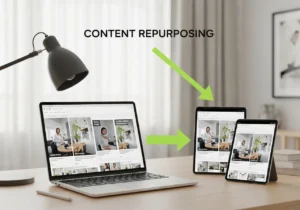
Content repurposing Strategy is the practice of adapting existing content into different formats and distributing it across additional channels to reach different audiences and extend the lifespan of the original investment. In the UAE market, where content production budgets are often stretched across English and Arabic requirements simultaneously, repurposing is not a secondary activity — it is the strategy that makes bilingual, multi-channel content programmes financially viable.
A single well-researched blog article can produce an Arabic-language equivalent, a LinkedIn post series, a short-form video script, a client-facing explainer document, and an email campaign sequence. Each of these reaches a different audience in a different context without the full cost of original production.
Why Most UAE Businesses Underuse the Content They Have Already Produced
Most businesses in this market treat content production as a linear process: research, write, publish, move on. The article goes live, receives whatever organic traffic it generates in its first weeks, and then becomes a static page that is rarely revisited, rarely promoted across other channels, and never adapted for the audiences and formats that the original production could have served.
This approach is commercially inefficient. A well-researched guide on seo for corporate event planning regulations in Dubai takes several hours to produce. Its organic search value compounds as Google indexes it and ranks it over months.
But its potential reach on LinkedIn — where event management professionals and corporate buyers scroll daily — is never activated. Its potential as a client-facing guide for prospects in the evaluation stage is never realised. Its Arabic adaptation for government event procurement research is never produced. The content investment is made once. The commercial return is a fraction of what the same investment could generate with a structured repurposing approach.
The most expensive content is the content you produce and then use only once. Repurposing is not recycling. It is extracting the full commercial value from every piece of content the business already has.
The Core Repurposing Framework for Dubai Businesses
An effective content repurposing strategy for the UAE market operates across three dimensions: format, channel, and language.
Format Repurposing
A long-form blog article contains enough structured information to produce multiple shorter-format content pieces. The key insight from a 2,000-word guide on DHA mandatory health insurance compliance can become a single LinkedIn post that links back to the full article.
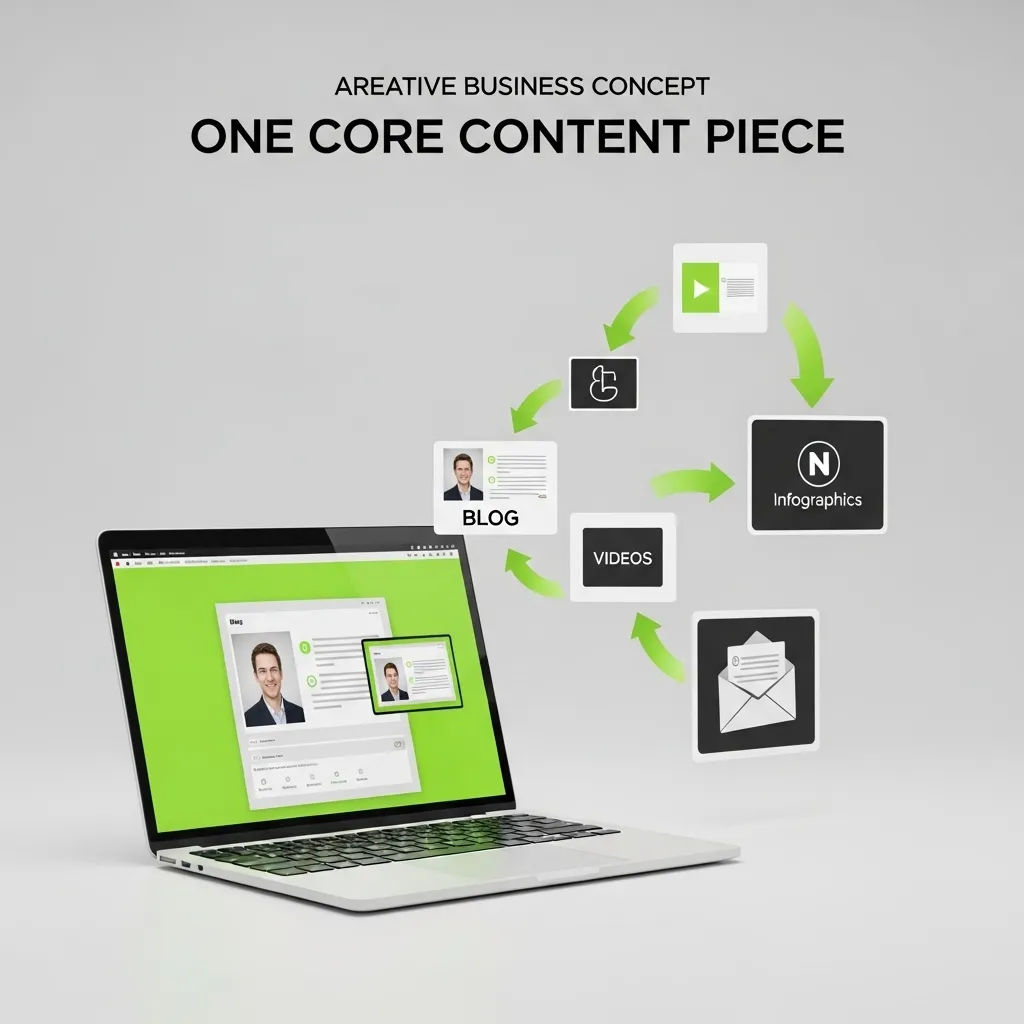
The step-by-step process section can become a numbered carousel post on Instagram or a short-form video script for a Reel or YouTube Short. The FAQ section can be extracted as a standalone FAQ page or used as the basis of a voice search-optimised content update. The statistics or key data points can become an infographic.
None of these adaptations require producing new research. They require restructuring existing information for different format constraints and consumption contexts. This multi-format approach is a core part of a modern digital marketing strategy that ensures content is not limited to a single platform or audience but works across search, social, and direct communication channels.
A LinkedIn post does not need to contain everything the article contains — it needs to contain enough to be valuable as a standalone piece and compelling enough to send interested readers to the full article.
Channel Repurposing
Different channels serve different stages of the buyer’s journey and reach different segments of the market. A blog article on the Skills Heaven website is discovered primarily through organic search — by buyers who are actively looking.
A LinkedIn post sharing the key insight from that article reaches buyers who were not searching — but who, upon seeing the insight, recognise its relevance to their situation. An email campaign to the existing subscriber list surfaces the article to people who have already expressed interest in the business but may not be actively searching at the moment of sending.
Each of these distribution actions extends the commercial reach of the original content investment without requiring original production. When repurposing content for UAE audiences, businesses should also align it with a strong local SEO strategy to ensure visibility in Google Maps, near-me searches, and location-based queries across Dubai and other Emirates.
The total cost of the repurposed distribution is a fraction of the original production cost. The incremental audience reached is often larger than the organic search audience the original article serves.
Knowing which channels to distribute repurposed content through is as important as the repurposing itself the right channel reaches the right buyer at the right stage. Our guide on Best Content Distribution Channels covers exactly which platforms deliver the strongest commercial reach in the UAE market.
Language Repurposing
This is the dimension most specific to the UAE market and most underutilised. An English-language article that has demonstrated commercial value — generating organic traffic and enquiries — is a validated topic brief for an Arabic-language equivalent. The research is done. The structure is proven.
The commercial intent has been confirmed by the English performance data. Commissioning a native Arabic adaptation rather than a translation is the most cost-efficient way to enter the Arabic search market with content known to be commercially relevant.
Skills Heaven recommends that every English content piece that generates consistent organic leads becomes an Arabic content brief. The Arabic version is written natively — not translated — but the structural template, the key questions addressed, and the commercial intent are informed by the English performance. This approach produces Arabic content that reaches the Arabic-speaking buyer community while leveraging the prior investment in topic research and structural development.
Repurposing Formats That Work in the UAE Market
- Blog to LinkedIn post series. Extract the three to five most commercially relevant insights from a long-form guide and publish each as a separate LinkedIn post over several weeks. Each post links back to the original article. This extends the article’s distribution timeline from its initial publication across an extended social media window.
- Blog to short-form video script. The FAQ section of any service guide is naturally scriptable. Each question and answer pair is a thirty to sixty second video. In a market where YouTube and Instagram Reels reach both English and Arabic-speaking audiences, video content derived from existing written guides extends reach to buyers who prefer visual formats.
- Guide to client-facing explainer. A detailed guide on a regulatory topic — DHA compliance, KHDA accreditation, customs clearance procedures — is commercially useful as a document shared directly with prospective clients during the evaluation stage. Reformatted as a clean, branded PDF, it serves as a trust-building leave-behind that references the business’s expertise.
- Article to email sequence. A long-form article can be broken into a four or five part email series delivered over several weeks. Each email covers one section of the original article and drives the reader to the full version. This approach maintains subscriber engagement while extending the distribution of content already produced.
- English to Arabic adaptation. As described above — every English content piece that generates commercial traffic is a validated topic for an Arabic-language equivalent. The Arabic version serves a different audience in a different search environment and should be treated as an original content investment, not a translation.
Measuring the Return on Repurposed Content
Repurposed content should be measured differently from original content. The original article is measured by its organic search performance — impressions, clicks, rankings, and lead attribution. Each repurposed format is measured by the metrics appropriate to its distribution channel.
LinkedIn post series: engagement rate, link click-through rate back to the original article, and new profile followers attributable to the content series. Video content: view count, watch time, and click-through to the website or contact page.
Email sequences: open rate, click-through rate to the full article, and new enquiries from email subscribers. Arabic equivalents: Arabic organic search impressions, Arabic traffic, and Arabic-language lead attribution in Search Console.
The cumulative commercial return from all repurposed formats, measured against the original production cost, typically far exceeds the return from the original publication alone. Skills Heaven includes repurposing planning in every content strategy — identifying which existing articles have the highest repurposing potential based on search performance, topic relevance, and format suitability.
KEY TAKEAWAYS
- Content repurposing extracts full commercial value from every piece already produced — without proportional additional production cost.
- Format repurposing converts long-form articles into LinkedIn posts, video scripts, infographics, and email sequences.
- Language repurposing turns validated English content topics into Arabic equivalents — the most cost-efficient route into the Arabic search market.
- Channel repurposing extends distribution beyond organic search to social media, email, and direct client-facing formats.
- Repurposed content should be measured by the metrics appropriate to its distribution channel — not by the same organic search metrics as the original article.
- Every English article generating commercial leads is a validated topic brief for an Arabic-language equivalent.
The Content Already on Your Website Is a Repurposing Asset Waiting to Be Used
Most businesses in Dubai that have been producing content for more than twelve months have a library of existing articles, guides, and service descriptions that have never been repurposed, adapted for Arabic audiences, or distributed across social and email channels. That library is not just historical content.
It is a catalogue of validated topic research, proven content structures, and confirmed commercial intent that a structured repurposing programme can activate at a fraction of original production cost.
Repurposing is not just an efficiency tactic — it is the content model that the future of content marketing in this market is moving toward. See The Future of Content Marketing in UAE to understand how repurposing fits into the broader content strategy evolution.
Skills Heaven identifies repurposing opportunities as part of every content strategy audit — reviewing existing content performance, identifying the highest-return repurposing actions, and integrating the language adaptation plan into the overall bilingual content strategy. The result is a content programme that generates more commercial return from less incremental investment rather than one that requires continuous original production to maintain momentum.
Want to get more commercial return from the content your business has already produced? Skills Heaven audits existing content libraries for repurposing opportunities and builds the bilingual adaptation plan in a free face-to-face session. Book a meeting today.
Frequently Asked Questions
What is content repurposing and why does it matter for UAE businesses?
Content repurposing is the practice of adapting existing content into different formats — video, social posts, email sequences, client documents — and distributing it across additional channels beyond its original publication. It matters for UAE businesses because it extracts additional commercial value from content already invested in, reaches different audience segments through different consumption formats, and — uniquely in this market — provides the most cost-efficient route into Arabic-language content by building on the topic research and structural work of existing English content.
How do I know which content is worth repurposing?
Start with content that is already generating organic traffic and leads. If a piece is producing commercial results in its original format, the topic is validated as commercially relevant. That validation is the most valuable input you can have when deciding where to invest repurposing effort. Content that has failed to generate organic traffic is a lower repurposing priority unless the distribution channel change — from organic search to LinkedIn, for example — addresses a different audience for the same topic.
Is translating English content into Arabic the same as content repurposing?
No. Machine translation of English content is not content repurposing and does not produce Arabic SEO value. True language repurposing involves commissioning native Arabic writers to produce an equivalent piece for the Arabic-speaking buyer community — using the keyword research, structural template, and commercial intent from the English original as a brief, but writing the Arabic version as an original piece for its specific audience. The result is content that ranks in Arabic search and converts Arabic-speaking buyers, not translated text that does neither.
How much of a content programme should be repurposed versus original?
There is no fixed ratio. The practical approach is to produce original research-backed content for the highest-priority keyword and audience targets, then extract maximum value from each piece through structured repurposing before moving to the next original production. A content programme that produces four high-quality original pieces per month and repurposes each across three to four formats generates more cumulative commercial return than one that produces twelve thin pieces and repurposes none.

M. Awais Khan is a Business Development and Digital Growth Strategist at SkillsHeaven, specializing in SEO, local search optimization, and performance-driven digital marketing. With experience supporting 100+ businesses, he develops and implements data-driven strategies that help companies increase online visibility, generate qualified leads, and drive sustainable revenue growth. His expertise spans Local SEO, Google Ads, social media marketing, and conversion-focused website optimization, ensuring every project is aligned with measurable business outcomes and long-term success.