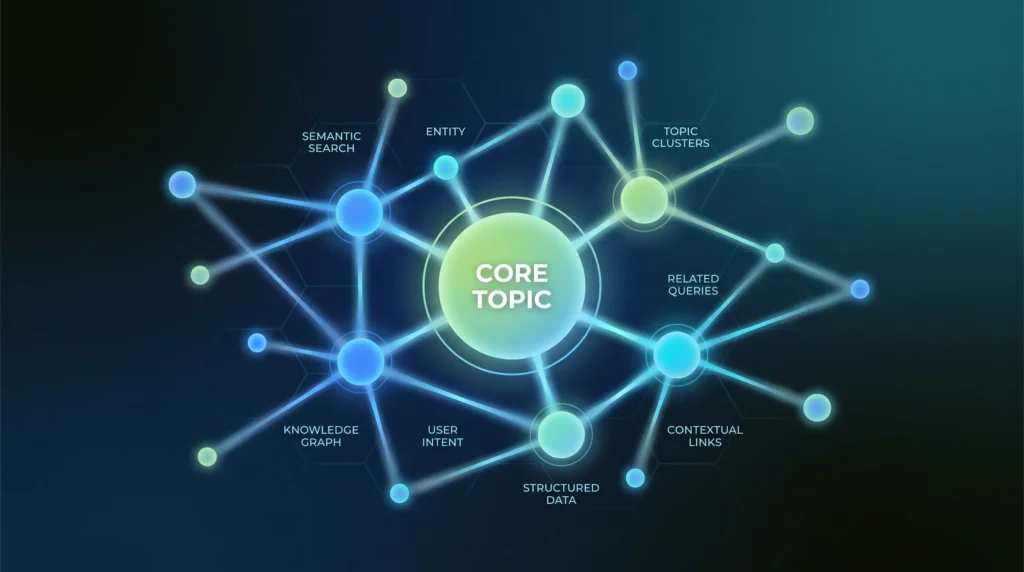
Semantic SEO is the practice of optimizing content for meaning and context, not just keywords. Google no longer matches search queries to pages word by word. It understands what users actually mean. That shift changed everything about how content needs to be written to rank.
Most pages targeting competitive queries are losing ground not because of bad links or slow load times. They are losing because Google has moved on from counting keywords, and their content has not caught up.
Semantic SEO fixes that.
What Is Semantic SEO?
Semantic SEO is the process of optimizing web content around topics, meaning, and entities rather than isolated keywords. It helps search engines understand the full context of your content. Google uses semantic understanding to match pages with user intent more accurately, which makes semantically rich content more likely to rank and appear in AI-generated answers.
Google used to work like a librarian matching your exact words to an index card. Today it works more like a subject expert who understands what you are asking, even when you phrase it differently each time.
That shift happened because of a fundamental change in how search engines process language. Keyword-based optimization told Google what words appeared on a page. Semantic optimization tells Google what a page is actually about.
The difference sounds small. The ranking impact is not.
Semantic Search vs. Traditional (Lexical) Search
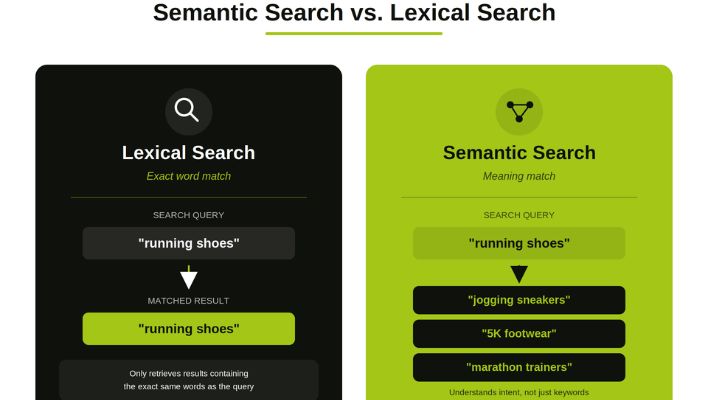
Lexical search matches the exact words in a query to the exact words on a page. Type “best running shoes,” and a lexical engine finds pages that contain those three words.
Semantic search goes further. It interprets the meaning behind the query. It understands that “best running shoes,” “top sneakers for jogging,” and “what shoes should I wear for a 5K” are all asking the same thing. Pages covering the topic thoroughly rank for all three, not just the one phrase they targeted.
The practical difference is this: lexical SEO rewards repetition. Semantic SEO rewards depth and relevance.
The Algorithms That Made Semantic SEO Non-Negotiable
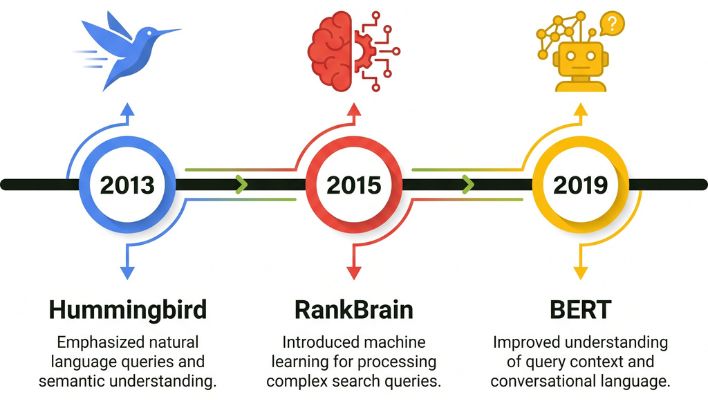
Three major algorithm updates pushed Google from lexical to semantic understanding. Each one raised the bar for what content needs to do to rank.
Google Hummingbird (2013) was the turning point. Before Hummingbird, Google processed queries by breaking them into individual words. Hummingbird enabled Google to process the full query as a single unit and understand conversational meaning. A question like “What is the closest coffee shop open right now” stopped being parsed as five separate keywords and started being read as a single intent.
RankBrain followed and added machine learning to the mix. It helped Google interpret queries it had never seen before, using patterns from past searches to make educated guesses about intent. This made it harder to rank by targeting obscure keyword variations and easier to rank by covering topics completely.
BERT (Bidirectional Encoder Representations from Transformers) deepened Google’s natural language processing capability. BERT reads words in context, both the words before and after each term in a sentence. This allowed Google to understand nuance, negation, and the relationships between words in a way it could not before.
Together, these three updates made one thing clear: Google rewards content that understands its subject, not content that repeats a phrase.
Is Entity SEO the Same as Semantic SEO?
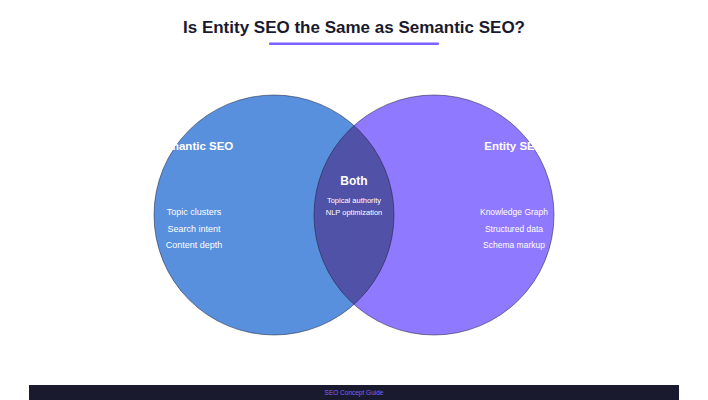
This question comes up constantly, and the answer matters for how you plan your content strategy.
Semantic SEO is the broader strategy. It covers how you structure content, build topic depth, align with user intent, and signal meaning to search engines across your entire site.
Entity SEO is a tactic within that strategy. It focuses specifically on people, places, things, and concepts that Google recognizes as distinct objects in its Knowledge Graph. Optimizing for entities means making sure Google can clearly identify what your content is about at an object level, not just a topic level.
Think of it this way. Semantic SEO is the framework. Entity SEO is one of the most powerful tools inside it.
Both matter. Neither replaces the other.
What Is Google’s Knowledge Graph and Why Does It Matter?
Google’s Knowledge Graph is a database of entities and the relationships between them. It launched in 2012 and gave Google the ability to store structured information about real-world objects: people, places, brands, events, and concepts.
When Google crawls your content, it tries to map what you have written to entities it already knows. The more clearly your content establishes its subject, the easier it is for Google to connect your page to relevant Knowledge Graph entries.
This has a direct ranking benefit. Pages that Google can clearly categorize tend to earn higher topical trust signals, appear more often in rich results, and get pulled more frequently into AI Overviews.
What Are Semantic Keywords and How Are They Different from LSI Keywords?
Semantic keywords are words and phrases that are conceptually related to your primary topic. They help search engines build a complete picture of what your content covers.
A page about “content marketing” that also discusses editorial calendars, audience targeting, content distribution, and conversion optimization signals deep topical knowledge. A page that just repeats “content marketing” fifteen times signals nothing useful.
The term LSI keywords (Latent Semantic Indexing) gets used often in SEO, but it is worth being precise. LSI is a document retrieval technique developed in the 1980s. Google does not use LSI as a ranking mechanism. What modern SEO calls “LSI keywords” are more accurately described as semantically related terms or co-occurring entities. The concept of using related vocabulary is sound. The technical label is outdated.
Use topic-relevant vocabulary throughout your content. Do it because it makes the content better and more complete, not because you are trying to trigger a specific algorithm.
How to Find Semantic Keywords for Your Content
Start with what Google already surfaces.
Run your primary keyword and scroll to the “People Also Ask” section. Every question there is a signal of what related topics users care about. The “Related searches” section at the bottom of the results page gives you another layer of topically connected terms.
Google Autosuggest reveals query patterns as you type. These are real searches from real users, organized by frequency. They show how people extend your primary topic into subtopics.
From a tools perspective, keyword research platforms that offer topic clustering and content gap analysis let you map the full semantic territory around a subject. The workflow is:
- Enter your primary topic
- Pull a broad keyword list
- Group keywords by shared intent and entity overlap
- Build content that covers each cluster, not each individual keyword
Keyword clustering is the bridge between semantic keyword research and actual content architecture.
Why Semantic Relevance Is the New Ranking Signal
Google’s ranking systems have shifted away from measuring individual page signals in isolation. Today, topical authority carries significant weight. A site that covers a subject completely, with clear entity relationships and consistent depth across related pages, earns more trust than a site with one strong page on a topic and nothing else around it.
Semantic relevance is what builds that authority. It is the degree to which your content covers the meaning, subtopics, entities, and relationships that Google associates with a query.
A high semantic relevance score, in practical terms, means:
Your content covers the primary topic and the surrounding subtopics. Your entities are clearly identified and contextually connected. Your language reflects how subject-matter-fluent writing actually reads. Your page satisfies not just the top-level query but the related questions users have next.
Pages that achieve this consistently earn featured snippets, appear in People Also Ask boxes, and get cited in AI-generated responses.
Semantic SEO and AI Overviews: What This Means for Visibility
Google’s AI Overviews pull content from pages that demonstrate clear topical authority and structured, trustworthy information. This is where semantic SEO and AI search visibility directly connect.
AI Overviews do not simply extract the first paragraph from the top-ranked page. They synthesize information across sources and prioritize pages where the content is well-structured, entity-rich, and directly answers specific sub-questions within a topic.
Semantically optimized content is structurally easier for AI systems to parse and attribute. Short declarative statements, clearly labeled sections, FAQ blocks with direct answers, and schema-marked content all increase the likelihood of being pulled into AI-generated responses.
This is not a future consideration. It is already affecting click-through rates and impression share for competitive informational queries right now.
How to Do Semantic SEO: A Practical Implementation Framework
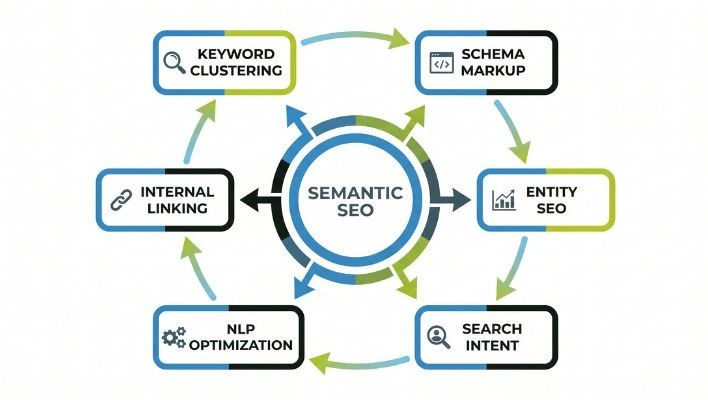
1. Build Topic Clusters, Not Keyword Lists
A topic cluster is a group of related pages that collectively cover a subject in depth. One pillar page covers the broad topic. Multiple supporting pages cover specific subtopics. Internal links connect them all.
This architecture does two things. It shows Google that your site has depth on a subject, not just one strong page. And it distributes topical authority from supporting pages back to the pillar, strengthening the entire cluster.
Start by mapping the full entity landscape around your topic. Identify the core concept, the related subtopics, the questions users ask, and the entities Google associates with the subject. Then assign each cluster of related content to a dedicated page.
2. Optimize for Search Intent at the Topic Level
Intent alignment is not just about choosing the right content format. It operates at the topic level too.
A query like “what is semantic SEO” is purely informational. A query like “semantic SEO services” is commercial. A query like “how to do semantic keyword research” is informational with an action orientation. Each one requires different content depth, structure, and call-to-action placement.
Within a topic cluster, each page should be built around the specific intent of its target query. Pillar pages typically serve informational intent. Supporting pages can serve more specific or transactional intents within the same cluster.
3. Use Semantic HTML to Reinforce Meaning
HTML structure is a signal. Heading tags (H1 through H3), paragraph tags, list elements, and semantic markup like article and section tags all help Google parse the hierarchy and relationships within your content.
Use one H1 per page. Use H2 tags for major topic sections. Use H3 tags for subtopics within those sections. Keep the heading hierarchy logical and consistent.
Avoid writing content where every paragraph is the same visual weight. Google’s natural language processing assigns more relevance weight to content that is clearly organized than to content that reads as an undifferentiated block of text.
4. Add Schema Markup and Structured Data
Schema markup from Schema.org provides explicit entity signals. It tells Google, in structured machine-readable format, exactly what your content is about.
For blog content, Article schema is the foundation. FAQ schema applied to your frequently asked questions section enables rich results directly in search and increases your content’s eligibility for featured answer boxes. HowTo schema works for instructional content. Author schema strengthens E-E-A-T signals.
Structured data does not directly guarantee rich results. It does make your content easier for Google to interpret and classify, which improves your odds significantly.
5. How to Use Semantic Analysis to Gather SEO Insights
This is where most content optimization efforts fall short. Finding semantic keywords is step one. Analyzing what your content is actually missing compared to what ranks is step two, and it is the more powerful step.
A semantic gap analysis works like this:
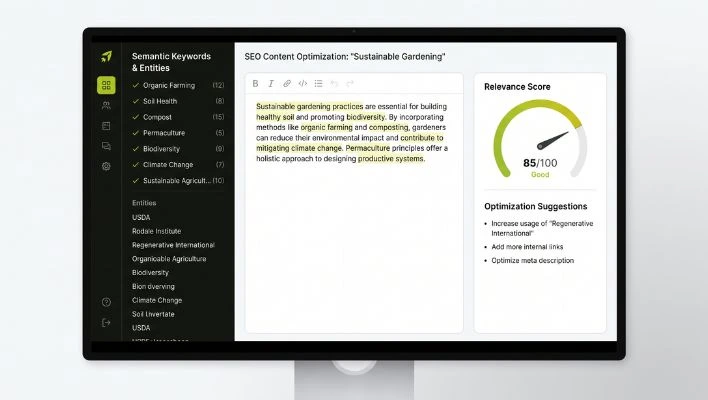
Take your target query. Pull the top-ranking pages. Run them through an NLP content analysis tool. Identify which entities, subtopics, and co-occurring terms appear consistently across top-ranking pages but are absent or thin in your own content. Those gaps are your optimization targets.
Content editing tools with NLP integration can score your draft against top-ranking pages and flag missing semantic elements in real time. The output is actionable: a list of topics, entities, and questions your content needs to address more thoroughly.
Use this analysis before publishing new content and when auditing existing pages that have lost ranking positions. Drops in ranking on semantically competitive queries are often caused by content that covered a topic adequately at one point but has since been overtaken by pages with greater entity coverage and depth.
6. Optimize Internal Linking for Semantic Relevance
Internal links carry two functions in semantic SEO. They pass PageRank between pages. And they pass topical relevance signals through the anchor text used.
When you link from a supporting page to a pillar page using anchor text that reflects the pillar’s primary topic, you reinforce the semantic relationship between those pages in Google’s understanding of your site.
Keep anchor text descriptive and natural. Avoid generic anchors like “click here” or “read more.” Use anchors that reflect the actual topic of the destination page. This practice strengthens entity associations across your content cluster and makes the cluster more cohesive as a topical unit.
When Semantic SEO Is (and Isn’t) the Right Approach
Semantic SEO delivers the greatest return on informational queries in competitive niches, queries where multiple subtopics exist, and content intended to rank in AI overviews or featured snippets.
It is the right approach when:
The query has significant informational depth. The topic has multiple related subtopics and entities. You are building long-term topical authority in a niche. The target query triggers AI Overviews, People Also Ask boxes, or featured snippets.
It may be more effort than necessary when
The query is purely transactional with minimal competition (a local service page in a small market, for example). The search intent is simple, and the user wants a direct answer with no context. The page targets a branded query where entity disambiguation is already established.
Calibrating your effort to query complexity saves time and keeps your content strategy focused on the work that actually moves rankings.
Semantic SEO Audit Checklist
Use this before publishing new content and when reviewing pages that have lost positions.
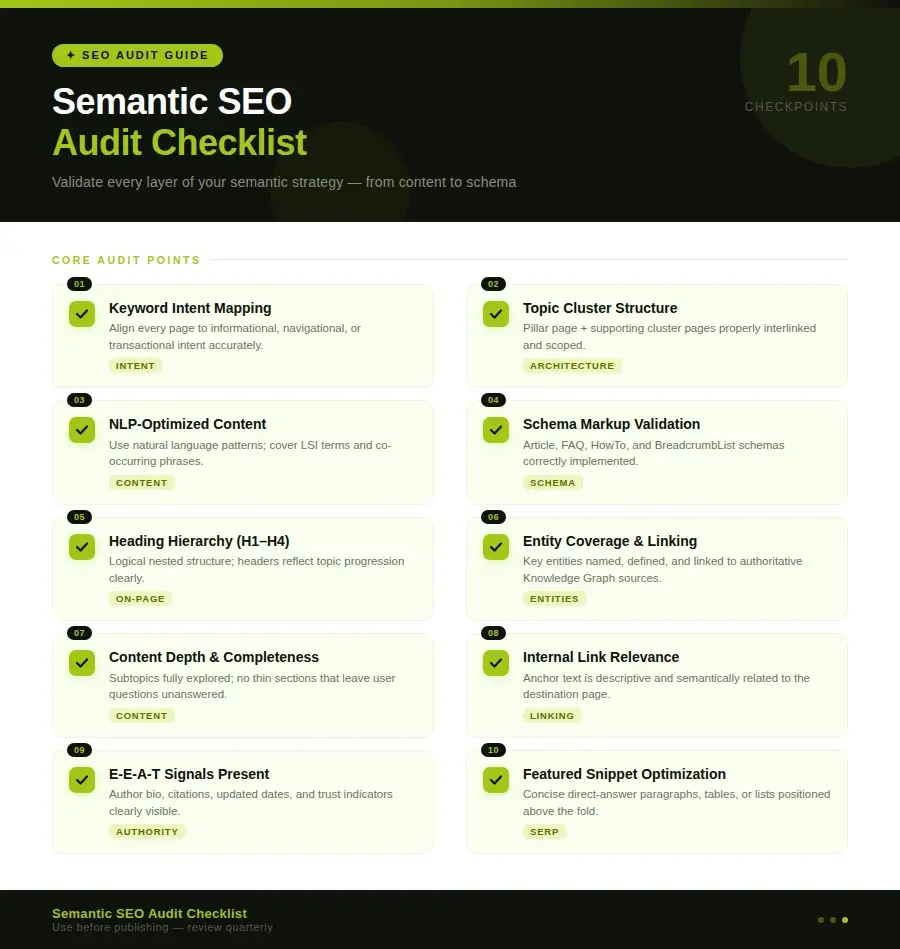
- Topic cluster completeness: Does this page link to, and receive links from, relevant supporting pages on related subtopics?
- Entity coverage: Have you clearly identified and covered the primary entities Google associates with this topic?
- Semantic keyword integration: Do semantically related terms appear naturally throughout the content without forced repetition?
- Search intent alignment: Does the content format, depth, and structure match what the target query actually demands?
- Schema markup: Is appropriate structured data (Article, FAQ, HowTo, Author) implemented and validated?
- Heading hierarchy: Is the HTML heading structure logical, with one H1 and a clear H2/H3 hierarchy?
- Internal linking: Do internal links to and from this page use descriptive, topic-relevant anchor text?
- NLP readability: Are sentences short, active, and clearly structured enough for both users and natural language processing systems to parse easily?
- FAQ coverage: Does the content address the real questions users ask around this topic, drawn from People Also Ask and related search data?
- Content freshness: Is the information current, with no outdated entity references or algorithm claims that no longer apply?
Frequently Asked Questions About Semantic SEO
What is the difference between semantic SEO and traditional SEO?
Traditional SEO focused primarily on keyword frequency, backlink volume, and on-page keyword placement. Semantic SEO focuses on meaning, topical depth, entity relationships, and search intent alignment. Both share technical foundations, but semantic SEO reflects how Google actually evaluates content today rather than how it did before 2013.
Is entity SEO the same as semantic SEO?
No. Semantic SEO is the broader strategy covering content structure, intent alignment, and topical authority. Entity SEO is a specific tactic within that strategy. It focuses on optimizing for the people, places, concepts, and things that Google stores in its Knowledge Graph. You can do semantic SEO without focusing heavily on entities, but combining both produces stronger results.
What are LSI keywords and how are they different from semantic keywords?
LSI (Latent Semantic Indexing) is a mathematical technique from document retrieval systems. Google does not use LSI as a ranking mechanism. Semantic keywords are the more accurate term for related vocabulary that helps search engines understand the full context of your content. Use topically relevant terms throughout your content. The underlying concept is valid even if the LSI label is technically imprecise.
How does Google’s Knowledge Graph affect semantic SEO?
The Knowledge Graph lets Google store structured information about entities and the relationships between them. When your content clearly covers recognized entities and their context, Google can classify your page more accurately. This improves topical trust signals, eligibility for rich results, and the likelihood of your content being cited in AI Overviews.
Do I still need to use keywords if I am doing semantic SEO?
Yes. Keywords remain the starting point for understanding what users search for. Semantic SEO does not replace keyword research. It expands it. You still target specific terms. You also build content that covers the full topic those terms represent, not just the exact phrase in isolation.
How does semantic SEO help with AI Overviews and LLM visibility?
AI Overviews synthesize information from pages with clear topical authority, well-structured content, and direct answers to specific sub-questions. Semantically optimized content is structurally easier for AI systems to parse. FAQ schema, clear heading hierarchies, short declarative answers, and thorough entity coverage all increase the probability of being cited in AI-generated search responses.
How do I organize keywords using semantic clustering?
Group keywords by shared search intent and entity overlap rather than surface-level similarity. Keywords that trigger similar results pages, reference the same entities, and satisfy the same user goal belong in the same cluster. Build one page per cluster rather than one page per keyword. This prevents keyword cannibalization and builds stronger topical signals around each target topic.
Will search engines eventually become purely semantic?
The direction is clear, but a hybrid model is more realistic than a purely semantic one. Exact keyword matching still plays a role in high-specificity queries, branded searches, and navigational intent. The balance continues to shift toward semantic and entity-based understanding, particularly as AI Mode and large language model integration become more central to how search results are generated and displayed.

M. Awais Khan is a Business Development and Digital Growth Strategist at SkillsHeaven, specializing in SEO, local search optimization, and performance-driven digital marketing. With experience supporting 100+ businesses, he develops and implements data-driven strategies that help companies increase online visibility, generate qualified leads, and drive sustainable revenue growth. His expertise spans Local SEO, Google Ads, social media marketing, and conversion-focused website optimization, ensuring every project is aligned with measurable business outcomes and long-term success.