

Most small businesses should spend between $1500 and $3,000 per month on SEO, depending on their industry, competition level, and growth goals. There isn’t one universal number that fits every business, but this guide breaks down exactly how to land on the right figure based on real benchmarks rather than guesswork.
What Determines How Much a Small Business Should Spend on SEO
There isn’t one fixed answer to how much a small business should spend on SEO, because the right figure depends on a handful of moving parts. Industry competition plays a huge role. A bakery competing for local foot traffic spends far less than a law firm or a real estate brand chasing high value leads. Website size and condition matter too. A five page site needs a fraction of the work that a five hundred page ecommerce catalog requires. Your growth stage also shapes the number. A brand new business validating its market spends differently than an established company defending market share.
As a starting benchmark, here’s how monthly SEO spend typically breaks down by business size:
Small businesses typically spend $500 to $2,500 per month on SEO for local visibility, $2,500 to $5,000 for regional or multi-location growth, and $5,000 plus when competing in high-value, high competition industries.
- Startups and very small local businesses: $500 to $1,500 per month
- Established small businesses targeting a city or region: $1,500 to $3,500 per month
- Growing small businesses with ecommerce or multi location needs: $3,500 to $7,500 per month
- Mid market companies scaling nationally: $7,500 to $15,000 per month
How to Calculate Your Own SEO Budget
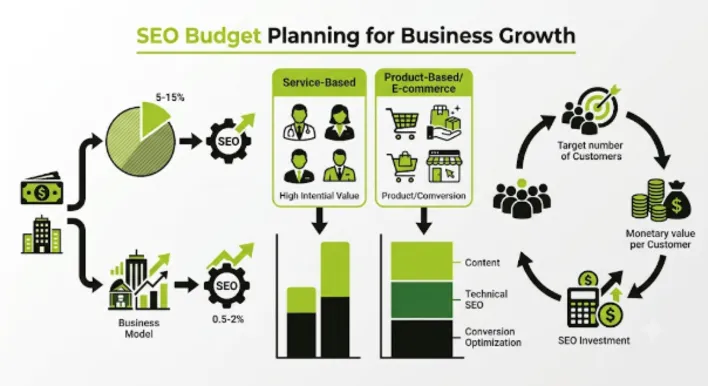
A simple rule many marketers use is allocating five to fifteen percent of your overall marketing budget to SEO, or roughly half to two percent of annual revenue if organic search is meant to be a primary growth channel. Service based businesses, where a single new client carries high lifetime value, generally benefit from leaning toward the higher end of that range. Product based and ecommerce businesses often spread their budget across content, technical SEO, and conversion optimization in roughly equal measure.
A practical way to think about the number is this: figure out what a new customer is worth to you, decide how many new customers you want from organic search each month, and work backward from there. This turns “how much should a small business spend on SEO” from a guessing game into a number tied directly to revenue.
What Small Businesses Can Learn From Enterprise SEO Strategies
Enterprise SEO teams operate at a different scale, often managing thousands of pages and dedicated specialists for technical SEO, content, and link building. Small businesses can’t replicate that scale, and they don’t need to, but several enterprise habits translate well to a smaller budget. Enterprise teams treat SEO as a long term asset rather than a short term campaign, and they track performance with the same rigor they apply to paid advertising. They also prioritize topical depth over thin, scattered content, focusing on fewer topics covered thoroughly rather than many covered lightly.
A small business can borrow this discipline without the enterprise price tag. Building a focused content hub around twenty to thirty core topics, maintaining clean technical SEO, and reviewing performance data every month brings enterprise level structure to a small business budget.

Can Small Businesses Compete With Big Brand SEO
Yes, small businesses can compete with big brand SEO, and in many cases they have a real advantage. Large brands often target broad, highly competitive keywords with enormous content libraries, while small businesses can win by going narrow and specific. Local intent, niche service pages, and highly targeted keywords give a small business room to rank where a national brand’s generic page simply doesn’t fit the searcher’s intent.
Speed is another advantage. A small business can publish a new page, update a service description, or respond to a fresh keyword trend in days, while larger organizations often move through layers of approval before a single page goes live. Combine that agility with strong local SEO signals, like Google Business Profile optimization and consistent NAP details, and a small business can regularly outrank far bigger competitors for the searches that actually bring in customers.
How Agencies Help Ecommerce Businesses With SEO
Ecommerce SEO carries its own complexity that goes beyond what a typical service business deals with. Agencies that work with ecommerce brands focus on product page optimization, category structure, duplicate content management across variants, schema markup for rich results, and site speed, since a slow checkout flow or poorly indexed product catalog quietly costs sales every day.
A good agency also builds a content layer around buying guides, comparison pages, and FAQ content that captures shoppers earlier in their search journey, before they’ve decided exactly what to buy. This is where SEO spend for an ecommerce business tends to land on the higher side of the small business range, since product catalogs scale the technical workload significantly compared to a standard service website.
Signs You’re Spending the Right Amount on SEO
A healthy SEO budget shows up in steady, measurable progress rather than overnight spikes. You should see your target keywords climbing in position over a three to six month window, organic traffic trending upward month over month, and a growing share of leads or sales attributed to organic search. If your current spend produces none of that movement after several months, the issue is usually scope or strategy rather than the dollar amount itself, and it’s worth reviewing what the budget is actually being used for.
Frequently Asked Questions
How much should a small business spend on SEO per month?
Most small businesses spend between $500 and $5,000 per month on SEO, with the exact figure depending on industry competition, website size, and growth goals.
Is SEO worth it for a small business?
Yes. Organic search consistently delivers a strong return over time, and unlike paid ads, the value of a well optimized page continues to compound long after the work is done.
What percentage of revenue should go toward SEO?
A common benchmark is half a percent to two percent of annual revenue, or five to fifteen percent of the total marketing budget.
How long does it take to see SEO results?
Most businesses begin seeing measurable movement within three to six months, with stronger, compounding results typically appearing between six and twelve months.

Wali Shah is the Founder and CEO of SkillsHeaven, a digital growth agency specializing in Local SEO, Google Ads, and conversion-focused website development. With over 8+ years of experience, he has helped scale 170+ businesses, including 93+ limousine companies globally, by building structured, lead-generating digital systems. His expertise spans local search optimization, paid media strategy, and high-performance website development, all aligned with measurable business growth. Known for a data-driven and ethical approach, Wali focuses on creating scalable marketing systems that increase visibility, generate qualified leads, and drive long-term revenue for service-based businesses.