
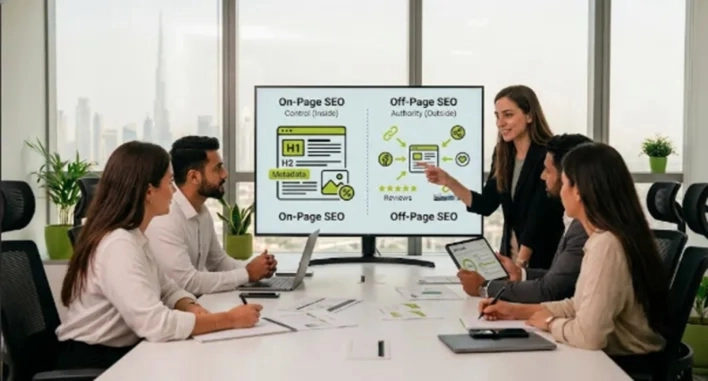
The difference between on page and off page SEO comes down to control. On page SEO covers everything you optimize directly on your website, like content, titles, and structure, while off page SEO covers everything that builds your site’s authority from outside sources, like backlinks and brand mentions. At Skill Heavens, we handle both sides of this equation for businesses in Dubai, and understanding the difference between on page and off page SEO is the first step to building a strategy that actually moves your rankings.
On Page SEO Explained
On page SEO is every adjustment you make directly to a webpage to help it rank and to give visitors a better experience once they land there. Because it lives entirely on your own site, you control every part of it. This includes writing content that matches what searchers are actually looking for, placing keywords naturally in titles and headings, structuring pages with clear H1, H2, and H3 tags, optimizing meta titles and descriptions, compressing images, and making sure the page loads fast on mobile devices.
Search engines read these signals to figure out what a page is about and whether it deserves to rank for a given query. A page with thin content and no clear structure struggles to compete, no matter how many other strengths the website has.
Off Page SEO Explained
Off-page SEO is everything that happens away from your website but still shapes how search engines and customers perceive it. The most well known piece of off page SEO is backlinks, where other reputable websites link back to your pages, signalling to search engines that your content is trustworthy and worth citing. But off-page SEO goes well beyond links. It also includes brand mentions across the web, guest contributions on industry sites, social media engagement, and the reviews customers leave on platforms like Google Business Profile.
Where on page SEO tells search engines what your page is about, off-page SEO tells them how much to trust it. A strong off page presence is often what separates two equally well-written pages competing for the same keyword, with the more trusted, more cited page winning the spot.
Which On Page Element Carries the Most Weight for SEO
Among all on-page elements, high-quality, search-intent-matched content carries the most weight for SEO. Search engines prioritise pages that thoroughly answer what a searcher is actually looking for, and every other on-page factor, from title tags to internal linking, exists to support that content rather than replace it. A page can have a perfect title tag and flawless formatting, but if the content itself doesn’t satisfy the query, it will rarely hold a strong position for long.
That said, a handful of other on page elements consistently carry significant weight alongside content:
- Title tags: the clickable headline in search results, ideally with your primary keyword placed near the front
- Header structure: clean H1, H2, and H3 tags that organize the page and help search engines understand its hierarchy
- Internal linking: links between your own pages that distribute authority and help search engines discover new content
- Page speed and mobile usability: technical factors that affect both rankings and how long visitors stay
- Meta descriptions: while not a direct ranking factor, a well written meta description improves click through rate, which indirectly supports rankings
On Page vs Off Page SEO: How They Work Together
Treating on page and off page SEO as separate, competing priorities is one of the most common mistakes businesses make. The reality is that they reinforce each other. A perfectly optimized page with zero backlinks often struggles to outrank a less polished page backed by strong off page signals, and a site with hundreds of backlinks pointing to thin, poorly structured pages will plateau just as quickly.
The general order of operations matters here. Solid on page SEO should come first, since there’s little benefit in earning links and mentions for a page that doesn’t satisfy the people who eventually click through. Once your pages are genuinely useful and well structured, off page efforts like outreach and content promotion compound that strength rather than masking a weak page.
A Combined Approach Works Best
Every project benefits from a full on-page audit, covering content quality, technical structure, and keyword mapping, before any outreach for link building begins. This sequencing matters. Businesses often spend months chasing backlinks for pages that were never going to convert that authority into rankings because the underlying content wasn’t strong enough to hold the position once it arrived. Pairing continuous on page improvements with steady, relevant off page growth keeps both sides of an SEO strategy working toward the same outcome at the same time.

Frequently Asked Questions
What’s the main difference between on page and off page SEO?
On page SEO covers everything you control directly on your website, like content and structure. Off page SEO covers everything outside your website that builds authority, like backlinks and brand mentions.
Which is more important, on page or off page SEO?
Neither works well without the other, but on page SEO should generally come first since it gives off page efforts something strong to build on.
Is Google Business Profile on page or off page SEO?
Google Business Profile optimization is considered off page SEO, since it lives outside your website but directly influences local search visibility and trust.
Do backlinks count as on page or off page SEO?
Backlinks are a core part of off page SEO, since they come from external websites linking back to your pages rather than anything you control on your own site.

M. Awais Khan is a Business Development and Digital Growth Strategist at SkillsHeaven, specializing in SEO, local search optimization, and performance-driven digital marketing. With experience supporting 100+ businesses, he develops and implements data-driven strategies that help companies increase online visibility, generate qualified leads, and drive sustainable revenue growth. His expertise spans Local SEO, Google Ads, social media marketing, and conversion-focused website optimization, ensuring every project is aligned with measurable business outcomes and long-term success.