
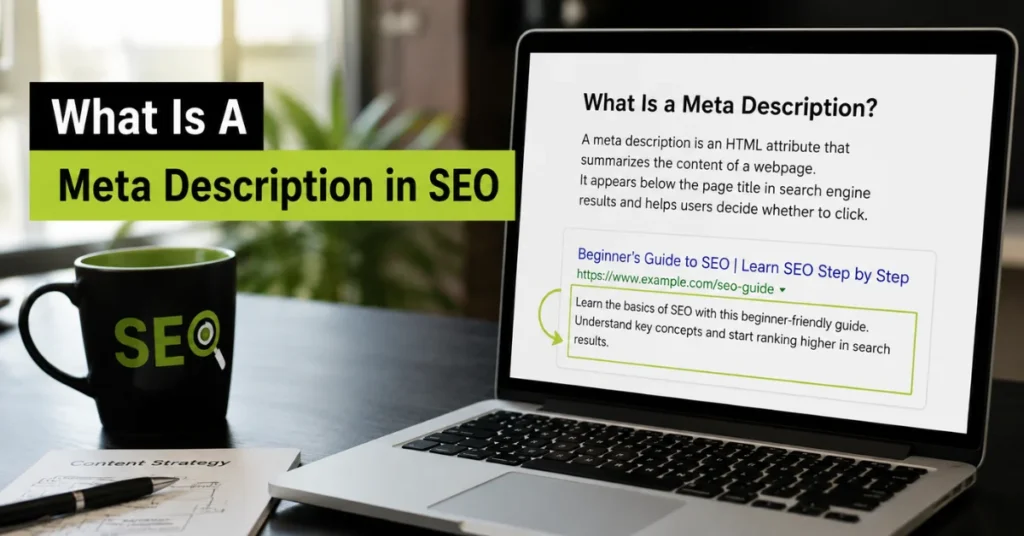
A meta description in SEO is a short HTML snippet, typically between 150 and 160 characters, that appears below your page title in Google search results and summarizes what a visitor can expect to find when they click through to your page.
Understanding what is a meta description in SEO is one of the most practical and high-impact skills any website owner or digital marketer can develop, because while it does not directly influence your ranking position, it plays a powerful role in determining how many people actually click on your result once it appears on the page. This complete guide covers everything from the basics of what an SEO meta description is to how it influences click-through rate, user engagement, and your overall organic search performance.
What Are Meta Descriptions in SEO
A meta description is an HTML tag placed in the head section of a webpage that provides a brief, readable summary of that page’s content. In the search engine results page, commonly referred to as the SERP, this text appears directly beneath the clickable blue title link and above the URL. It is one of the first things a potential visitor reads when deciding whether to click your result or scroll past it to a competitor.
The HTML code for a meta description looks like this:
<meta name=”description” content=”Your compelling page summary goes here.”>
Search engines like Google read this tag and, in many cases, display it as the snippet beneath your result. However, Google also reserves the right to rewrite your meta description entirely if it believes a different section of your page better matches the user’s search query. Research shows Google rewrites meta descriptions approximately 63 percent of the time, which makes it even more important to write page content that is thorough and well-structured throughout, not just in the description tag itself.
What Is an SEO Meta Description and Why Does It Exist
The purpose of an SEO meta description is to serve as a mini advertisement for your page. It communicates to a searcher, in a single glance, what value they will receive by clicking your result. Think of it as the 160-character pitch that convinces someone to choose your page over the nine other results sitting on the same page of Google.
When meta descriptions are written well and aligned with what a searcher is actually looking for, they create an immediate sense of relevance and trust. When they are generic, vague, or missing entirely, Google fills in the blank with whatever text it pulls from your page, which may or may not represent your content in the most compelling or accurate way.
A well-crafted meta description accomplishes three things at once. It communicates the core value of the page clearly. It incorporates the primary keyword naturally so that Google bolds it in the search results when it matches the user’s query, increasing visual attention. And it includes a call to action that gives the reader a clear reason to click right now rather than later.
Do Meta Descriptions Affect SEO
This is one of the most commonly asked questions in the SEO community, and the answer requires a clear distinction between direct and indirect impact. Meta descriptions do not affect SEO rankings directly. Google has confirmed multiple times, most notably through statements from its Search Advocate John Mueller, that meta descriptions are not used as a ranking signal in its core algorithm. Your position in search results will not move up or down based on the words in your meta description tag alone.
However, meta descriptions affect SEO in a very meaningful indirect way, and that indirect impact is significant enough that treating meta descriptions as unimportant would be a strategic mistake. Here is how the indirect relationship works.
When your meta description is compelling and well-matched to search intent, more users click your result. A higher click-through rate signals to Google that your page is satisfying the query effectively. Over time, consistently strong CTR performance relative to competing pages at the same ranking position can influence Google to reward your page with improved visibility. The chain reaction moves from well-written description to more clicks to stronger engagement signals to better long-term ranking performance.

Does Meta Description Affect SEO Rankings
To be precise, meta description does not affect SEO rankings as a direct algorithmic signal. However, it does affect the behavioral signals that Google monitors and responds to. Click-through rate is one of those behavioral signals. When your page earns significantly more clicks than other pages ranking around it, Google interprets that as evidence of relevance and user satisfaction, both of which contribute to ranking sustainability and improvement.
There is also the matter of keyword bolding. When a user’s search query matches words within your meta description, Google bolds those matching words in the displayed snippet. Bold text draws the eye, and when a searcher immediately sees their own search terms reflected back to them in your description, they are far more likely to perceive your result as directly relevant to their need. This natural bolding effect is one of the strongest reasons to include your primary keyword naturally within your meta description.
Is Meta Description Important for SEO
Yes, meta description is genuinely important for SEO, though not in the way many beginners assume. Its importance lies in its role as the bridge between a ranking position and actual organic traffic. Ranking on page one of Google is valuable only if people click through to your page. A weak or missing meta description means you are leaving that decision entirely in Google’s hands, and the automatically generated snippet may not represent your page’s unique value or speak directly to what your ideal visitor is searching for.
Consider this: 74 percent of web users report that they judge whether to click a search result based primarily on the meta description. That means the majority of people making click decisions are doing so based on those 160 characters before they ever see your actual content. Optimized meta descriptions can improve click-through rates by 20 to 30 percent compared to pages with generic or missing descriptions. For a page that already ranks on the first page of Google, that kind of CTR improvement can translate into a substantial increase in organic traffic without changing a single other element of the page.
How Important Is Meta Description to SEO: A Practical Perspective
The importance of a meta description to SEO becomes clearest when you consider the competitive landscape of a search results page. Every result on page one has invested time and resources into earning that ranking. What differentiates who gets the click often comes down to which result communicates the most relevant, compelling, and trustworthy value in the snippet beneath the title.
A well-optimized meta description gives you control over that first impression. It lets you speak directly to the searcher’s intent, highlight what makes your page different from the others on the page, and provide a clear reason to act. Without a deliberate meta description strategy, you are handing that competitive advantage to whoever writes their snippet more thoughtfully than you do.
For high-traffic pages, competitive keywords, and any page where conversion matters, meta description optimization is one of the highest-return, lowest-effort improvements available in on-page SEO. You are not building new content or earning new backlinks. You are simply making an existing ranking position work harder for your website.
How Do Meta Descriptions Help SEO: The Full Picture
Meta descriptions help SEO through several distinct mechanisms that work together to strengthen your organic search performance over time.
Improved click-through rate from search results. A persuasive, search-intent-aligned meta description attracts more clicks from users who see your result. Higher CTR relative to your ranking position is a positive behavioral signal that contributes to ranking stability and growth.
Reduced bounce rate through accurate expectation setting. When your meta description accurately describes what a visitor will find on the page, users who click through are already aligned with the content they are about to read. They are less likely to immediately leave because the page delivered exactly what the description promised. Lower bounce rates and longer session durations both contribute positively to how Google perceives your content quality.
Keyword relevance signaling. Including your primary keyword naturally in the meta description causes Google to bold that term when it matches a user’s search query. This visual emphasis increases perceived relevance at a glance and drives higher engagement from exactly the users most likely to find your content valuable.
Brand positioning in the SERP. Every search result is an opportunity to communicate your brand voice, your unique value proposition, and your authority in your topic area. A well-written meta description does this in a handful of words and creates a consistent, professional impression that builds brand recognition across every search query your pages appear for.
Control over your page narrative. Without a meta description, Google writes one for you. While Google’s generated snippets are not always poor, they are algorithmically chosen rather than strategically crafted. Writing your own description gives you control over the message that represents your page to thousands of potential visitors every month.
Do Meta Descriptions Affect SEO Rankings on Google
The official and consistently confirmed position from Google is that meta descriptions are not a direct ranking factor. They are not processed by the ranking algorithm in the same way that page content, backlinks, Core Web Vitals, or structured data are. Changing your meta description alone will not move your page from position seven to position three.
What meta descriptions do affect is your ability to maximize the value of whatever ranking position you already hold. A page ranking in position four with an excellent meta description can generate more traffic than a page ranking in position two with a weak or auto-generated snippet. This is particularly true for high-intent searches where users are evaluating their options carefully before clicking.
Google also generates different meta descriptions for the same page depending on the specific search query entered. When your meta description closely matches common query patterns for your topic, Google is more likely to display your written description rather than generating its own. This consistency of messaging is another strong reason to invest time in crafting descriptions that are both accurate and compelling.
Do Numbers in Meta Titles Increase CTR in SEO
Numbers in meta titles are one of the most reliably effective CTR optimization techniques available. Research consistently shows that including specific numbers in title tags can increase click-through rate by up to 27 percent compared to titles without numbers. The reason this works is rooted in how the human brain processes information in a scanning environment.
When a searcher scans a page of results quickly, specific numbers like 7 proven strategies, 12 best practices, or 5 common mistakes create an immediate pattern interrupt. They signal precision and specificity in a sea of vague, generic headlines. A title that says How to Write Meta Descriptions blends into the background, while a title that says 9 Ways to Write Meta Descriptions That Double Your CTR stands out because it promises a concrete, quantifiable outcome.
Numbers also set clear expectations about content format and scope. A reader knows before clicking that they are going to get a numbered list of actionable items, which matches a very common content preference and reduces the perceived risk of clicking through to find something unexpected. This expectation alignment is one of the reasons numbered titles consistently outperform their non-numbered counterparts in A/B testing across industries.
Best practices for using numbers in meta titles include placing the number near the beginning of the title where it receives the most visual attention, using specific numbers rather than round figures because specificity reads as more credible, combining numbers with emotional or power words that reinforce the value of clicking, and ensuring the title remains under 60 characters to avoid truncation in search results on both desktop and mobile devices. Book a call now for free estimate.
How to Write a High-Performing Meta Description: Best Practice
Writing a meta description that consistently earns clicks requires understanding both what searchers are looking for and what elements of a description make it more persuasive than the alternatives beside it on the page.
Keep it between 150 and 160 characters. This is the standard display range for desktop search results. On mobile devices, the visible length is slightly shorter, so front-loading your most important information within the first 120 characters ensures your core message always appears, regardless of device. Anything beyond 160 characters gets truncated with an ellipsis, which can cut off your call to action or your most compelling point.
Include your primary keyword naturally. When your meta description contains the exact keyword or a close variation of what the user searched for, Google bolds those words in the displayed snippet. Bold text draws the eye and immediately communicates relevance. Use the keyword once, placed naturally within a sentence that reads smoothly to a human reader, not forced or repeated.
Write a genuine call to action. Every effective meta description ends with a clear invitation to take the next step. Phrases like discover how, learn the full guide, get started today, or find out now convert passive readers into active visitors. The call to action should match the type of page you are describing. An informational article invites readers to learn or discover. A product or service page invites them to explore, shop, or get a quote.
Match the search intent precisely. If the searcher is looking for information, your description should promise a clear and thorough educational resource. If they are ready to buy, your description should highlight the value, trust signals, and ease of the next step. Mismatching intent and description is one of the most common causes of high bounce rates even when CTR is strong.
Write a unique description for every page. Using the same meta description across multiple pages confuses search engines about which page is most relevant for a given query and diminishes user experience when they see identical snippets for different results. Each page’s description should reflect that specific page’s unique content and value proposition.
Use action verbs and emotional language strategically. Words like discover, proven, trusted, complete, essential, and powerful add energy to a description and make it feel worth engaging with. Research from Backlinko found that emotionally compelling meta descriptions can increase CTR by nearly 14 percent compared to neutral, factual descriptions of the same content.
Common Meta Description Mistakes That Reduce Clicks
Even experienced website owners make avoidable mistakes with their meta descriptions that directly reduce the number of clicks their pages earn from search results.
Writing descriptions that are too long and get truncated at the wrong point is one of the most widespread issues. When the cut-off happens before your call to action or your most compelling claim, the incomplete sentence can make your result appear unprofessional or unclear.
Keyword stuffing in meta descriptions, which means repeating keywords multiple times in an unnatural way, signals low quality to both readers and Google. Google may respond by overriding your description entirely and generating its own, which removes your control over the first impression entirely.
Using the same generic description across all pages is a missed opportunity on every page that shares it. Each page represents a different topic, serves a different intent, and attracts a different searcher. The description should reflect the specific value that the page delivers.
Writing descriptions that do not accurately match the actual page content creates a mismatch between user expectation and delivery, which produces high bounce rates and short session durations. These signals tell Google that your page is not satisfying the query, which can gradually suppress rankings over time.
Ignoring mobile display is increasingly costly as more than 60 percent of searches now happen on mobile devices, where the visible snippet length is shorter than on desktop. Testing how your description appears on both device types before publishing is a straightforward step that many website owners skip.
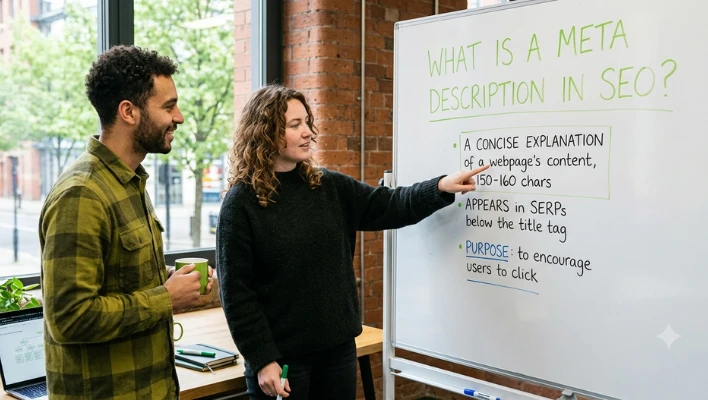
How to Check and Optimize Your Existing Meta Descriptions
Improving your current meta descriptions across your website is one of the fastest ways to increase organic traffic from rankings you already hold. The process begins with identifying which pages have the greatest opportunity for improvement.
Google Search Console is the most valuable tool for this work. Its Performance report shows your click-through rate for every page and keyword your site appears for in search results. Pages with high impressions but lower-than-average CTR are the strongest candidates for meta description optimization because they are already ranking well but not converting that visibility into clicks effectively.
After identifying priority pages, compare your current meta description against the actual snippet Google is displaying for your most common search queries. Google Search Console shows both your specified description and the queries driving impressions, which makes it straightforward to identify where your description is not matching user intent closely enough.
Tools like Screaming Frog allow you to crawl your entire website and identify pages with missing meta descriptions, descriptions that are too short, descriptions that exceed the recommended character limit, or pages where the description is duplicated across multiple URLs. Addressing all of these issues systematically creates a stronger, more consistent SERP presence across your entire website.
For WordPress websites, plugins like Yoast SEO and Rank Math provide a dedicated field for writing and previewing meta descriptions with a real-time character counter and a visual preview of how your snippet will appear in search results. These tools make the optimization process accessible without requiring any direct HTML editing.
Meta Description Length: How Long Should It Be
The recommended meta description length for SEO sits between 150 and 160 characters, including spaces. This range reflects how Google displays snippets on desktop screens, where the display area accommodates approximately 920 pixels of width. On mobile devices, the visible length is slightly shorter, which is why placing your most critical information within the first 120 characters is a reliable best practice.
It is worth understanding that Google measures display length in pixels rather than characters, which means the actual number of characters that fit within the display area varies slightly depending on which letters are used. Wide letters like W and M take up more space than narrow ones like i and l. As a practical guideline, staying within 155 characters provides a comfortable buffer that works consistently across both device types and most character combinations.
Descriptions that are significantly shorter than 150 characters miss the opportunity to communicate enough value to stand out from competing results. Descriptions that exceed 160 characters risk having their most important conclusion or call to action cut off with an ellipsis, which can reduce the impact of the overall message.
Related Topic: What is Title Tag in SEO
What Happens If You Do Not Write a Meta Description
When no meta description is specified for a page, Google automatically generates a snippet from the page content it deems most relevant to the specific search query entered. This dynamic snippet generation is Google’s way of ensuring that every result in its search pages has accompanying context for users, regardless of whether the publisher provided one.
Auto-generated snippets are not always poor. In fact, Google’s system is sophisticated enough that for some queries and pages, the automatically selected snippet may perform comparably to a manually written description. Research shows that approximately 25 percent of top-ranking pages in Google do not have a specified meta description and instead rely on Google’s automatic selection.
However, the consistent best practice remains to write a custom meta description for every page you want to rank, particularly for pages where the content is dense, the value proposition is nuanced, or the competitive landscape is strong. A manually written description gives you strategic control over your page’s first impression in search results, and that control is almost always more valuable than leaving the decision to an algorithm. Contact us today for more information.
Meta Descriptions for Local SEO and Business Pages
For local businesses and service-area-based websites, meta descriptions carry additional strategic weight because local search results are highly competitive and users are often closer to a decision when they search with local intent. A local meta description should communicate not just what the page is about but also where the business serves, what makes it the best choice for a local searcher, and what immediate action the user can take.
Including the city or region name in the meta description reinforces local relevance, particularly for service pages targeting specific geographic areas. Mentioning credentials, years of experience, or service guarantees within the description adds trust signals that are especially persuasive for local searchers evaluating multiple options at once.
Schema markup and structured data work alongside meta descriptions for local pages by enhancing how rich results appear in search, adding star ratings, business hours, and other engaging elements that further increase click rates beyond what the description text alone can achieve.
Final Thoughts: Why Every Meta Description Deserves Your Attention
Understanding what is a meta description in local SEO in sharjah and committing to writing strong ones for every important page on your website is one of the most accessible and high-return investments in your overall organic search strategy. You are not changing your rankings directly. You are maximizing the value of every ranking position you already hold by ensuring the first impression your page makes is as compelling, relevant, and click-worthy as possible.
Every search result impression is an opportunity. Your meta description determines whether that opportunity converts into a visitor or passes to a competitor. At scale, across hundreds of pages and thousands of monthly impressions, the cumulative effect of well-optimized meta descriptions is a measurable and sustained increase in organic traffic that compounds over time.
Write every meta description as if it is a 160-character advertisement for the single most valuable thing your page offers. That standard, applied consistently, will make every page on your website perform better from the rankings you already have.
Frequently Asked Questions About Meta Descriptions in SEO
What is a meta description in SEO?
A meta description is a short HTML tag, typically 150 to 160 characters, that summarizes a webpage’s content and appears beneath the title in Google search results. It helps users decide whether to click your result and serves as a mini advertisement for your page in the SERP.
Do meta descriptions affect SEO rankings?
Meta descriptions are not a direct ranking factor. Google has confirmed this officially. However, they indirectly impact SEO by influencing click-through rate. A compelling description earns more clicks, which sends positive behavioral signals to Google and can contribute to stronger rankings over time.
Is meta description important for SEO?
Yes, it is genuinely important. Research shows 74 percent of users judge whether to click a result based on the meta description. Optimized descriptions can improve CTR by 20 to 30 percent, meaning more organic traffic from rankings you already hold without requiring any change to the page content itself.
How long should a meta description be for SEO?
The recommended length is between 150 and 160 characters. This fits within Google’s standard desktop display area. On mobile, visible length is slightly shorter, so placing your most important information within the first 120 characters ensures your core message always shows regardless of device.
What happens if I do not write a meta description?
Google automatically generates a snippet from your page content based on what it considers most relevant to the search query. While auto-generated snippets are not always poor, writing your own description gives you strategic control over your first impression in search results and typically produces stronger CTR performance.
Do numbers in meta titles increase CTR in SEO?
Yes, significantly. Research shows that including specific numbers in meta titles can increase CTR by up to 27 percent. Numbers signal precision, set clear expectations about content format, and create a visual pattern interrupt in a page of text-based results, all of which make users more likely to choose your result over competing ones.
How do meta descriptions help SEO performance?
Meta descriptions help SEO by improving CTR, reducing bounce rates through accurate expectation setting, triggering keyword bolding in search results when the user’s query matches your description, and giving you control over your brand narrative in the SERP. These combined effects strengthen organic traffic and engagement signals over time.
Does Google always use the meta description I write?
No. Google rewrites meta descriptions approximately 63 percent of the time, selecting a different snippet from the page when it believes an alternative section better matches the specific query. Writing thorough, well-structured page content alongside a strong meta description gives you the best chance of Google displaying your intended message consistently.

M. Awais Khan is a Business Development and Digital Growth Strategist at SkillsHeaven, specializing in SEO, local search optimization, and performance-driven digital marketing. With experience supporting 100+ businesses, he develops and implements data-driven strategies that help companies increase online visibility, generate qualified leads, and drive sustainable revenue growth. His expertise spans Local SEO, Google Ads, social media marketing, and conversion-focused website optimization, ensuring every project is aligned with measurable business outcomes and long-term success.