Most important local SEO ranking factors that determine whether your business appears in Google’s local pack? The answer matters because 46% of all Google searches have local intent, and nearly 90% of consumers use Google Maps to find businesses . If you are not showing up in those top three map results, you are invisible to a massive segment of potential customers. Google uses a distinct local algorithm, separate from its standard organic search algorithm . This algorithm evaluates your business across three primary dimensions: relevance, distance, and prominence . Everything you do in local SEO feeds into one of these three core factors. Understanding exactly how each factor is weighted will help you focus your efforts where they deliver the greatest return.
What Are the Three Core Factors That Determine Local Rankings?
Google’s own documentation confirms that local search results are based on three primary factors . Every other local SEO signal feeds into one or more of these dimensions. Getting these right is the foundation of any effective local strategy.
Relevance measures how well your business matches what someone is searching for. Google uses your Google Business Profile categories, your website content, your service descriptions, and the keywords associated with your business to assess relevance for any given query . A business with complete and accurate information is easier to match with the right searches .
Distance considers how far your business is from the searcher’s location or from the location specified in the search query . You cannot change your physical location, but you can optimize for distance by ensuring your address is verified and consistent across your profile, website, and all directory listings. Service area businesses can set service areas in their Google Business Profile to influence which searches they appear for .
Prominence reflects how well-known and trusted your business is both online and offline . Google assesses prominence through the number and quality of reviews, the strength of your backlink profile, your citation consistency across directories, and your overall domain authority. Businesses with hundreds of positive reviews, strong local backlinks, and consistent citations signal high prominence to Google .
What Is the Weight of Each Local Ranking Factor?
The annual Local Search Ranking Factors survey from Whitespark, the most widely cited practitioner survey in the industry, provides a clear breakdown of how much weight each factor carries . Understanding this distribution helps you prioritize your efforts.
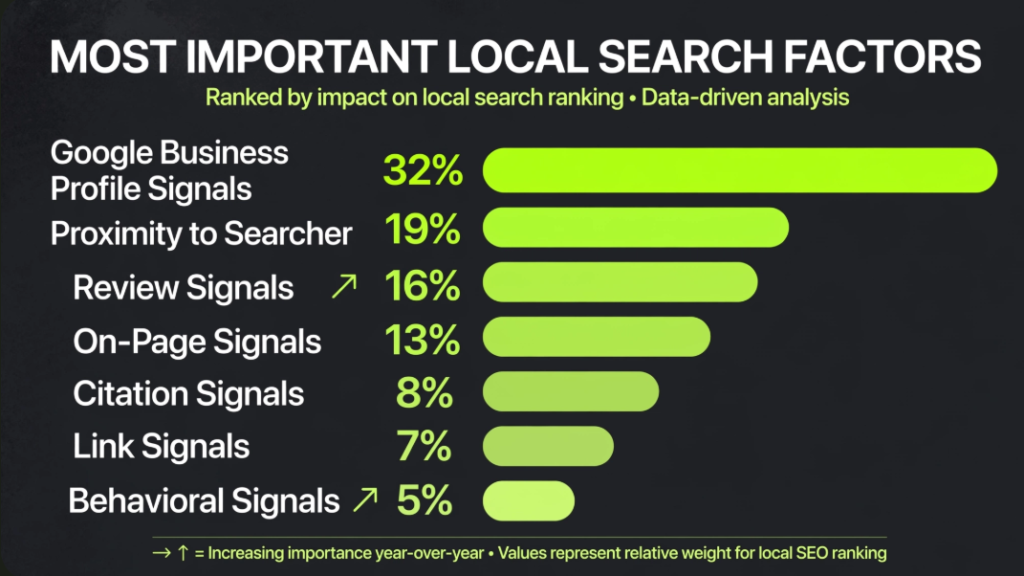
Your Google Business Profile signals carry the most weight at 32% . This is the single most influential factor in local rankings. Proximity to the searcher follows at 19% . While you cannot change your location, you can expand your effective radius through strong relevance and prominence signals. Review signals account for 16% and have increased in weight every year for the past five years . On-page signals contribute 13%, while citation signals have decreased to 8% . Link signals carry 7%, and behavioral signals make up 5% but are a growing factor .
Google Business Profile Signals: The 32% Game Changer
Your Google Business Profile is the most influential asset in local SEO. An incomplete or inconsistent profile directly limits how well Google can match your business to relevant local searches . Every field in your profile is a ranking signal. The more completely and accurately you fill it out, the more data Google has to surface your business.
Your primary category selection is the strongest individual signal within your profile . Choosing ‘Personal Injury Attorney’ instead of generic ‘Attorney’ makes a measurable difference . Your primary category provides the structural permission for Google to consider you a candidate for specific queries . If your primary category is wrong, your 500 five-star reviews do not even get looked at .
Your business name must match your real business name exactly. Keyword-stuffed names violate Google’s guidelines and risk suspension . Google evaluates your business name and category as part of a single location element, parsing them through the same semantic model . Words in your name become signals of “what you are” . If your name contains a specific token like “pizza” or “smoothie,” it creates a narrow entity boundary that can limit your ability to rank for broader queries . To rank for broader searches, your name and category must align with the intent you are targeting .
Profile completeness is also critical. A fully optimized GBP outranks an incomplete one in nearly every scenario, even when other factors are equal . Complete your services and products sections with descriptions. Add all relevant secondary categories. Post weekly updates with photos, active profiles outrank dormant ones . Businesses with 100+ photos get substantially more engagement than those with fewer than 10 . Enable messaging, appointments, and every applicable feature to maximize your profile completeness .
Review Signals: The 16% Rising Factor
Reviews have grown as a ranking factor every year for the past five years . Their influence now extends beyond traditional rankings into AI-generated recommendations. Google uses review data not just to grade your reputation but to determine whether your business should be displayed at all .
The specific review signals Google uses include review quantity on Google, review velocity, review diversity, average star rating, keyword content in reviews, and owner response rate . A steady stream of fresh, location-specific reviews signals an active, trusted business . Businesses that respond to every review within 24 hours demonstrate operational health that Google rewards .
AI search models do not just sort businesses by a score. They read and synthesize the actual text within reviews to decide which brands to recommend in natural language answers . A location with fewer total reviews that frequently mention specific services or regional project work can be cited by AI ahead of a business with thousands of generic “great service” ratings . Your review content matters as much as your review count.
On-Page Signals: Supporting Your Local Presence
Your website still matters for local rankings. Key on-page signals include NAP consistency between your site and GBP, location keywords in title tags, city and service landing pages with unique content, LocalBusiness schema markup, and mobile performance . Dedicated location pages give search engines a specific, indexable URL to associate with each service area your business operates in . Each page needs unique content that reflects the specific area and includes locally relevant customer references .
For businesses serving multiple locations, create unique location pages with original content, local testimonials, embedded Google Maps, and location-specific information . Avoid cookie-cutter pages that only swap out city names. Google recognizes and devalues thin, duplicate location pages . Display your NAP in the footer of every page and on your contact page. Mark it up with the LocalBusiness schema so Google can read and verify it as structured data rather than just plain text .
Citation Signals and Link Signals: The Declining but Foundational Factors
Citations have declined in weight over the past three years but remain a foundational signal . What matters most is NAP consistency across all listings, citation volume on authoritative directories, and the quality of directories where you appear . Inconsistent citations actively hurt your rankings by creating confusion about your business identity .
The real reason data consistency matters today is entity disambiguation . Clean data allows search algorithms and AI systems to confidently match different mentions across the web to the exact same physical business location. If your business name changes slightly across platforms, search algorithms see multiple conflicting signals instead of building a single, authoritative entity profile .
Links from locally relevant sources carry outsized weight in local rankings. A link from your city’s chamber of commerce or local newspaper is worth more than a link from a generic national directory . Quality and local relevance matter far more than quantity. Focus on earning links from local organizations, news publications, business partners, and community resources .
Behavioral Signals: The Growing Validation Layer
Behavioral signals are a growing factor that validates whether a business deserves its ranking position based on real user behavior . Google tracks click-through rates from local search results, direction requests, mobile clicks-to-call, and dwell time . These signals indicate whether searchers find your business relevant and engaging .
A higher click-through rate tells Google that searchers find your business more relevant than competing listings at the same position . Direction requests and phone calls tracked through your Google Business Profile are direct signals of user intent . They tell Google that real people are acting on your listing, which validates the relevance and prominence signals your profile sends .
Why Eligibility Comes Before Ranking
Local rankings are not just about optimization. They are about confidence . Google ranks what it understands and suppresses what it does not. Your business name and primary category determine whether you are even eligible to show up for a query before traditional ranking factors like reviews or links are ever considered .
Think of it as a machine learning classifier designed to minimize noise . By filtering out businesses that are semantically unlikely to be a match for a query, Google ensures its Map Pack results are highly confident. If you do not pass this semantic filter, your reviews and links do not get looked at . This is why businesses that change their primary category from “steakhouse” to “halal restaurant” can see immediate ranking improvements for halal searches. Secondary signals did not matter until the primary category gave Google semantic permission .
Start Optimizing Your Local Presence Today
Your local SEO success depends on understanding what actually moves the needle. Focus your efforts on your Google Business Profile completeness and review generation first. These two areas deliver the majority of your local SEO gains . Then ensure your NAP is consistent across every platform, create locally optimized content on your website, and build links from trusted local sources. Your customers are searching for you right now. Make sure they can find you.
Frequently Asked Questions (FAQ)
What are the key factors that influence local SEO rankings?
The key factors are your Google Business Profile completeness, review quantity and quality, proximity to the searcher, NAP consistency, on-page SEO, local citations, and backlinks from local sources . These all feed into Google’s three core ranking dimensions: relevance, distance, and prominence .
What makes a business rank for local SEO?
A business ranks by having a fully optimized Google Business Profile with accurate categories, consistent NAP information across all directories, a steady stream of positive reviews, locally relevant content on its website, and citations from authoritative local sources . Ranking requires excelling across multiple signals, not just one.
What causes ranking fluctuations in local SEO?
Ranking fluctuations can result from changes in competitor activity, new reviews, updates to your business information, algorithm changes, proximity shifts depending on the searcher’s location, and seasonal variations in demand . Google’s local algorithm updates continuously, with major shifts happening annually .
How does Google assign local SEO ranking?
Google assigns local ranking by evaluating three core factors: relevance (how well your business matches the search), distance (how close you are to the searcher), and prominence (how well-known and trusted your business is) . These are applied through a semantic filter that determines eligibility before traditional ranking factors are considered .
Can a business rank if it is farther from the searcher than competitors?
Yes. While proximity is a significant factor, businesses with stronger GBP optimization, more reviews, and better on-page signals regularly outrank closer competitors . The key is excelling in every controllable factor to overcome the proximity disadvantage .
Read Also: What Are the Best Tools for Local SEO Rank Tracking? Complete Guide

Wali Shah is the Founder and CEO of SkillsHeaven, a digital growth agency specializing in Local SEO, Google Ads, and conversion-focused website development. With over 8+ years of experience, he has helped scale 170+ businesses, including 93+ limousine companies globally, by building structured, lead-generating digital systems. His expertise spans local search optimization, paid media strategy, and high-performance website development, all aligned with measurable business growth. Known for a data-driven and ethical approach, Wali focuses on creating scalable marketing systems that increase visibility, generate qualified leads, and drive long-term revenue for service-based businesses.