
Customer journey mapping is a powerful strategic tool for UAE businesses aiming to understand, optimise, and differentiate their customer experience. It visually captures every interaction a customer has with a brand, from initial awareness to purchase and post-sale engagement, helping businesses identify opportunities for improvement.
The global customer journey analytics market, valued at USD 4.53 billion in 2024, is expected to reach USD 9.95 billion by 2032, reflecting its growing importance in driving revenue, retention, and competitive advantage.
In the UAE, journey mapping is both more complex and more valuable due to a highly diverse population of over 200 nationalities. Customer behaviours vary widely across languages, cultures, and digital habits, making a structured, localised approach essential. This guide from Skills Heaven presents a practical framework tailored specifically to the UAE market.
Why Customer Journey Mapping Matters in the UAE
The Business Case for Journey Mapping
Research by Gartner found that companies using AI-powered customer journey mapping tools see a 25% increase in customer satisfaction and a 15% increase in revenue. A Forrester study revealed that 90% of businesses believe customer experience is a key differentiator in their industry, but only 20% have a clear understanding of their customers’ journeys. This gap between aspiration and capability is where competitive advantage is built.
A Salesforce survey found that 70% of consumers say a company’s understanding of their personal needs influences their loyalty. In the UAE, where brand switching is common and consumer expectations are shaped by exposure to world-class service standards, this loyalty driver is particularly powerful.
UAE-based retail companies that adopted AI-driven customer insights reported 30% increases in customer retention rates — a direct commercial consequence of understanding and optimising the customer journey.
UAE-Specific Journey Complexity
Customer journey mapping in the UAE must account for factors that are absent or less significant in more homogeneous markets. Language plays a critical role: a UAE consumer’s journey may begin with an Arabic-language Google search, continue with English-language website research, involve
WhatsApp communication in a third language, and conclude with an in-person transaction conducted in Arabic or Urdu. Each language transition represents a potential point of friction that journey mapping can identify and address.
Cultural considerations also shape UAE customer journeys significantly. Ramadan and Eid periods completely alter purchasing behavior, decision timelines, and communication preferences. Family and social proof play stronger roles in UAE consumer decision-making than in many Western markets.
Trust signals, verified certifications, testimonials from trusted community members, physical presence and credibility carry significant weight in UAE consumer evaluation. These cultural factors must be embedded in journey maps to reflect accurately how UAE customers actually behave.
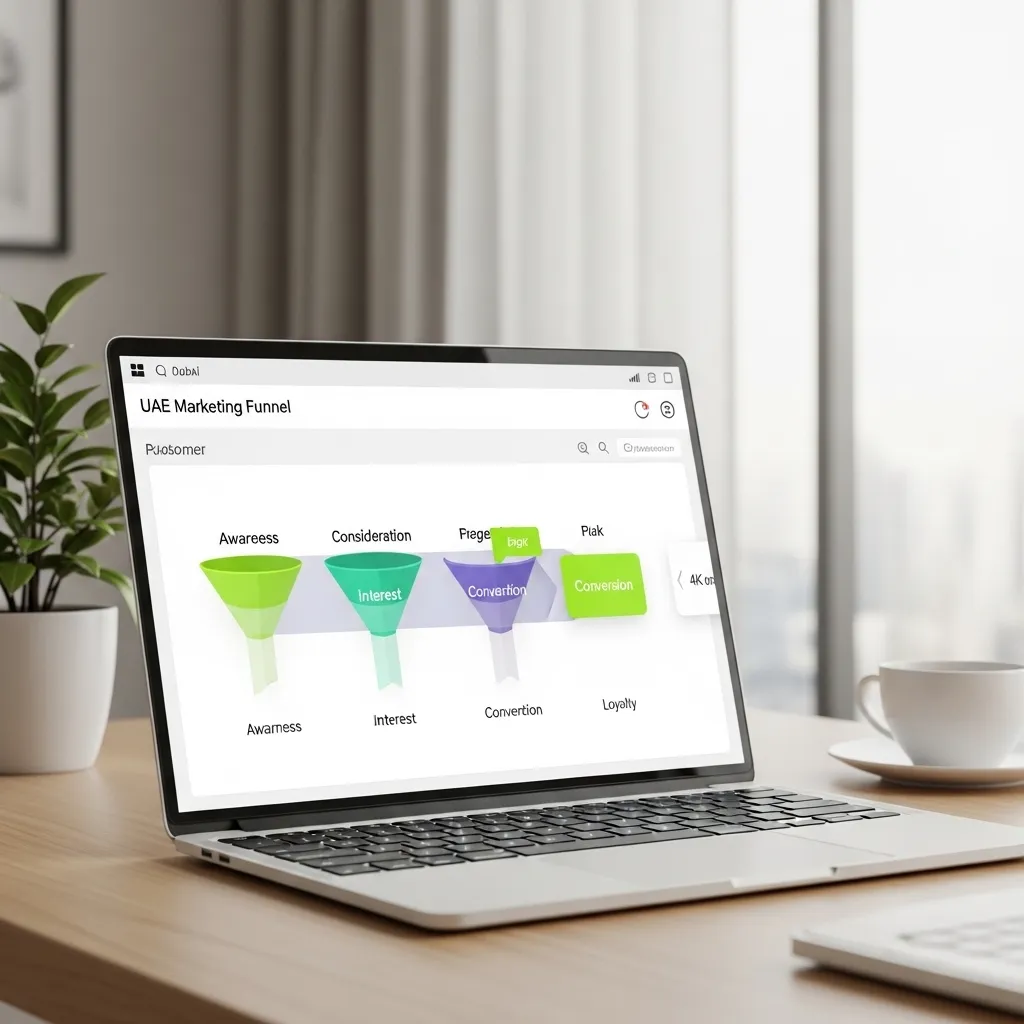
The Five Stages of the UAE Customer Journey
Stage 1: Awareness, How UAE Customers Discover Your Business
The awareness stage is where potential UAE customers first encounter your brand. Research shows that 68% of all online experiences begin with a search engine, making Google search the primary awareness channel for most UAE businesses. With Google commanding over 92% of UAE search market share, appearing in organic search results and Google Maps is essential for awareness-stage discovery.
Social media plays a growing awareness role: YouTube reaches 73.6% of the UAE population, Instagram reaches 67.8%, and TikTok has 11.3 million UAE users. Influencer content is a significant awareness driver in the UAE, where over 70% of UAE consumers follow influencers. For many consumer-facing UAE businesses, a customer’s first brand encounter happens through an influencer post rather than a search result.
For UAE businesses, the awareness-stage journey map must answer: How are customers in each target segment currently finding businesses like ours? What search queries are they using (in English and Arabic)? Which social platforms are driving discovery? What does the customer know and feel at this first moment of contact? Journey mapping at this stage typically reveals that businesses are invisible to large segments of potential customers who are using discovery channels the business has not optimised.
Identifying where UAE customers discover businesses is only the first step knowing which channels to prioritise for each audience segment is what turns awareness-stage insight into commercial action. Our guide on Choosing the Right Marketing Channels in UAE gives the full channel selection framework for this market.
Stage 2: Consideration, How UAE Customers Evaluate Options
After discovering a potential solution, UAE customers enter the consideration stage actively evaluating options and building internal confidence in a purchasing decision. This stage is characterised by information-seeking: reading reviews, comparing competitors, visiting multiple websites, asking for recommendations from friends and family, and engaging with social media content.
In the UAE market, local SEO signals such as Google Maps visibility, “near me” searches, and location-based keywords like Dubai Marina, Business Bay, JAFZA, and Dubai Hills strongly influence the consideration stage, as customers prefer nearby and easily accessible businesses.
The UAE consideration stage has specific characteristics. WhatsApp is widely used for asking personal network contacts for business recommendations. Google reviews carry significant weight, with UAE consumers reading an average of multiple reviews before making a purchase decision.
Price transparency is important UAE consumers expect clear pricing information on websites rather than requiring a quote request for standard products. Mobile-first content consumption means that consideration-stage content must be immediately accessible and easy to engage with on smartphones.
Journey mapping at the consideration stage reveals what information customers need to feel confident in their decision, where they are seeking that information, and what obstacles are preventing them from progressing toward purchase.
Common consideration-stage journey gaps for UAE businesses include insufficient social proof (few or no online reviews), unclear pricing, competitor comparison content that does not adequately differentiate the business, and slow response times to WhatsApp and website inquiries.
For web development businesses in the UAE, local SEO factors such as “web development company Dubai,” “website design Business Bay,” and “near me development services” play a key role in attracting high-intent clients who are actively looking for nearby agencies.

Stage 3: Decision, The Purchase Moment in the UAE
The decision stage is where a UAE customer makes their final purchasing choice. The decision triggers in the UAE context include trust signals (verified certifications, established brand reputation, positive reviews from trusted sources), convenience (seamless digital payment, clear ordering process, delivery options), personal engagement (WhatsApp conversations that provide confidence and answer specific questions), and price-value perception.
For e-commerce businesses, the decision stage is the checkout process, and UAE-specific optimisation is critical. Electronic payment is the preferred method of payment for 75% of UAE consumers.
Credit and debit cards account for 93.2% of online transactions. Businesses that offer multiple payment options including Apple Pay, Google Pay, and buy-now-pay-later alongside traditional card payment remove friction from the decision moment.
Stage 4: Retention, Keeping UAE Customers Coming Back
Customer retention in the UAE is a significant opportunity for most businesses. Research consistently shows that acquiring a new customer costs five to seven times more than retaining an existing one. For UAE businesses operating in a competitive market where consumers have abundant alternatives, the post-purchase experience is a critical differentiator.
Retention-stage journey mapping in the UAE must address: How does the customer experience the product or service after purchase? What communication does the business provide post-sale? Are there proactive check-ins or satisfaction surveys? Is there a loyalty program that rewards repeat purchases? UAE consumers particularly the high-disposable-income expatriate segment demonstrate strong brand loyalty when their post-purchase experience consistently meets or exceeds expectations.
Stage 5: Advocacy, Turning UAE Customers into Brand Ambassadors
The advocacy stage is where satisfied UAE customers become active promoters of your business through word-of-mouth, online reviews, and social media sharing. In the UAE, where personal recommendations carry significant cultural weight, customer advocacy is one of the most valuable marketing assets a business can build.
Advocacy-stage journey mapping identifies what triggers UAE customers to recommend a business and what prevents advocacy even among satisfied customers. Common barriers to advocacy include businesses not making it easy to leave reviews, not creating shareable brand experiences, and not actively thanking or recognising customers who refer to new business.
How to Create a Customer Journey Map for a UAE Business
Step 1: Define Your Customer Segments
UAE businesses must create separate journey maps for each distinct customer segment, as journey experiences vary significantly across the UAE’s diverse population. A retail business might map separate journeys for UAE nationals, Arab expatriates, South Asian expatriates, and Western expatriates, each of whom may discover the business through different channels, evaluate using different criteria, and respond to different trust signals.
Step 2: Conduct Customer Research
Effective journey mapping is built on customer data, not internal assumptions. Research methods for UAE journey mapping include in-depth customer interviews exploring the complete decision journey, customer surveys gathering quantitative data on discovery channels and decision factors, analytics data review from Google Analytics (traffic sources, page behavior), WhatsApp and CRM conversation analysis, and social media listening tools to understand brand perception.
Skills Heaven emphasises that the most common journey mapping failure is building maps from internal assumptions rather than customer data. Businesses frequently discover that customers found them through channels they were not actively investing in, or that significant purchase decisions were made based on factors the business had not prioritised.
Building journey maps from internal assumptions rather than real customer data is one of the most common strategic errors UAE businesses make — and it is part of a broader pattern of digital marketing decisions that compound over time. See Common Digital Marketing Mistakes UAE Companies Make to identify every strategic gap at once.
Step 3: Map Touchpoints and Identify Pain Points
With customer research in hand, map every touchpoint a customer has with the business across all five journey stages. For each touchpoint, document what the customer is doing, thinking, and feeling; what channel or medium the interaction occurs through; what the current customer experience is; and what the ideal experience should be. Identify the moments where customer experience falls below expectations, these pain points are the highest-priority optimisation opportunities.
Step 4: Implement Journey Improvements and Measure Impact
Journey mapping is only valuable if it drives action. Prioritise journey improvements based on the pain points that affect the most customers, that occur at the highest-impact stages (particularly consideration and decision), and that are within the business’s capability to address.
Implement improvements systematically and measure impact using customer satisfaction scores, conversion rates, retention rates, and Net Promoter Score. Regular journey map reviews, at minimum annually, ideally semi-annually, ensure that maps stay current as customer behaviour and market conditions evolve.
Implementing journey improvements systematically requires a broader marketing execution framework particularly for businesses in early growth stages where every channel decision carries significant commercial weight. Our UAE Startup Marketing Roadmap gives a 12-month structured plan for building each stage of the customer journey from scratch.
Tools and Technology for UAE Customer Journey Mapping
UAE businesses have access to a range of tools for customer journey mapping and analytics. Google Analytics 4 provides detailed data on customer behaviour across the website journey. Hotjar enables visual analysis of user behaviour through heatmaps and session recordings.
Customer relationship management systems including HubSpot and Salesforce track individual customer journeys from lead to retention. Dedicated journey mapping tools including Miro, Smaply, and Lucidchart enable visual journey map creation and team collaboration.
The global customer journey analytics market is growing at 10.4% CAGR, driven by the increasing availability of AI-powered tools that can analyse vast customer datasets to identify journey patterns and optimisation opportunities automatically.
For UAE businesses investing in journey analytics capability, cloud-based solutions are dominant, cloud deployment held 65% of the customer journey analytics market share in 2024, offering scalability, flexibility, and integration with existing marketing platforms.
Conclusion: Customer Journey Mapping as a Competitive Advantage in the UAE
Customer journey mapping is not a one-time exercise, it is an ongoing strategic discipline that enables UAE businesses to understand their customers more deeply than competitors, identify and resolve experience gaps more systematically, and build the customer loyalty that drives sustainable revenue growth.
In the UAE’s high-expectation, multicultural consumer market, the businesses that truly understand their customers’ journeys are the ones best positioned to serve them effectively.
Skills Heaven provides customer journey mapping frameworks, UAE-specific consumer behavior research, and practical implementation guides for businesses across every sector. By investing in genuine customer understanding and systematic journey optimisation, UAE businesses build the customer relationships that are the most defensible source of competitive advantage in any market.
Frequently Asked Questions
What is customer journey mapping?
Customer journey mapping is the process of visualising every interaction a customer has with a business, from initial awareness to post-purchase engagement, to improve overall customer experience and business performance.
Why is customer journey mapping important for UAE businesses?
It helps UAE businesses understand diverse customer behaviours across different nationalities, languages, and cultural backgrounds, enabling them to deliver more personalised and effective customer experiences.
What are the main stages of the customer journey?
The five key stages are Awareness, Consideration, Decision, Retention, and Advocacy. Each stage represents a different phase in how customers interact with a business.
How is the UAE customer journey different from other markets?
The UAE market is highly multicultural, with customers using multiple languages, channels like WhatsApp, and relying heavily on social proof, cultural events (like Ramadan), and personal recommendations.
What tools can be used for customer journey mapping?
Popular tools include Google Analytics 4, Hotjar, HubSpot, Salesforce, Miro, Smaply, and Lucidchart, which help analyse and visualise customer behaviour.
How can businesses improve their customer journey?
By identifying pain points, optimising touchpoints, improving communication channels, enhancing trust signals, and continuously measuring performance using metrics like conversion rates and customer satisfaction.

Wali Shah is the Founder and CEO of SkillsHeaven, a digital growth agency specializing in Local SEO, Google Ads, and conversion-focused website development. With over 8+ years of experience, he has helped scale 170+ businesses, including 93+ limousine companies globally, by building structured, lead-generating digital systems. His expertise spans local search optimization, paid media strategy, and high-performance website development, all aligned with measurable business growth. Known for a data-driven and ethical approach, Wali focuses on creating scalable marketing systems that increase visibility, generate qualified leads, and drive long-term revenue for service-based businesses.