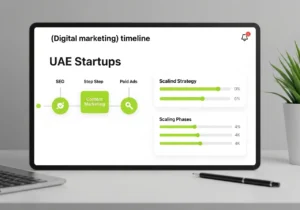
Marketing Roadmap for UAE Startups success begins in the first twelve months, which are often the most critical period for growth. The decisions made during this stage, which channels to invest in, how to position the brand, how to build an audience, and how to acquire the first customers, set the trajectory for everything that follows.
Get these foundational marketing decisions right and you build compounding momentum. Get them wrong and you spend the next two years correcting course while burning through budget.
Dubai alone sees thousands of new businesses registered annually. The UAE ranked first globally in the Global Entrepreneurship Monitor 2024-2025 report for the fourth consecutive year, supported by a $8.7 billion government investment in the entrepreneurship ecosystem.
In this environment, a structurally sound, systematically executed first-year marketing roadmap is a genuine competitive differentiator.
This guide from Skills Heaven provides a month-by-month marketing roadmap specifically designed for UAE startups, covering everything from pre-launch preparation through the end of the first year. Every stage includes specific actions, recommended tools, measurable milestones, and UAE-specific considerations.
Pre-Launch Phase (Months 1-2): Foundations
Month 1: Market Research and Brand Foundation
Before any marketing activity begins, UAE startups must invest time in structured market research and brand development.
Market research in the UAE context must account for the country’s unique demographic profile: a population of 11.2 million comprising over 200 nationalities, with Emiratis representing approximately 11% and expatriates 89%. This diversity means your target audience definition must be specific and evidence-based.
The brand foundation established in Month 1 will underpin all marketing activities for years. This includes brand name and identity development (logo, color palette, typography), brand voice and tone guidelines that work in both English and Arabic contexts, brand positioning statement that differentiates the startup in the UAE market, and a basic brand style guide that ensures consistency across all future marketing materials.
Simultaneously, Month 1 should include competitor analysis — identifying the five to ten most relevant competitors in your UAE market category, analyzing their digital presence, SEO rankings, social media positioning, and content strategy.
This research identifies gaps and opportunities that inform your own positioning and channel strategy.
Month 2: Digital Infrastructure Setup
Month 2 is infrastructure month. Every digital marketing asset and tracking system must be built and configured correctly before launch. This includes website development with mobile-first design (73% of UAE internet users access via mobile), SEO architecture implemented from day one, HTTPS security, fast load times, and bilingual (Arabic and English) capability.
Analytics infrastructure setup includes Google Analytics 4 with full conversion tracking, Google Search Console, Google Tag Manager, Google Business Profile creation and optimization, Facebook Business Manager and Pixel setup, and LinkedIn Company Page creation for B2B startups.
Social media profiles on relevant platforms should be created with consistent branding. Email marketing platform setup with welcome sequence automation should also be completed in Month 2.
Skills Heaven emphasizes that building this infrastructure correctly in Month 2 is significantly more efficient than retrofitting it later. Every day of marketing activity before analytics is properly configured is data that is lost forever.
Launch Phase (Months 3-4): Building Initial Visibility
Month 3: Launch and Initial Content Publishing
Month 3 is launch month. The goal is not to generate large volumes of traffic immediately — it is to launch credibly and begin building the digital signals that will drive organic growth over the following months.
On launch day, ensure the website is fully indexed in Google Search Console, Google Business Profile is live and complete, and all social profiles are active with initial content published.
The content strategy for Month 3 should focus on publishing five to ten high-quality, SEO-optimized pieces of foundational content that address the most important questions and concerns of your target audience.
For UAE startups, this content should incorporate UAE-specific context, use both English and Arabic keywords where appropriate, and demonstrate genuine expertise and value.
Paid advertising can be initiated in Month 3 with small, tightly targeted test campaigns. Begin with a daily budget of AED 200 to AED 500 on Google Search Ads targeting your highest-intent keywords.
The goal at this stage is to collect data on which keywords convert, not to achieve scale. Facebook and Instagram retargeting campaigns targeting website visitors can also be activated once the pixel has accumulated sufficient data.
Month 4: Local SEO and Community Building
Month 4 should focus on local SEO optimization and community building within the UAE startup and business ecosystem. Local SEO activities include optimizing your Google Business Profile with photos, posts, and complete category information; building local citations on UAE-specific directories (Connect.ae, YellowPages UAE, Gulf Business Directory); and beginning to actively solicit customer reviews on Google.
Community building involves connecting with relevant UAE business communities: Dubai Chamber of Commerce, relevant free zone communities, startup accelerator networks (Hub71, Flat6Labs, in5), and industry-specific associations.
These connections generate early brand awareness, potential partnership opportunities, and high-quality backlinks that accelerate organic search authority.

Growth Phase (Months 5-8): Scaling What Works
Month 5: Data Review and Channel Optimization
By Month 5, the startup has accumulated two months of post-launch marketing performance data. This data review is one of the most important activities in the entire first-year roadmap.
Analyze Google Analytics 4 to identify which traffic sources are driving the highest-quality visitors (lowest bounce rate, most pages per session, highest conversion rate). Review Google Ads performance to identify which keywords are delivering qualified leads at an acceptable cost per acquisition.
Assess social media performance to identify which content types and platforms are generating the most engagement.
Based on this data review, reallocate marketing budget toward the channels and tactics that are demonstrating the best early performance. Double down on what is working and reduce or eliminate what is not. This data-driven reallocation is what separates high-performing UAE startups from those that continue spending on ineffective channels out of inertia.
Month 6: Content Acceleration and Link Building
Month 6 marks the beginning of the content acceleration phase. With the foundational content published in Months 3 to 5, the startup should now shift to a more systematic content production cadence — ideally two to four new pieces of SEO-optimized content per week.
This volume is necessary to build topical authority in a competitive market. Link building should also become a structured activity in Month 6.
Targeted link building approaches for UAE startups include guest posting on UAE business publications such as Gulf Business, Arabian Business, and Entrepreneur Middle East; press release distribution through UAE wire services for any newsworthy startup developments; and partnerships with complementary non-competing UAE businesses for mutual content promotion.
Month 7: Email Marketing and Lead Nurturing
By Month 7, the startup should have an email list of between 500 and 2,000 subscribers, depending on the industry and audience size. Email marketing becomes a significant revenue and retention channel at this stage.
Implement a structured email marketing program with weekly or bi-weekly newsletters delivering genuine value to subscribers, promotional campaigns tied to UAE seasonal events and product updates, and segmented campaigns targeting different customer segments based on behavior and purchase history.
Lead nurturing sequences — automated email sequences triggered by specific user behaviors such as downloading a guide, visiting a pricing page, or abandoning a shopping cart — are particularly effective for UAE startups with longer sales cycles.
These sequences keep prospects engaged between initial interest and purchase decision without requiring manual follow-up from the sales team.
Month 8: Influencer and Partnership Marketing
Month 8 is the appropriate time for UAE startups to begin exploring influencer partnerships, having established sufficient brand credibility and content depth to make influencer collaborations productive.
The UAE’s influencer marketing sector is projected to reach USD 276.61 million in 2025, growing at 8.14% CAGR. However, the market has evolved beyond simple celebrity endorsements toward more measurable, niche-focused partnerships.
For UAE startups with limited budgets, nano-influencers (1,000 to 10,000 followers) and micro-influencers (10,000 to 100,000 followers) in directly relevant niches offer the best value.
These creators have highly engaged, trust-based relationships with their audiences and are typically willing to collaborate at modest fees or in exchange for product. Skills Heaven recommends identifying three to five aligned influencers per month and building long-term relationships rather than one-off posts.

Consolidation Phase (Months 9-12): Optimization and Scale
Month 9: Conversion Rate Optimization
By Month 9, the startup has accumulated significant data on how users interact with the website and marketing materials. Conversion Rate Optimization (CRO) — the systematic process of improving the percentage of website visitors who complete a desired action — should become a structured program in this phase.
CRO activities include A/B testing landing page headlines, call-to-action copy, form layouts, and page designs; analyzing user behavior through heatmap and session recording tools such as Hotjar; simplifying the conversion path (reducing the number of steps between intent and action); and improving website speed, as 70% of users say page speed directly impacts their willingness to buy.
Month 10: Performance Review and Year-Two Planning
Month 10 is the strategic planning month. Review the full nine months of marketing performance data against the goals set in Month 1. Assess which channels have delivered the best ROI, which audience segments have the highest customer lifetime value, and which marketing activities have generated the most durable competitive advantages (organic rankings, email list growth, social following, domain authority).
The Year 2 marketing plan should be built on the foundation of these data-driven insights. Channels that have demonstrated strong ROI should receive increased investment. New channels that have not yet been tested should be evaluated and tested in controlled experiments.
Skills Heaven recommends that UAE startups set explicit Year 2 marketing goals at least three months before the end of Year 1 to ensure strategic continuity.
Months 11-12: Scale and Systematize
The final two months of the first year should focus on scaling the most effective marketing programs and systematizing the processes that deliver them. Scaling involves increasing investment in high-performing channels, expanding geographic targeting to additional emirates or GCC markets, and launching new product or service lines to existing customers.
Systematization involves documenting the processes, workflows, and playbooks that have been developed through trial and error over the first year.
A content production workflow, a paid advertising optimization protocol, a customer review generation process, and a monthly analytics reporting template are examples of the operational systems that should be documented and institutionalized before the startup enters its second year.
First-Year Marketing Milestones Checklist for UAE Startups
| Phase | Month | Key Milestone | Success Indicator |
| Foundation | 1-2 | Brand + digital infrastructure built | Website live, analytics tracking, GBP live |
| Launch | 3-4 | Initial content + local SEO active | 10 articles published, 5+ directory listings |
| Growth | 5-6 | Data-driven channel focus + content scale | Top 10 ranking for 5+ keywords |
| Acceleration | 7-8 | Email list + influencer partnerships active | 1,000+ subscribers, 3+ influencer posts |
| Scale | 9-10 | CRO program + Year 2 plan complete | 5%+ conversion rate on key landing pages |
| Optimize | 11-12 | All channels systematized and scaling | Positive ROI across primary channels |
Conclusion: The Compounding Power of a Structured First Year
The first twelve months of marketing for a UAE startup are the most leveraged period of the entire business lifecycle. The brand positioning established, the content published, the SEO foundations built, the email list grown, and the customer relationships developed in Year 1 create compounding assets that grow in value every subsequent year.
Startups that approach this period with a structured roadmap — defining goals, building infrastructure, launching with discipline, scaling based on data, and systematizing what works — consistently outperform those that take an ad hoc approach. The UAE’s highly competitive, digitally sophisticated market rewards structured, strategic execution.
Skills Heaven provides education, frameworks, and strategic resources specifically designed to help UAE startups navigate their first-year marketing journey. Every recommendation in this roadmap has been developed based on the real-world experiences of UAE businesses across multiple sectors and emirates.
Follow this roadmap with consistency and discipline and you will enter your second year with established digital assets, proven customer acquisition channels, and the data-driven knowledge to scale efficiently.
Frequently Asked Questions
What is a marketing roadmap for UAE startups?
A marketing roadmap for UAE startups is a structured plan that outlines strategies, channels, and milestones over a defined period typically the first 12 months to build brand awareness, acquire customers, and scale efficiently in the UAE market.
Why is the first year important for startup marketing in the UAE?
The first year sets the foundation for long-term growth. Decisions related to branding, SEO, paid ads, and audience targeting during this period directly impact customer acquisition costs, scalability, and overall ROI.
Which marketing channels work best for UAE startups?
The most effective channels include SEO, Google Ads, social media marketing (especially Instagram and LinkedIn), email marketing, and local SEO through Google Business Profile and UAE directories.
How much should a UAE startup spend on marketing in the first year?
Most UAE startups allocate 7% to 15% of their revenue or projected revenue to marketing. Early-stage startups often start with small test budgets (e.g., AED 200–500/day for ads) and scale based on performance.
When should a startup start SEO in the UAE?
SEO should begin in the pre-launch phase. Building a strong SEO foundation early through technical setup, keyword research, and content creation helps generate organic traffic and reduces long-term acquisition costs.

Wali Shah is the Founder and CEO of SkillsHeaven, a digital growth agency specializing in Local SEO, Google Ads, and conversion-focused website development. With over 8+ years of experience, he has helped scale 170+ businesses, including 93+ limousine companies globally, by building structured, lead-generating digital systems. His expertise spans local search optimization, paid media strategy, and high-performance website development, all aligned with measurable business growth. Known for a data-driven and ethical approach, Wali focuses on creating scalable marketing systems that increase visibility, generate qualified leads, and drive long-term revenue for service-based businesses.