
UAE businesses spend millions on Google Ads and Meta campaigns annually, yet most leave 40–60% of budget on the table through avoidable execution mistakes. The problem isn’t the market, it’s the setup. Campaigns often start strong, then plateau or hemorrhage within weeks because core structures are flawed from day one.
The UAE’s digital advertising landscape amplifies common mistakes. With 97.6% smartphone penetration, ultra-high CPC rates (often 2–3x Western benchmarks), and bilingual audience fragmentation, every structural error compounds fast. A keyword mismatch that costs $200/month in London burns $600/month in Dubai without proper optimization layers.
This guide talks about the exact PPC mistakes in UAE breaking campaigns and provides a diagnostic framework you can apply immediately. You’ll learn why competitors rank higher with lower budgets, where budget drain actually happens, and the specific fixes Skills Heaven uses to repair underperforming accounts.
Reasons UAE PPC Campaigns Fail Without a Market-Specific Strategy
Generic campaign structures continue to fail in the UAE because they are not built around local market behavior. Even experienced PPC managers rely on Western frameworks that don’t translate well here, leading to structural inefficiencies from the start.
Campaign Structure Misalignment
Your campaign setup is likely built on global playbooks that ignore how buyers behave in the UAE. With an 85% expat population and significantly higher purchasing power, every targeting decision needs precision to avoid wasted spend.
- Generic keyword strategies fail because local competitors aggressively bid on high-intent terms.
- Without proper segmentation, ads reach audiences with completely different intent levels.
- Most campaigns ignore critical filters like nationality, expat status, and income brackets.
- This leads to irrelevant clicks that drain budget without driving conversions.
- Broad targeting increases CPC while reducing efficiency across the funnel.
- Campaigns targeting “Dubai properties” broadly attract low-intent renters instead of serious buyers.
- High-budget campaigns end up competing for irrelevant traffic segments.
- The budget gets distributed across users who are unlikely to convert.
- Missing audience layers result in poor ROI from the very beginning.
Mobile-First Optimization Strategies For UAE PPC Campaigns
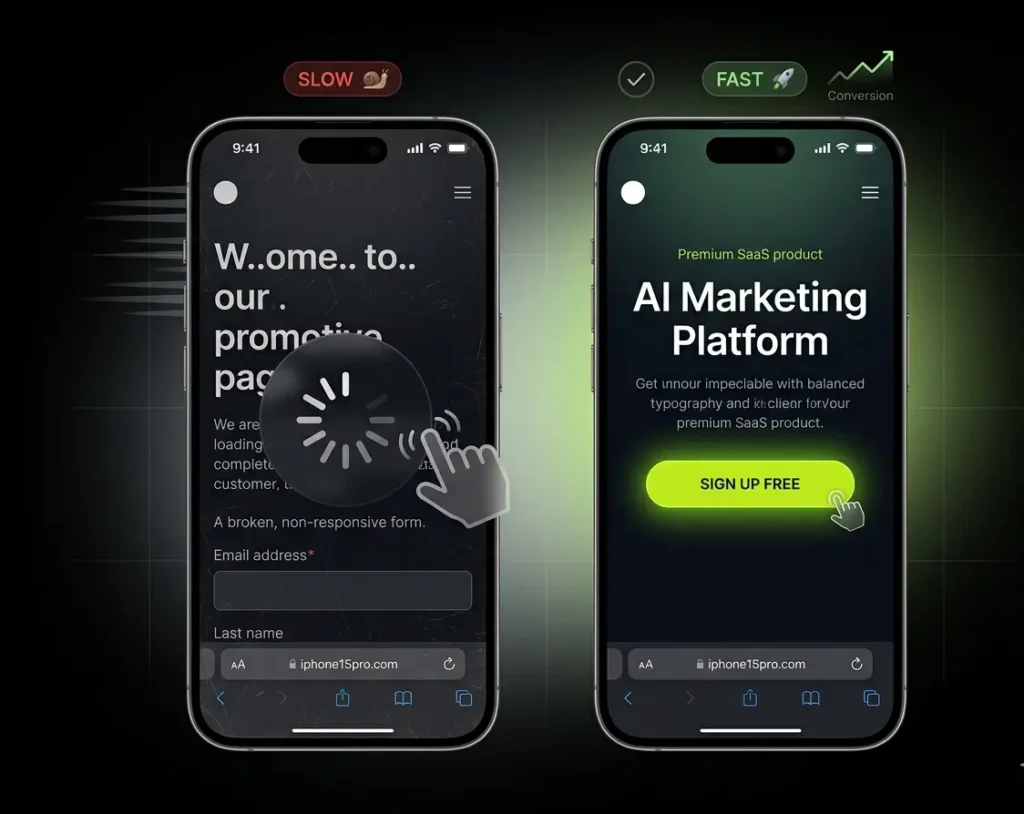
Mobile performance is the backbone of PPC success in the UAE, yet many campaigns fail to align with mobile behavior. Most advertisers still design funnels with desktop assumptions, which creates friction in real user journeys. This mismatch leads to lost conversions and wasted ad spend.
Slow Load Times
Mobile traffic in the UAE dominates user behavior, but slow-loading pages break the experience instantly. A landing page that takes more than a few seconds to load loses users before they even see the offer. This directly increases bounce rate and wastes paid clicks.
Poor Layout
Designs created for desktop often don’t translate well to smaller screens. Important elements like CTAs, forms, and key messaging get buried or misaligned. This confusion reduces engagement and lowers the chances of conversion.
Conversion Drop-Off
Even when users land on your page, friction in the mobile journey prevents action. Long forms, unnecessary steps, and cluttered sections create resistance. Simplifying the experience can significantly improve conversion rates without increasing ad spend.
Reasons Targeting Search Volume Instead of Purchase Intent Fails in UAE PPC Campaigns
Focusing on search volume instead of buyer intent leads to wasted spend and low-quality conversions in the UAE market.
Volume Trap
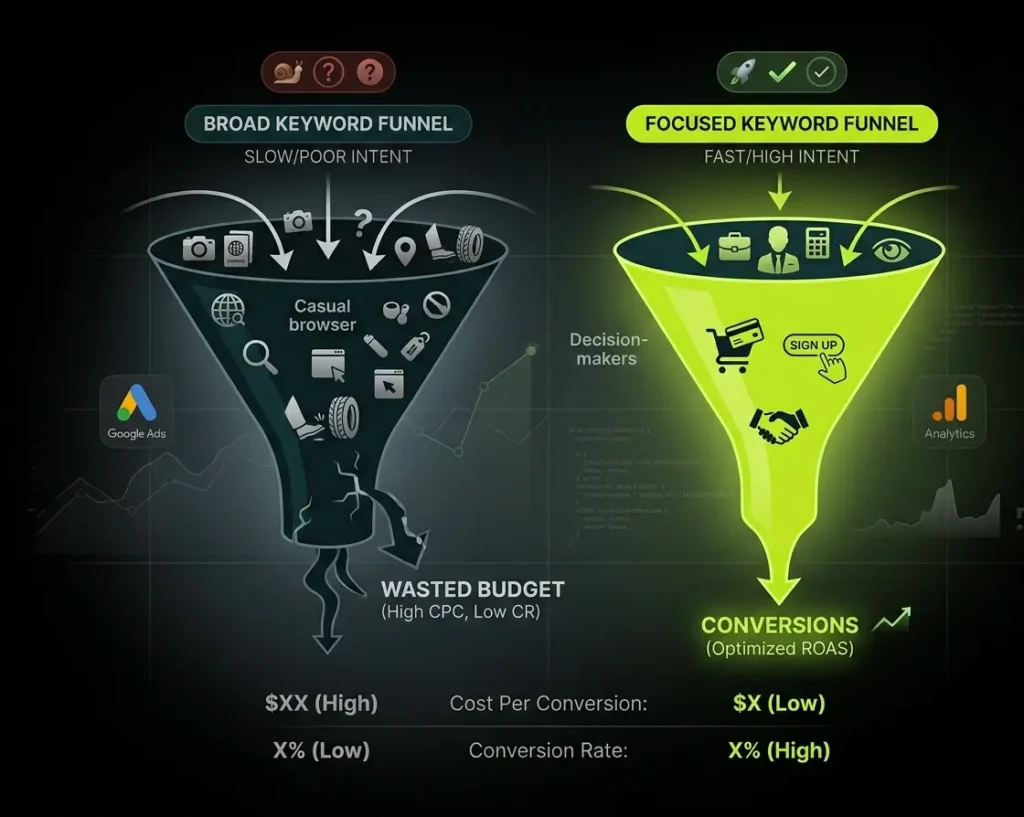
The common approach is to target keywords with the highest monthly searches and expect scale. In the UAE, this backfires because generic searches are dominated by tourists, students, and casual users. Instead of attracting buyers, campaigns end up pulling in low-intent traffic.
Mixed Intent Traffic
A keyword like luxury apartment Dubai generates around 12,100 searches, but most users are not ready to buy. It includes renters comparing prices, students researching areas, and users exploring options. This spreads your budget across audiences that do not convert.
High-Intent Searches
Specific queries like villa for sale in Jumeirah 2024, penthouse Dubai Marina ready possession, or buy freehold villa Arabian Ranches have lower volume but stronger intent. These searches filter out casual users and attract people actively looking to purchase. As a result, they convert at significantly higher rates.
Budget Misallocation
Most campaigns allocate a large share of budget to broad keywords while ignoring long-tail variations. This leads to high CPC spend on traffic that does not convert. At the same time, high-intent opportunities remain underutilized.
Long-Tail Neglect
Long-tail keywords are often dismissed as too small to matter. In reality, they deliver better return on ad spend because they capture qualified users. Ignoring them weakens overall campaign performance.
Negative Keyword Gap
Campaigns often pay for searches that will never convert because they are not filtered properly. Search term reports usually contain irrelevant queries, yet they are not actively excluded. This leads to continuous budget loss.
Irrelevant Queries
For example, a cosmetic dental campaign can appear for searches like cheap tooth extraction UAE or dental cleaning cost comparison. These users are not looking for premium services. Still, they trigger ads and consume budget.
Budget Leakage
Unfiltered searches can drain around 15 to 25 percent of total spend. These clicks do not contribute to conversions and reduce overall efficiency. Over time, this weakens campaign performance.
Missing Negatives
Without a structured negative keyword list, the same irrelevant queries keep triggering ads. This prevents campaigns from improving over time. Many setups, including those handled by agencies like Skills Heaven, show this gap clearly.
Performance Impact
Adding negative keywords improves targeting precision and shifts budget toward high-intent users. This reduces wasted spend and improves conversion rates. Without this step, even well-structured campaigns struggle to perform.
Arabic Language Mistakes That Break UAE PPC Campaign Performance
The following mistakes often go unnoticed in bilingual campaigns, something Skills Heaven regularly comes across when working on Arabic ad structures.
Literal Translation Issues
Basic translation tools convert words but miss meaning and intent. Arabic messaging needs cultural adaptation, not direct word-for-word translation. When ads sound generic or foreign, users scroll past without engaging.
Intent Mismatch in Messaging
A phrase like best online deals translated directly into Arabic loses its emotional and commercial impact. Local phrasing focuses more on value and smart savings rather than literal wording. This difference affects how users perceive trust, urgency, and relevance.
Lack of Cultural Relevance
Arabic audiences in the UAE are not uniform and respond differently based on background. Messaging that works for one group may feel off or unnatural to another. Without localization, campaigns fail to connect with the intended audience.
Timing Misalignment
Running ads on a standard schedule during Ramadan leads to wasted spend. Most conversions happen after Iftar, not during the day. Without adjusting ad timing, campaigns miss high-intent traffic windows.
Seasonal Intent Changes
User priorities shift toward family, gifting, and group purchases during Ramadan and Eid. Campaigns focused on regular offers fail to match this change in intent. Ad messaging and targeting must adapt to stay relevant.
Landing Page Friction That Reduces Conversions in UAE Mobile PPC Campaigns
Small friction points on mobile landing pages quietly reduce conversions and waste high-cost UAE traffic.
Form Complexity
- Too Many Fields: Forms asking for 6–8 inputs overwhelm users, especially on mobile where typing is slower and effort feels higher.
- High CPC Loss: At around 15 AED per click, every abandoned form directly turns into wasted budget.
- Mobile Disruption: Users switch apps, lose context, or exit midway when forms feel long or intrusive.
- Unnecessary Data: Fields like company registration, industry type, or annual revenue create friction without immediate value.
- Real Impact: Simplifying forms to name, email, and phone has shown completion rates jump from 6% to 18% on the same traffic.
Bilingual Experience
- Hidden Language Toggle: Arabic-English switch is often small, buried, or not visible immediately on landing.
- Extra Effort: Each additional tap increases abandonment, especially for users expecting instant clarity.
- Mismatched Entry: Users clicking Arabic ads land on English pages, creating confusion from the first second.
- Unequal Design: Arabic experience is treated as secondary instead of being equally accessible.
- Auto Detection: Language detection based on user behavior or geo removes friction instantly.
- Conversion Lift: Removing this friction improves Arabic segment performance by up to 1.4x–1.8x without changing ads.
Setting Bids Without Understanding UAE CPC Economics
Unrealistic bidding in the UAE leads to poor visibility or wasted spend because CPCs are significantly higher than Western markets.
High CPC Reality
CPCs in premium UAE segments are far higher than most advertisers expect. Luxury real estate can reach 25 to 40 AED per click, legal services 30 to 60 AED, and consulting or finance even higher. Bidding too low results in no visibility, while aggressive bidding without strategy quickly drains budget.
No ROAS Anchor
Bidding without a defined return target turns campaigns into guesswork. Increasing bids for more traffic often raises CPA without improving conversions. Without a clear ROAS or CPA baseline, spend grows while profitability declines.
Cost vs Conversion Math
Bidding should be based on actual business economics, not competition. If your allowable acquisition cost is 315 AED and conversion rate is 2.5%, it takes around 21 clicks at 15 AED CPC to convert one customer. Small improvements in conversion rate significantly change how much you can afford to bid.
Margin Misalignment
Most campaigns ignore how margins impact bidding decisions. When bids are set without considering profit per sale, campaigns may generate revenue but not actual profit. Aligning bids with margins ensures sustainable scaling.
Device Blindspots
Average CPC hides performance differences across devices. Mobile may convert at 0.8% while desktop reaches over 3%, yet many campaigns treat them equally. Without device-level adjustments, the budget is wasted on lower-performing traffic.
Daypart Gaps
Conversion behavior changes throughout the day in the UAE. Evening hours often convert significantly better than midday, but many campaigns run flat bids across all hours. This leads to overspending during low-intent periods.
Weekly Trends
Performance also varies by day of the week. Some businesses see stronger conversions mid-week compared to Mondays or Fridays due to workflow patterns. Adjusting bids based on these trends improves efficiency without increasing spend.
Tracking Mistakes That Break UAE PPC Campaign Performance
The following tracking gaps often go unnoticed in campaigns and continue draining performance, something Skills Heaven consistently factors in during account audits.
Hidden Tracking Failures
You set up conversion tracking, assume it works, and launch. Six weeks later, you’re optimizing based on incomplete or broken data. Issues like broken UTM parameters, site tagging errors, and cross-domain tracking gaps make ROAS calculations unreliable.
Platform Data Mismatch
Your website reports conversions while Google Ads shows different numbers with no clear explanation. Cross-domain tracking often breaks between ad click, funnel page, and conversion page. Form submissions may track in analytics but not pass back to Ads, and click-to-call conversions often go completely untracked.
False Optimization Signals
Campaigns begin optimizing toward incorrect data without realizing it. One account showed a 2.2% conversion rate when the actual rate was 0.6% due to broken form tracking. The budget was pushed toward keywords that appeared to perform but were not generating real results.
Search Term Neglect
Your search term report sits unreviewed for weeks while irrelevant queries keep triggering ads. In that time, 15–20% of the budget is spent on traffic you do not want. This waste continues silently without regular audits.
Missed Keywords
Search term reports often reveal dozens of irrelevant queries that should be blocked. Many campaigns carry 40–80 unnecessary terms that keep the budget consuming. Without adding negatives, targeting remains loose and inefficient.
Compounding Budget Waste
Proper weekly audits identify non-converting patterns and remove waste quickly. Blocking even one bad search term can save 50–100 AED per week. Over time, this shifts budget toward qualified searches and improves conversion rates.
Ad Copy Mistakes That Reduce CTR and Increase CPC in UAE PPC Campaigns
Low CTR in UAE PPC campaigns directly increases CPC because Quality Score penalties make you pay 18–22% more for the same keywords.
Generic Value Propositions
- Invisible positioning: Phrases like best quality service in Dubai appear in 100+ competitor ads, so your ad blends in and gets ignored.
- Feature-heavy copy: Describing services instead of outcomes fails to trigger action from users already searching with intent.
- No outcome clarity: Competitors using lines like save 8 hours monthly or qualify in 2 days attract users ready to act.
- CTR gap impact: The difference between 1.5% and 3.2% CTR is often just messaging precision, not budget or targeting.
- CPC inflation: Lower CTR reduces Quality Score, which pushes your cost per click higher for identical keywords.
Weak or Misaligned CTAs
- Low-commitment CTAs: Using learn weakens intent capture compared to action-driven CTAs.
- Intent mismatch: High-intent users respond to buy now or get a quote, while exploratory users prefer to see pricing or learn more.
- Missed urgency: Lack of urgency signals like sale ends in 2 days reduces click motivation.
- Performance difference: A clear CTA like shop now can push CTR from 2.1% to 3.8% on the same audience.
- ROAS impact: Better CTAs don’t just increase clicks, they improve traffic quality and overall conversion efficiency.
Conclusion
PPC campaigns fail in UAE markets not because the market is difficult, but because the core setup ignores how the market actually works. Mobile-first behavior, bilingual precision, cultural segmentation, high CPCs, and consistent optimization are what separate profitable campaigns from those that waste budget. Skills Heaven rebuilds underperforming accounts by focusing on strategy, audience targeting, mobile experience, bidding approach, tracking, and messaging. Contact Skills Heaven today to fix PPC mistakes in UAE and turn wasted ad spend into real results.
The diagnosis process is simple. Audit your campaigns using these mistake areas. You will likely find three to five clear gaps. Fix the most impactful ones first, such as tracking, mobile experience, or audience targeting. Revenue often improves within 30 days because you are reducing waste, not increasing spend.
Frequently Asked Question
How do I know if my PPC campaign is wasting budget on wrong keywords?
Check your search term report for queries with high spend and zero conversions. Add them as negative keywords quickly.
Should I run Arabic and English PPC campaigns separately in the UAE?
Yes, separate campaigns perform better. Each language has different CPCs, search behavior, and intent. Separation allows better control over bids, budget, and messaging, improving overall ROAS in bilingual UAE campaigns.
What is a good conversion rate for UAE PPC campaigns?
Conversion rates vary by industry. B2B ranges from 0.5–2%, e-commerce 1–4%, services 0.8–2.5%, and real estate 0.3–1.5%. If performance is low, review landing pages and audience targeting before increasing spend.
How often should I adjust bids in UAE PPC campaigns?
Review bids weekly for active campaigns. UAE CPCs change due to competition and seasonality. Bid adjustments by device, audience, and time of day should be reviewed monthly. Skills Heaven performs weekly audits to catch performance drops early.
What is the main reason PPC campaigns underperform in UAE?
Weak audience targeting and poor mobile experience are the main issues. UAE audiences are diverse, and mobile traffic dominates. Fixing segmentation and mobile friction usually improves conversions and overall campaign performance.

M. Awais Khan is a Business Development and Digital Growth Strategist at SkillsHeaven, specializing in SEO, local search optimization, and performance-driven digital marketing. With experience supporting 100+ businesses, he develops and implements data-driven strategies that help companies increase online visibility, generate qualified leads, and drive sustainable revenue growth. His expertise spans Local SEO, Google Ads, social media marketing, and conversion-focused website optimization, ensuring every project is aligned with measurable business outcomes and long-term success.