Why Most UAE Landing Pages Fail to Convert
Here is an uncomfortable truth: most UAE businesses are spending real money driving traffic to landing pages that quietly destroy that investment every single day. They invest in Google Ads, Meta campaigns, and influencer partnerships and then send visitors to a page that confuses, overwhelms, or simply fails to earn trust.
The result is high traffic paired with low conversions, and a growing frustration that digital marketing doesn’t work.
The UAE digital landscape in 2026 is more competitive than ever. Over 9.7 million people in the Emirates are active internet users. Smartphone penetration exceeds 97%, and e-commerce revenue is projected to surpass AED 55 billion.If you want to stand out, drive conversions, and maximize ROI, investing in professional Landing Page Design for UAE Businesses is no longer optional—it is essential for growth.
Your customers are online, they are ready to buy, and they are ruthlessly quick to leave a page that doesn’t immediately feel right.
UAE Conversion Rate Benchmarks: How Does Your Page Compare?
The average landing page conversion rate globally sits around 2.35%. The top 25% of landing pages convert at 5.31% or above. In the UAE, where consumer trust is harder to earn but brand loyalty runs deeper once it is established, top-performing landing pages regularly achieve 6% to 11% conversion rates but only when they follow a disciplined design framework.
This guide gives you that framework. Every section is built around what actually works in the UAE market in 2026, not recycled generic advice. Whether you are running a real estate lead generation page in Dubai, a service booking page in Abu Dhabi, or a product launch page for a national e-commerce brand, these principles apply directly to your situation.
What This Guide Covers
- The psychology behind UAE buyer decisions and how to design around them.
- 8 core landing page best practices each with UAE specific examples and actionable steps.
- Advanced 2026 strategies your competitors haven’t implemented yet.
- A complete pre launch checklist, FAQ section, and industry specific tips.
Craft a Value Proposition That Speaks Directly to UAE Audiences
At Skills Heaven, we’ve seen that visitor lands on your page and their brain asks one question within the first three seconds: ‘Is this for me?’ Your value proposition is the answer. Get it right, and they lean in. Get it wrong, and they leave forever.
The common mistake UAE businesses make is writing value propositions from the inside out: ‘We are a leading provider of premium digital solutions with over 15 years of experience’ Nobody reads past the third word. Your customer does not care about your legacy they care about their problem, and whether you can solve it faster, better, or more affordably than anyone else.
The Headline Subheadline Bullet Formula That Works
The most reliable structure for a UAE landing page value proposition follows a three part formula:
- The Headline: One powerful sentence that states the primary benefit, not the feature. Example: ‘Fill Your Dubai Property in 30 Days Or We Work for Free.’
- The Subheadline: Two to three sentences that clarify who this is for and how it works. Keep it plain. No jargon, no buzzwords.
- Three to Five Bullet Points: Specific, scannable benefits that support the headline. Lead each bullet with the outcome, not the process.
What Makes a Value Proposition UAE Ready?
UAE buyers whether Emirati nationals, South Asian expats, Arab professionals, or Western executives share certain decision-making traits that your value proposition must address:
- Trust before transaction: UAE consumers research extensively before buying. Your value proposition must signal credibility from the first line.
- Speed and convenience: The UAE is a high pace market. Phrases like ‘same day delivery,’ ‘instant quote,’ or ‘setup in 24 hours’ outperform vague promises.
- Status and quality: Particularly in Dubai and Abu Dhabi, aspirational language tied to quality and exclusivity outperforms purely price led messaging.
- Local relevance: Reference to UAE-specific contexts (free zones, ADNOC suppliers, Dubai property market, UAE Vision 2031) signals that you understand their world.
Actionable Tip The 5-Second Test
Print your landing page headline on a plain piece of paper. Show it to someone unfamiliar with your business for exactly 5 seconds, then take it away. Ask: What does this company do? Who is it for? Why should I choose them? If they cannot answer all three, your value proposition needs work.
A/B Testing Your Value Proposition for the UAE Market
Never assume your first version is your best version. Run A/B tests on your headline using at least 500 visitors per variant before drawing conclusions. In the UAE’s multicultural market, the same offer often resonates differently across audience segments. A headline targeting property investors in Dubai Marina may fall flat with SME owners in Sharjah. Segment your traffic and test accordingly.
Internal link: For a deeper guide on understanding your UAE customer’s language, visit the Skills Heaven blog on Digital Marketing Strategy for UAE Businesses.
Design a Single, Irresistible Call to Action (CTA)
Skills Heaven recognizes that every landing page has one job, your CTA is the moment that job either gets done or doesn’t. Yet the single most common landing page mistake in the UAE market is offering too many choices: a ‘Contact Us’ button, a WhatsApp link, a ‘Learn More’ tab, a newsletter signup, and a social media icon strip. Each additional option dilutes the others. Psychology calls this ‘decision paralysis,’ and it silently kills conversions every minute of every day. Remove everything except one primary action. One page, one goal, one CTA.
CTA Button Design: Color, Size, and Placement
Your CTA button must demand attention without screaming. In the UAE market, these design principles consistently outperform generic approaches:
- Color contrast: Your CTA button must contrast sharply with the page background. If your brand palette is navy and white, an orange or green CTA button will dramatically outperform a navy one. Never use the same color as your background or dominant design elements.
- Size and touch targets: For mobile users who represent the majority of UAE web traffic buttons must be at least 48px tall. Anything smaller creates tap errors on smartphones and frustrates users into leaving.
- Whitespace around the button: Give your CTA room to breathe. Crowding it with text or other elements reduces its visual authority and click-through rate.
Writing CTA Copy That Drives Action UAE Examples
The words on your button matter more than most designers admit. ‘Submit’ is the weakest CTA in existence. It tells the user what they are doing, not what they are getting. Replace process language with value language:
- Instead of ‘Submit’ → ‘Get My Free Quote’
- Instead of ‘Sign Up’ → ‘Start My Free Trial Today’
- Instead of ‘Learn More’ → ‘See How It Works’
- Instead of ‘Contact Us’ → ‘Speak to a UAE Expert Now’
- Instead of ‘Buy Now’ → ‘Claim My Exclusive Offer’
UAE Mini Case Study
A Dubai-based property management firm replaced ‘Contact Us’ on their landing page CTA with ‘Get Your Free Rental Yield Report.’ Within 30 days, form submissions increased by 67% with no change to ad spend, targeting, or page design. The only change was four words on a button.
Above the Fold vs. Repeated CTAs The Right Balance
Your primary CTA must appear above the fold visible without any scrolling. For longer pages (above 800 words of content), repeat the CTA at natural pause points: after your key benefit section, after testimonials, and at the absolute bottom of the page. Each repetition should use slightly different button copy to feel contextually relevant rather than repetitive.
Mobile First Design The Non Negotiable Foundation
In 2026, designing a landing page for desktop first is the equivalent of building a shop with a main entrance that only tall people can use. The UAE has one of the highest smartphone penetration rates in the world at over 97%, and more than 72% of all web traffic in the region now originates from mobile devices. If your landing page does not deliver a flawless mobile experience, you are not just losing mobile users, you are losing the majority of your potential customers.
What Mobile-First Actually Means
Mobile first is not ‘make the desktop version smaller.’ It is a fundamentally different design philosophy: you start with the most constrained screen size (typically 375px wide) and design upward. This forces disciplined prioritisation only the truly essential elements survive the small screen constraint, which paradoxically makes the page better on all devices.
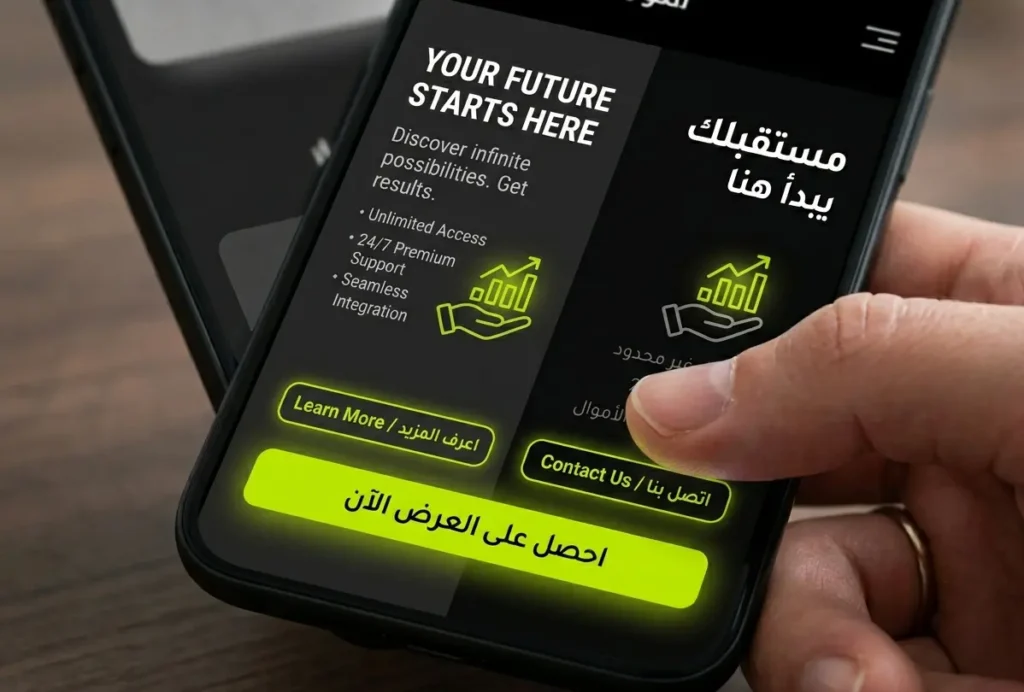
Arabic RTL Design Considerations for UAE Audiences
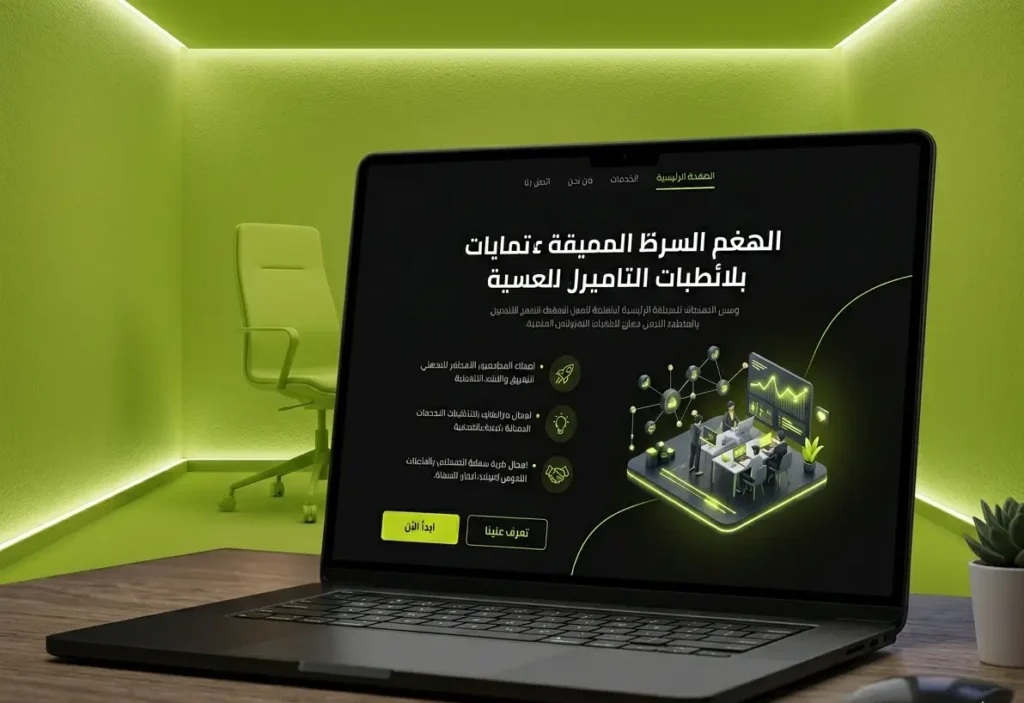
This is the section your competitors skipped, and it costs them dearly. The UAE’s population is approximately 30% Arab nationals and a significant proportion of Arabic-speaking expats. If your business serves this audience and your landing page is only available in English with left-to-right (LTR) layout, you are leaving conversions on the table.
Key RTL considerations for UAE landing pages:
- Typography alignment: Arabic text must align right. Mixing Arabic copy into an LTR layout creates a jarring, untrustworthy visual experience.
- Button and icon placement: In RTL layouts, directional arrows and chevrons should point left (backward in LTR becomes forward in RTL).
- Form field direction: Input fields must be RTL-native. Browser autocomplete for Arabic names and addresses requires specific HTML direction attributes.
- Image mirroring: Illustrations showing directional flow (e.g., a user journey or process steps) should be mirrored for RTL audiences.
Designing for Touch: Practical Standards
Mobile users interact with their thumbs, not a precise cursor. Design every interactive element with the ‘thumb zone’ in mind the central-lower area of the screen that is most naturally reachable without repositioning the hand. Specifically:
Single-column layout: On screens below 480px, stack all content vertically. Side-by-side columns on mobile create horizontal scrolling, which is the fastest way to lose a user.
- Minimum tap target size: 48×48 CSS pixels for all buttons and links.
- Spacing between interactive elements: At least 8px to prevent accidental taps.
- Form fields: Large, clearly labelled, with ample height (minimum 44px) and large enough text (16px minimum) to prevent iOS from auto-zooming on focus.
- Single-column layout: On screens below 480px, stack all content vertically. Side-by-side columns on mobile create horizontal scrolling, which is the fastest way to lose a user.
Actionable Tip Real Device Testing
Browser simulators lie. Test your landing page on real physical devices — at minimum, an iPhone (Safari), a Samsung Galaxy (Chrome), and an older Android device (to simulate lower-spec hardware). UAE users span the full spectrum of device quality
Above the Fold Optimisation Win in the First 5 Seconds
The ‘fold’ is the bottom edge of the visible screen before a user scrolls. Everything above it is premium real estate, the most viewed, most influential space on your entire page. Studies consistently show that 80% of user attention is spent above the fold. What you put there determines whether a visitor decides to stay and engage or immediately bounces.
What Belongs Above the Fold in 2026
A high-converting above-the-fold section in 2026 contains exactly five elements no more, no less:
- A headline that communicates your primary value proposition in plain language.
- A subheadline that expands on the headline and qualifies the audience.
- A hero visual either an image or an autoplay (muted) video that emotionally reinforces the headline.
- One primary CTA button, clearly visible and high-contrast.
- A single trust signal a recognisable client logo, a star rating, a media mention, or a security badge.
Hero Images vs. Hero Videos What Works in the UAE
Video backgrounds can increase time-on-page by up to 88%, but they come with a significant risk: page speed. An unoptimised hero video can add 3-8 seconds to your load time, which in the UAE’s competitive mobile-browsing environment will destroy your bounce rate. If you use video, follow these non-negotiable rules:
- Autoplay must be muted by default (required by all major browsers).
- Video file size must be below 5MB use .mp4 with H.264 encoding.
- Always provide a static image fallback for slow connections.
- Video content should loop seamlessly and reinforce the headline not distract from it.
Using Heatmaps to Validate Your Layout
Tools like Hotjar and Microsoft Clarity (both free to start) generate heatmaps showing exactly where users look, click, and scroll. For UAE landing pages, heatmap data consistently reveals two surprises: first, users click on images that look like buttons but don’t make sure your actual buttons are visually unmistakeable. Second, attention drops sharply at the fold line if your CTA is even slightly below the fold on a popular screen resolution, clicks drop by an average of 41%.
Social Proof and Trust Signals That Convert UAE Visitors
Trust is the currency of online conversion. In the UAE’s diverse market, where consumers have been burned by fly by night businesses and predatory e-commerce operators, earning trust quickly is not a ‘nice to have’ it is the conversion. A page that looks credible converts; one that raises even a flicker of doubt does not.
Why UAE Audiences Are Especially Trust Sensitive
The UAE hosts a consumer base that is simultaneously one of the most digitally sophisticated in the world and one of the most trust-sensitive. Consumers here have high expectations for professionalism and have developed sharp radar for anything that feels inauthentic. Generic stock photos of smiling models, vague ‘over 10,000 happy customers’ claims without evidence, and poorly translated English to Arabic copy all trigger immediate distrust.
The Trust Signal Hierarchy What Works Best
Not all social proof is equal. Rank your trust signals by impact and place the strongest ones closest to your CTA:
- Video testimonials (highest impact): A 30-60 second video of a real UAE customer describing a specific result they achieved outperforms every other trust signal format. Film these in a genuine setting not a white studio and include the customer’s name, company, and emirate.
- Specific written testimonials with photo, name and company: ‘Fatima Al Rashidi, Marketing Director, Majid Al Futtaim Group this team delivered our campaign three days early and exceeded our KPIs by 40%.’ That is social proof. ‘Great service!’ is not.
- Recognisable client logos: Displaying logos of well-known UAE brands (Emirates, Etihad, Emaar, ADNOC, government entities) immediately elevates perceived credibility. One recognizable logo is worth ten unknown ones.
- Third party ratings: Google Reviews, Clutch ratings, and Trustpilot scores with live review counts provide independently verified credibility that your own words cannot match.
Trust Signals Specific to UAE Buyers
Beyond universal social proof formats, certain trust signals carry particular weight with UAE audiences:
Physical address and local phone number: A UAE landline number (+971 2… or +971 4…) and a physical office address signal permanence and accountability.
UAE trade licence number: Displaying your DED or free zone trade licence number signals that you are a legitimate, regulated business not a pop-up operation.
Payment security badges: UAE consumers are increasingly cautious about online payments. Displaying 3D Secure, Visa Verified, and Mastercard SecureCode logos at payment stages reduces cart abandonment significantly.
Arabic language testimonials: A review written in Arabic by an Arab customer carries disproportionate weight with Arabic speaking audiences. Do not translate genuine Arabic testimonials.
UAE Mini Case Study
An Abu Dhabi based legal consultancy added their ADGM registration number and a video testimonial from a CFO at a recognisable UAE conglomerate to their services landing page. Lead quality (measured by contract value) improved by 34% in the following quarter, with no change to traffic sources.
Page Speed Optimisation Every Millisecond Costs Money
Google’s data is unambiguous: as page load time increases from 1 second to 3 seconds, the probability of a mobile user bouncing increases by 32%. At 5 seconds, that probability rises by 90%. At 6 seconds, by 106%.
In the UAE, where mobile users on 5G networks expect near instant loading and users on older networks in areas like Al Ain or Fujairah still experience variable connectivity, page speed optimization is both a conversion issue and an equity issue.
Core Web Vitals What They Mean for UAE Businesses
Google’s Core Web Vitals are the specific metrics that determine your page’s speed score in Google Search rankings. Understanding them is no longer optional for UAE businesses competing for organic traffic:
- Largest Contentful Paint (LCP): How long until the largest visible content element loads. Target: under 2.5 seconds. This is most often your hero image or video thumbnail.
- Cumulative Layout Shift (CLS): How much your page layout ‘jumps’ as elements load. A high CLS score means users accidentally click the wrong thing because buttons move after they tap. Target: below 0.1.
- Interaction to Next Paint (INP): How quickly your page responds to user interactions like button clicks. Target: under 200 milliseconds.
CDN Selection for UAE and Middle East Visitors
A Content Delivery Network (CDN) stores copies of your landing page assets on servers around the world, serving each visitor from the nearest location. For UAE landing pages targeting local visitors, choose a CDN provider with Points of Presence (PoPs) in the UAE or at minimum the GCC region.
Cloudflare, AWS CloudFront, and Fastly all operate UAE/Gulf region infrastructure. A well configured CDN can reduce load times for UAE visitors by 40-60% compared to a single origin server hosted in Europe or the US.
The Speed Audit You Can Do in 10 Minutes
Run your landing page URL through Google PageSpeed Insights (free) and GTmetrix (free tier available). These tools give you a specific score and prioritised list of improvements. Focus first on the issues flagged as ‘Opportunities’ these have the highest impact on real world load times. Common quick wins for UAE landing pages include:
- Compress all images using TinyPNG or Squoosh and convert to WebP format.
- Remove unused JavaScript and CSS especially from third party plugins and widgets that are not essential to the landing page’s single goal.
- Enable lazy loading for images below the fold: they only load when a user scrolls to them.
- Eliminate render blocking resources by loading non-essential scripts asynchronously.
Simplified Forms Remove Every Reason to Abandon
Your form is the last gate between a visitor and a conversion. After all the work of writing compelling copy, earning trust, and optimising your page speed, a poorly designed form can undo everything in the final moment.
The principle is simple: every field you add reduces your conversion rate. The question to ask about each field is not ‘Would it be nice to have this information?’ but ‘Is it worth losing 10-15% of our leads to get it?’
How Many Fields Are Too Many? The Data-Backed Answer
Research by HubSpot across thousands of landing pages shows the optimal number of form fields for maximum lead volume is between 3 and 5. For UAE B2B landing pages where lead quality matters more than volume, 5 to 7 fields is acceptable if each field genuinely qualifies the prospect.
Beyond 7 fields, conversion rates typically drop below the point where the additional data justifies the lost leads.
For most UAE service businesses, these three fields are sufficient for a first touch landing page: Full Name, Email Address, and Mobile Number (WhatsApp number in the UAE context is often more valuable than email for immediate follow-up).
Multi Step Forms: When Breaking It Up Increases Completions
For longer forms that genuinely require more information (e.g., insurance quote forms, property enquiry forms, business loan applications), a multi step format consistently outperforms a single long form.
The psychology is straightforward: once a user has completed step one, they are committed; the ‘sunk cost’ of the time invested motivates them to complete the remaining steps.
Structure multi step forms so that the easiest, least sensitive questions appear in step one (name, email), with more detailed or personal questions in subsequent steps. Show a clear progress indicator. Use next step button copy that sets expectations: ‘Almost There 1 More Step’ performs better than a generic ‘Next’ arrow.
Privacy and Data Concerns Among UAE Users
The UAE’s Personal Data Protection Law (PDPL) requires explicit consent for personal data collection. Beyond legal compliance, addressing privacy concerns directly on your form increases submissions.
Place a short reassurance line directly below your submit button: ‘Your details are secure and will never be shared with third parties see our Privacy Policy.’ Include a GDPR/PDPL-compliant checkbox for email marketing consent, kept separate from the form submission itself.
Actionable Tip The Form Audit
List every field on your current form. For each one, ask: ‘What would we do differently with this information in the first 48 hours after receiving a lead?’ If the answer is nothing, remove the field. You can always ask for it later in the sales conversation
Visual Hierarchy and Design Psychology for UAE Markets
Good visual design is not about aesthetics, it is about guiding the eye to the right place at the right moment. Visual hierarchy is the invisible architecture of your landing page: it determines what users see first, second, and third, and therefore what they think about, feel, and ultimately do.
How the Human Eye Reads a Landing Page
Eye-tracking research reveals two dominant reading patterns on web pages. The F-Pattern applies to text heavy pages: users scan the headline horizontally, drop down and scan a shorter horizontal line, then scan vertically down the left side.
The Z-Pattern applies to landing pages with a clear visual layout: the eye moves from top left to top right (the headline), diagonally to the bottom left, then across to the bottom right (the CTA). Understanding these patterns lets you place your most critical elements headline, key benefit, CTA precisely where the eye naturally travels.
Color Psychology in the UAE and Arab World
Color carries cultural meaning, and that meaning varies significantly by market. UAE and broader Arab audiences associate specific colors with specific qualities that differ from Western conventions:
- Green: Strongly associated with Islam, prosperity, and nature. Used by UAE government brands extensively. Appropriate for financial services, health, and sustainable brands.
- Gold and deep yellow: Signals luxury, prestige, and success in the UAE market. Highly effective for premium service brands, hospitality, and real estate.
- Dark navy and royal blue: Conveys trust, stability, and professionalism. Widely used in banking, legal, and corporate sectors.
- Red: Use cautiously. In Arab culture, red is not primarily associated with urgency or sales (as in Western markets) but can carry negative connotations. Limit red to small accent uses rather than dominant design elements.
- White: Purity and cleanliness. Works well as a background to create a premium, uncluttered feel — highly effective for UAE luxury and healthcare brands.
Whitespace The Most Underused Tool in UAE Landing Pages
UAE businesses frequently make the mistake of equating whitespace with wasted space. The reality is the opposite: whitespace is what makes your key elements breathe and stand out.
A headline surrounded by generous whitespace commands more attention than the same headline crowded by text and images. Apple’s website, one of the highest converting in the world, has more whitespace than content. This approach signals confidence, premium quality, and clarity.
Localisation Designing for UAE’s Multicultural Audience
The UAE is home to over 200 nationalities. No other market on earth requires as nuanced an approach to audience localisation. A landing page that works brilliantly for British expats in Dubai Marina may completely miss the mark with Emirati decision makers in Abu Dhabi or South Asian entrepreneurs in Sharjah. Localisation is not just translation it is a full reimagining of your message for each audience segment.
English vs. Arabic Landing Pages When to Use Each
The practical answer for most UAE businesses is both but with a deliberate strategy:
- English first with Arabic option: Appropriate for B2B technology, professional services, and international brands whose primary decision-makers are likely to be English-speaking regardless of nationality.
- Arabic first with English option: Appropriate for government-related services, Islamic finance, local retail, and any business where Emirati nationals or Arabic speaking Arab nationals are the primary audience.
- Fully separate landing pages per language: The highest converting approach for businesses with sufficient traffic. Each page is written natively, not translated, for its target audience.
Geo Targeting by Emirate
Abu Dhabi, Dubai, Sharjah, and the Northern Emirates represent meaningfully different buyer profiles, price sensitivities, and communication preferences. A real estate landing page performing well in Dubai JVC may underperform in Abu Dhabi’s investment market without localised adjustments.
Use UTM parameters in your ad campaigns to direct traffic from each emirate to a dedicated landing page variant, or use dynamic content tools to swap city-specific references based on the visitor’s location.
Localised Offers and CTAs That Resonate
Small language adjustments create outsized impact. ‘WhatsApp Us Now’ consistently outperforms ‘Contact Us’ in the UAE, where WhatsApp is the dominant business communication channel.
Request a Call Back outperforms ‘Fill in the Form’ because it implies personal service. ‘Schedule a Free Consultation’ outperforms ‘Get in Touch’ because it sets a clear expectation and removes uncertainty from the next step.
Advanced Strategies for 2026 Your Competitive Edge
The basics covered above will put your landing page ahead of most UAE competitors. The following strategies represent the next frontier approaches that high performing UAE digital brands are implementing now, and that your competitors likely have not discovered yet.
AI Powered Personalisation: Dynamic Landing Pages
In 2026, serving a single static landing page to every visitor is the equivalent of playing the same sales pitch to every prospect regardless of who they are or what brought them to your page.
AI-powered dynamic content tools (including offerings from Mutiny, Optimizely, and HubSpot’s smart content features) allow you to automatically swap headline text, imagery, testimonials, and even CTA copy based on:
- The ad or keyword that brought the visitor to the page (UTM parameters)
- The visitor’s geographic location (emirate or city)
- Whether the visitor is a first-time or returning visitor
- The device and browser being used
A visitor arriving from a Google Ad for ‘property management Abu Dhabi’ sees a headline that references Abu Dhabi property, while a visitor from a Dubai-targeted campaign sees a Dubai specific copy. The same page, dramatically different results.
Exit Intent Popups That Recover UAE Visitors
When a desktop user moves their cursor toward the browser’s back button or address bar, exit intent technology can detect this signal and display a targeted popup before the visitor leaves.
Effective exit intent popups in the UAE market offer something of genuine value: a free consultation, a downloadable guide, a limited time discount, or simply a different CTA (e.g., switching from ‘Book Now’ to ‘WhatsApp Us Instead’ for visitors who were not ready to commit to a form).
Thank You Pages That Continue the Conversion
Most UAE businesses treat the Thank You page as the end of the journey. High-performing businesses treat it as the beginning of the next one. Your Thank You page, the page a visitor sees after completing your form is the highest-trust moment in the entire customer journey. The visitor just said yes to you. Use this moment to:
- Confirm exactly what happens next (call within 24 hours, email with next steps, etc.)
- Offer an upsell or complementary resource relevant to their specific inquiry
- Encourage a social share or referral with a simple incentive
- Reduce post-submission anxiety with a clear timeline and contact details for follow-up
Measuring What Actually Matters Analytics for UAE Landing Pages
You cannot improve what you do not measure. Yet the majority of UAE businesses operating landing pages are flying blind they know their total conversion count but have no understanding of where the page is losing people, what elements are driving conversions, and which audience segments are most valuable.
Essential Metrics Every UAE Business Should Track
| Metric | What It Tells You |
| Conversion Rate (%) | Overall page effectiveness — leads or sales divided by visitors |
| Bounce Rate | Percentage leaving after one page — high bounce = above-fold problem |
| Time on Page | Engagement quality — very short or very long times both signal issues |
| Scroll Depth (%) | How far users reach — reveals where interest drops off |
| CTA Click Rate | How compelling your CTA is low rate means copy or design issue |
| Form Abandonment Rate | Percentage starting but not completing the form with too many fields? |
| Mobile vs. Desktop CVR | Whether your mobile experience matches your desktop experience |
| Traffic Source CVR | Which ad channel brings the highest-quality, best-converting visitors |
How to Run a Proper A/B Test
A/B testing is not guessing with data it is a structured experiment. For valid results in the UAE market:
- Test one variable at a time: headline OR CTA color OR hero image. Testing multiple elements simultaneously makes it impossible to know what caused the change.
- Run each test for a minimum of two weeks and 500 visitors per variant to achieve statistical significance.
- Define your success metric before starting conversion rate for the primary CTA, not secondary metrics.
- Do not stop a test early because one variant looks better in week one. UAE consumer behavior often shifts around weekends (Thursday-Friday), religious holidays, and shopping events.
Industry-Specific Landing Page Tips for UAE Businesses
Real Estate Dubai and Abu Dhabi
UAE real estate landing pages compete in one of the most aggressively advertised digital spaces in the world. Differentiation requires hyper specificity: name the specific development, the exact payment plan, the precise ROI percentage.
Vague ‘luxury apartments’ pages convert a fraction of what specific ‘AED 1.2M 2-bedroom in Business Bay 30% down, 70% over 7 years’ pages achieve. Include a floor plan download, a virtual tour link, and a WhatsApp CTA for immediate follow up UAE property buyers expect instant response.
E-Commerce Product Landing Pages
For UAE e-commerce, the single most impactful addition to a product landing page is a local shipping promise: ‘Order before 2pm delivered to Dubai today.’ UAE consumers have been conditioned by Amazon.ae, Noon, and other fast delivery platforms to expect speed.
Competing in this dimension is essential. Including free returns information prominently UAE consumers cite fear of returns complexity as a primary barrier to first-time online purchases with new brands.
Professional Services (Legal, Finance, Medical)
Trust is everything for professional services landing pages in the UAE. Lead with qualifications, certifications, and regulatory registrations (DHA license for healthcare, DFSA registration for finance, Dubai Courts registration for legal).
Feature the specific professional who will handle the enquiry by name and photograph personalisation dramatically reduces anxiety in high stakes service decisions. A short video introduction from the lead practitioner, placed above the fold, consistently outperforms all other trust signal formats in this category.
Pre-Launch Checklist for UAE Landing Pages
| Before Launch | Ongoing Optimisation |
| ✓ Value proposition tested with 5-second test | ✓ Weekly conversion rate review |
| ✓ Single primary CTA — no competing actions | ✓ Monthly A/B test running |
| ✓ Mobile experience tested on real devices | ✓ Heatmap review every 30 days |
| ✓ Page load time under 3 seconds on mobile | ✓ Form field audit quarterly |
| ✓ SSL certificate installed (HTTPS) | ✓ Testimonials updated every 6 months |
| ✓ Trust signals visible above the fold | ✓ Speed audit monthly |
| ✓ WhatsApp CTA included for UAE audience | ✓ Analytics goals verified monthly |
| ✓ Privacy Policy link and consent checkbox | ✓ User session recordings reviewed |
| ✓ Thank You page configured with next steps | ✓ Seasonal offers updated as relevant |
Conclusion Build Landing Pages That Work as Hard as Your Business
The difference between a landing page that converts at 1.5% and one that converts at 7% is not luck, and it is not budget. It is the consistent, disciplined application of the principles covered in this guide: a value proposition written in your customer’s language, a single irresistible CTA, a mobile first design that works beautifully on the device your customer is actually using, trust signals placed exactly where doubt arises, and a page that loads before impatience sets in.
In the UAE’s 2026 digital landscape, every one of these elements is table stakes. The businesses winning online are the ones that go further testing continuously, personalising for their specific audience segments, designing with UAE cultural context in mind, and treating their landing page not as a one time project but as a living, evolving business asset.
The brands that treat landing page optimisation as ongoing discipline not a launch and forget task are the ones that compound their competitive advantage month after month. Every percentage point of conversion rate improvement multiplies the return on every dirham spent on advertising
Ready to Turn Your Landing Page Into a Conversion Machine?
Skills Heaven’s UAE-based digital marketing experts design and optimise landing pages that consistently outperform industry benchmarks — for businesses across all sectors and emirates. Get Your Free Landing Page Audit from Skills Heaven Today
Visit skillsheaven.ae | WhatsApp: +971559504395 No obligation.
No jargon. Just a clear, actionable plan to grow your conversions.
Frequently Asked Questions
What is the ideal length for a UAE landing page?
The ideal length depends on your offer’s complexity: simple lead generation works best at 400-600 words, while high value products like property or software require 1,200-2,500 words to build trust. Ultimately, your page should be just long enough to answer all visitor objections and secure the conversion.
How many CTAs should a landing page have?
The length depends on complexity: simple lead generation needs 400-600 words, while high value products like property or software require 1,200-2,500 words. Your page should be just long enough to address all visitor objections and secure the conversion
Should my UAE landing page be in English or Arabic?
Ideally, both but as separate, natively written pages. Most UAE B2B firms succeed with English first, while consumer and government brands should prioritize Arabic. Never use machine translation; poor Arabic instantly destroys your credibility with native speakers
What is a good conversion rate for a UAE landing page?
In the UAE, lead generation usually converts at 3-7%, while e-commerce averages 1.5-4%. A rate below 2% indicates design or messaging issues, whereas anything above 8% is excellent and suggests you should focus on increasing traffic.
Do I need separate landing pages for Google Ads and Meta Ads?
Yes, because intent differs: Google users actively search for solutions, while Meta users are scrolling a feed. Google visitors need immediate confirmation of their search, whereas Meta visitors require a stronger hook and more context. Use UTM parameters and dynamic content to serve tailored headlines or hero images to each audience.
How does landing page speed affect my Google Ads Quality Score?
Directly and significantly. Google’s Quality Score for paid search ads includes ‘Landing Page Experience’ as a major component, alongside expected click-through rate and ad relevance. A slow, low quality landing page leads to a lower Quality Score, which increases your cost per click and reduces your ad position relative to competitors. Improving landing page speed and relevance is one of the few ways to simultaneously improve conversion rate and reduce ad costs.
What tools do UAE businesses use to build high converting landing pages?
Popular choices among UAE digital marketers include: Unbounce and Instapage (purpose built landing page platforms with A/B testing built in), HubSpot CMS (for businesses with CRM integration requirements), WordPress with Elementor Pro (flexible, cost effective for most SMEs), and Webflow (for design-forward brands requiring precise visual control). For UAE specific hosting performance, ensure your chosen platform supports CDN delivery through UAE/GCC region servers.

M. Awais Khan is a Business Development and Digital Growth Strategist at SkillsHeaven, specializing in SEO, local search optimization, and performance-driven digital marketing. With experience supporting 100+ businesses, he develops and implements data-driven strategies that help companies increase online visibility, generate qualified leads, and drive sustainable revenue growth. His expertise spans Local SEO, Google Ads, social media marketing, and conversion-focused website optimization, ensuring every project is aligned with measurable business outcomes and long-term success.