
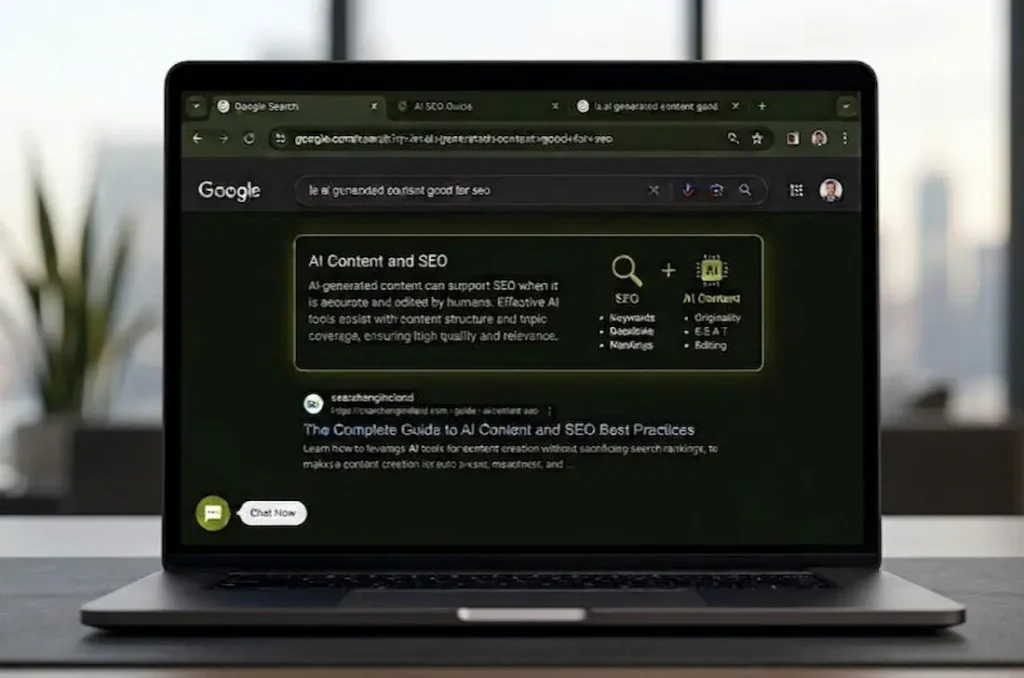
AI-generated content is good for SEO when it is accurate, well-structured, and genuinely useful to readers, and it can hurt your rankings when it is published in bulk without editing or expertise behind it. The real factor Google weighs is quality and helpfulness, not whether a human or a machine typed the first draft.
If you are searching for is AI generated content good for SEO because your traffic has stalled or you are unsure whether to scale up your blog with AI tools, here is the short version: it depends entirely on how the content is produced, reviewed, and structured after it leaves the AI tool. We provide AI content strategy and SEO writing services, helping local businesses use AI the right way instead of guessing.
What Google Actually Says About AI Generated Content
Google has been fairly consistent on this point for years. Its search quality team has stated that automation, including AI, has long been used to produce helpful content such as weather updates, sports scores, and transcripts, and that this kind of automation is not against its guidelines. What violates Google’s spam policies is using automation with the primary goal of manipulating rankings, regardless of whether AI was involved.
So when people ask “Does AI content affect SEO?”, the honest answer is that the production method itself is not the ranking factor. The ranking factor is whether the page demonstrates real expertise, experience, authority, and trust, a framework most SEOs simply call E-E-A-T.
This same standard determines how your pages compete for visibility across SERP features like featured snippets and AI Overviews. A page written entirely by a person can fail this test just as easily as a page drafted by an AI tool. A page assisted by AI can pass this test if a human adds judgment, fact-checking, and a point of view that the model could not have generated on its own.
This is also why so many close variations of the same question keep showing up in search bars: Does AI-generated content impact SEO? Does AI-written content affect SEO? Is AI-generated content bad for SEO? Should you use AI content for SEO? They are all circling the same underlying concern. People are not really asking about the technology. They are asking whether they can trust the output enough to publish it.
Is AI-Generated Content Good for SEO, or Bad for SEO
Both outcomes are possible, and the difference comes down to process rather than the tool. Is AI-generated content good for SEO when it is treated as a first draft, fact-checked against reliable sources, and rewritten to include original insight, a clear structure, and details a competitor cannot simply copy? Generally yes.
Is it bad for SEO when hundreds of thin, near-identical pages are published with no editorial review purely to chase keyword volume? Also, yes, and Google’s spam systems are specifically built to catch that pattern, which it calls scaled content abuse.
Several independent studies back this up. Research analyzing top-ranking pages has found that the large majority already contain some degree of AI assistance, and sites that combine AI drafting with strong editorial oversight have reported meaningful traffic growth, while sites that published large volumes of unedited AI output saw sharp drops after core updates. The pattern is not about the AI label. It is about whether the page earns its place in front of a reader.

Does AI-Generated Content Hurt SEO? The Honest Breakdown
Here is where AI-generated content tends to hurt rankings:
No fact-checking layer:
AI models can present outdated or incorrect information with total confidence. If a reader spots one factual mistake, they stop trusting the rest of the page, and so does Google over time as engagement signals weaken.
Publishing at scale with no differentiation:
Dozens of articles covering the same topic with slightly reworded paragraphs read as duplicate intent to Google’s systems, even if no two sentences are identical. If you are unsure whether your existing content already shows these warning signs, running a proper SEO competitive analysis against sites in your niche is a fast way to spot the gap.
Missing first-hand experience:
AI cannot have used a product, visited a location, or run a test. When a topic calls for that kind of proof, and the page has none, it tends to underperform against competitors who include it.
Generic structure and phrasing:
Readers and algorithms alike notice when every paragraph reads like a summary rather than an answer. Thin transitions and vague claims reduce time on page, which is a signal search engines do track.
Here is where it helps instead:
Faster research and outlining
AI tools can pull together background research, keyword groupings, and content outlines in minutes, freeing up time for the parts that actually need a human, like original analysis and examples.
Scaling well-defined topics:
Businesses with a clear content strategy and strong internal review have used AI to publish consistently without sacrificing quality, which compounds into steady ranking gains over months.
Improving and refreshing old pages:
Feeding an underperforming page into an AI tool and asking for structural or clarity improvements is one of the lowest-risk, highest-value uses of AI in SEO today.
How AI-Generated Content Affects SEO in 2026?
The conversation has shifted because two things changed at once. First, Google’s core updates got better at spotting low-value content regardless of who or what wrote it. Second, AI Overviews now sit above traditional search results for a large share of informational queries, which means even a page that ranks well may get fewer clicks than it did back in 2025.
This is the heart of how AI Overview is affecting SEO for blogging. When someone searches a basic question, Google increasingly answers it directly inside the search results page, summarizing information pulled from several sources at once. Blog posts built around simple definitions or basic how-to steps are the ones losing the most clicks, because the AI Overview already gives the reader what they came for. Posts built around original data, specific scenarios, or a genuine point of view tend to hold their traffic better, and in some cases gain visibility by being the source the AI Overview actually cites.
That last part matters more than most blog advice admits. Being cited inside an AI Overview does not always bring a click, but it does build brand recognition and trust signals that compound over time, the same kind of long-term signals reflected in your site’s domain authority and page authority. Bloggers who treat this as a reason to abandon SEO are missing the point. The strategy is shifting toward depth, originality, and topical authority rather than away from SEO entirely.

Is Optimizing Content for AI Search Different From SEO?
Yes, and this is where a second, related discipline comes in: Answer Engine Optimization, sometimes called AEO. Traditional SEO is built to help full pages rank in a list of results. AEO is built to help AI systems extract a clear, direct answer from your content and use it inside a summary, a voice response, or a chat-style answer panel.
Is optimizing content for AI search different from SEO in practice? Somewhat. SEO still handles the groundwork: crawlability, site speed, internal linking, keyword mapping, and backlinks. AEO adds a layer on top of that foundation, favoring content that states its answer plainly near the top, breaks information into clearly labeled sections, uses structured data like FAQ schema, and answers in language close to how a person would actually ask the question out loud.
The two are not competitors. SEO gets your content found. AEO gets used inside an AI-generated answer. A page built only for traditional ranking signals can still miss out on AI citations, while a page that ignores basic SEO fundamentals will rarely get discovered well enough to be cited in the first place.
How to Avoid AI Content Penalties in SEO?
Google does not maintain a separate filter that detects and demotes AI text specifically. What it does detect, increasingly well, are quality patterns that happen to correlate with rushed AI publishing. Here is how to stay on the safe side.
Edit every draft before it goes live. Remove generic phrasing, vague transition words, and any sentence that does not add new information. If a sentence could appear on ten other websites verbatim, rewrite or remove it.
Add something AI cannot generate. Original data, a screenshot, a customer quote, a personal example, or a specific local detail all signal genuine experience behind the page.
Slow down publishing volume if you cannot review properly. Five well-edited posts a month will consistently outperform fifty unedited ones, and they carry far less risk during a core update.
Keep a visible author with real credentials, especially for health, financial, legal, or other high-stakes topics where Google’s quality raters apply extra scrutiny.
Watch Search Console for early warning signs. A sudden drop in impressions or clicks across a cluster of pages is usually the first sign that batch needs a second look, and the same logic applies offline too. Local businesses that pair this kind of content monitoring with a strong Google Business Profile ranking tend to build trust signals that carry across both organic and local search.
Following this kind of process is really the full answer to how to avoid AI content penalties in SEO. There is no shortcut beyond consistent editorial standards.
Can You Use AI Content for SEO? Practical Answers
Can I use AI content for SEO, and can we use AI content for SEO as a team or agency? Yes to both, and most established publishers already do in some form. The more useful question is how to use ChatGPT for SEO content writing in a way that protects rather than risks your rankings.
A reliable workflow looks like this. Start with real keyword research and a clear outline built around what the reader actually needs answered, not just what ranks. Use the AI tool to draft sections from that outline rather than a vague one-line prompt, since detailed prompts that specify structure, tone, and target keywords produce far more usable output than generic requests.
Then have a person with real knowledge of the topic rewrite weak sections, verify every fact and statistic against a current source, and add specific examples, screenshots, or data the AI could not have invented. Finally, format the piece with proper headings, a direct answer near the top, and schema markup before publishing.
This is also the practical answer to how AI tools can assist in content creation for SEO. They are excellent at research speed, outline generation, headline variations, and meta description drafts. They are far less reliable for anything requiring up-to-date facts, nuanced judgment, or lived experience, which is exactly where a human editor needs to step in.
Is ChatGPT Content Good for SEO, Specifically
Is ChatGPT content good for SEO, or does ChatGPT content affect SEO differently than other AI tools? ChatGPT, along with other large language models, behaves the same way under Google’s guidelines as any other AI writing tool. The tool’s brand has no special weighting in search rankings. What matters is the same set of quality signals already covered above.
Can ChatGPT write SEO content that ranks? Yes, when it is guided by a strong, specific prompt and reviewed by someone who understands the topic and the audience. Used on its own with a vague prompt and no editing, it tends to produce the same generic output that struggles to rank, simply because thousands of other people are generating near-identical pages with the same shortcut.

How AI-Generated Content Affects SEO Ranking Long Term
Looking ahead, the gap is widening between two types of sites: those using AI to scale genuinely useful, well-researched content, and those using AI to flood the web with filler. Search engines are getting sharper at telling the two apart, and the sites that built strong topical authority and editorial habits before jumping into AI tools tend to weather core updates far better than sites that scaled purely on volume.
For anyone still deciding whether to bring AI into their content workflow, the safest mental model is this: AI-generated content is good for SEO when it functions as a drafting and research accelerator guided by human expertise, and it is risky for SEO when it functions as a replacement for that expertise. The technology itself is neutral. The process built around it decides the outcome.
Get Help Using AI Content the Right Way
If you have been generating blog content with AI and are not seeing the results you expected, or you want a content strategy that holds up through Google’s core updates while also showing up inside AI Overviews, our team can help. We build content workflows that combine AI speed with real editorial standards, keyword strategy grounded in actual search intent, and the structural and schema work needed for both traditional rankings and AI search visibility. Reach out to discuss your blog, your current traffic trends, and where AI can genuinely help rather than hurt your results.
Frequently Asked Questions
Do I need to disclose that my content is AI-generated?
No, Google does not require disclosure for ranking purposes, since it does not factor AI use into rankings at all. That said, adding a short note about human review or AI assistance can build extra reader trust, especially for health, financial, or how-to content.
What percentage of AI content is safe to publish on a blog?
There is no fixed percentage Google enforces, since it judges each page individually rather than counting AI versus human-written words. What matters far more is whether every published page, regardless of how much AI was involved, passes a genuine quality and usefulness test.
Does AI-generated content get indexed more slowly than human-written content?
No, Google indexes AI-assisted content at the same speed as any other page, since indexing depends on crawlability, site authority, and technical signals, not authorship. Ranking timelines still vary by competition and search intent, just as they would for human-written content.
Can AI hallucinations get my blog penalized?
Not directly, since Google does not penalize hallucinations as a category, but the factual errors they cause can hurt trust signals and reader engagement over time. This risk grows significantly on health, financial, or legal topics, where even one inaccurate claim can damage credibility fast.
Is it risky to use the same AI tool for every blog post?
The tool itself carries no risk, but relying on one tool with the same generic prompt across every post often produces repetitive structure and phrasing. Varying your prompts, angles, and editorial input keeps each piece distinct enough to avoid looking like templated, mass-produced content.
Final Thoughts
AI-generated content is neither a shortcut to rankings nor a guaranteed risk to them, it simply reflects the effort put in after the first draft is created. The blogs that hold up through Google’s updates are the ones pairing AI speed with real fact checking, original insight, and a clear structure built for both readers and AI Overviews. Treat AI as a research and drafting partner rather than a replacement for editorial judgment, and the technology becomes an advantage instead of a liability. The goal was never to write content for search engines in the first place, it was always to write something genuinely worth a reader’s time.

Wali Shah is the Founder and CEO of SkillsHeaven, a digital growth agency specializing in Local SEO, Google Ads, and conversion-focused website development. With over 8+ years of experience, he has helped scale 170+ businesses, including 93+ limousine companies globally, by building structured, lead-generating digital systems. His expertise spans local search optimization, paid media strategy, and high-performance website development, all aligned with measurable business growth. Known for a data-driven and ethical approach, Wali focuses on creating scalable marketing systems that increase visibility, generate qualified leads, and drive long-term revenue for service-based businesses.