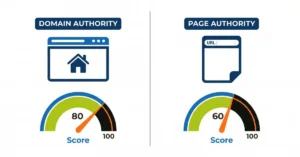
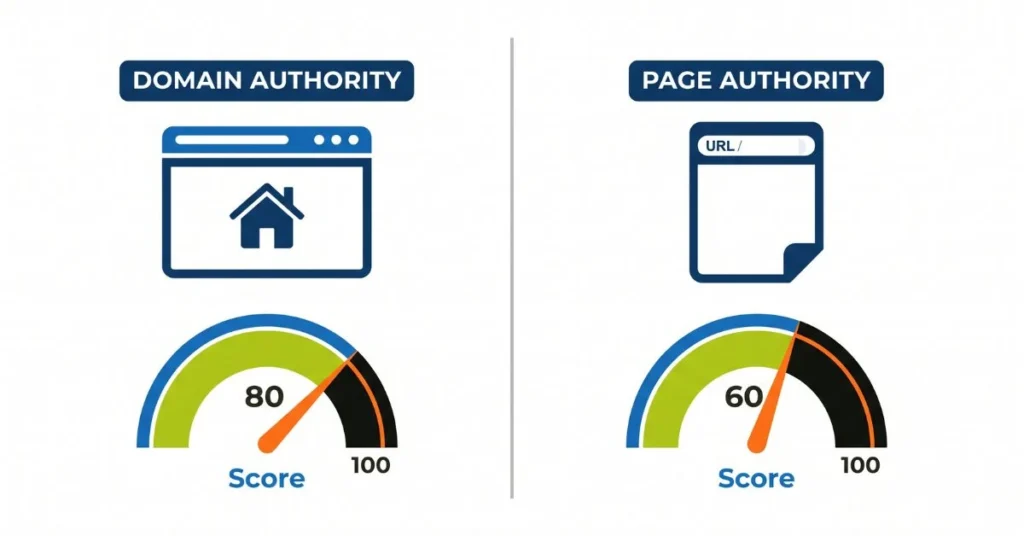
Domain Authority and Page Authority are SEO metrics created by Moz that predict how likely a website or a single webpage is to rank in search engine results. Neither is a Google ranking factor. Both run on a scale of 0 to 100 and are used by SEO professionals to compare site strength, evaluate link-building opportunities, and track off-page SEO progress over time.
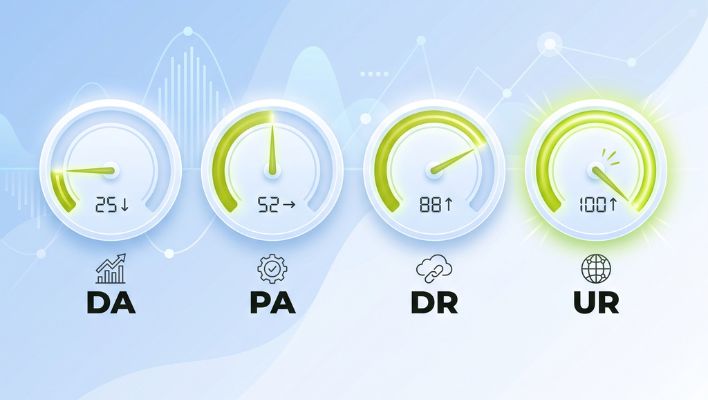
Most people see these scores in their SEO tools and assume a higher number means better Google rankings. That assumption leads to bad decisions. Understanding what DA, PA, DR, and UR actually measure, and what they do not, is one of the most practical things you can learn in SEO.
This guide explains all four metrics clearly, covers what a good score looks like in your niche, and tells you exactly which metric to track for which purpose.
What Is Domain Authority in SEO?
Domain Authority (DA) is a metric developed by Moz that estimates how likely an entire website is to rank in search engine results. Scored on a logarithmic scale from 1 to 100, it factors in backlink quality, linking root domains, and overall SEO signals. DA is not a Google ranking factor. It is a comparative tool used to measure site strength against competitors.
Moz introduced Domain Authority around 2009. At the time, Google’s public PageRank score was the only widely used measure of a site’s link strength. When Google stopped updating public PageRank scores, the SEO industry needed a replacement. DA filled that gap.
DA measures the ranking potential of an entire domain or subdomain. It looks at how many other websites link to you, how strong those websites are, and how trustworthy your overall link profile looks. All of that gets processed through a machine learning model trained on thousands of real search results, and the output is a single score.
The scale is logarithmic. Moving from DA 10 to DA 20 is relatively straightforward with consistent link building. Moving from DA 60 to DA 70 takes significantly more effort. The higher you go, the harder each point becomes to earn.
One important thing to understand: DA is a comparative metric. Your score does not exist in isolation. If other websites in your niche build links faster than you do, your DA can drop even if your actual SEO improves. The score moves relative to the entire web, not just your own progress.
How Is Domain Authority Calculated?
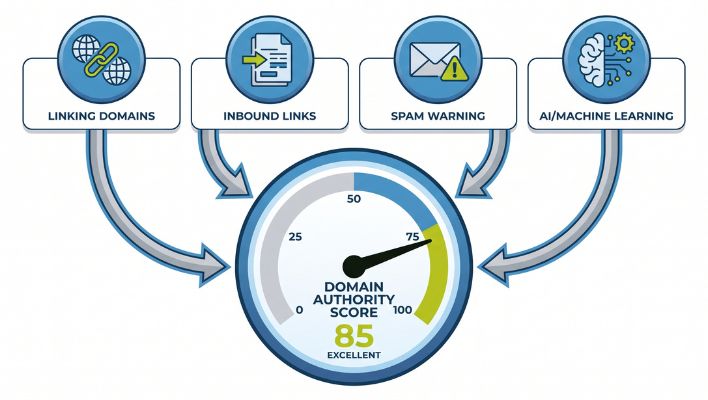
Moz does not publish the full formula, but they have shared the key inputs:
- Linking root domains: The number of unique websites linking to yours. Ten links from ten different websites is stronger than ten links from one website.
- Total inbound links: The overall volume of links pointing to your domain, weighted by quality.
- Spam Score: Moz assigns a Spam Score to domains based on patterns that correlate with penalized or low-quality sites. A high Spam Score on your linking domains pulls your DA down.
- Machine learning model: All of these inputs feed into a model that Moz trains against real SERP data. The goal is to produce a score that correlates with how well sites actually rank.
Because the model is retrained regularly, your DA can fluctuate even when nothing changes on your site. A major update to Moz’s algorithm can shift scores across the entire web at once.
What Is Page Authority in SEO?
Page Authority (PA) is the page-level version of Domain Authority. Also developed by Moz, PA runs on the same logarithmic 0 to 100 scale but focuses on a single URL rather than the whole domain.
Where DA asks “how strong is this entire website,” PA asks “how strong is this specific page.” A site can have a DA of 50 but have individual pages with PA scores ranging from 20 to 70 depending on how many links point to each page specifically.
PA factors in:
- Backlink quality to that page: Links pointing directly to the URL, not just the domain.
- Content relevance: How topically relevant the page is to the links it receives.
- Internal linking strength: How many internal links on the site point to that page, and how authoritative those source pages are.
Knowing a page’s PA helps you make specific decisions. If a product page or blog post is not ranking despite good content, a low PA is often the signal that the page needs more links or stronger internal linking support.
When to use DA vs PA:
Use DA when evaluating a competitor’s overall site strength or deciding whether a site is worth getting a backlink from. Use PA when deciding which specific pages on your own site need link-building attention or when evaluating whether a specific competitor page will be hard to outrank.
What Is Domain Rating in SEO?
Domain Rating (DR) is Ahrefs’ version of a domain-level authority score. It measures the strength of a website’s backlink profile on a logarithmic scale from 0 to 100.
DR is more focused than DA. It looks almost exclusively at backlinks. Specifically, it evaluates the following:
- Number of unique referring domains: How many different websites have sent at least one do-follow link to your domain.
- DR of those referring domains: A link from a DR 80 site passes more strength than a link from a DR 20 site.
- How many outbound links those domains have: A site that links to thousands of other domains passes less link strength per link than a site that links to only a few.
DR does not factor in domain age, organic traffic, spam links, or on-page SEO signals. It is a pure backlink metric. That focus makes it more transparent and easier to move with a clear link-building strategy.
Domain Authority vs Domain Rating: Key Differences
Both DA and DR run on the same 0 to 100 logarithmic scale, but they measure different things and come from different companies. Here is how they compare:
- Creator: DA is from Moz. DR is from Ahrefs.
- What it measures: DA estimates overall ranking potential using multiple SEO signals. DR measures backlink profile strength only.
- Factors included: DA uses linking root domains, total links, spam score, and a broader set of SEO signals. DR uses referring domains and their individual DR scores.
- Spam handling: DA actively factors in spam signals through Moz’s Spam Score. DR does not calculate backlink spam but uses careful filtering to spot and exclude toxic links.
- Best use case: Use DA for overall site health comparison and competitor benchmarking. Use DR specifically for link-building decisions and evaluating potential link sources.
- Important note: The same website can have very different DA and DR scores because both tools use different data sources and different formulas. Neither score is more correct than the other. They measure different things.
What Is URL Rating (UR) in SEO?
URL Rating (UR) is Ahrefs’ page-level metric. It is the page-equivalent of DR, measuring the backlink strength of a specific URL rather than the whole domain.
Most people know about DR but overlook UR. That is a mistake. Ahrefs has stated that UR correlates more strongly with Google rankings than DR does. The reason is straightforward: Google ranks pages, not domains. The strength of the specific page competing for a keyword matters more than the overall site’s authority in many cases.
UR evaluates:
- Do-follow links pointing to that specific URL: Both from external sites and from internal pages on the same domain.
- The UR of pages linking to that URL: A link from a high-UR page on an external site passes more strength than a link from a low-UR page on the same site.
- Internal link equity: Strong internal links from high-UR pages on your own site improve the target page’s UR significantly.
What Is DR and UR in SEO? The Ahrefs Pair Explained
If you use Ahrefs as your primary SEO tool, these two metrics work together and give you a complete authority picture:
- DR tells you: How strong the entire domain is based on its backlink profile.
- UR tells you: How strong a specific page is based on its own backlinks and the internal links it receives.
Use DR to evaluate whether a website is worth getting a backlink from. Use UR to evaluate whether a specific page on your site has enough authority to rank for its target keyword or whether a competitor’s page will be difficult to beat in a specific SERP.
Does Domain Authority Actually Affect SEO?
This is the most important question in this entire guide, and the answer surprises many people.
Google does not use Domain Authority, Domain Rating, or any third-party authority score in its crawling, indexing, or ranking process. Google’s John Mueller has confirmed this multiple times. In one widely referenced statement, Mueller said directly that Google does not use Domain Authority at all and that it has no effect on search crawling, indexing, or ranking. Ahrefs also states in its own help documentation that there is no evidence search engines use DR as a ranking factor.
So why do high-DA sites so often rank at the top of Google?
The answer is correlation, not causation. Sites with high DA typically have strong backlink profiles. Strong backlink profiles also improve PageRank, which Google does use as a ranking signal. Both things move in the same direction because they share the same root cause: high-quality backlinks. The DA score itself does not cause the rankings. The backlinks behind the DA score do.
Think of it this way. Carrying an umbrella does not cause rain. But people with umbrellas are often near rain because they know rain is coming. High DA is the umbrella. The backlinks are the actual weather.
Google’s internal authority signal is PageRank. It has been active since Google’s founding, and Google confirmed as recently as 2016 that backlinks from individual pages remain one of its strongest ranking factors. The problem is that PageRank scores are not publicly visible. DA, PA, DR, and UR exist largely because SEOs need something measurable to work with since they cannot see the actual PageRank of any page or domain.
Is Domain Rating Important for SEO?
DR is not a direct ranking factor, but it is still a useful tool when used correctly.
DR is genuinely helpful for the following:
- Link prospecting: When you are deciding whether a site is worth pursuing for a backlink, DR gives you a quick signal of how strong that site’s backlink profile is. A DR 60 site will generally pass more link strength than a DR 15 site.
- Competitor analysis: Comparing your DR to competitors’ rankings for your target keywords tells you how much link-building work lies ahead.
- Measuring link-building progress: Because DR responds directly to backlink changes, it is a reliable indicator that your link-building efforts are working over time.
DR becomes a problem when it is the only thing people look at. A DR 70 site with no topical relevance to your niche is worth less than a DR 35 site publishing content directly related to your subject. Relevance matters as much as authority in modern link building.
One more important point: UR matters more than DR at the page level. If you are evaluating whether a specific page can rank, check its UR before looking at the domain’s DR. A high-DR domain with low-UR pages on the specific topic you care about is less valuable than it appears.
What Are Good DA, PA, DR, and UR Scores?
There is no universal good score. All of these metrics are relative to your niche and your direct competitors.
Comparing your DA to Wikipedia or major news sites is meaningless. Those domains have millions of backlinks accumulated over decades. What matters is how your score compares to the sites already ranking for your target keywords.
That said, here are general reference ranges that apply across most niches:
- 1 to 20: New or very low-authority site. Limited backlinks. Focus on building a foundation.
- 21 to 40: Developing authority. Enough link strength to compete for low to medium difficulty keywords.
- 41 to 60: Solid mid-range authority. Competitive across a wide range of topics with the right content.
- 61 to 80: Strong authority. Capable of ranking for competitive keywords with good content and relevance.
- 80 and above: Elite authority. Occupied by major news outlets, platforms, and well-established brands with enormous backlink profiles.
The most practical approach is to check the DA and DR of the sites already ranking on page one for your target keyword. If the average DR of page one results is 45 and yours is 30, you are within reach with strong content and a focused link-building campaign. If the average is 75 and yours is 20, you need to target lower-difficulty keywords first and build from there.
A DA 30 site in a niche with low competition can consistently outrank a DA 70 site that lacks topical relevance or has thin content. The number is a starting point for analysis, not a final verdict.
How to Improve Domain Authority and Page Authority
Build High-Quality Backlinks
The single biggest driver of DA and PA improvement is earning do-follow links from relevant, authoritative domains. One link from a DA 65 site in your niche is worth more than twenty links from DA 15 directories.
Effective link-building methods include:
- Digital PR: Getting your site mentioned in industry publications and news outlets.
- Guest posting: Writing content for relevant sites in your niche in exchange for a link back to your domain.
- Resource link building: Creating genuinely useful tools, guides, or data that other sites naturally want to reference.
Focus on sites with high DA or DR, low Spam Score, and strong topical relevance to your niche. All three factors matter.
Audit and Remove Toxic Links
Low-quality backlinks from spammy or irrelevant sites can suppress your DA through Moz’s Spam Score calculation. Run a regular backlink audit using Moz’s Link Explorer to identify links with high Spam Score signals.
For links you can remove, reach out to the linking site directly and request removal. For links you cannot remove, use Google’s Disavow Tool to tell Google to ignore them. Cleaning your backlink profile protects your DA and removes noise from your authority signals.
Strengthen Internal Linking
Internal links pass link equity from stronger pages to weaker ones across your site. A page with high PA can share that authority with other pages through well-placed internal links.
Audit your internal link structure regularly. Make sure your most important pages, the ones targeting your hardest keywords, receive strong internal links from other high-PA pages on your site. This is one of the fastest ways to lift individual page PA scores without building new external links.
Publish Link-Worthy Content
Content that earns natural backlinks over time is the highest-leverage DA and PA growth strategy available. Original research, comprehensive guides, free tools, and data-driven content attract links without requiring outreach for every single one.
Every backlink your content earns without you asking for it is a compounding asset. It raises your DA and PA while also directly improving the underlying signal that Google actually uses: the strength of real backlinks from real sites.
Improve Technical SEO Foundations
Technical issues do not directly affect DA or DR calculations, but they do affect Moz’s broader assessment of site health. Clean crawlability, correct canonical tags, a valid XML sitemap, HTTPS, and fast page load times all contribute to the overall signals that Moz factors into DA indirectly.
More importantly, strong technical SEO ensures Google can properly crawl and index your content, which means the backlinks you earn actually pass value to your pages instead of being wasted on uncrawled or misconfigured URLs.
Which Metric Should You Actually Track?
Every tool shows you a different number. Here is a clear framework for when to use each one.
Track DA when you want to compare your site’s overall authority to competitors, evaluate the health of your off-page SEO strategy over time, or decide whether a site is a good link-building target from a holistic perspective.
Track DR when you are specifically evaluating the backlink profile strength of a potential link source or tracking how your own backlink acquisition is progressing. DR responds directly to backlink changes, making it useful as a link-building KPI.
Track PA when you want to identify which specific pages on your site need more link-building support, or when comparing your individual content page to a specific competitor page you are trying to outrank.
Track UR when you are evaluating whether a specific page has the page-level authority needed to rank for a target keyword. UR is the most granular and, per Ahrefs’ own data, the most directly correlated with actual rankings at the page level.
The most important principle: use these metrics as directional indicators, not absolute verdicts. A site with DA 40 and highly relevant content in a low-competition niche will consistently outperform a DA 70 site with poor content and no topical focus. The numbers point you in the right direction. They do not guarantee anything.
Frequently Asked Questions
What is Domain Authority in SEO?
Domain Authority is a metric created by Moz that predicts how likely an entire website is to rank in search engine results. It runs on a logarithmic scale from 1 to 100. Higher scores indicate stronger ranking potential based on backlink quality, linking root domains, and overall link profile health. It is not a Google ranking factor.
What is Page Authority in SEO?
Page Authority is also a Moz metric running on the same 1 to 100 scale, but it measures a single webpage rather than the whole domain. It considers the quality of links pointing to that specific URL, the relevance of those links, and the strength of internal links the page receives from the rest of the site.
Is Domain Authority a Google ranking factor?
No. Google’s John Mueller has confirmed multiple times that Google does not use Domain Authority in its crawling, indexing, or ranking process. High-DA sites often rank well because strong backlinks improve both DA and Google’s own PageRank signal simultaneously. That is correlation, not a direct cause-and-effect relationship.
What is Domain Rating and how is it different from Domain Authority?
Domain Rating (DR) is Ahrefs’ authority metric. It measures backlink profile strength based on the number of unique referring domains and their individual DR scores. Domain Authority (DA) is Moz’s metric and factors in a broader set of signals including spam patterns and overall SEO health. Both run on a 0 to 100 scale but use different data sources and formulas, so the same site can have very different DA and DR scores.
What is URL Rating (UR) in SEO?
URL Rating is Ahrefs’ page-level metric. It measures the strength of a specific URL’s backlink profile, including both external links and internal links from the same site. Ahrefs has stated that UR correlates more strongly with Google rankings than DR does because Google ranks individual pages, not whole domains.
What is a good DA score?
There is no universal good DA score. It depends entirely on your niche. Check the average DA of sites already ranking on page one for your target keywords and use that as your benchmark. Generally, DA 40 to 60 is considered solid authority for most niches, but a DA 30 site can outrank a DA 70 site with the right content and topical relevance.
Does a high DA guarantee better rankings?
No. DA is a predictive metric, not a guarantee. Google does not use DA directly. A high DA simply suggests a site has a strong backlink profile, which indirectly correlates with good rankings because backlinks are a real Google ranking signal. Content quality, search intent alignment, and topical relevance all play equally important roles.
How long does it take to improve domain authority?
DA improvement timelines vary widely depending on your current score, the competitiveness of your niche, and how aggressively you build links. Moving from DA 10 to DA 30 can happen within six to twelve months with consistent link building. Moving from DA 50 to DA 60 often takes one to two years of sustained effort because the logarithmic scale makes each point progressively harder to earn.
What is the difference between DA and DR?
DA (Domain Authority) comes from Moz and measures overall ranking potential using multiple SEO signals. DR (Domain Rating) comes from Ahrefs and measures backlink profile strength using referring domain data only. Use DA for broad site health comparison. Use DR for focused link-building evaluation.
Which is more important, DR or DA?
Neither is more important in absolute terms. They measure different things and serve different purposes. DR is more transparent and directly tied to backlinks. DA gives a broader view of overall SEO health. Most experienced SEOs track both alongside actual organic traffic and keyword rankings, rather than relying on either score alone.

Atif Khan is a highly experienced Local SEO Expert and Strategic SEO Consultant who helps businesses turn their websites into powerful lead-generating assets. With hands-on experience optimizing and ranking over 100 websites across competitive industries, he specializes in building data-driven SEO systems that improve local search visibility, attract qualified traffic, and convert visitors into customers. His expertise spans Google Business Profile optimization, technical SEO, keyword research, content strategy, and conversion-focused website optimization, ensuring every project is aligned with measurable business outcomes. Atif focuses on creating complete local search ecosystems, combining website authority, relevance, and trust signals to help businesses dominate in their target locations. Beyond rankings, he develops scalable growth strategies that drive calls, inquiries, and long-term revenue. His approach is rooted in ethical, white-hat SEO practices, continuous optimization, and performance tracking, ensuring sustainable results. As a consultant, he works closely with businesses and agencies to align SEO with revenue goals, improve digital presence, and build long-term organic acquisition systems.