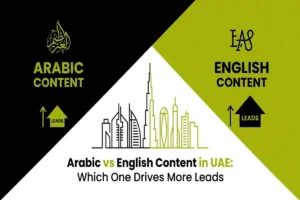
English content in the UAE drives faster leads because it targets experts and business audiences who already have high purchase intent and are familiar with online decision making.
Arabic content builds deeper trust and stronger emotional connections with local Emirati audiences, which leads to better long term conversions and customer retention. The most effective strategy for UAE businesses is using both languages together, with each one assigned a specific role based on audience, industry, and business goals.
Arabic vs English content in UAE is not a simple comparison between two writing styles. It is a strategic decision that directly affects how your business ranks on Google, connects with different audience segments, and generates leads consistently over time.
Many companies still treat language choice as a translation task, switching one to the other without any strategic thinking behind it. In reality, this decision defines your entire content performance.
Skills Heaven specializes in building bilingual SEO content strategies that are aligned with real search behavior, audience psychology, and measurable conversion goals.
Understanding the Two Core Audiences in the UAE
Before deciding between Arabic and English content, every UAE business must develop a clear picture of the audience it is trying to reach.
Without this clarity, content loses direction and impact regardless of how well it is written. The two primary content audiences in the UAE have distinct characteristics that directly shape what kind of content performs best for each.
The English Speaking Audience in UAE
English is widely used among expats, startup founders, corporate professionals, and international businesses operating across Dubai, Abu Dhabi, and the wider UAE.
This audience prefers direct, informative, and well structured content that helps them make decisions efficiently. They are accustomed to consuming content online and generally move through the buying journey faster than other segments.
English speaking users in the UAE typically search with detailed and intent-driven queries. They expect clear answers, credible sources, and actionable content that respects their time. Their purchasing decisions are often influenced by data, comparisons, and evidence of expertise rather than emotional connection or cultural familiarity. For B2B services, digital agencies, SaaS products, and professional services, English content is the primary driver of qualified traffic and leads.
The Arabic Speaking Audience in UAE
Arabic content targets Emirati nationals, regional Arab audiences, and the growing segment of Arabic-preferred users across the country.
This audience values trust, cultural alignment, and authentic relationship building above speed or data. They engage more deeply with content that feels genuinely written for them in their language, rather than translated or adapted from English originals.
Decision making within Arabic speaking audiences is often influenced by credibility, community reputation, and a sense that the brand understands and respects local values.
Content must feel natural and culturally grounded rather than technically translated. For local service businesses, healthcare providers, educational institutions, and government-adjacent sectors, Arabic content is not optional. It is the primary vehicle for earning audience trust and long term loyalty.
How Search Behavior Differs Between Arabic and English Users in UAE
Search behavior is one of the most important and most commonly ignored factors in building an SEO content strategy for the UAE.
The way Arabic and English speakers formulate search queries is fundamentally different, and understanding these differences determines which keywords to target, what content format performs best, and how competitive any given search opportunity is.
English users in the UAE search with intent-driven and highly specific queries. They tend to use longer search phrases, include modifiers like best, top, how to, or compare, and expect results that answer their questions precisely and quickly.
Keywords like best SEO content writing agency UAE or how to rank on Google in Dubai represent the kind of high competition, high search volume opportunities that English content must compete for with strong domain authority and well optimized pages.
Arabic users often search with shorter or more conversational queries. Their search behavior is less competitive in most industries, which creates genuine ranking opportunities for businesses willing to invest in properly localized Arabic content.
However, ranking for Arabic keywords requires more than simply translating English content. The phrasing, tone, and cultural references within the content must feel native and authentic.
Skills Heaven builds separate keyword strategies for Arabic and English, treating each as an independent content opportunity with its own research, planning, and optimization process.
Which Language Drives More Leads: English or Arabic
This is the central question, and the honest answer is that neither language drives more leads in isolation. The better question is which language drives more leads for your specific audience, in your specific industry, at a specific stage of the customer journey. When that question is answered properly, the path forward becomes clear.
English Content for Faster Conversions
English content generates faster leads in the UAE because the audience it reaches is already comfortable with online decision making and is often searching with a clear intent to buy or enquire.
Professionals who search for a service in English are typically further along in their decision process and require less nurturing before they convert. This makes English content particularly effective for B2B services, digital agencies, SaaS platforms, and any business where speed of conversion is a primary goal.
The trade-off with English content in the UAE is competition. Because most businesses target English keywords by default, ranking for competitive terms requires significant domain authority, strong SEO, and consistently high quality content.
Shortcuts and thin content simply do not work in a market where dozens of well-resourced competitors are targeting the same keywords with the same intent.
Arabic Content for Trust and Long Term Retention
Arabic content builds a different kind of lead. It reaches audiences who respond more strongly to relationship building, cultural alignment, and brand familiarity than to immediate information delivery.
These leads may take longer to convert, but they tend to be more loyal, more likely to refer others, and more resistant to switching to a competitor. For industries where trust is the primary purchasing factor, Arabic content is not just beneficial but essential.
Arabic content also benefits from significantly lower competition across most keyword categories in the UAE.
Businesses that invest in properly localized Arabic SEO content have a genuine opportunity to dominate search results in their sector because so few competitors have addressed this audience with depth and authenticity.
This is one of the most underutilized competitive advantages available to UAE businesses right now.
The Hybrid Strategy That Outperforms Both
The highest performing UAE businesses do not choose between Arabic and English. They use both strategically, with each language serving a defined purpose within a broader content system.
English content attracts traffic quickly, captures high intent leads, and drives faster conversions.
Arabic content builds brand authority with local audiences, earns deeper trust, and creates the long term retention that sustains business growth beyond the initial sale.
Skills Heaven creates hybrid bilingual content strategies where Arabic and English content work together as a unified system.
Each language is assigned specific roles, targeted to specific audience segments, and optimized for the keywords and intent that matter most to that audience. The result is a content program that captures the full width of the UAE market rather than leaving half of it unserved.
Arabic vs English Content Performance Comparison
The table below provides a direct comparison of how Arabic and English content perform across the key factors that matter most for UAE businesses.
Understanding these differences is the starting point for building a language strategy that maximizes results across both audiences.
| Factor | English Content | Arabic Content |
| Primary Audience | Expats and international professionals | Emirati nationals and regional users |
| Search Volume | High across most industries | Moderate but growing rapidly |
| Keyword Competition | High and difficult to rank | Lower and more accessible |
| Conversion Speed | Faster due to purchase-ready intent | Slower but leads to stronger retention |
| Trust Building | Moderate, information driven | High, culturally aligned |
| SEO Opportunity | Competitive, requires authority | Strong potential, largely underutilized |
| Best For | B2B, SaaS, digital services, startups | Local services, healthcare, education |
When to Use Arabic vs English: A Practical Guide
Choosing the right language for each piece of content depends on who you are targeting, what action you want them to take, and what industry you operate in.
The guide below maps common business situations to the language approach that consistently produces the best results.
| Situation | Best Language Choice |
| Targeting expats and startup founders | English |
| Targeting local Emirati audience | Arabic |
| Building long term brand trust | Arabic |
| Generating quick qualified leads | English |
| E-commerce and retail businesses | Both Arabic and English |
| B2B and corporate communication | English |
| Healthcare and government services | Arabic |
| Luxury and premium brand presence | Both Arabic and English |
How Blog Writing Differs Between Arabic and English
One of the most significant and consistently overlooked gaps in UAE content strategies is the failure to adapt blog writing style to the language being used. Publishing an English blog and a directly translated Arabic version of the same piece is not a bilingual strategy. It is a missed opportunity dressed up as one.
English Blog Writing Style
English blogs in the UAE perform best when they are structured, direct, and focused on solving a specific problem quickly. Readers expect clear headings, scannable paragraphs, data-backed claims, and a logical flow from problem to solution.
Long introductions and abstract language reduce engagement. The most effective English blogs answer the key question in the opening paragraph and then build the argument in clear, digestible sections.
Calls to action in English blogs should be specific and confidence-building. English speaking audiences respond well to evidence of expertise, case studies, and clear demonstrations of value.
Content that positions the brand as a knowledgeable partner rather than a salesperson consistently generates better engagement and higher conversion rates from this audience segment.
Arabic Blog Writing Style
Arabic blogs require a fundamentally different approach. This audience responds more strongly to expressive, context-rich writing that takes the time to establish trust before moving toward any commercial message.
Storytelling, cultural references, and an emphasis on community and relationships create the kind of resonance that drives genuine engagement from Arabic speaking readers.
The structure of an Arabic blog should feel conversational and welcoming rather than purely informational. Readers are evaluating not just the information but the character and values of the brand delivering it.
A blog that feels rushed, overly promotional, or culturally generic will fail to build the connection that Arabic content is uniquely capable of creating. Skills Heaven ensures that Arabic content is written natively, not adapted, and that the tone and structure serve the cultural expectations of the audience it is targeting.
Common Mistakes UAE Businesses Make with Bilingual Content
Most businesses that attempt bilingual content in the UAE fall into a set of predictable and avoidable mistakes.
Understanding these errors is as valuable as knowing the right approach, because the wrong execution of a bilingual strategy can damage credibility with both audiences simultaneously.
- The most damaging mistake is treating Arabic as a direct translation of English content. Audiences can tell the difference between content written for them and content adapted from a source written for someone else. Translated content lacks the naturalness and cultural specificity that makes Arabic content effective.
- Ignoring Arabic SEO is the second major failure. Many UAE businesses publish Arabic content without conducting dedicated keyword research in Arabic, without optimizing meta tags and headings in Arabic, and without building the internal linking structure that gives Arabic pages authority.
- A third common mistake is publishing in only one language and assuming it covers the entire UAE market. English-only content consistently misses the local Emirati audience. Arabic-only content misses the professional expat segment. Neither approach is sufficient in a market as diverse as the UAE, and businesses that limit themselves to one language are structurally limiting their growth potential from the start.
The Future of Arabic and English Content in UAE
The future of SEO content writing in the UAE is multilingual, intent driven, and increasingly personalized. Search engines are becoming more sophisticated at understanding language nuance, cultural context, and user intent across both Arabic and English queries. Businesses that build genuine depth in both languages today will be far better positioned as these algorithms continue to evolve.
Arabic content is set to grow significantly as digital adoption among local Emirati audiences increases and as regional Arab markets become more integrated with the UAE’s digital economy.
The businesses that establish Arabic content authority now will hold a durable advantage over competitors who attempt to enter this space later when competition has increased. English will remain the dominant language for international business communication, but Arabic will close the gap steadily over the coming years.
Businesses that combine both languages strategically, with each serving a defined role within a broader bilingual content system, will lead their markets. Those that continue to treat language choice as an afterthought will find themselves increasingly squeezed out of search results by competitors who took the decision seriously and built content systems designed to serve the full diversity of the UAE market.
Conclusion
Arabic vs English content in UAE is not a choice between two options. It is a decision about how comprehensively you want to serve your market and how strategically you want to grow.
English content drives faster leads from high intent professional audiences. Arabic content builds the deeper trust that converts into long term customer relationships and referrals. Used together with a clear strategy behind each, they form the most powerful content system available to any UAE business.
Businesses that invest in a properly structured bilingual content strategy gain higher search visibility across both language audiences, stronger engagement from local and international users, and a consistent pipeline of leads that grows over time. The compounding effect of well executed bilingual SEO content is one of the most durable growth advantages available in the UAE digital market.
If your content is reaching only half of your potential audience, the issue is not the quality of what you are publishing. The issue is the strategic thinking, or the absence of it, behind your language decisions. That is the problem Skills Heaven was built to solve.
Build a Bilingual Content Strategy That Covers the Full UAE Market
Skills Heaven designs Arabic and English content systems for businesses in Dubai, Abu Dhabi, and across the UAE. From separate keyword research and content planning for each language to writing, SEO optimization, and performance tracking, every step is handled with strategy and precision. Contact Skills Heaven today and start building content that reaches every segment of your market and converts both audiences into consistent, qualified leads.
FAQs
Which language drives more leads in UAE, Arabic or English?
English content drives faster leads by reaching high intent professional and expat audiences, while Arabic content drives stronger long term conversions by building trust with local Emirati users. A combined bilingual strategy consistently outperforms either language used alone in the UAE market.
Does Arabic content rank faster on Google in UAE?
Yes, Arabic content can rank faster in most UAE industries because keyword competition in Arabic is significantly lower than in English. However, it must be properly localized with dedicated Arabic keyword research and on-page SEO optimization to perform well in search results.
Should UAE businesses invest in both Arabic and English content?
Yes, businesses serving the UAE market benefit most from investing in both languages, with each one targeting a different audience segment and serving a specific role within the broader content strategy. English alone misses local audiences and Arabic alone misses the international professional segment.
How does language choice affect conversion rates in UAE?
English content produces faster conversions because the audience has higher purchase intent and makes decisions quickly, while Arabic content produces slower but more loyal conversions built on cultural trust and deeper relationship with the brand.
What industries perform better with Arabic content in UAE?
Healthcare, education, local retail, government services, and real estate targeting Emirati buyers perform significantly better with Arabic content because local audiences in these sectors make decisions based on trust, cultural alignment, and community reputation.
What is the best bilingual content strategy for UAE?
The most effective strategy assigns English content to attract professional traffic and generate fast leads, while Arabic content builds local brand authority and long term audience loyalty. Both are developed with separate keyword research and optimized independently for maximum impact.
How can Skills Heaven help with Arabic and English content strategy?
Skills Heaven builds complete bilingual SEO content systems that include separate audience research, keyword strategies, content planning, writing, and optimization for both Arabic and English, ensuring every piece of content reaches the right audience and drives measurable business results.

Wali Shah is the Founder and CEO of SkillsHeaven, a digital growth agency specializing in Local SEO, Google Ads, and conversion-focused website development. With over 8+ years of experience, he has helped scale 170+ businesses, including 93+ limousine companies globally, by building structured, lead-generating digital systems. His expertise spans local search optimization, paid media strategy, and high-performance website development, all aligned with measurable business growth. Known for a data-driven and ethical approach, Wali focuses on creating scalable marketing systems that increase visibility, generate qualified leads, and drive long-term revenue for service-based businesses.