Choosing the best language for web development shapes everything about your project. It decides how fast your site loads, how much it costs to maintain, and how easily it grows over time. Our team at SkillsHeaven offers professional web development services, and we build websites and web apps with these languages every day. This guide answers the question right away, then ranks the top ten options so you can pick with confidence.
JavaScript is the best language for web development in 2026. It is the only language that runs natively in every browser, and it powers both frontend and backend work through Node.js. Python is the top pick for beginners and AI driven apps. PHP leads for CMS websites, while TypeScript wins for large scale projects.
What Is a Web Development Programming Language?
A web development programming language is a tool developers use to tell browsers and servers what to do. The code controls how a page looks, how it behaves, and how it handles data behind the scenes. Every website you visit runs on these languages, from simple blogs to booking systems and online stores.
Some languages shape what users see. Others manage logins, databases, and payments on the server. Understanding this split helps you pick the right tool, so let’s break it down first.
People often mix up programming languages with frameworks, so here is the difference. A language is the raw material, like JavaScript or Python. By contrast, a framework is a ready made structure built with that language, like React or Django, that saves you from writing common features from scratch. You choose a language first, then pick a framework that fits it.
Frontend vs Backend vs Full Stack Languages
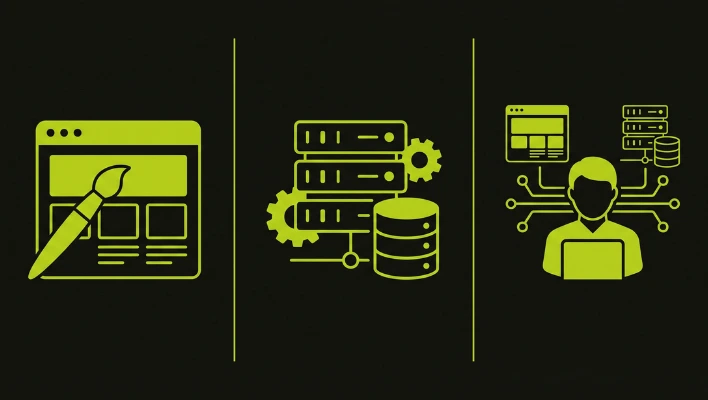
Web development splits into three areas. Each one uses different languages for different jobs.
Frontend Languages
Frontend languages control everything a visitor sees and clicks in the browser. They handle layout, colors, menus, buttons, and animations. The core trio is HTML, CSS, and JavaScript, and together they form the foundation of the web. HTML structures the content. CSS styles it. JavaScript makes it interactive.
HTML is a markup language rather than a true programming language, yet every developer starts here. CSS turns plain pages into responsive designs that adapt to phones, tablets, and desktops. Client side code like this runs on the visitor’s device, which keeps pages feeling fast.
Backend Languages
Backend languages run on the server, where users never see them. They process requests, manage user accounts, talk to databases, and keep everything secure. Server side scripting languages like Python, PHP, Java, and C# dominate this space. Your choice here affects speed, security, and hosting costs.
Think of the backend as the engine room. When a customer places an order, the backend checks stock, charges the card, saves the record, and sends the confirmation email. Dynamic websites depend on this layer for every personalized page they serve.
Full Stack Languages
Full stack languages work on both sides. A full stack developer can build a complete web application with one language instead of two. JavaScript leads this category because it runs in the browser and on the server through Node.js. TypeScript follows the same path with added type safety.
The 10 Best Languages for Web Development
We ranked these ten languages by popularity, job demand, ease of learning, and real world performance. Data comes from the Stack Overflow Developer Survey, Statista, and W3Techs.
Each entry below covers what the language does best, its key features, and the companies that trust it in production. Read the full list if you are choosing a career path. Jump straight to the comparison table if you need a quick decision for a project.
1. JavaScript: The Best Overall Language for Web Development
JavaScript tops every popularity chart for a reason. According to Statista, 63.6% of developers use it, more than any other language. It runs natively in every browser, gives instant visual feedback, and handles both client side and server side work.
The ecosystem is massive. React, Angular, and Vue power modern user interfaces, while Node.js and Express run servers at global scale. Beginners love the fast feedback loop, and employers love the huge talent pool.
Key features:
- Runs natively in every browser with zero setup
- Works on frontend and backend through Node.js
- Supports real time updates and asynchronous actions
- Offers the largest package ecosystem in software through npm
Best for: Interactive websites, single page applications, real time dashboards, full stack development Popular frameworks: React, Angular, Vue, Node.js, Express, Next.js Used by: Netflix, LinkedIn, PayPal
2. Python: Best for Beginners and AI Powered Web Apps
Python reads almost like plain English. Its clean syntax makes it the easiest programming language for beginners to learn, and its power keeps experts loyal for decades. On the web, Python runs the backend through Django and Flask, two mature frameworks with strong security records.
AI integration sets Python apart in 2026. Teams building smart features like chatbots, recommendations, and data analysis reach for Python first because every major machine learning library supports it.
Key features:
- Clean, readable syntax that speeds up learning
- Deep library support for data, automation, and machine learning
- Mature web frameworks with built in security tools
- Rapid development that shortens time to launch
Best for: Web backends, AI powered applications, data heavy platforms, API development Popular frameworks: Django, Flask, FastAPI Used by: Instagram, Spotify, Dropbox
3. TypeScript: Best for Large Scale Projects
TypeScript builds on JavaScript by adding static types. The compiler catches errors before your code ever reaches users, which saves hours of debugging on big projects. Adoption keeps climbing, with the Stack Overflow Developer Survey showing 38.5% of developers now use it.
Large teams benefit most. Types act like documentation, so new developers understand the codebase faster and break fewer things.
Key features:
- Static typing that catches errors before release
- Full compatibility with existing JavaScript code
- Stronger tooling, autocomplete, and refactoring support
- Types that document the codebase for new team members
Best for: Enterprise frontend systems, large codebases, team projects Popular frameworks: Angular, Next.js, NestJS Used by: Microsoft, Slack, Airbnb
4. PHP: Best for CMS and WordPress Websites
PHP powers more of the internet than any other serserver-sidenguage. W3Techs reports that PHP runs on over 75% of websites with a known server side language. WordPress alone accounts for 43.5% of all websites, and it runs entirely on PHP.
Hosting is cheap and universal. Nearly every hosting provider supports PHP out of the box, which keeps setup simple and costs low. Modern frameworks like Laravel bring elegant syntax and strong security to the language.
Key features:
- Built specifically for server side web work
- Simple integration with MySQL and other databases
- Support from nearly every hosting provider on earth
- Huge ecosystem of themes, plugins, and frameworks
Best for: Content management systems, blogs, ecommerce stores, web portals Popular frameworks: Laravel, Symfony, CodeIgniter Used by: WordPress, Wikipedia, Etsy
5. Java: Best for Enterprise Web Applications
Java has anchored enterprise development for nearly three decades. Banks, insurers, and government platforms trust it for stability, security, and raw processing power. The language runs on the Java Virtual Machine, so the same code works across every operating system.
Spring Boot makes modern Java web development fast. It handles configuration for you, which lets teams focus on business logic instead of setup.
Key features:
- Strong object oriented structure for complex systems
- Proven performance under heavy enterprise traffic
- Code that runs on any platform through the JVM
- Decades of tooling, libraries, and long term support
Best for: Banking platforms, large web services, high traffic enterprise systems Popular frameworks: Spring Boot, Hibernate Used by: Amazon, LinkedIn, eBay
6. C# and .NET: Best for Microsoft Ecosystems
C# pairs with the .NET platform to deliver secure, scalable web applications. Companies already invested in Microsoft tools like Azure and Visual Studio get deep integration and first class support. The language offers strong typing, clean structure, and excellent performance.
ASP.NET Core, the web framework for C#, ranks among the fastest frameworks in independent benchmarks. It suits internal business tools and public web apps alike.
Key features:
- Strong typing and structured, readable syntax
- Deep integration with the .NET platform and Azure cloud
- Excellent speed in independent web framework benchmarks
- World class tooling through Visual Studio
Best for: Enterprise web apps, cloud systems on Azure, internal business tools Popular frameworks: ASP.NET Core, Blazor Used by: Microsoft, Stack Overflow, Dell
7. Go: Best for High Performance Backends
Go, created at Google, delivers speed with simple syntax. It compiles to machine code, so it runs far faster than interpreted languages. Built in concurrency lets one server handle thousands of tasks at once, which makes Go a favorite for APIs and microservices.
Cloud platforms love it. Docker and Kubernetes, the tools that run modern cloud infrastructure, are both written in Go.
Key features:
- Compiled speed that beats interpreted languages by a wide margin
- Built in concurrency for handling thousands of requests
- Simple syntax that keeps codebases easy to maintain
- Single binary deployment that simplifies cloud hosting
Best for: Cloud platforms, APIs, microservices, distributed systems Popular frameworks: Gin, Echo, Fiber Used by: Google, Uber, Dropbox
8. Ruby: Best for Startups and MVPs
Ruby prioritizes developer happiness. Its famous framework, Ruby on Rails, follows convention over configuration, which means you write less code and ship faster. Startups pick Rails to launch a working product in weeks instead of months.
The community remains loyal and mature. Thousands of ready made libraries, called gems, cover almost every feature a web app needs.
Key features:
- Clean syntax designed for developer productivity
- Convention over configuration that cuts boilerplate code
- Thousands of gems covering common web features
- A framework that has powered startups for twenty years
Best for: Startup platforms, MVP development, rapid prototyping Popular frameworks: Ruby on Rails Used by: GitHub, Shopify, Airbnb
9. SQL: Essential for Every Database
SQL is not a website building language, yet almost no web application works without it. The language stores, filters, and retrieves data in relational databases like MySQL and PostgreSQL. More than half of all developers use SQL, which places it near the top of the Stack Overflow Developer Survey every year.
Every backend developer needs it. User accounts, orders, posts, and payments all live in databases that speak SQL.
Key features:
- Structured storage and retrieval for relational data
- Powerful querying, filtering, and reporting commands
- A standard skill that transfers across every database system
- Essential support for every data driven application
Best for: Database management, reporting, analytics platforms Popular systems: MySQL, PostgreSQL, SQL Server Used by: Nearly every data driven website in the world
10. Rust: Best for Performance Critical Systems
Rust delivers speed that matches low level languages while preventing entire classes of memory bugs. The compiler enforces safety rules that stop crashes and security holes before the code ships. Developers vote it the most admired language in the Stack Overflow Developer Survey year after year.
WebAssembly gives Rust a growing role in browsers too. Teams use it to run heavy tasks like video editing and 3D rendering at near native speed inside a web page.
Key features:
- Memory safety enforced by the compiler, not the runtime
- Speed on par with the fastest system languages
- Protection against entire categories of security bugs
- First class support for WebAssembly in the browser
Best for: High performance backends, secure systems, WebAssembly modules Popular frameworks: Actix Web, Rocket, Axum Used by: Discord, Cloudflare, Mozilla
Web Development Languages Compared
This table sums up the full list at a glance. Difficulty reflects the learning curve for a new developer. Performance describes raw execution speed under real traffic, and the final column names the sweet spot for each language.
| Language | Type | Difficulty | Performance | Best For |
| JavaScript | Full stack | Medium | High | Interactive sites, full stack apps |
| Python | Backend | Easy | Medium | Beginners, AI apps, APIs |
| TypeScript | Full stack | Medium | High | Large team projects |
| PHP | Backend | Easy | Medium | CMS, WordPress, ecommerce |
| Java | Backend | Hard | High | Enterprise systems |
| C# (.NET) | Backend | Medium | High | Microsoft cloud apps |
| Go | Backend | Medium | Very high | Microservices, cloud APIs |
| Ruby | Backend | Easy | Medium | Startups, MVPs |
| SQL | Database | Easy | High | Data storage and queries |
| Rust | Backend | Hard | Very high | Speed critical systems |
Notice a pattern here. Easy languages trade some raw speed for faster building, while hard languages trade learning time for power. Most successful projects combine two or three of these rather than betting on one.
How to Choose the Best Language for Web Development

The right choice depends on your project, your team, and your budget. Use the guide below to match the language to the job.
Match the Language to Your Project Type
Ecommerce stores run well on PHP with Laravel or JavaScript with Node.js. Both handle product catalogs, carts, and payment integrations with proven, ready made libraries.
SaaS applications favor TypeScript on the frontend and Python or Go on the backend. This combination scales smoothly as your user base grows.
Content heavy sites like blogs and news portals belong on PHP. WordPress and its ecosystem make publishing fast and affordable.
Real time applications such as chat tools and live dashboards need JavaScript with Node.js or Go. Both handle thousands of simultaneous connections without breaking a sweat.
Enterprise platforms call for Java or C#. Their strict structure, mature tooling, and long term support protect large investments.
Portfolio and small business sites rarely need custom code at all. A WordPress build on PHP delivers a professional result quickly, and it keeps future edits simple for non technical owners.
Startups and MVPs move fastest with Ruby on Rails or Python with Django. Both frameworks favor convention, so a small team can launch, test, and adjust before the budget runs out.
Weigh the Business Factors
Talent pool matters more than most founders expect. JavaScript, Python, and PHP developers are easy to hire in every market. Rare languages raise salaries and slow recruitment.
Development speed affects your launch date. Ruby on Rails and Python get an MVP live fastest, while Java and Rust trade speed of delivery for durability. Our guide on how long it takes to develop a web application breaks down realistic timelines for each project size.
Maintenance costs stack up over years. Popular languages with strong ecosystems keep those costs predictable because fixes, updates, and developers stay available.
Scalability determines how your app handles growth. Go and Java shine under heavy traffic, and JavaScript scales well with the right architecture.
Security requirements vary by industry. Healthcare and finance projects benefit from strongly typed languages like Java, C#, and Rust, where the compiler blocks entire classes of bugs. Mature frameworks in every language ship with protection against common web attacks.
Ecosystem maturity decides how much you build versus borrow. A language with rich libraries, active documentation, and a strong community lets your team ship features instead of reinventing them. This is a major reason JavaScript and Python keep winning new projects.
Which Web Development Language Pays the Most?
Salary follows scarcity and demand. The Stack Overflow Developer Survey consistently places Rust and Go developers among the highest paid in the industry because supply stays low while demand climbs. TypeScript and Python developers also command strong salaries thanks to enterprise and AI demand.
JavaScript and PHP sit lower on the pay scale, yet they offer the most job openings by far. For career starters, the smart play is JavaScript plus Python. That pair opens the widest door, and you can add a premium language like Go later.
Job demand tells a similar story. Full stack developers who pair a frontend skill with a backend language earn more than specialists in either one alone. Employers pay a premium for people who can carry a feature from the database to the browser. Add SQL to any language pair, since nearly every listing asks for it.
Location and industry shift the numbers too. Fintech and enterprise employers pay top rates for Java and C#. Startups reward speed, so Ruby and Node.js skills stay valuable there.
Web Development Language Trends in 2026
Three shifts are shaping language choices this year.
AI assisted development is changing how code gets written. Developers now pair with AI tools to draft, test, and review code, and Python remains the language of choice for teams building AI features into their apps.
WebAssembly adoption keeps growing. It lets languages like Rust and Go run inside the browser at near native speed, which unlocks web apps that once required desktop software.
Cloud native architecture favors fast, compiled languages. Microservices and containers reward the efficiency of Go and Rust, which explains their steady rise in backend work.
TypeScript keeps converting JavaScript teams as well. Codebases grow, and type safety becomes the cheapest insurance a team can buy. New frameworks now ship with TypeScript support as the default rather than an option.
None of these trends replace the fundamentals. HTML, CSS, JavaScript, and SQL remain the constant core, and every trend above builds on top of them.
Frequently Asked Questions
Which programming language is best for backend web development?
Python, PHP, and Node.js lead for most projects. Python wins on readability and AI support, PHP wins on hosting cost and CMS power, and Node.js lets JavaScript teams cover the full stack. Enterprise systems lean on Java or C# for stability.
What language is best for frontend web development?
JavaScript is the only real answer, because browsers run it natively. Start with HTML and CSS for structure and style, then add JavaScript for interactivity. Teams on large projects should step up to TypeScript for safer code.
What is the best web development language for beginners?
Python and JavaScript are the friendliest starting points. Python offers the cleanest syntax for learning core concepts, while JavaScript shows instant results in the browser. Pick JavaScript if your goal is web work from day one, and use the free lessons on MDN Web Docs to learn HTML, CSS, and JavaScript step by step.
Is PHP still relevant in 2026?
Yes. PHP runs over 75% of websites with a known server side language, according to W3Techs, and WordPress alone powers 43.5% of all sites. Modern PHP with Laravel is fast, secure, and actively maintained.
Is Python better than JavaScript for web development?
Each wins in its own lane. JavaScript is essential because it runs in the browser, so every web developer needs it. Python is stronger for backend logic, data work, and AI features. Many teams use both together.
Can I rely on just one language for web development?
JavaScript comes closest to a single language solution. It covers frontend and backend through Node.js, and full stack developers build complete apps with it. You will still need HTML, CSS, and SQL alongside it for structure, style, and data.
Which programming language is most commonly used for web development?
JavaScript, used by 63.6% of developers according to Statista. HTML and CSS appear on every website by definition, and Python, SQL, and TypeScript round out the most used list in the Stack Overflow Developer Survey.
Which language is most cost effective for web development?
PHP delivers the lowest total cost for typical business sites. Hosting is cheap, developers are plentiful, and WordPress cuts build time dramatically. For custom apps, JavaScript keeps costs down by using one language across the whole stack.
Final Thoughts
There is no single winner for every project, yet the decision gets easy once you define your goals. JavaScript remains the best language for web development overall. Python rules AI and beginner learning, PHP owns content sites; and Go plus Rust own raw performance.
Start with your project type, then check your hiring market, then plan for growth. Those three steps point to the right language almost every time. The languages on this list have powered the web for years, and each one will keep your project on solid ground.
Still unsure which fits your project? Our web development team can review your requirements and recommend the right stack for your budget and timeline. Book a free strategy call and get clear, actionable advice with zero pressure.

Atif Khan is a highly experienced Local SEO Expert and Strategic SEO Consultant who helps businesses turn their websites into powerful lead-generating assets. With hands-on experience optimizing and ranking over 100 websites across competitive industries, he specializes in building data-driven SEO systems that improve local search visibility, attract qualified traffic, and convert visitors into customers. His expertise spans Google Business Profile optimization, technical SEO, keyword research, content strategy, and conversion-focused website optimization, ensuring every project is aligned with measurable business outcomes. Atif focuses on creating complete local search ecosystems, combining website authority, relevance, and trust signals to help businesses dominate in their target locations. Beyond rankings, he develops scalable growth strategies that drive calls, inquiries, and long-term revenue. His approach is rooted in ethical, white-hat SEO practices, continuous optimization, and performance tracking, ensuring sustainable results. As a consultant, he works closely with businesses and agencies to align SEO with revenue goals, improve digital presence, and build long-term organic acquisition systems.