
Email marketing in UAE is not underperforming because the channel is outdated. It is underperforming because most businesses skip the fundamentals. If your emails are landing in spam, your open rates are below 15%, or your campaigns are generating no measurable return, the problem is almost never the email itself; it is the strategy, the technical setup, and the targeting behind it.
This guide is written specifically for businesses operating in the UAE market, a market defined by its diverse, mobile-first population, high competition across verticals, and audience that is simultaneously digitally sophisticated and highly selective about what earns their attention.
Whether you are running cold email marketing campaigns, building email automation sequences, or simply trying to improve email deliverability in
UAE, every section of this guide addresses a real, practical problem that businesses face daily.
We cover everything: why your emails go to spam, how email warm-up works, how to build a quality list, how to structure campaigns that convert, and why combining email with multi-channel outreach is now a necessity rather than a bonus.
And it truly depicts that how Skillsheaven is generating exceptional leads with amazing services of Email Marketing Guide for UAE Businesses
Why Does Email Marketing Still Work in the UAE in 2026?
Every year, someone predicts the death of email marketing. Every year, businesses that use it correctly continue to generate consistent, measurable revenue from it. Unlike social media platforms, where organic reach has declined sharply and ad costs have increased, email remains one of the few digital marketing channels.
The platform where you own your audience outright. No algorithm decides who sees your message. No platform policy change can cut your reach overnight.
In the UAE specifically, the case for email is even stronger. The country has one of the highest smartphone penetration rates in the world, with consumers checking email multiple times daily.
The audience, a mix of UAE nationals, South Asian professionals, Western expats, and Arab diaspora is digitally fluent and responsive to well-targeted, relevant communication.
Sectors that consistently see strong results from email marketing in UAE include e-commerce, real estate, healthcare, hospitality, financial services, and B2B professional services.
In each of these verticals, the ability to communicate directly with a segmented audience without paying per impression gives email a structural advantage over paid channels.
What Makes the UAE Email Audience Different from Other Markets?
Understanding your audience’s behavior is the first step in building campaigns that actually work. UAE consumers tend to prefer concise, well-structured communication over lengthy emails.
They are highly sensitive to irrelevance if an email does not feel personally applicable within the first two lines, it gets deleted or, worse, marked as spam.
Language segmentation also plays a significant role. While English is the primary business language, businesses that segment their Arabic-speaking audience and tailor messaging accordingly consistently outperform those that send uniform campaigns.
The same principle applies to industry-specific tone: a real estate firm communicating with high-net-worth investors should sound very different from a retail brand targeting everyday consumers.
Timing also matters more here than in some other markets. Friday and Saturday are the weekend in the UAE, which shifts the optimal sending window compared to Western markets. Campaigns sent on Sunday through Tuesday mornings tend to see higher open rates across most industries.
Why Are My Emails Going to Spam? (And How to Fix It)
This is the single most common complaint from UAE businesses running email campaigns. You invest time in writing a campaign, build a list, hit send and discover that a significant portion of your emails never reached the inbox at all. The problem is almost always rooted in one of three areas: sender reputation, technical authentication, or list quality.
What Is Email Warm-Up and Why Is It Non-Negotiable?
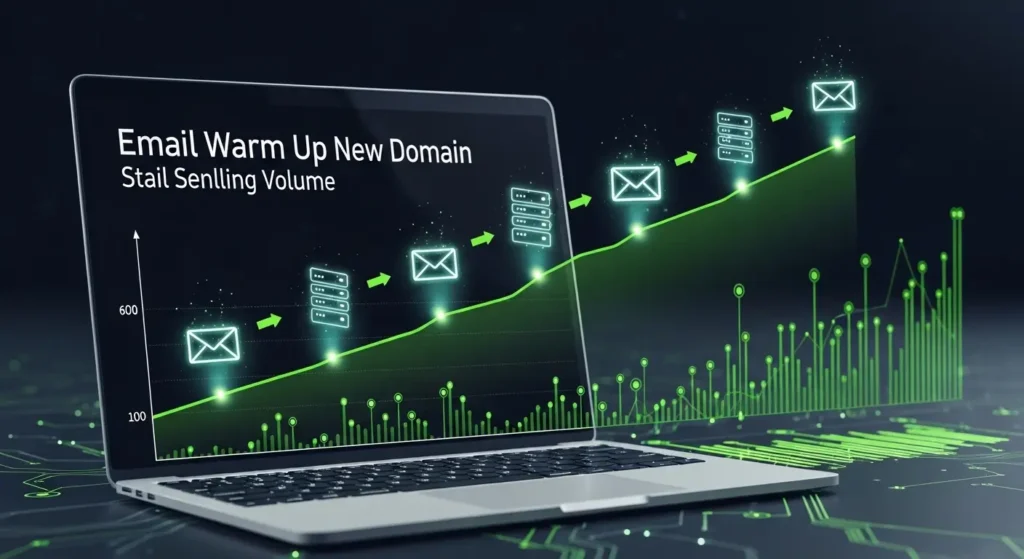
Email warm-up is the process of gradually building sending volume from a new or inactive domain so that email service providers (ESPs) Gmail, Outlook, Yahoo recognize your sending behavior as legitimate.
When you send large volumes of email from a domain with no sending history, spam filters treat it as a red flag and route your messages to junk folders automatically.
For businesses running cold email outreach or launching new campaigns from a fresh domain, warm-up is not optional, it is the foundation. Without it, campaigns fail silently. Emails are delivered, technically speaking, but they never reach the intended recipient’s primary inbox.
The warm-up process typically involves starting with 10–20 emails per day and gradually increasing volume over 2–4 weeks, ensuring that early emails generate genuine engagement such as opens and replies.
Many businesses use dedicated warm-up tools that automate this by simulating real back-and-forth conversations between email accounts, building a positive sending history with ESPs.
How Long Does Email Domain Warm-Up Take?
For a brand new domain, a proper warm-up cycle takes between 3 to 6 weeks, depending on your target daily send volume. Businesses aiming to send fewer than 500 emails per day can often complete warm-up in 3 weeks.
Those targeting high-volume campaigns 5,000 or more per day should allow 5–6 weeks to build sufficient sender reputation.
Attempting to accelerate this timeline consistently backfires. ESPs track not just the volume you send, but the velocity at which you increase it. Sudden spikes in sending volume are one of the most reliable spam triggers. A slow, consistent build always produces better long-term results than rushing.
What Happens If You Skip the Email Warm-Up Process?
Skipping warm-up creates a compounding problem. Once a domain earns a poor sender reputation, recovering it is significantly harder than building it correctly from the start. ESPs update sender reputation scores continuously, and a domain flagged for spam behavior can take months to rehabilitate if it ever fully recovers.
In practical terms, skipping warm-up means your open rates will be artificially low (because most emails land in spam), your deliverability metrics will deteriorate over time, and future campaigns on the same domain will perform increasingly poorly. The cost of getting this wrong far exceeds the few weeks it takes to do it right.
How to Set Up Email Authentication in UAE
Technical authentication is one of the most overlooked aspects of email deliverability for UAE businesses. Without proper authentication records in place, even a warmed-up domain with a strong sender reputation will face deliverability issues. These three records SPF, DKIM, and DMARC are the technical backbone that tells receiving servers your emails are legitimate.
What Is SPF and Why Does It Matter for Email Deliverability?
SPF (Sender Policy Framework) is a DNS record that specifies which mail servers are authorized to send email on behalf of your domain. Without SPF, receiving servers have no way to verify that the email claiming to come from your domain is actually from you. This alone can result in emails being flagged or rejected.
What Is DKIM and How Does It Protect Your Email Campaigns?
DKIM (DomainKeys Identified Mail) adds a digital signature to your outgoing emails that receiving servers can verify against a public key stored in your DNS.
This signature proves that the email content has not been tampered with in transit and confirms that it genuinely originated from your domain. It is a critical trust signal for major ESPs including Gmail and Microsoft Outlook.
What Is DMARC and How Does It Prevent Email Spoofing?
DMARC (Domain-based Message Authentication, Reporting and Conformance) builds on SPF and DKIM by giving you control over what happens when an email fails authentication.
You can set policy to monitor, quarantine, or reject non-compliant emails, and DMARC reporting gives you visibility into who is sending email using your domain including unauthorized senders.
Setting up all three authentication records is a prerequisite for any serious email marketing strategy in UAE. Without them, your campaigns are technically vulnerable and your deliverability will always be compromised regardless of content quality.
How to Build a High-Quality Email List That Actually Converts
The quality of your email list has a direct, measurable impact on every performance metric in your campaigns. A list of 5,000 genuinely interested subscribers will consistently outperform a purchased list of 50,000 unverified contacts in open rates, click rates, conversions, and long-term deliverability.
What Are the Best Ways to Collect Emails in the UAE Market?
Permission-based email collection is the only sustainable approach. Purchased lists not only perform poorly but also pose a serious deliverability risk sending to contacts who have not opted in generates complaints and spam reports that damage your domain reputation quickly.
High-performing list-building methods for UAE businesses include:
- Website opt-in forms with a clear value proposition offer something genuinely useful such as a discount, a free resource, or exclusive access
- Exit-intent popups triggered when a user is about to leave your site these capture leads that would otherwise be lost
- Lead magnets tailored to your industry: property investment guides for real estate firms, health assessment tools for clinics, free consultation offers for service businesses
- Event and webinar registrations both in-person and virtual events are highly effective for building engaged lists in the UAE corporate sector
- In-store data collection through loyalty programs or registration forms particularly effective for retail and hospitality businesses
- Integration with WhatsApp and other messaging platforms where users already have high engagement cross-channel opt-in often produces higher intent leads.
Regular list hygiene is equally important. Remove hard bounces immediately and suppress contacts who have not engaged in 6–12 months. A clean, active list maintains higher deliverability and gives you more accurate performance data.
How to Improve Email Open Rates: Proven Strategies for UAE Campaigns
The average email open rate across industries in the UAE sits between 18–25%, but high-performing campaigns regularly achieve 35–45% by paying close attention to the factors that determine whether someone opens an email or ignores it. Subject lines, sender name, preview text, and send timing all play a role and all can be systematically optimized.
How to Write Subject Lines That Get Opened in Competitive Inboxes
The subject line is the single highest-impact element in your email. It determines whether your message gets opened or skipped in under two seconds.
For UAE audiences, the most effective subject lines tend to be direct and specific rather than clever or vague. Overly creative subject lines often feel misleading and damage long-term trust, even if they boost open rates short-term.
Keep subject lines between 40–60 characters to avoid truncation on mobile. Front-load the most important word or phrase. Avoid spam-trigger words like ‘FREE’, ‘GUARANTEED’, ‘ACT NOW’, and excessive punctuation; these reliably reduce deliverability. Testing two or three subject line variations through A/B testing consistently improves performance over time.
Does Send Time Affect Email Open Rates in UAE?
Yes, significantly. UAE professionals are most active in their inboxes on Sunday through Tuesday, particularly between 8–10 AM and 1–3 PM Gulf Standard Time. B2C audiences tend to engage more in evenings between 7–9 PM.
These are not universal rules your specific audience may behave differently but they provide a data-backed starting point for optimizing send timing.
Most professional email marketing tools now offer send-time optimization features that analyze individual subscriber engagement patterns and deliver emails at the time each person is most likely to open them. For campaigns sent to large, diverse lists across the UAE, this feature alone can lift open rates by 8–15%.
Why Is Mobile Optimization Critical for UAE Email Campaigns?
Over 70% of emails in the UAE are opened on mobile devices. An email that renders poorly on a smartphone with broken layout, oversized images, or text that requires zooming to read is almost always deleted immediately.
Mobile optimization is not a nice-to-have feature; it directly affects whether your campaign achieves its goal.
Use single-column layouts, a minimum 14pt font size for body text, buttons that are at least 44px tall for easy tapping, and compress images to ensure fast loading on mobile connections. Preview your email across multiple device types before every send.
Email Segmentation and Personalization: Why Generic Campaigns Fail
Sending the same email to your entire list is one of the most reliable ways to generate poor results. It produces low engagement, higher unsubscribe rates, and over time, it trains your audience to ignore your emails.
Email segmentation dividing your list into smaller groups based on shared characteristics is what separates campaigns that convert from campaigns that sit unread.
What Are the Most Effective Email Segmentation Strategies?
Segmentation can be applied across several dimensions depending on the data you have available. Demographic segmentation by age, location, language preference, or job title is the most basic form and is appropriate for businesses with limited behavioral data.
Behavioral segmentation, based on how contacts have interacted with your brand pages visited, products browsed, past purchases tends to produce significantly higher conversion rates.
For UAE businesses, geographic micro-segmentation within the country is often underused. A real estate developer with projects in both Dubai and Abu Dhabi should be sending distinct campaigns to contacts in each emirate, featuring locally relevant properties, pricing, and regulatory context.
How Does Email Personalization Go Beyond First Name Tokens?
True email personalization is behavioral, not cosmetic. Adding ‘Dear Ahmed’ to a generic promotional email is not personalization, it is a first name token.
Real personalization means sending an email about a product category the recipient has actually shown interest in, at a stage in their customer journey where that message is genuinely relevant.
Behavioral triggers a subscriber who viewed a pricing page but did not convert should receive a different email than one who has never visited the pricing page.
A customer who purchased three months ago and has not returned should receive a re-engagement offer, not a new acquisition campaign. Building these behavioral flows requires more initial setup but dramatically improves both engagement and ROI.
Email Marketing Automation: What Campaigns Should Every UAE Business Have Running?
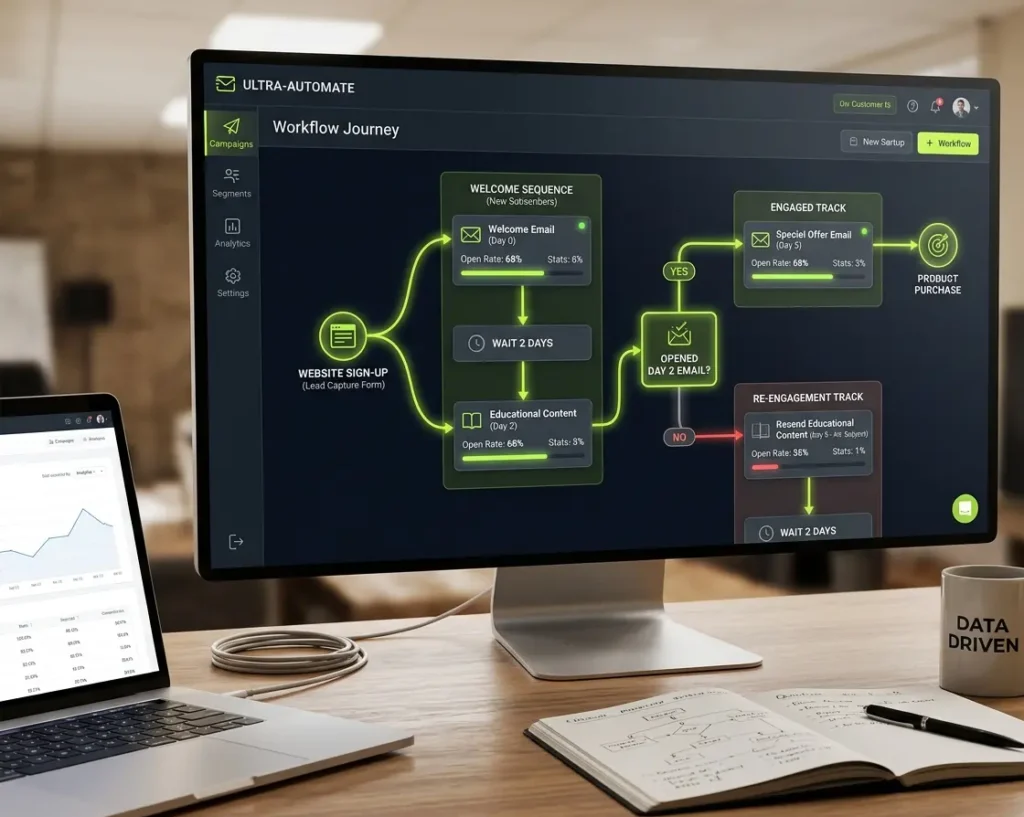
Automation is what transforms email from a one-off broadcast channel into a revenue-generating system that works continuously without requiring manual effort for every send.
A well-configured automation stack ensures that the right message reaches each subscriber at the right moment in their relationship with your business.
What Is a Welcome Email Sequence and How Should It Be Structured?
The welcome sequence is triggered when someone first joins your list and is consistently the highest-performing automation any business can run. New subscribers are at peak interest; they just raised their hand to hear from you.
A three-to-five email welcome sequence that introduces your brand, demonstrates value, and guides the subscriber toward a first action typically generates 4–5x higher open rates than standard campaigns.
Structure the welcome sequence to build progressively: the first email confirms subscription and delivers any promised lead magnet; the second introduces your brand story and value proposition; the third provides useful, non-promotional content relevant to why they subscribed; the fourth and fifth move toward a relevant conversion offer. Spacing emails 1–2 days apart maintains momentum without overwhelming the subscriber.
How Do Abandoned Cart Emails Work and What Results Can UAE E-Commerce Businesses Expect?
Abandoned cart emails are triggered when a customer adds items to an online shopping cart but does not complete the purchase. These are among the highest-converting emails in e-commerce, because the recipient has already demonstrated clear purchase intent. A well-timed sequence of 2–3 abandoned cart emails typically recovers 10–15% of abandoned carts.
The first email should arrive within 1 hour of abandonment and be simple a reminder with the cart contents and a direct checkout link. The second, sent 24 hours later, can address common objections such as shipping concerns or product questions. The third, at 48–72 hours, may include a time-limited incentive if recovery is a high priority.
What Is a Re-Engagement Campaign and When Should You Run One?
Subscribers who have not opened or clicked any email in 6–12 months are classified as inactive and pose a deliverability risk if left on your active list. Re-engagement campaigns are designed to win these contacts back before you remove them.
A straightforward 3-email re-engagement sequence that acknowledges the lapse, offers renewed value, and ultimately gives the subscriber a clear choice to stay or unsubscribe is healthier for your list than continuing to send to disengaged contacts indefinitely.
Why Email Alone Is No Longer Enough: The Multi-Channel Outreach Approach
Cold email response rates have been declining steadily across all markets, including UAE. This is not a failure of email as a channel, it is a reflection of inbox saturation. Most professionals in the UAE receive dozens of unsolicited emails weekly, and a single email from an unknown sender is very easy to miss or dismiss, regardless of how well it is written.
How Does Combining Email with LinkedIn Improve B2B Response Rates?
A coordinated email-LinkedIn approach creates familiarity across multiple touchpoints before asking for a response. When a prospect sees your name in their inbox and then notices a profile view or a connection request from the same name, you shift from being an unknown sender to a recognizable presence. This dramatically increases the likelihood that your follow-up email gets opened and read.
A practical multi-touch sequence for B2B email marketing in UAE looks like this: send a short, focused first email; one day later, visit the prospect’s LinkedIn profile without messaging.
send a connection request 2–3 days after with no sales pitch in the message; follow up with a second email referencing something specific about their business; if the connection is accepted, send a casual LinkedIn message that continues the conversation naturally. Each step reinforces the previous one.
What Practical Rules Apply to Multi-Channel Outreach in UAE?
Execution discipline matters as much as strategy when running multi-channel outreach. Avoid sending more than 15–20 LinkedIn connection requests per day to prevent triggering LinkedIn’s spam detection.
Never send a LinkedIn message on the same day as a connection request; this is widely perceived as aggressive and reduces acceptance rates significantly.
Keep all touchpoints email and LinkedIn concise, genuine, and specific to the individual. Generic messages that clearly come from a template damage credibility faster than no contact at all.
The goal of multi-channel outreach is not to send more messages, it is to become recognized and trusted before asking for a response.
How to Choose the Right Email Marketing Tools for UAE Businesses
The right tool depends on your sending volume, level of automation required, and how tightly you need your email platform to integrate with your CRM, e-commerce platform, or other business systems.
For UAE businesses, there are a few additional considerations: GDPR-aligned data handling, strong Arabic language support, and the ability to segment and target audiences by geographic sub-region within the UAE.
What Features Should UAE Businesses Prioritize When Selecting an Email Platform?
For small to mid-size businesses beginning with email campaign management, the priority features are ease of use, responsive template design, basic segmentation, and robust analytics.
As your strategy matures, look for advanced automation, behavioral triggers, CRM integration, dynamic content blocks, and A/B testing capabilities across subject lines, send times, and content variations.
Regardless of which platform you choose, ensure it provides SPF and DKIM authentication support, a dedicated IP option for high-volume senders, and a deliverability monitoring dashboard that shows you sender reputation metrics in real time.
How to Measure Email Marketing in Dubai Success: The Metrics That Actually Matter
Tracking the right metrics separates businesses that continuously improve from those that run the same campaigns hoping for different results. Many UAE businesses measure open rates and stop there.
Open rate is a useful top-of-funnel indicator, but it tells you nothing about whether your email achieved its business objective.
What Is a Good Click-Through Rate for Email Campaigns in UAE?
Click-through rate (CTR) measures the percentage of recipients who clicked at least one link in your email. A strong CTR across most UAE industries sits between 2.5–5%.
Anything above 5% indicates a highly targeted, highly relevant campaign. If your open rates are healthy but your CTR is low, the problem is inside the email your content, offer, or call-to-action is not compelling enough to drive action.
Why Is Revenue Per Email a More Useful Metric Than Open Rate?
Revenue per email (RPE) divides the total revenue generated by a campaign by the number of emails sent. It directly connects your email activity to business outcomes rather than engagement proxies.
For e-commerce businesses, RPE benchmarks allow you to compare campaign types promotional vs. educational vs. automation and allocate effort accordingly.
Other metrics worth tracking include deliverability rate (emails successfully delivered as a percentage of emails sent), unsubscribe rate (a rising unsubscribe rate is a strong signal that relevance is declining), and conversion rate (the percentage of email recipients who completed a target action such as a purchase, booking, or form submission).
Common Email Marketing in Dubai Mistakes Businesses Must Avoid
Most email marketing failures are not caused by one catastrophic mistake; they accumulate gradually through a series of small errors that each reduce performance slightly until the cumulative effect renders campaigns ineffective.
Identifying and correcting these patterns early prevents compounding damage to your sender reputation and audience relationship.
- Sending without segmentation: Uniform campaigns to your entire list guarantee below-average performance. Even basic segmentation by engagement level active vs. inactive subscribers will improve results immediately.
- Ignoring deliverability until something breaks: Proactively monitor your sender score, authentication records, and bounce rates. Waiting until your open rates collapse means the damage to your domain reputation has already occurred.
- Over-promoting without providing value: If every email you send is a promotional offer, subscribers disengage. A content-to-promotion ratio of roughly 3:1 keeps your audience engaged without training them to tune out every email.
- No clear call-to-action: Every email should guide the reader toward a single, specific next step. Multiple competing CTAs create decision paralysis and reduce click rates.
- Inconsistent sending frequency: Long gaps in communication cause subscribers to forget who you are, leading to spam reports when you do reach out. Establishing a predictable cadence even if infrequent maintains audience familiarity.
Future of Email Marketing in UAE: What Trends Should Businesses Prepare For?
Email marketing in UAE continues to evolve with changes in technology, privacy regulation, and consumer behavior. Businesses that adapt proactively will maintain a competitive advantage; those that continue running the same strategy year after year will see performance gradually erode.
How Will AI-Driven Personalization Change Email Marketing?
AI-powered personalization is already beginning to shift email marketing from rule-based segmentation to genuinely predictive communication.
Rather than manually defining segments, advanced platforms now analyze subscriber behavior across dozens of signals to predict the optimal content, offer, and timing for each individual contact. For UAE businesses competing in crowded inboxes, this level of relevance will become an important differentiator.
What Impact Will Privacy Regulations Have on Email Marketing in UAE?
The UAE’s personal data protection law (PDPL), which came into effect in 2022, establishes requirements for how businesses collect, store, and use personal data including email addresses.
As enforcement matures, businesses will need to ensure their list-building practices are fully consent-based, that they maintain clear records of how each contact opted in, and that unsubscribe requests are honored promptly.
Proactive compliance is both a legal requirement and a strategic advantage. Businesses that handle data responsibly build stronger audience trust and tend to have more engaged lists as a result.
Building Email Marketing That Compounds Over Time
Email marketing in UAE rewards businesses that invest in doing it correctly. The channel is not declining, it is maturing, and the gap between businesses that understand its technical and strategic requirements and those that treat it as a simple broadcast tool is widening every year.
Start with the foundation: set up your authentication records, warm up your domain properly, and build your list through genuine consent. Then layer in segmentation, automation, and behavioral personalization to move from campaigns that occasionally perform to a system that consistently delivers.
SkillsHeaven in UAE is working tremendously for businesses by adding multi-channel touchpoints to your outreach where relevant, track metrics that connect to real business outcomes, and commit to continuous testing and iteration.
The businesses in the UAE that take this structured approach do not just see better open rates. They build an owned audience that becomes an increasingly valuable business asset independent of any platform, immune to algorithm changes, and compounding in value with every campaign that reinforces the relationship.
Frequently Asked Questions
Is email marketing effective for small businesses in the UAE?
Yes, email marketing is one of the most cost-effective channels available to small businesses because it requires no per-impression spend and provides a direct line of communication with your audience. The key is list quality and segmentation rather than volume.
What is a realistic open rate for email campaigns in UAE?
Industry benchmarks typically sit between 18–25% across most UAE verticals, but well-segmented, well-timed campaigns routinely achieve 30–45%. If your open rate is below 15%, audit your subject lines, send timing, and list quality.
How often should UAE businesses send marketing emails?
For most businesses, 1–2 emails per week is sustainable and effective. More frequent sending requires exceptionally strong content to avoid list fatigue. Less frequent sending can cause audience familiarity to decay. Consistency matters more than frequency.
What is the best email marketing tool for UAE businesses?
The best tool depends on your needs. For automation and behavioral segmentation, enterprise-grade platforms offer the most capability. For simpler campaigns, user-friendly platforms with strong template editors and analytics are sufficient. Prioritize deliverability infrastructure, segmentation capability, and CRM integration when evaluating options.
How do I recover from a poor email sender reputation?
Recovery requires stopping all campaigns, cleaning your list aggressively to remove unengaged contacts, implementing proper authentication records if not already in place, and restarting with a warm-up sequence at very low volume. Recovery typically takes 4–8 weeks of consistent, clean sending behavior.

Wali Shah is the Founder and CEO of SkillsHeaven, a digital growth agency specializing in Local SEO, Google Ads, and conversion-focused website development. With over 8+ years of experience, he has helped scale 170+ businesses, including 93+ limousine companies globally, by building structured, lead-generating digital systems. His expertise spans local search optimization, paid media strategy, and high-performance website development, all aligned with measurable business growth. Known for a data-driven and ethical approach, Wali focuses on creating scalable marketing systems that increase visibility, generate qualified leads, and drive long-term revenue for service-based businesses.