
Local SEO typically takes three to six months to show measurable results, with stronger, more stable rankings developing between six and twelve months of consistent effort. The exact timeline depends on your starting point, your level of local competition, and how regularly you keep optimizing, since local SEO is an ongoing process rather than a one time project.
We help businesses set realistic expectations and build a timeline that actually matches their market, and this guide breaks down what happens month by month, what speeds results up, what slows them down, and how often you genuinely need to keep working on local SEO once the first results appear. If you want the full picture of what this work involves, our local SEO services outline the complete process from setup through ongoing management.
The Honest Answer to How Long Local SEO Takes
There is no single number that applies to every business, but the general pattern holds steady across most industries. Early movement, such as small improvements in your Google Business Profile visibility or initial keyword rankings, often appears within two to eight weeks of solid foundational work. Meaningful traffic, calls, and local pack appearances usually take three to six months. Strong, stable rankings that hold up against competitors typically take six to twelve months of sustained effort.
This timeline is not a flaw in the process. Search engines are designed to reward consistency and trust over time, which means a business that shows up accurately and repeatedly across the web earns more confidence than one that makes a single burst of changes and then stops. Our Google Business Profile optimization guide is a useful place to start if you want to understand which early actions tend to move the fastest.
A Realistic Month by Month Timeline
Breaking the process into phases makes the waiting period easier to plan around.
Month One: Foundation
The first month is largely invisible work that sets up everything else. This includes a full website audit to catch technical issues, keyword research to identify the local search terms your customers actually use, and a complete Google Business Profile setup or cleanup. A citation audit usually happens here too, since correcting your business name, address, and phone number early prevents confusion later.
Months Two and Three
This is when the groundwork starts converting into early signals. Your Google Business Profile may begin appearing for more searches, your website should be more crawlable and technically sound, and your first batch of local content and citations starts to get indexed. Reviews collected during this period begin contributing to your prominence in local results.
Months Three to Six
Rankings for local keywords typically become more noticeable during this window, and visibility in the Maps results tends to stabilize. Traffic from local searches increases, and inquiries from nearby customers often pick up. This is also the stage where consistency matters most, since businesses that keep publishing content, earning reviews, and maintaining citations during this period see steadier growth than those that slow down once initial movement appears.
Months Six to Twelve
By this point, results tend to solidify. Many businesses rank in competitive positions for several important local searches and see more predictable organic leads. Your overall online presence becomes more established, and the gap between your business and less consistent competitors tends to widen rather than close.

How Long Before SEO Results Appear, Broken Down by Activity
Different local SEO activities move at noticeably different speeds, which is part of why the overall timeline feels confusing.
Google Business Profile optimization tends to be the fastest lever. Claiming, fully completing, and actively managing your profile can produce visible movement within two to four weeks.
Citation building and NAP consistency fixes generally take a bit longer to show up, often within four to eight weeks, since directories and aggregators need time to update and search engines need time to cross reference the corrected data.
Review generation can influence prominence relatively quickly, sometimes within a similar four to eight week window, particularly when reviews are detailed and arrive at a steady pace rather than all at once.
Content and on page optimization usually takes the longest to fully mature, often three to six months, since search engines need to crawl, index, and evaluate new or updated pages against everything else competing for the same searches.
Backlinks and off page authority compound the slowest of all, frequently taking six months or more to meaningfully shift rankings, because authority building is inherently a long, gradual trust building process rather than a quick technical fix.
Related Topic: https://skillsheaven.org/local-link-building-in-seo/
Local Pack Speed Versus Organic Ranking Speed
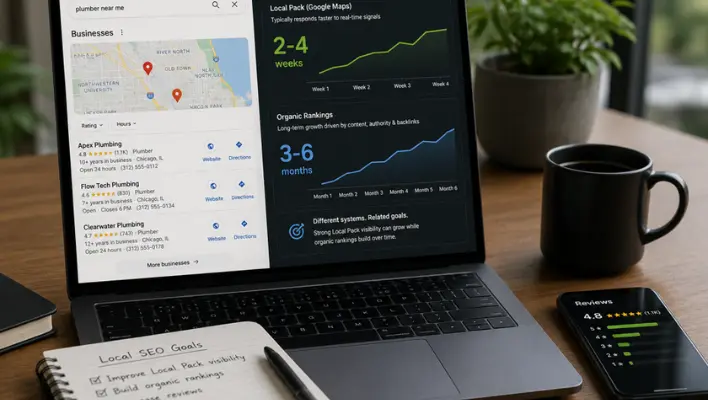
It helps to understand that the Local Pack and standard organic results are not the same system, even though they influence each other. The Local Pack, the cluster of three business listings shown alongside a map for local searches, tends to respond faster to real time signals like Google Business Profile updates, reviews, and citation accuracy. Businesses can sometimes appear in the Local Pack within two to four weeks of solid profile work.
Organic rankings, on the other hand, behave more like a long distance effort, shaped heavily by content quality, site authority, and backlinks. Securing a strong position on the first page of standard organic results generally takes three to six months, sometimes longer in competitive industries. It is entirely possible for a business to rank well in the Local Pack while still building toward stronger organic visibility, and the two should be tracked as related but distinct goals.
Factors That Speed Up or Slow Down Your Timeline
Several variables explain why one business sees results in two months while another needs closer to a year.
Starting point. A website with some existing traction, a handful of reviews, and a few consistent listings already in place tends to see results faster than a brand new domain starting from zero.
Competition level. Saturated industries with many established competitors require more sustained effort to stand out, while niche services or less competitive local categories can show movement more quickly.
Consistency of effort. Regular, ongoing optimization produces steadier, faster compounding results than sporadic bursts of activity followed by long pauses.
Market size. Smaller communities with fewer competing businesses can sometimes see meaningful results in as little as two to three months, while larger, denser metropolitan markets may require a longer runway before results stabilize.
Domain history. An established website with prior authority generally moves faster than a freshly registered domain, since newer sites typically go through a longer trust building period before search engines fully extend confidence to them.
Is Local SEO a One Time Thing
No, and this is one of the most common misunderstandings business owners run into. Local SEO is not a project you complete once and then leave alone. It is closer to ongoing maintenance, similar to how a storefront needs regular upkeep even after the initial renovation is finished.
The reason comes down to how search engines evaluate trust. Rankings are not a fixed reward for past work, they reflect a continuously updated assessment of how active, accurate, and relevant your business currently appears. Competitors keep optimizing, directories change their formatting, customer behavior shifts, and search algorithms themselves evolve. A business that stops all activity after reaching a good position will typically see that position erode over time, not because anything was done wrong, but because the surrounding landscape kept moving while the business stood still.
How Often to Update Local SEO
There is no need to make changes daily, but a regular rhythm keeps your visibility from quietly slipping.
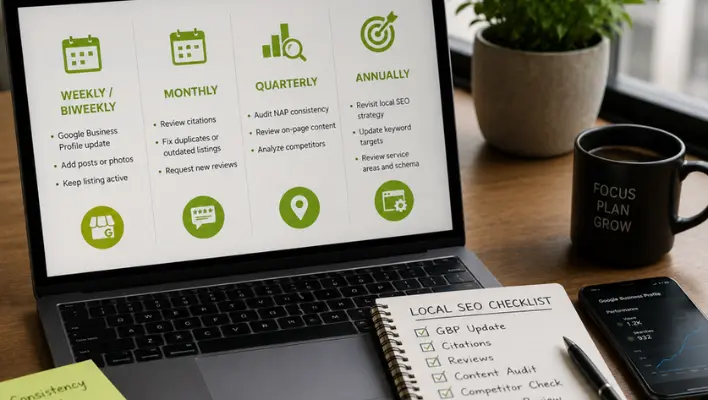
Weekly or biweekly, a Google Business Profile update, post, or photo addition keeps your listing active and signals ongoing management to both search engines and potential customers.
Monthly, review your citation profile for new duplicates, outdated listings, or formatting drift, and request new reviews from recent customers to maintain a steady, natural pace of feedback.
Quarterly, conduct a deeper audit covering your NAP consistency across directories, your on page content for any outdated information, and your competitor landscape to see whether new players have entered your market.
Annually, revisit your overall local SEO strategy, including your keyword targets, your service area pages, and your schema markup, since search behavior and algorithm priorities shift gradually over the course of a year.
Ongoing Local SEO Activities That Maintain Your Rankings
A handful of recurring activities form the backbone of sustainable local visibility once the initial setup phase is complete.
Consistent review generation keeps your prominence signals fresh, since search engines weigh not just the volume of reviews but how recently and steadily they arrive.
Regular Google Business Profile activity, including updates, new photos, and prompt responses to questions and reviews, demonstrates active management rather than a listing that was set up once and forgotten.
Periodic citation audits catch the small inconsistencies that accumulate naturally over time, such as an old address lingering on a directory or a duplicate listing created by accident.
Fresh, locally relevant content published on a regular cadence gives search engines new material to crawl and gives your audience new reasons to engage with your site.
Ongoing local link building, through community involvement, local partnerships, or coverage from local publications, continues to build the authority that supports both Local Pack and organic visibility over the long term.
Treating these as a standing routine, rather than a checklist to complete once, is what separates businesses with durable rankings from those that see an initial spike followed by a slow decline.
What Can Make Local SEO Take Longer Than Expected
A few recurring issues stretch out the timeline beyond what businesses typically anticipate.
Operating in a highly saturated industry with many established competitors naturally extends the runway needed to stand out. A history of inconsistent or outdated business information across directories can require extra time to correct before new progress becomes visible. Expecting results from a single round of changes, rather than committing to the ongoing activities described above, tends to produce a plateau rather than continued growth. Algorithm updates can also introduce temporary fluctuations, which is a normal part of the process rather than a sign that something has gone wrong with your strategy.
How to Track Progress While You Wait
Because results build gradually, it helps to monitor a few specific indicators rather than waiting for a single dramatic milestone.
Track your Google Business Profile insights for changes in calls, direction requests, and website clicks, since these behavioral signals often shift before overall rankings fully stabilize. Monitor your visibility for a defined set of local keywords using a rank tracking tool, comparing month over month rather than expecting daily movement. Keep an eye on your review velocity and average rating, since steady, genuine review growth is one of the more visible early indicators of progress. The Google Search Console Help Center offers free, official guidance on monitoring how your site performs in search over time, which pairs well with whatever rank tracking tool you choose to use.

Frequently Asked Questions
How long does local SEO take to work?
Most businesses see early movement within two to eight weeks, noticeable traffic and ranking improvements within three to six months, and stable, competitive positioning within six to twelve months of consistent effort.
How long before SEO results appear after I make changes?
It depends on the type of change. Google Business Profile updates can show movement within a few weeks, while content and backlink improvements often take three to six months to fully mature.
Is local SEO a one time thing?
No. Local SEO requires ongoing maintenance, since rankings reflect your current activity and consistency rather than a fixed reward for past work.
How often should I update my local SEO?
A practical rhythm is weekly Google Business Profile activity, monthly review and citation checks, quarterly deeper audits, and an annual strategy review.
Can local SEO work faster in smaller markets?
Yes. Lower competition markets can sometimes see meaningful movement within two to three months, while larger, denser markets typically require a longer timeline.
Putting It Into Perspective
Local SEO typically takes three to six months to produce noticeable results and six to twelve months to fully stabilize, but the exact pace always depends on your starting point, your competition, and how consistently you keep working at it. Because rankings reflect ongoing trust rather than a one time achievement, local SEO works best as a standing routine of profile management, citation upkeep, review generation, and fresh content rather than a project with a defined finish line.
If you are trying to set realistic expectations for your own market or want help building a timeline that fits your specific competition and goals, our local SEO agency can help map out exactly what to prioritize first.

Atif Khan is a highly experienced Local SEO Expert and Strategic SEO Consultant who helps businesses turn their websites into powerful lead-generating assets. With hands-on experience optimizing and ranking over 100 websites across competitive industries, he specializes in building data-driven SEO systems that improve local search visibility, attract qualified traffic, and convert visitors into customers. His expertise spans Google Business Profile optimization, technical SEO, keyword research, content strategy, and conversion-focused website optimization, ensuring every project is aligned with measurable business outcomes. Atif focuses on creating complete local search ecosystems, combining website authority, relevance, and trust signals to help businesses dominate in their target locations. Beyond rankings, he develops scalable growth strategies that drive calls, inquiries, and long-term revenue. His approach is rooted in ethical, white-hat SEO practices, continuous optimization, and performance tracking, ensuring sustainable results. As a consultant, he works closely with businesses and agencies to align SEO with revenue goals, improve digital presence, and build long-term organic acquisition systems.