
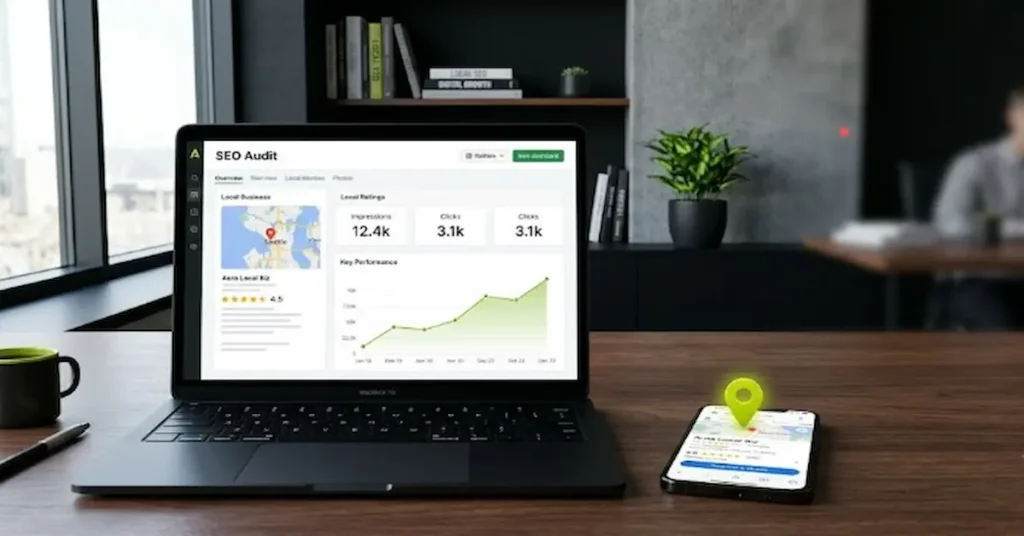
A local SEO audit is the process of reviewing your Google Business Profile, website, citations, backlinks, and reviews to find out exactly why a business isn’t showing up where local customers are searching for it. It’s the difference between guessing why a competitor outranks you and actually knowing.
If you’ve ever searched for your own business and noticed a competitor sitting above you in the map pack, you’ve already felt why this matters. Local search has become the first stop for anyone looking for a nearby service, and a proper local SEO audit is the most reliable way to understand whether a business is positioned to capture that moment or losing it to someone else further down the street.
This guide walks through how to do a local SEO audit, what it actually covers, which tools are worth using, what one tends to cost, and how AI search is changing the way audits get done in 2026. (For a deeper technical walkthrough, Search Engine Land’s local SEO audit guide is a solid companion resource.)
What Is a Local SEO Audit
A local SEO audit is a structured review of every signal that influences how a business ranks in local search results, including Google Maps, the local map pack, AI Overviews, and standard organic listings for location based searches. Instead of assuming why a competitor outranks you, an audit gives you a clear, evidence based answer.
Most people assume ranking locally is mostly about having a website. It isn’t. Local search results are shaped by three forces working together: how close the searcher is to the business, how relevant the listing and content are to what they typed, and how prominent the brand is across the web in terms of links, mentions, and reviews. A local SEO audit examines each of these forces individually so the real bottleneck becomes obvious instead of assumed.
What Are the Key Components of a Local SEO Audit
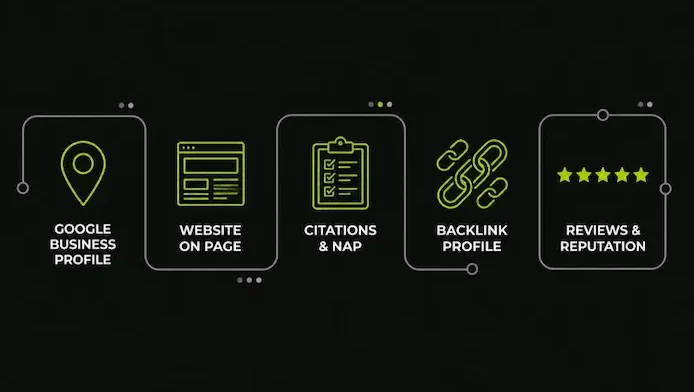
A complete local SEO audit looks at five connected areas. Skipping any one of them tends to leave a blind spot that quietly undoes the rest of the effort.
Google Business Profile Health
The Google Business Profile is usually the single biggest lever in local rankings, which is exactly why auditing it comes first.
Website and On Page Signals
This covers how well a site communicates location and service relevance to search engines, from title tags to internal linking.
Citations and NAP Consistency
The business name, address, and phone number need to match exactly across every directory, listing, and platform where the business appears.
Backlink Profile and Online Authority
Search engines treat links from credible, relevant sites as a vote of trust, and a weak or inconsistent backlink profile can quietly cap rankings regardless of how good the on-page content is.
Reviews and Reputation Signals
Review volume, recency, and response rate all feed directly into how Google and AI search tools judge credibility.
Each of these is broken down in more detail below.
How to Do a Local SEO Audit Step by Step
Here’s how to do a local SEO audit in the order that tends to produce the clearest results.
Step 1: Audit the Google Business Profile First
Start with the Google Business Profile because it carries more weight in local rankings than almost anything else on this list. Check that the business name, category, and service area are accurate. Confirm the hours are current, especially around public holidays. Review how many photos have been uploaded recently and whether posts are going out on a regular cadence. Search the business name to check for duplicate or outdated listings, since a duplicate profile actively competes against the main one for visibility.
Step 2: Check NAP Consistency Across the Web
Search the business name across major directories, niche industry listings, and social platforms. The name, address, and phone number should be identical everywhere, down to formatting. A phone number listed one way on the website and another way on a directory creates confusion that search engines interpret as a trust issue, not a typo.
Step 3: Run a Technical and On Page Website Check
Use a crawler to identify broken links, missing meta descriptions, duplicate title tags, and slow loading pages. Confirm the site is mobile friendly, since the majority of local searches now happen on a phone. Check whether there’s a dedicated page for each service offered and each area served, rather than one generic page trying to cover everything at once. Semrush’s guide to local SEO audits goes deeper into how dedicated location and service pages should be structured for local intent.
Step 4: Review the Backlink Profile
Pull a full list of sites linking to the domain and separate the genuinely relevant, local, and industry specific links from anything spammy or unrelated. A handful of strong local backlinks tends to move rankings further than dozens of low quality ones, and in some cases an inconsistent link profile is quietly capping visibility.

Step 5: Audit Reviews and Reputation
Count total reviews, average rating, and how recently new ones have come in across Google, Facebook, and any niche platforms relevant to the industry. Check whether reviews are being responded to, including critical ones, since an unanswered comment sitting on a profile for months signals that nobody is actively managing the online presence.
Step 6: Analyze Where Competitors Are Winning
Search the core keywords from the location customers actually search from and note who appears in the map pack and organic results. Look at what they’re doing differently. Are they publishing Google posts weekly while activity elsewhere has gone quiet for months? Do they have location pages for areas that haven’t been covered yet? Are they collecting reviews faster? This step alone often reveals the fastest wins available.
Step 7: Check AI Search Visibility
Search the business and its core services inside ChatGPT, Gemini, and Google’s AI Overviews. Note whether the business appears, whether the information returned is accurate, and which competitors are showing up instead. AI search tools pull from the same citation and review signals as traditional local search, so this step ties directly back into everything else in the audit.
Step 8: Document Everything in One Place
Record every finding from each step above into a single sheet or document, organized by category. This becomes the action plan and the benchmark for the next audit, which should be repeated every few months since local rankings shift constantly as competitors change, algorithms update, and the business itself evolves.
How to Conduct a Local SEO Audit for Multiple Locations
Auditing one location is fairly straightforward. Auditing five, ten, or fifty locations is a different challenge entirely.
The biggest mistake multi-location businesses make is treating every branch like a clone of the main location, using the same generic page with only the city name swapped out. Each location needs its own Google Business Profile, its own on-page content reflecting that specific neighborhood, and its own citation consistency check, because Google evaluates each profile independently even when they belong to the same brand.
For businesses managing several branches, the audit process benefits from a centralized tracking sheet that flags inconsistencies between locations side by side: mismatched categories, conflicting hours, missing photos at certain branches, or one location quietly accumulating negative reviews while others perform well. Multi-location audits also benefit from bulk citation checks rather than manual one-by-one searching, since the volume of data involved makes spreadsheet tracking essential rather than optional.

How AI Is Transforming Local SEO Audits
AI has changed what a local SEO audit needs to cover, not just how fast it gets done.
A few years ago, an audit only had to answer one question: where does this business rank on Google. Today it has to answer a second one too: does this business show up when someone asks ChatGPT, Gemini, or Google’s AI Overviews for a recommendation. These AI tools don’t crawl the web the same way traditional search does. They lean heavily on consistent, well-structured citation data and genuine review sentiment to decide which businesses are trustworthy enough to recommend, which means an inconsistent citation profile now carries consequences beyond traditional rankings alone. As outlined in this local SEO audit checklist, this shift toward AI-driven evaluation is becoming a core part of how audits are structured today.
On the practical side, AI has also sped up parts of the audit process itself. Pattern recognition across large citation and review data sets, sentiment analysis on hundreds of reviews at once, and automated geo-grid rank tracking across a service area used to take days to do manually and now take minutes. The audit still needs a person making the final calls, but AI has removed a lot of the repetitive groundwork.
How to Audit a Google Business Profile for Local SEO
Because this step matters more than any other, it deserves its own checklist.
Start with the basics: business name exactly matching the real-world signage, the most specific accurate category available, complete service descriptions, and a service area that reflects where the business genuinely operates rather than an inflated radius. Move on to activity signals: is the profile posting updates, are photos current, are products or services listed with accurate details. Finally, look at engagement: response time to messages, how quickly reviews get a reply, and whether the Q&A section has accurate answers rather than being left empty for random users to fill in.
A profile that’s complete, active, and accurately categorized will consistently outperform a profile that’s merely claimed but never maintained, even when the competing business has a smaller website.
What Tools Are Best for Performing a Local SEO Audit
A dozen subscriptions aren’t necessary to do this properly. Here’s what tends to earn its place in the stack:
Google Search Console shows exactly which queries are bringing in traffic and flags indexing issues, and it’s free.
Google Business Profile dashboard gives direct insight into how customers are finding and interacting with the listing.
Google PageSpeed Insights measures site speed and Core Web Vitals, both of which influence mobile local rankings.
Screaming Frog (free up to 500 URLs) crawls a site for broken links, duplicate metadata, and technical issues.
A geo-grid rank tracker shows how rankings shift across different points in a service area rather than from a single fixed location, which matters because local rankings aren’t the same everywhere in a city.
A citation checker scans directories for NAP inconsistencies across the web in one pass instead of manual searching.
For most small and mid-sized businesses, a combination of two or three of these tools, used properly, tends to outperform owning ten tools used carelessly.

How Much Should a Local SEO Audit Cost
Costs vary widely depending on scope. A single-location business doing a self-audit with free tools can complete a solid first pass at no direct cost beyond time. A professional one-time audit from an agency typically runs anywhere from a few hundred to over a thousand dollars depending on the depth of the report and the size of the business. Multi-location brands or businesses in highly competitive industries tend to land on the higher end, since the audit needs to cover more profiles, more citations, and more competitive analysis.
A more useful way to think about budget isn’t the audit cost in isolation, it’s what an incomplete audit costs in missed visibility if the real issue goes undiagnosed for another six months.
Get a Professional Local SEO Audit for Your Business
Running through this process manually takes real time, and it’s easy to miss the one issue that’s actually holding your rankings back. SkillsHeaven offers local SEO audits for businesses across Dubai, Abu Dhabi, Sharjah, Ajman, and the wider GCC, paired with a local SEO strategy built around what the audit actually finds, not a generic package.
Book your free strategy call and find out exactly where your local search visibility stands today.

Atif Khan is a highly experienced Local SEO Expert and Strategic SEO Consultant who helps businesses turn their websites into powerful lead-generating assets. With hands-on experience optimizing and ranking over 100 websites across competitive industries, he specializes in building data-driven SEO systems that improve local search visibility, attract qualified traffic, and convert visitors into customers. His expertise spans Google Business Profile optimization, technical SEO, keyword research, content strategy, and conversion-focused website optimization, ensuring every project is aligned with measurable business outcomes. Atif focuses on creating complete local search ecosystems, combining website authority, relevance, and trust signals to help businesses dominate in their target locations. Beyond rankings, he develops scalable growth strategies that drive calls, inquiries, and long-term revenue. His approach is rooted in ethical, white-hat SEO practices, continuous optimization, and performance tracking, ensuring sustainable results. As a consultant, he works closely with businesses and agencies to align SEO with revenue goals, improve digital presence, and build long-term organic acquisition systems.