
Knowing how many internal links per page SEO best practices recommend is the foundation of a strong site architecture strategy. For standard blog content, the recommended range is 3 to 5 internal links per 1,000 words, 5 to 10 links for medium-length pages, and 10 to 20 links for long-form content above 2,000 words. Our SEO team helps businesses across every niche build purposeful internal linking structures that strengthen crawl coverage, distribute authority to priority pages, and produce measurable ranking gains.
An estimated 25% of web pages receive zero internal links, and large-site analysis suggests fewer than half of pages get enough internal links to be reliably discovered by search engines. If your pages are not connected through a well-planned strategy, your best content may never reach its ranking potential
What Is Internal Linking in SEO and Why Does It Matter?
Before diving into numbers, understanding what is internal linking in SEO gives you the strategic clarity to use it effectively. Internal linking is the practice of placing hyperlinks within your website that connect one page to another page on the same domain.
What is meant by internal linking in SEO goes beyond simple navigation. When you create hyperlinks from one page to another within your domain, you are establishing relationships between your content pieces, telling search engines which pages matter most, how your content relates to each other, and creating a logical hierarchy that makes sense to both human visitors and crawling bots.
What is internal linking SEO in practical terms means every clickable connection inside your website that passes authority, guides users, and shapes how Google understands your content structure. It is entirely within your control, requires no external outreach, and delivers compounding returns over time.
Do Internal Links Per Page SEO Help? Here Is What the Data Shows
A common question among website owners and marketers is do internal links help SEO in any meaningful way, or is it just housekeeping. The answer is clear and backed by data.
Internal links can pass link juice and tell Google which pages are more important. As an added benefit, internal links contribute to better user experience, a higher conversion rate, and a more efficient website crawling. When implemented correctly, internal linking is a legitimate way to improve your rankings and the performance of your website in general.
Google’s John Mueller has called internal linking “super critical” and one of the biggest on-page things you can do to guide both Google and visitors to the pages that matter most.
The data confirms it clearly. 51% of marketers see positive results within just a few months after implementing internal linking strategies.
Are Internal Links Good for SEO Across All Page Types?
Are internal links good for SEO for every kind of page, whether blog posts, product pages, or service landing pages? Yes, and the mechanism works the same way regardless of page type.
Pages with high authority or PageRank, often the homepage or popular content pages, carry significant SEO weight. You effectively distribute this value across your site by linking these to less-visited or newer pages, boosting their visibility and SEO potential.
Internal links do not just support SEO. They help answer engines understand which pages are most relevant. A clean link structure increases your chances of being cited in AI tools like ChatGPT and Google AI Overviews.
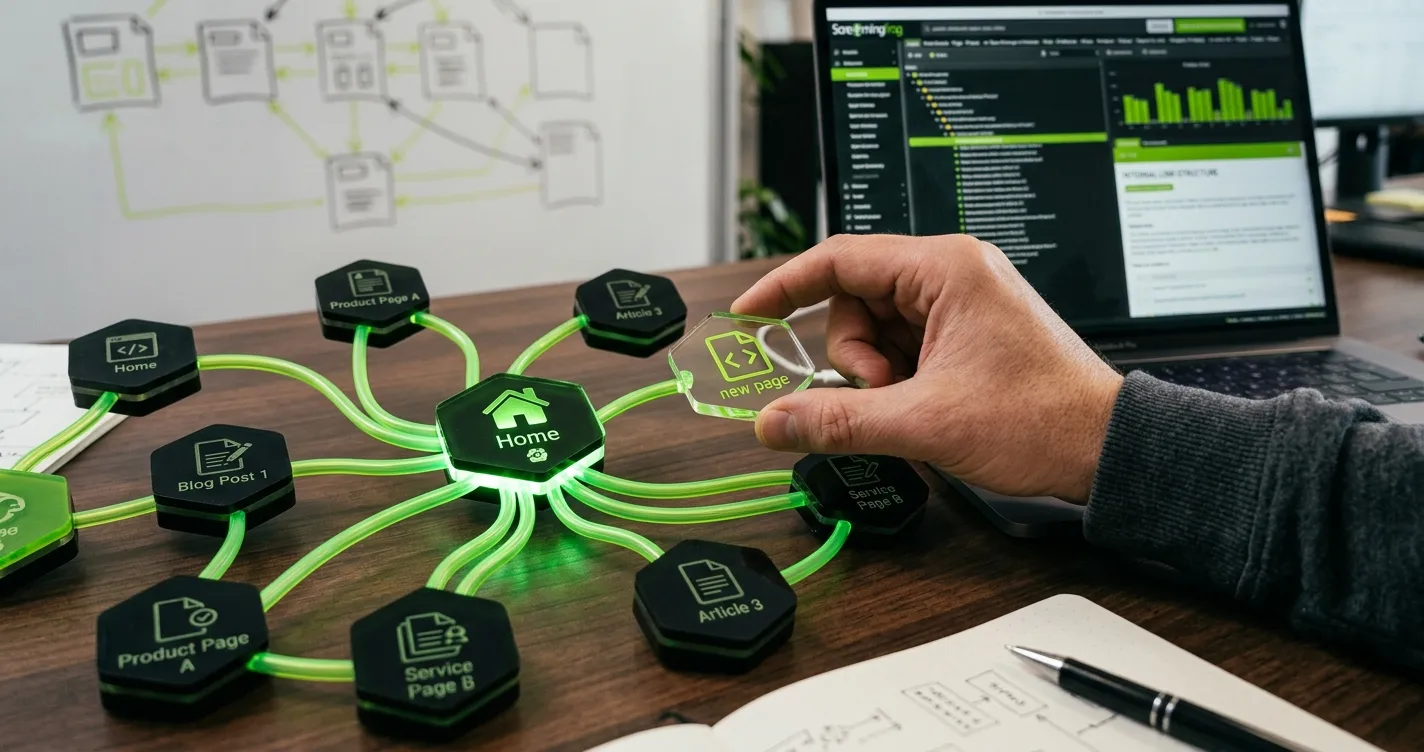
How Does Internal Linking Help SEO: The Four Core Mechanisms
Understanding how internal linking helps SEO means looking at the four ways it directly influences your site’s performance in search results.
Crawlability and Indexation
Internal links act like signposts, guiding crawlers through your site’s content. A well-linked site ensures all pages are found and indexed without exceeding your crawl budget. Pages that are not linked to are called orphaned pages and they are harder to discover. In fact, they may not get indexed at all. The assumption is that if you were not willing to link to it directly, it must not be that important.
Link Equity and Authority Distribution
Link equity, which Google describes as importance scoring and historically called PageRank, flows through internal links. A strong internal link from a high-authority page can give a target page more indexation priority than a weak external backlink.
Anchor Text Relevance Signals
Googlebot considers the anchor text used in hyperlinks to provide context about the linked page. More descriptive and relevant link text increases the relevance scores of linked pages, increasing their search result rankings for those keywords.
User Engagement and Dwell Time
When users can easily navigate from one relevant page to another, they stay longer on your site. Lower bounce rates signal search engines that your content is valuable, contributing to improved rankings.
How Do Internal Links Help SEO Through Site Architecture?
How do internal links help SEO when it comes to the broader architecture of a website? The answer lies in how authority flows through a connected structure versus a disconnected one.
Internal links form the backbone of your site architecture. They guide crawlers through your content in a logical way, helping them understand how topics relate to one another and which pages are central to your message.
A shallow site structure, where key pages are easily accessible from the homepage, allows link juice to circulate more effectively between pages, improving overall SEO. Important pages should be easily accessible, each page should have relevant internal links to help Google crawl them better, and the site should be organized with logical categories and subcategories.
Pages should ideally be no more than three clicks away from the homepage. A study found that pages at depth 1 to 3 generate 9 times more SEO traffic than those at depth 4 or beyond.
Does Internal Linking Help SEO for Topical Authority?
Does internal linking help SEO when it comes to building topical authority and being recognized as an expert source in your niche? Absolutely, and the topic cluster model is the most powerful way to achieve this.
A well-architected site is organized into topic silos or clusters, where a main pillar page covers a broad topic and is linked to and from several cluster pages that cover related sub-topics in greater detail. This practice concentrates link equity within a specific subject area, sending a powerful signal to Google that you have deep authority and expertise on that topic.
Topic clusters are an advanced SEO strategy that involves creating pillar pages focused on broad topics and linking them to more specific content pieces. By linking pillar content to supporting articles, you create a network of interrelated pages that boosts the crawlability and SEO value of your website.
Is Internal Linking Good for SEO on Ecommerce Sites?
Is internal linking good for SEO in ecommerce specifically, where you may have thousands of product and category pages? It is one of the highest-impact optimizations available to ecommerce teams, and most stores leave it dramatically underutilized.
How to improve internal linking in ecommerce for SEO starts with understanding the commercial page hierarchy. Every product page should sit within three clicks of the homepage. Category pages serve as authority hubs, and every high-traffic blog post or buying guide should link directly to the most relevant product and category pages using keyword-rich anchor text.
For ecommerce category pages, focusing on high-quality internal links is a strong SEO strategy. Focus on links that guide visitors to meaningful products or sections, improve site navigation, and help search engines crawl your store efficiently. In internal linking, quality and usability always outperform excessive quantity.
Additional ecommerce internal linking priorities include related product suggestions that distribute authority across the full catalog, breadcrumb navigation that reinforces site hierarchy from every product page upward, and collection pages that consolidate link equity around commercially important keyword targets.
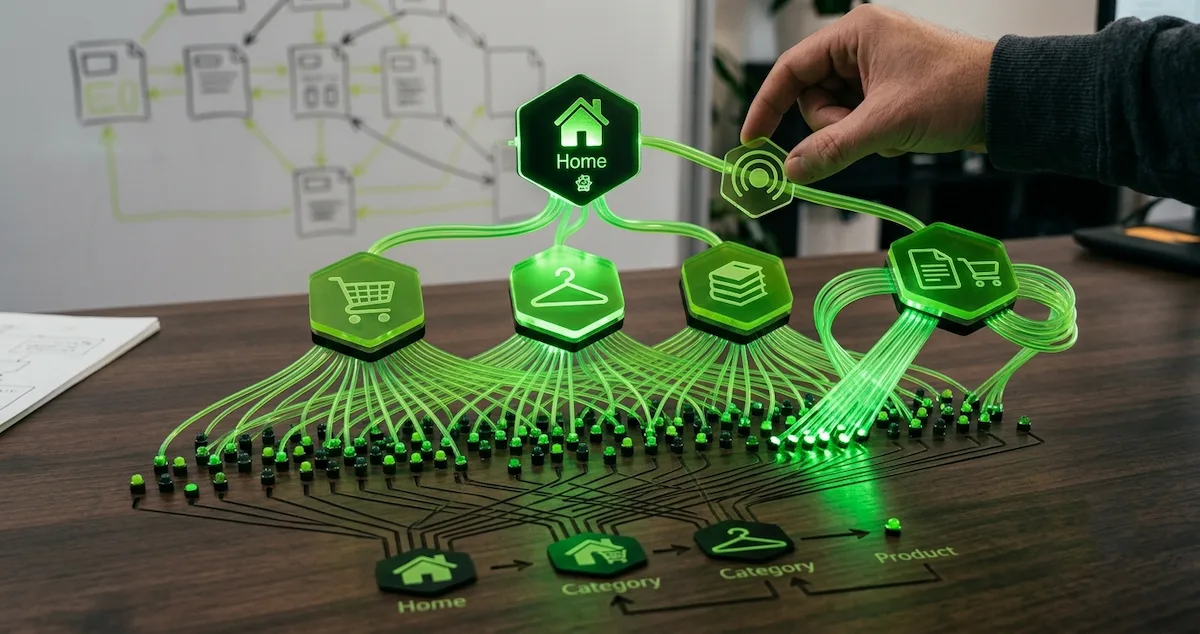
How Internal Linking Improves SEO: Fixing the Most Damaging Issues
How internal linking improves SEO becomes most visible when the worst structural problems are identified and resolved. The gains from fixing fundamental linking errors are often faster and larger than any other on-page change.
Orphan Pages
Orphan pages have no internal links pointing to them from anywhere on your site. Users and search engines cannot find them. Even pages in your XML sitemap get lower priority than well-connected content, and their ranking potential is significantly reduced because they receive no PageRank or link equity from other site pages.
Nofollow Internal Links
How to fix nofollow internal links SEO teams encounter is straightforward once identified. While dofollow links pass link equity to the linked page, nofollow links waste it. Nofollow links are rather senseless in internal linking for SEO. Audit your site for internal nofollows and make sure they are not abundant. Simply let PageRank flow freely across your pages and focus on the site structure instead.
Run a site crawl using Screaming Frog or SEMrush Site Audit, filter for internal links with the rel=”nofollow” attribute, and remove that attribute from any page where restricting authority flow serves no clear purpose.
Broken Internal Links
Broken internal links are a quieter drain. Every internal 404 error wastes crawl budget and cuts off a path for link equity to flow. Running a regular technical SEO audit to catch and fix broken links is basic maintenance for any growing platform.
How Internal Linking Influences SEO Outcomes: Metrics That Move
How internal linking influences SEO outcomes shows up across a range of trackable performance indicators when a strategy is implemented with consistency and precision.
Organic keyword rankings improve as previously under linked pages begin receiving authority from established pillar content. Pages per session increase as contextual links guide users toward related resources they find genuinely useful. Crawl coverage expands as orphan pages receive their first internal links and enter Google’s index for the first time. Indexation speed accelerates for new content when it is immediately linked from relevant existing pages at publication.
A clear internal linking structure improves the site’s information architecture, making it easier for both users and search engines to understand the relationship between content. Search engines allocate a limited amount of time to index pages on your website. Without proper internal linking, some valuable pages may be overlooked, reducing their chances of ranking.
How Internal Linking Structure Improves Site SEO at Scale
How internal linking structure improves site SEO becomes most significant on large websites where hundreds or thousands of pages compete for crawl attention and authority allocation.
For a content hub, an ecommerce catalog, or a programmatic site running into tens or hundreds of thousands of URLs, internal linking becomes architecture. Crawl budget, link equity distribution, anchor text signals, and click depth all interact, and getting them wrong can mute pages that are otherwise well-written and well-linked from outside.
The pillar and cluster topology is the recognized best practice for large-site internal linking structure. A pillar page covers a broad topic comprehensively. Supporting cluster pages go deeper on specific subtopics and link back to the pillar. The pillar links outward to all cluster pages. This bidirectional architecture concentrates topical authority and signals subject matter expertise at scale.
How Important Is Internal Linking for SEO Compared to Other Factors?
How important is internal linking for SEO when weighed against other ranking factors like backlinks, content quality, and technical optimization? It belongs in the top tier of on-page factors, and it is uniquely valuable because it is entirely within your control.
Internal links are a powerful ranking factor that can significantly impact your website’s SEO performance. While external links pointing to your site help establish domain authority, internal links distribute that authority throughout your web pages, telling Google which pages are more important.
Unlike backlink acquisition, which depends on other websites choosing to link to you, internal linking requires no external cooperation. Every improvement you make to your internal link structure takes effect as soon as the next crawl occurs. For websites that already have strong content and decent backlink profiles, internal linking optimization is often the fastest remaining lever to pull for meaningful ranking improvements.
How Many Internal Links in Content Is the Right Number?
How many internal links in content SEO guidelines consider optimal depends on content length, page purpose, and site structure. The benchmarks below provide a working framework.
As a general rule, add 2 to 5 links for content under 1,000 words, 5 to 10 links for content between 1,000 and 2,000 words, and 10 to 20 links for content exceeding 2,000 words.
For most SEO blog posts, 8 to 15 contextual internal links is a practical range. Pillar pages can naturally support more. Thin pages usually need fewer. A page with 10 highly relevant internal links will usually perform better than a page with 30 random ones.
Think of each page’s authority as a pie. Every link you add slices that pie into smaller pieces. If you have hundreds of links, the value passed by each one becomes very small. A good practice is to treat 100 links as a soft review point.
The total link count includes navigation, header, footer, sidebar, and all contextual links combined. Keep this total number in mind when adding contextual links within body content, particularly on pages that already carry significant navigation elements.
Common Internal Linking Mistakes That Suppress Rankings
Overlinking or repeating exact-match anchor texts looks unnatural and can hurt your SEO. Anchor text should clearly describe the linked page rather than using vague generic phrases. Ignoring broken or outdated links frustrates users and signals poor site maintenance to search engines. Irrelevant linking confuses both users and search engines. Ignoring orphan pages makes them nearly invisible to Google.
Additional high-impact errors include neglecting to link from established high-authority pages to newer content, allowing internal link structures to drift out of alignment as content is moved or deleted, and relying exclusively on navigation links while placing no contextual links within body content.

Our Internal Linking SEO Service: What You Get
Our team conducts a comprehensive audit of your entire internal linking structure and delivers a prioritized plan your team can act on immediately.
The service covers a full site crawl identifying every orphan page, broken internal link, excessive nofollow tag, and crawl depth problem across your domain. We map your content into pillar and cluster relationships and identify which pages should serve as authority hubs. We review your existing anchor text distribution and provide specific recommendations aligned with target keywords. For ecommerce sites, we build category-to-product and content-to-product linking maps that push authority toward your highest-converting pages. We identify every internal nofollow tag suppressing authority flow and provide clean remediation guidance. Ongoing monitoring catches new broken links, orphan pages, and structural problems before they affect rankings.
Frequently Asked Questions
Does internal link help SEO for brand new websites with no backlinks?
Yes. For new websites, internal linking is one of the most impactful optimizations available because it ensures Google can discover and index every page efficiently from launch, even before backlinks exist.
What anchor text performs best for internal links?
Use descriptive and targeted anchor text that accurately reflects the linked content. For example, use “benefits of CRM for B2B sales teams” rather than “learn more about CRM.”
How often should internal links be audited?
For actively growing websites, a monthly crawl catches broken links and new orphan pages before they compound. Large ecommerce and enterprise sites benefit from continuous monitoring through automated crawl tools.
How does internal linking increase SEO value on older pages that already rank?
Older pages that already carry topical authority are among the strongest internal linking assets on any website. Adding links from those pages to newer or weaker content transfers authority precisely where it is needed, often producing ranking improvements within weeks of the change being crawled.

M. Awais Khan is a Business Development and Digital Growth Strategist at SkillsHeaven, specializing in SEO, local search optimization, and performance-driven digital marketing. With experience supporting 100+ businesses, he develops and implements data-driven strategies that help companies increase online visibility, generate qualified leads, and drive sustainable revenue growth. His expertise spans Local SEO, Google Ads, social media marketing, and conversion-focused website optimization, ensuring every project is aligned with measurable business outcomes and long-term success.