
SEO for service-based businesses in UAE is structurally different from SEO for product businesses. Products are tangible, comparable, and searchable by specification. Services are intangible, evaluated primarily through trust, and discovered through searches that express a problem rather than a product name. In the Dubai market, where services dominate the commercial landscape healthcare, legal, financial, logistics, education, hospitality, professional services the challenge is not just ranking for the right searches but building the credibility signals that convert service-intent searches into genuine enquiries.
Why SEO for Service-Based Businesses In UAE Is Different from Product SEO
When someone searches for a product, they are usually comparing specifications, prices, and availability. The buying decision is largely analytical. When someone searches for a service, they are trying to answer a different question: can I trust this person or company to solve my problem? That trust question sits at the centre of every service business SEO challenge and it shapes every content, technical, and structural decision that a service business makes about its online presence.
A clinic does not rank by listing its equipment. It ranks by demonstrating that its practitioners are credentialled, that its treatments are evidence-based, and that its existing clients have had the experience the prospective client is hoping for. A logistics company does not rank by describing its fleet. It ranks by demonstrating that it has moved the specific type of cargo the searcher needs to move, on the specific corridor they need to use, with the specific compliance certifications their shipment requires. Service SEO is credibility architecture, not product catalogue optimisation.
In the UAE market specifically, this distinction carries additional weight because of two characteristics that amplify the trust requirement. The first is the concentration of YMYL industries, healthcare, finance, legal, insurance, education, where Google itself applies stricter quality standards to content because the stakes of a poor recommendation are genuinely high. The second is the multicultural, multilingual buyer community, where trust signals must communicate credibility across different cultural frameworks simultaneously. A UAE national evaluating a training institute looks for KHDA approval. A British expat evaluating a school looks for A-Level results. Both are searching for trust. Neither is searching for the same signal.
How Clients Search for Services in Dubai and What That Means for Your Content
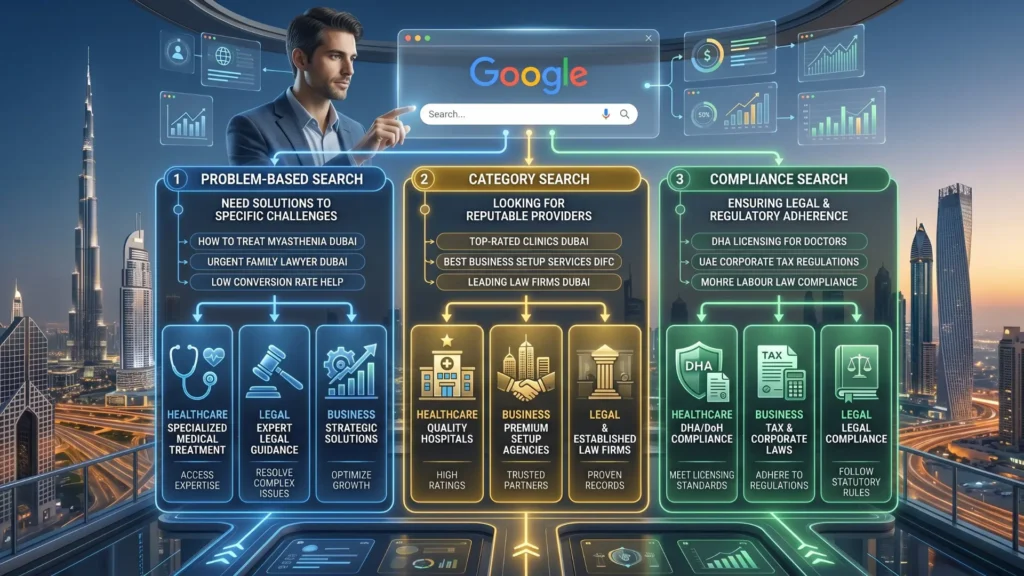
Service searches in the Emirates fall into three distinct patterns, each of which requires a different content response.
- Problem-first searches. These are the most common and the most commercially valuable service search type. The searcher does not yet know who they want to hire. They know what problem they have. “Lower back pain treatment Dubai”. “How to reduce customs clearance time in JAFZA”. “My child is struggling at school, what options are there in Dubai Hills”. Content that addresses the problem directly, with specific, useful information, earns the searcher’s trust before the commercial conversation begins. That trust is the primary conversion asset in service SEO.
- Category searches. These are searches for the type of service rather than the problem it solves. “Physiotherapy clinic Jumeirah”. “Freight forwarding company Dubai”. “Corporate training institute Dubai”. The searcher has already identified the solution category. They are now evaluating providers within it. This is where service page quality, credential display, and review credibility determine which provider gets the enquiry.
- Compliance and qualification searches. These are specific to the UAE market and particularly to YMYL and regulated service categories. “DHA licensed dermatologist Dubai”. “KHDA approved training institute Dubai”. “CBUAE regulated insurance broker UAE”. The searcher is not just looking for a provider, they are looking for a qualified provider. Service businesses that have these credentials but do not make them searchable and prominent are failing a commercial qualification filter that their prospective clients are specifically applying.
Most service businesses in Dubai are visible for category searches but invisible for problem-first searches. The problem-first content layer is where the conversion happens, and it is almost always the most underbuilt layer in a service business website.
Service Page Architecture: How to Build Pages That Rank and Convert
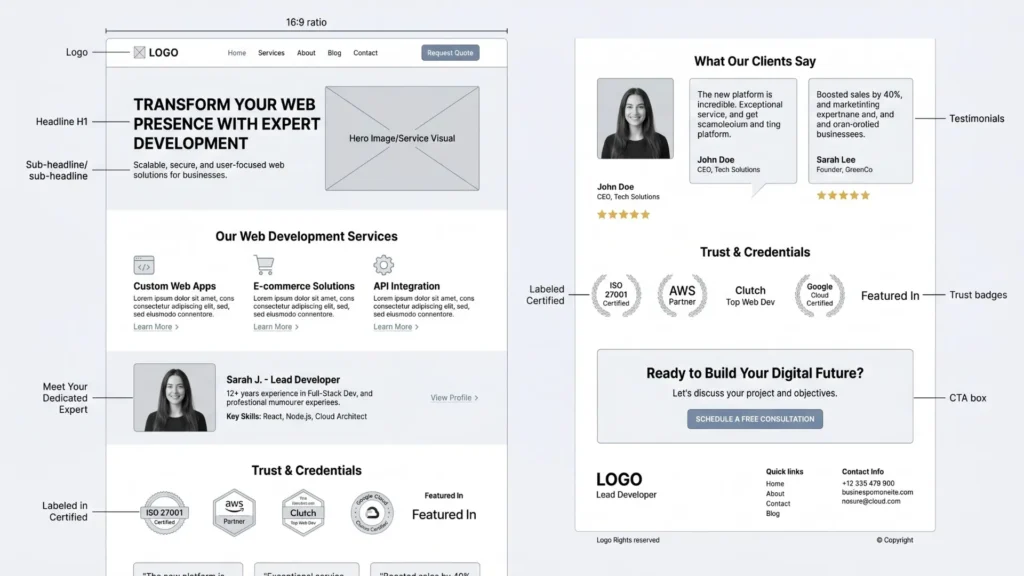
Every service of a business should have its own dedicated page. This is the single most structurally important principle in service SEO and the one most frequently violated by service businesses in Dubai, where the common alternative is a single services overview page that lists every offering in a paragraph or two.
A single services overview page cannot rank competitively for any specific service search because it is trying to serve too many different keyword intents simultaneously, one of the common content mistakes service businesses make when offering multiple services like SEO, social media marketing, PPC advertising, or web development services on a single page. Google evaluates how directly a page satisfies the specific intent of a search query. A page titled “Our Services” that mentions SEO, social media marketing, content marketing, PPC advertising, or web development services in three paragraphs satisfies the intent of none of these searches.
What Every Service Page Needs to Include
The elements that make a service page rank and convert simultaneously are the same elements. Content that genuinely serves the prospective client is content that Google ranks. There is no distinction between the two requirements.
- A keyword-specific H1 that matches the search intent. The H1 should contain the primary keyword for the service in the language the searcher would use, not in the language the business uses internally. “Dubai Sports Injury Physiotherapy” not “Musculoskeletal Rehabilitation Services.” The H1 is the first signal Google uses to evaluate page relevance.
- A clear description of what the service involves and who it is for. The opening section should address the specific problem the service solves and the specific type of client it serves. A prospective client scanning the page should know within ten seconds whether they are in the right place.
- Named practitioner or expert attribution. Every service page should name the practitioner, consultant, or expert responsible for delivering the service. A clinic page for a specific treatment should name the treating doctor. A training institute page for a programme should name the facilitator. Anonymous service descriptions fail the E-E-A-T requirement that YMYL content specifically needs to meet.
- Specific outcome information. What does a client who uses this service achieve? Not in generic terms — “we provide excellent results” — but in specific, verifiable terms that a prospective client can evaluate. Recovery timelines for physiotherapy treatments. Accreditation outcomes for training programmes. Claims processing timelines for insurance services.
- A clear, low-friction conversion pathway. The service page should make the next step as easy as possible. A phone number, a WhatsApp link, a booking form, or a consultation request button should be visible without scrolling on mobile. Every additional step between reading about a service and contacting about it costs conversions.
- Client testimonials or outcome evidence relevant to this specific service. Generic testimonials about the business are less persuasive than specific testimonials about the service being described. A quote from a client who used exactly this treatment, who attended exactly this programme, or who needed exactly this type of logistics solution is the social proof that converts evaluation into action.
Trust Architecture: The SEO Layer That Service Businesses Cannot Afford to Skip
Trust in the context of service SEO is not a vague concept. It is a set of specific, verifiable signals that both Google and prospective clients evaluate when deciding whether a service business is worth engaging. Understanding which signals matter in the UAE market specifically is the difference between a service website that generates enquiries and one that generates traffic.
Regulatory Credentials and Licences
The Emirates has a well-developed regulatory framework for professional services. DHA licensing for healthcare providers. KHDA approval for educational institutions. CBUAE regulation for financial service providers. MOHRE compliance for employment and training businesses. Each of these credentials is both a commercial qualification signal and a search signal.
A prospective healthcare client searching for a “DHA licensed physiotherapy clinic Dubai” is not just searching for a physiotherapy clinic. They are filtering for compliance. A business that holds DHA licensing and displays it prominently throughout its website captures that filtered search and converts that prospective client from filtered browser to engaged enquirer in a single page visit. A business that holds the same licensing but does not display it — or buries it in a footer or credentials section — fails the filter at the search stage before the prospect even arrives.
Practitioner Profiles and Expertise Signals
Service businesses are evaluated through the practitioners who deliver the service. A physiotherapy clinic is evaluated through its physiotherapists. A law firm is evaluated through its lawyers. A training institute is evaluated through its trainers. Individual practitioner profile pages — with professional photographs, qualifications, years of experience, specialist areas, and direct contact options — are one of the highest-converting content types on any service business website in this market.
These profiles serve two commercial functions simultaneously. They satisfy Google’s E-E-A-T requirement by demonstrating that the content on the website is backed by named experts with verifiable credentials. They satisfy the prospective client’s primary evaluation concern by showing them the specific person who will serve them, before any commitment is made. SkillsHeaven recommends practitioner profile development as a priority investment for every service business we work with where individual expertise is the primary product being sold.
Reviews and Social Proof in the UAE Market
Google reviews are the most commercially significant social proof asset for service businesses in this market. They appear directly in Google Maps and Local Pack results, the search positions that most local service searches encounter first. A business with forty reviews averaging 4.7 stars is more likely to receive the enquiry from a local search than one with ten reviews averaging 4.9 stars, because volume creates the confidence that a small number of perfect scores cannot.
Building reviews in the UAE market requires understanding two specific dynamics that generic review advice does not address. First, the review-requesting culture varies significantly across the nationalities that make up Dubai’s buyer population. Direct requests work well with English-speaking expat communities. More contextually placed requests — as part of a follow-up after a positive service experience — are more effective with Arabic-speaking communities where direct solicitation feels transactional. Second, Arabic-language reviews carry additional weight for Arabic-language search visibility — a review written in Arabic by an Arabic-speaking client signals to Google that the business genuinely serves that community, which improves rankings in Arabic-language local searches.
Local SEO for Service Businesses: The Most Commercially Direct Search Channel
For the majority of service businesses in Dubai, clinics, schools, professional services firms, fitness studios, law offices, and training centres, the Google Local Pack is the most commercially direct position in search results. It appears above the organic results. It shows the business name, address, phone number, rating, and a link to the Google Business Profile. A prospective client who is ready to call or book sees the Local Pack before they see any organic search results. A service business not in the Local Pack for its primary service searches is losing a disproportionate share of its highest-intent prospective clients to the three businesses that are.
The algorithm that determines Local Pack rankings evaluates three factors: relevance (how closely the business matches the search), distance (how close the business is to the searcher), and prominence (how well-known and well-reviewed the business is). Of these, prominence is the one most within the business’s direct control, and the one most neglected. A consistent stream of genuine reviews, regular Google Posts, complete and accurate service listings, and an active business description in both English and Arabic all contribute to prominence signals that Local Pack rankings directly reward.
The location-specific keyword dimension is equally important for service businesses in this market. Dubai’s commercial geography is organised into distinct districts, Jumeirah, Al Barsha, Business Bay, DIFC, Dubai Hills, Arabian Ranches, each of which functions as a distinct local search territory. A service business that adds its specific district to title tags, service page headings, and Google Business Profile content is competing with a much smaller set of competitors than one that uses only “Dubai” as its location modifier. The relevance signal is stronger. The competitive set is smaller. The enquiry quality is higher because the searcher has already filtered by proximity.
Content Strategy for Service Businesses: Building the Problem-First Layer
Service page optimisation addresses the category search layer, clients who already know what type of service they need. Content strategy addresses the problem-first layer, clients who are still in the earlier stage of understanding their situation and evaluating options. Both layers are necessary. Building only one of them leaves the other audience unserved and the organic footprint incomplete.
The problem-first content layer for a service business looks different depending on the industry. For a physiotherapy clinic, it is guides explaining how specific conditions are treated and what to expect from rehabilitation. For a corporate training institute, it is thought leadership covering workforce development challenges and training ROI frameworks. For an insurance broker, it is explanatory content about mandatory coverage requirements, how to compare plans, and what the claims process actually involves. For a logistics company, it is content about free zone regulations, customs clearance procedures, and trade lane-specific shipping guides.
Each of these content types serves the same commercial function: it attracts the prospective client at the research stage, demonstrates genuine expertise in the relevant domain, and creates a trust relationship with the reader before any commercial contact is initiated. A client who has read three useful, accurate, genuinely helpful articles from a service provider before they are ready to hire is far more likely to contact that provider than one they found through a single generic category search.
Problem-first content does not sell services directly. It earns the right to be considered when the reader is ready to buy. In service categories with long evaluation cycles, this is the highest-value content investment available.
The content strategy must also account for the bilingual nature of this market. Problem-first content in Arabic serves the Arabic-speaking communities who are in the research phase for professional services — government employees seeking training, UAE national families evaluating healthcare options, Arab expat business owners understanding insurance obligations. This content almost entirely does not exist for most service categories in the Dubai market. The service business that produces it first becomes the Arabic-language authority for its category with almost no competing content to overcome.
SEO Priorities by Service Type in the UAE Market
While the principles above apply across all service businesses, the relative priority of each layer varies significantly by industry. The table below identifies the highest-return SEO priorities for the major service business types in this market.
| Service Type | Highest SEO Priority | UAE-Specific Differentiator |
| Healthcare and clinics | Named practitioner profiles and DHA/DOH credential display on every service page. | Arabic-language treatment pages and Arabic GBP profile for UAE national and Arab expat patient acquisition. |
| Legal and professional services | Case study and outcome content demonstrating sector-specific expertise. E-E-A-T compliance critical. | Arabic legal terminology content for UAE national and government client searches almost entirely uncontested. |
| Education and training | KHDA accreditation displayed prominently. Programme-specific pages with named facilitators. | Arabic government training procurement content captures high-value contract searches with near-zero competition. |
| Financial services and insurance | Regulatory approval display (CBUAE, IA). DHA mandatory insurance compliance content. | Arabic Takaful content and Arabic regulatory guidance pages carry high intent and almost no competing content. |
| Logistics and freight | Free zone and port-specific service pages (JAFZA, Jebel Ali, Dubai South). Compliance credential pages. | Arabic logistics and customs clearance content for UAE national business and government procurement searches. |
| Hospitality and restaurants | Google Business Profile optimisation. Location-specific content with neighbourhood and area references. | Arabic menu and occasion content for UAE national and Arab community searches. Ramadan and event season pages. |
| B2B corporate services | Thought leadership content. Case studies by sector and client type. LinkedIn integration for decision-maker credibility. | Arabic B2B content for government entity and UAE national corporate procurement searches. |
Arabic SEO for Service Businesses: The Channel Most Are Leaving Unclaimed
The Arabic-language search opportunity for service businesses in this market has been referenced throughout this article in specific industry contexts. The overarching point deserves to be stated directly because it is commercially significant and consistently underacted upon. Most service businesses in Dubai have no Arabic-language content. Most of their Arabic-speaking prospective clients are searching for those services in Arabic. The gap is not small. It is the difference between complete market presence and partial market presence.
Arabic SEO for service businesses requires understanding three things that generic SEO guides never address. First, Arabic service searches are expressed differently from English ones, not just linguistically but structurally. Arabic search queries for professional services tend to reference regulatory bodies by their Arabic names, to use cultural and religious qualifiers that have no English equivalent, and to phrase the search around the relationship with the service provider rather than the transaction. Second, Arabic service searches in most categories in this market have almost no competing content from independent service businesses. The search results for Arabic-language service queries are dominated by directories and government portals, not by competing service provider websites. Third, Arabic-speaking service buyers in this market include some of the highest-value client segments available: government entities, UAE national businesses, high-net-worth UAE national individuals, and the large Arab expat communities whose professional services spending is concentrated in healthcare, education, and financial services.
KEY TAKEAWAYS
- SEO service in Dubai is a credibility architecture. Trust signals — credentials, practitioner profiles, reviews, regulatory approvals — are not supplementary to the SEO strategy. They are the strategy.
- Every service offered should have its own dedicated page with a keyword-specific H1, named practitioner attribution, and a low-friction conversion pathway.
- Problem-first content attracts clients in the research phase and builds the trust relationship that earns the enquiry when they are ready to hire.
- The Google Local Pack is the most commercially direct position for local service searches. Prominence signals — reviews, posts, complete GBP — determine who appears in it.
- Arabic SEO for service businesses operates in a near-uncontested competitive space in most categories and produces rankings significantly faster than equivalent English investment.
- District and neighbourhood-specific keywords reduce the competitive set, increase relevance, and improve enquiry quality for location-serving service businesses.
- Compliance credential visibility — DHA, KHDA, CBUAE — is a search filter applied by prospective clients in regulated service categories, not just a trust signal on the page.
Service SEO in Dubai Is a Trust-Building Discipline Before It Is a Ranking Discipline
The businesses in this market that generate the most consistent and highest-quality leads from organic search are the ones that have understood this distinction. They do not build websites designed to rank. They build websites designed to earn trust from the specific prospective clients they serve — and then optimise those websites so that Google can find them. The ranking is the outcome. The trust is the mechanism.
This means service page architecture that puts the client’s question before the business’s answer. Practitioner profiles that communicate genuine expertise rather than listing qualifications. Regulatory credentials that are prominently visible rather than buried. Problem-first content that helps prospective clients understand their situation rather than promoting the business’s capabilities. Arabic content that genuinely serves Arabic-speaking buyer communities rather than translating English content for a checkbox requirement. And local search optimisation that puts the business in front of the right client at the exact moment they are ready to make contact.
SkillsHeaven builds SEO strategies for service businesses across every major sector in Dubai and across the wider Emirates. Every strategy starts with a face-to-face session that covers the specific services offered, the specific client types served, the trust signals that matter most in the relevant industry, and the competitive gaps in both English and Arabic search that represent the fastest path to qualified leads. No standard packages. No generic content strategy. A specific strategy for a specific service business in a specific market.
Frequently Asked Questions
How is SEO for service businesses different from product businesses?
Service businesses sell intangible outcomes evaluated primarily through trust — the expertise of the practitioner, the credibility of the business, the evidence from previous clients. Product businesses sell tangible items evaluated through specification comparisons. SEO for service businesses therefore prioritises trust architecture — practitioner profiles, regulatory credential display, reviews, case studies, and E-E-A-T compliance — alongside keyword targeting. In the UAE market, this trust dimension is amplified by the concentration of YMYL industries where Google applies its strictest quality standards.
Should every service have its own page on my website?
Yes. A single services overview page cannot rank competitively for specific service searches because it fails to satisfy the intent of any one of them with sufficient depth. A dedicated page for each service — with a keyword-specific H1, full service description, practitioner attribution, outcomes information, and a conversion pathway — consistently outranks generic overview pages for the specific searches that produce the most qualified enquiries. If a business has fifteen distinct services, it needs fifteen service pages to compete for all fifteen service searches.
How important are Google reviews for service business SEO in Dubai?
Critically important for local search visibility. Google Business Profile reviews are among the primary signals that determine whether a service business appears in the Local Pack — the map results that appear above organic listings for location-specific searches. Volume and recency matter as much as average rating. A business with forty recent reviews at 4.6 stars consistently outranks a business with eight reviews at 4.9 stars. Arabic-language reviews specifically improve visibility in Arabic-language local searches.
What content should a service business in Dubai produce?
Two layers: service pages that address category searches from clients who already know what service type they need, and problem-first content that addresses the research phase from clients who are still evaluating options. Problem-first content takes the form of guides, treatment explanations, process descriptions, and FAQ content that addresses the specific questions prospective clients ask before they are ready to enquire. This content attracts and builds trust with prospective clients earlier in their decision journey than service pages alone can reach.
How does Arabic SEO work for service businesses in Dubai?
Arabic SEO for service businesses requires dedicated Arabic service pages written by native Arabic speakers with UAE market knowledge, Arabic keyword research using the actual search vocabulary of the relevant buyer community, and correct technical implementation including hreflang tags and Arabic metadata. Most service businesses in Dubai have no Arabic content, which means Arabic service searches in most categories are almost entirely uncontested. Rankings typically appear within four to eight weeks of correctly implemented Arabic service pages going live.
Do I need separate SEO for each district or area of Dubai I serve?
If the business serves multiple distinct areas of Dubai and search volume justifies it, dedicated location-specific service pages consistently outperform generic city-level pages. A clinic in Jumeirah targeting “physiotherapy Jumeirah” is competing with a much smaller set of competitors than one targeting “physiotherapy Dubai.” The location specificity increases relevance, reduces the competitive set, and improves enquiry quality because the searcher has already filtered by proximity. Free zone-specific pages — JAFZA, Dubai South, Business Bay — carry the same advantage for B2B service businesses operating in or near those zones.

Wali Shah is the Founder and CEO of SkillsHeaven, a digital growth agency specializing in Local SEO, Google Ads, and conversion-focused website development. With over 8+ years of experience, he has helped scale 170+ businesses, including 93+ limousine companies globally, by building structured, lead-generating digital systems. His expertise spans local search optimization, paid media strategy, and high-performance website development, all aligned with measurable business growth. Known for a data-driven and ethical approach, Wali focuses on creating scalable marketing systems that increase visibility, generate qualified leads, and drive long-term revenue for service-based businesses.