
What Is International SEO and How It Helps Your Business Grow Globally
International SEO is the process of optimizing your website so that search engines can identify which countries and languages you are targeting, and serve the most relevant version of your content to users around the world. If your business is ready to reach customers across multiple countries, Skills Heaven delivers complete international SEO services that build your global organic presence, drive qualified traffic from every target market, and position your brand as an authority in search results worldwide.
Understanding What International SEO Truly Means
International SEO is the process of optimizing multilingual or multinational websites to improve their visibility, organic traffic, and overall performance across multiple countries and languages. Effective international SEO ensures that search engines can identify the countries and languages a website is targeting and deliver the most relevant version of the site to users based on their location and language preferences.
Think of it as local SEO, but scaled across borders. Where standard SEO focuses on one website targeting one country, international SEO builds a framework that serves multiple markets simultaneously, each with its own language, search behavior, and cultural expectations. Businesses that execute this correctly earn a consistent stream of organic traffic from every region they serve.
Why Is International SEO Important
The opportunity in global search is enormous, and the businesses capturing it are the ones that have invested in a structured international SEO approach. Brands that invest in international SEO typically see major results, including improved visibility in regional SERPs, higher conversion rates through localized content, and better user experience for multilingual audiences.
A meticulously executed international SEO strategy is the engine that can power exponential growth in traffic, deepen user engagement, and ultimately grow revenue. With the right approach, your business can dominate global keywords, capture high-intent organic traffic from diverse markets, and build a truly international brand.
Beyond growth, international SEO protects your existing rankings. Without proper international signals in place, search engines may serve the wrong version of your content to the wrong audience, creating duplicate content issues and reducing your visibility across all markets simultaneously.
What Is Multilingual SEO
Multilingual SEO refers to the practice of optimizing a website’s content for multiple languages so that users searching in French, Spanish, German, Arabic, or any other language can find the most relevant version of your pages in their own language. International SEO, multilingual SEO, and local SEO are often used interchangeably but each addresses a different challenge. A company might use international SEO to serve the same English site across global markets, add multilingual SEO to support German and Spanish speakers, and rely on local SEO for office locations in key cities.
Multilingual SEO goes beyond translation. It requires localized keyword research in each target language, culturally adapted content, and proper technical signals that tell search engines which language version to serve for any given query. A word-for-word translation rarely captures the way real users search in a different language, which is why genuine localization produces far stronger results than simple content translation.
What Is Multi-Regional SEO
Multi-regional SEO focuses on targeting users in specific countries rather than specific languages. This becomes relevant when your business serves multiple countries that share the same language. If you are targeting English-speaking audiences in the US, UK, Australia, and Ireland, you might have one English-language website for all of them, or separate English websites for each market, each offering unique products and pricing tailored to that specific region.
Multi-regional SEO ensures search engines understand which version of your content belongs to which country. Without these signals, Google may display your US pricing to UK customers, or rank your Australian content in US search results, reducing relevance and conversion rates across every market.

What Is a Hreflang Tag in SEO
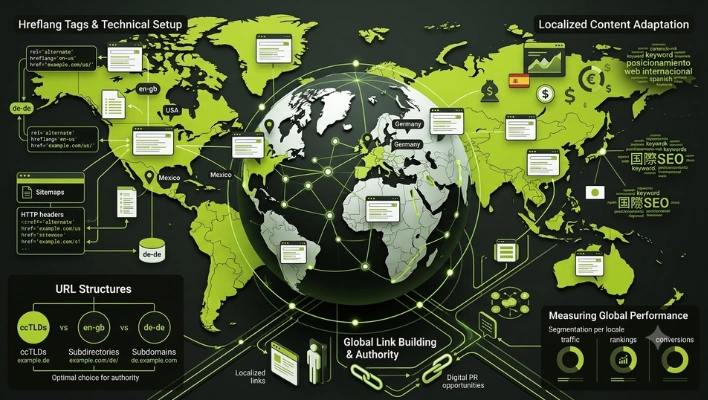
The hreflang tag is one of the most important technical elements in any international SEO strategy. Hreflang tags are HTML attributes that tell search engines which language and regional version of a page to show users. They help search engines understand relationships between alternate language versions of the same page, and they prevent translated pages from being treated as duplicate content.
The hreflang attribute allows you to specify to search engines the language and regional targeting of a specific page version. Simply put, it tells Google which page to show the user based on their language and geography.
Every hreflang tag contains three core components. The rel=”alternate” attribute tells search engine crawlers that an alternate version of the page exists. The href attribute specifies the exact URL of that alternate version. The hreflang attribute itself uses ISO language codes such as “en” for English or “de” for German, and optionally combines them with ISO country codes such as “en-us” for English in the United States or “en-gb” for English in the United Kingdom.
How Hreflang Tags Work in International SEO
Understanding how hreflang tags work in international SEO helps you appreciate why correct implementation is so critical. Each hreflang tag must be reciprocal, meaning every page must reference its alternate versions and itself. The x-default tag is used as a fallback when no language or region matches the user. Hreflang can be implemented in HTML tags, XML sitemaps, or HTTP headers.
When a user in Germany searches for a product you sell, Google reads your hreflang annotations and identifies that you have a German-language version of that page. It then serves the German version in the German search results, rather than showing the English page to a user who prefers German content. This process improves click-through rates, reduces bounce rates, and builds trust with international audiences.
Studies show 75% of hreflang implementations contain errors, including missing return tags, broken URLs, or incorrect ISO codes. A single error in a hreflang cluster causes Google to ignore the entire cluster, wasting implementation effort.
This is why working with an experienced international SEO agency matters. Hreflang implementation requires precision at every level, and the consequences of errors compound across every language and country version of your website.
How to Use Hreflang Tags for International SEO
There are three primary methods for implementing hreflang tags for international SEO, and the right choice depends on the size and structure of your website.
HTML Head Implementation places hreflang tags directly inside the HTML head section of each page. These tags use the link rel=”alternate” attribute to identify alternate language or regional versions of the same page, and each page references all alternate language versions including itself. HTML implementation works well for smaller multilingual websites where each page has a manageable number of alternate versions.
XML Sitemap Implementation is recommended for larger websites. For larger websites, hreflang is often implemented in XML sitemaps. Instead of placing hreflang annotations inside the HTML of every page, the relationships between language versions are defined inside the sitemap. This approach is much easier to manage when a website contains thousands of pages across multiple languages.
HTTP Header Implementation is used for non-HTML content such as PDF files, where placing tags in the HTML head is not possible.
Regardless of implementation method, every hreflang setup must include the x-default tag. The hreflang x-default tag indicates to search engines a fallback version of the page, shown to users whose language or region does not match any of the localized site versions. Without this tag, users with unrecognized languages might land on an arbitrary localization, resulting in high bounce rates and loss of conversions.

How Hreflang Tags Affect International SEO Performance
The impact of correctly implemented hreflang tags on international SEO performance is significant and measurable. Accurate hreflang implementation addresses duplicate content issues by ensuring that users are directed to the most appropriate version of a page, enhancing user experience, increasing conversion rates, and boosting general SEO performance.
Backlinks to any hreflang variant benefit all variants in the cluster through consolidated signals. You do not need to build links to each language version separately because links to your main domain support all regional versions.
When hreflang is implemented correctly, every regional version of your website benefits from the authority your domain earns globally. This makes your entire international SEO infrastructure stronger over time, as link equity flows across all language and country versions rather than being siloed in a single version of your site.
How to Adapt Content for International SEO
Content adaptation is one of the most important and most often overlooked elements of a successful international SEO strategy. A successful international SEO strategy begins with knowing which markets to target and understanding what people are actually searching for in those places. The keyword strategy, content topics, and tone all need to be localized, meaning adapting language, cultural references, and even timing to suit each audience.
True content localization goes far beyond changing words. Each page should use locally searched keyword variations, reflect the cultural context of the target market, display the correct currency and pricing, and feel native to the user rather than like a translated copy of another market’s content.
In 2026, Google’s algorithms are more context-aware than ever. Translating content and hitting publish is no longer sufficient. You need country-specific keyword data and a solid technical setup alongside content that resonates with your target audience in their context.
For businesses targeting Spanish-speaking markets, for example, the keywords and phrases used in Spain differ significantly from those used in Mexico or Argentina. Separate keyword research for each market ensures your content aligns with the exact terms your target audience uses when searching, rather than the terms that are simply a direct translation of your primary market’s keywords.
International SEO URL Structure: Choosing the Right Approach
One of the foundational decisions in any international SEO project is choosing the right URL structure for your global website. There are three main options, each with distinct advantages.
Country Code Top-Level Domains (ccTLDs) use country-specific domain extensions such as .de for Germany, .fr for France, or .jp for Japan. Country-code top-level domains send the strongest geotargeting signal to Google, clearly communicating which country each domain is intended to serve. The trade-off is that each ccTLD requires its own domain authority, which means building separate link profiles for every country.
Subdirectories place language or country-specific content within folders on your main domain, such as example.com/de/ or example.com/fr/. Subfolders are often more efficient from a centralized SEO authority standpoint and easier to manage. This approach allows all international versions to benefit from the authority of a single root domain.
Subdomains host each language or country version on a separate subdomain, such as de.example.com or fr.example.com. This provides flexibility but requires separate authority building for each subdomain.
For most businesses, especially those in the early stages of international expansion, subdirectories on a single domain offer the strongest combination of SEO authority consolidation and ease of management.
International SEO and Technical Foundations
A strong technical foundation is essential for any international SEO strategy to perform at its full potential. A complete international SEO audit should confirm that the URL strategy is chosen and consistent, that a language switcher is in place remembering user preference, that hreflang covers all alternates with an x-default fallback, that self-canonicals are set per locale, that localized schema is implemented, and that sitemaps are organized by locale with internal cross-links between alternates.
Site speed is another technical priority that often goes underappreciated in international SEO. A page that loads quickly for users in one country may load slowly for users in another region. If your site is accessed from multiple countries, a Content Delivery Network (CDN) can significantly improve load times, something that directly affects SEO rankings and user experience.
Google Search Console also plays an important role in monitoring international SEO performance. Setting up separate properties for each language subdirectory allows you to configure country targeting for each version of your site and monitor indexing, crawl errors, and hreflang validation reports specific to each market.
Building International Authority With Global Link Building
Authority signals remain a powerful ranking factor in international search. Building links from trusted, locally relevant websites in each target country reinforces your website’s credibility within regional search ecosystems.
Building backlinks from trusted sites in each target country can massively boost your visibility, but only if your content earns it through relevance and quality.
An effective international link building strategy identifies authoritative publishers, industry directories, and digital PR opportunities in each target market, then earns links that signal both topical relevance and geographic authority to search engines.
Measuring International SEO Performance
Tracking the performance of your international SEO efforts requires market-specific measurement. Analytics and Search Console should be segmented per locale, with dashboards and properties set up for each target market. Quarterly audits on hreflang, indexing, Core Web Vitals, schema, and content parity provide the ongoing visibility needed to identify opportunities and resolve issues across all international versions of your site.
Key metrics to monitor for each market include organic traffic by country and language, keyword rankings in regional SERPs, click-through rates by locale, page speed performance by geographic region, and conversion rates from international organic traffic. Regular reporting against these metrics allows your strategy to evolve continuously and adapt to shifts in search behavior, algorithm updates, and competitive changes in each target market.
Why Choose Our International SEO Services
Skills Heaven brings deep expertise in international SEO strategy, technical implementation, content localization, and global authority building. We manage every component of your international SEO program, from hreflang implementation and URL structure planning to market-specific keyword research and multilingual content adaptation.
International SEO in 2026 is not a one-time investment but a continuous investment in visibility, trust, and worldwide expansion. We build strategies designed for long-term global growth, ensuring your website earns the visibility it deserves in every market you serve. Whether you are entering two new countries or scaling to twenty, our international SEO framework gives your business the technical precision, content quality, and authority signals needed to succeed in global search.

Atif Khan is a highly experienced Local SEO Expert and Strategic SEO Consultant who helps businesses turn their websites into powerful lead-generating assets. With hands-on experience optimizing and ranking over 100 websites across competitive industries, he specializes in building data-driven SEO systems that improve local search visibility, attract qualified traffic, and convert visitors into customers. His expertise spans Google Business Profile optimization, technical SEO, keyword research, content strategy, and conversion-focused website optimization, ensuring every project is aligned with measurable business outcomes. Atif focuses on creating complete local search ecosystems, combining website authority, relevance, and trust signals to help businesses dominate in their target locations. Beyond rankings, he develops scalable growth strategies that drive calls, inquiries, and long-term revenue. His approach is rooted in ethical, white-hat SEO practices, continuous optimization, and performance tracking, ensuring sustainable results. As a consultant, he works closely with businesses and agencies to align SEO with revenue goals, improve digital presence, and build long-term organic acquisition systems.