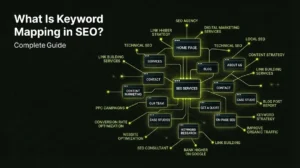
What is keyword mapping in SEO? It is the process of assigning specific target keywords to individual pages on your website so that every page has a clear purpose and avoids competing with your other pages on Google. In simple words, it means deciding which page will rank for which keyword before you even start writing content. At Skills Heaven, our digital marketing agency in Dubai, UAE, we help local businesses across Sharjah, Abu Dhabi, and the wider GCC region build proper keyword maps so their websites rank higher, attract the right visitors, and convert more leads instead of competing against their own pages on Google search results.
If you have ever wondered why two pages on your website are fighting for the same keyword and neither one ranks well, the answer is almost always a missing or poorly executed keyword mapping strategy. This guide will walk you through everything you need to know, from the basics to advanced techniques, so you can build a keyword map that actually works.
Why Keyword Mapping Matters in SEO
Search engines like Google try to show the single best page for any given search query. When your website has multiple pages targeting the same keyword, you create a problem called keyword cannibalization. This confuses Google’s algorithm, splits your ranking signals across pages, and weakens your overall visibility.
Keyword mapping in SEO solves this problem by organizing your website into a clear structure where every page owns one primary keyword and a set of related supporting terms. This approach improves crawl efficiency, strengthens internal linking, and helps search engines understand exactly what each page is about. Businesses that invest time in proper keyword mapping often see faster ranking improvements because their site architecture is clean and logical from the start.
How Keyword Mapping Works
The process generally follows these steps:
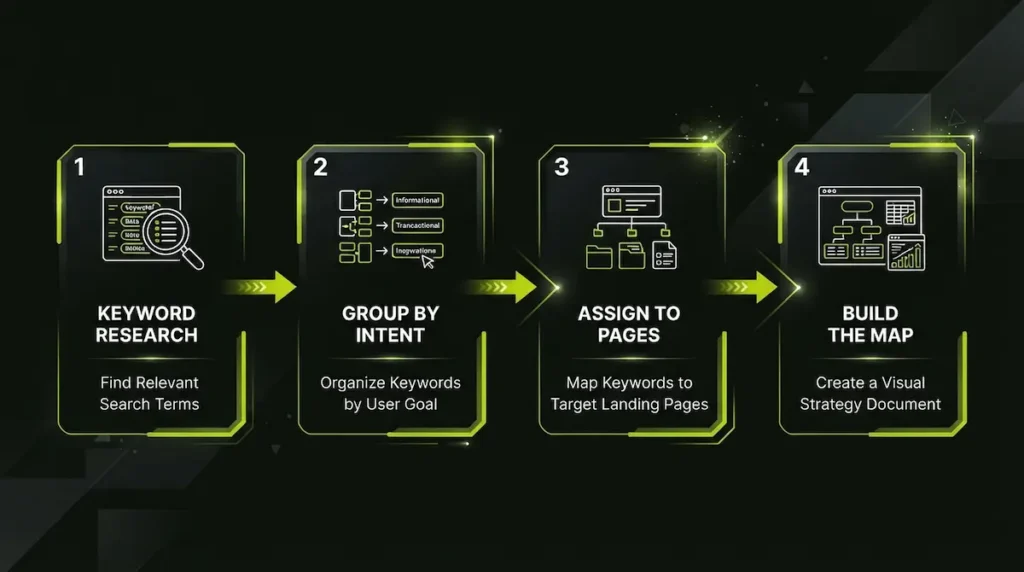
Step 1: Keyword Research and Grouping
You begin by gathering a large list of keywords related to your business or industry. Once collected, these keywords are grouped into clusters based on similar search intent. For example, all keywords related to pricing might form one cluster, while keywords related to “how to” guides form another.
Step 2: Assigning Keywords to Pages
Each cluster is then assigned to a specific page, whether that’s an existing page or a new one you plan to create. This is the core of keyword mapping. One page should own one primary keyword cluster, supported by a handful of closely related secondary terms.
Step 3: Auditing Existing Content
Before creating new pages, audit your current site to see which pages already rank for certain terms. This prevents duplication and helps you decide whether to update an existing page or build a fresh one.
Step 4: Building the Map Document
Most SEO professionals use a simple spreadsheet listing the URL, primary keyword, secondary keywords, search intent, and page title for every page on the site. This becomes your reference document for content creation and future updates.
What Is Keyword Intent in SEO
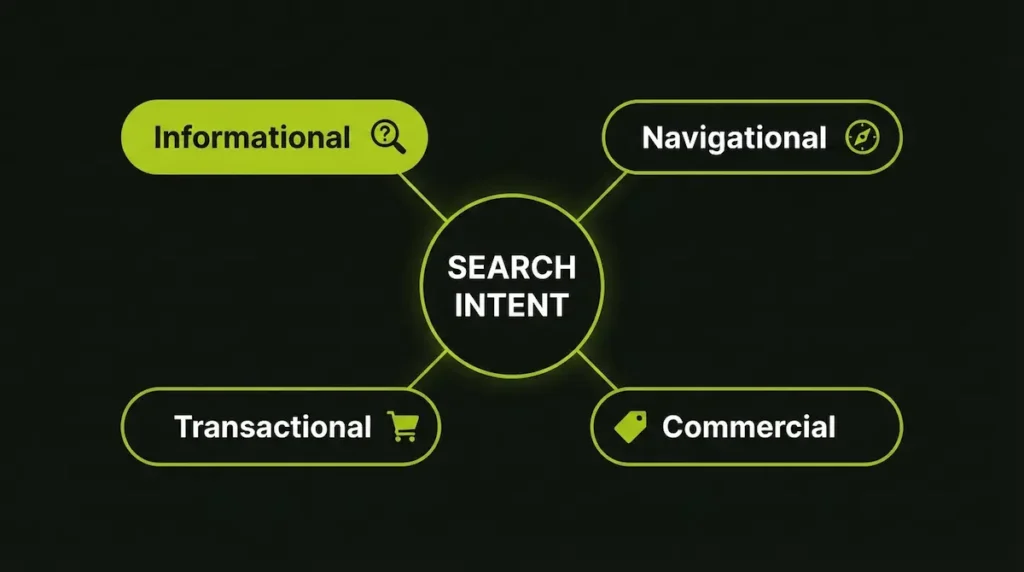
What is keyword intent in SEO? It refers to the underlying goal behind a person’s search query. Every search falls into one of four main categories: informational, navigational, commercial, and transactional. Someone searching “what is keyword mapping in seo” wants information, while someone searching “hire SEO agency Dubai” is ready to take action.
Understanding intent is essential because it directly shapes how you map keywords to pages. A blog post should target informational intent, while a service page should target commercial or transactional intent. Mixing these up on the same page often leads to poor conversion rates and weaker rankings, since the content doesn’t match what the searcher actually wants.
What Is Keyword Volume in SEO
What is keyword volume in SEO? It is the average number of times a particular keyword is searched on Google within a given period, usually measured monthly. Keyword volume helps you prioritize which terms deserve a dedicated page and which ones can simply be folded into existing content as supporting phrases.
High-volume keywords often come with higher competition, while lower-volume, longer phrases (often called long tail keywords) tend to convert better because they reflect more specific intent. A balanced keyword map includes a mix of both so you can capture quick wins alongside long-term authority building.
What Is Keyword Prominence in SEO
What is keyword prominence in SEO? It refers to how visible and important your target keyword appears within a page, particularly in high-impact areas such as the title tag, the first paragraph, headings, image alt text, and the URL itself. Search engines give more weight to keywords placed in these prominent positions compared to keywords buried deep within paragraphs.
When building your keyword map, prominence should guide your on-page structure. Your primary keyword needs to appear early and clearly, while secondary keywords can be woven naturally throughout subheadings and body content.
What Is Keyword Ranking in SEO
What is keyword ranking in SEO? It is simply the position your webpage holds on the search engine results page for a specific keyword. A ranking of one means your page appears at the very top, while a ranking of fifty means it’s buried on page five, where almost no one clicks.
Keyword ranking is the outcome you’re working toward through proper mapping, quality content, technical optimization, and authority building. Tracking your rankings regularly tells you whether your keyword map is producing results or whether adjustments are needed.
How to Target a Keyword in SEO
How to target a keyword in SEO comes down to aligning every element of a page with that keyword’s intent and language. Start by placing the keyword in the title tag, meta description, the first hundred words of content, at least one subheading, and naturally throughout the body text.
Beyond placement, targeting also means matching the content format to what’s already ranking. If the top results for a keyword are list-style articles, a single paragraph answer probably won’t compete well. If the top results are service pages, a blog post likely won’t satisfy the intent either. This is where in-depth competitor analysis becomes valuable, not to copy what others have done, but to understand what format and depth Google currently rewards for that specific term.
How to Rank Keywords in SEO Organically
How to rank keywords in seo organically requires a combination of strong content, solid technical SEO, and consistent link building. Here are the core elements that drive organic rankings:
Create content that fully answers the query: Google rewards pages that satisfy user intent completely rather than skimming the surface.
Build internal links: from related pages on your site pointing to your target page using natural anchor text.
Earn backlinks: from relevant, trustworthy websites in your industry or local market.
Improve page speed and mobile usability: since technical performance directly affects how Google evaluates your page.
Update content regularly: to keep it fresh and accurate, which signals ongoing relevance to search engines.
Organic ranking growth takes time, but a well-built keyword map accelerates the process because it eliminates internal competition and gives each page a clear, focused path to the top.
How to Adjust SEO Keywords When Updating Content
How to adjust seo keywords when updating content is a common challenge for businesses that already have an established website. Start by reviewing current performance data to see which keywords are already driving impressions and clicks, even if rankings are weak. These are your priority candidates for optimization since Google already considers the page somewhat relevant.
Next, check whether the search intent for your target keyword has shifted since the page was originally written. Search trends evolve, and a keyword that once had informational intent might now lean commercial. Update your content structure accordingly. Finally, refresh statistics, examples, and internal links, and make sure any newly identified secondary keywords are added naturally rather than forced into existing sentences.
How to Balance SEO Keywords With Natural Writing Flow
How to balance seo keywords with natural writing flow is one of the most important skills in modern content writing. The days of repeating a keyword every other sentence are long gone. Google’s natural language processing systems now evaluate content the way a human reader would, paying attention to context, related entities, and overall topic coverage rather than raw keyword counts.
The best approach is to write naturally for your audience first, then check whether your primary and secondary keywords appear in logical places. If a sentence sounds forced or robotic because of a keyword, rewrite it. Search engines today reward content that reads smoothly and covers a topic comprehensively far more than content that mechanically repeats phrases.
What Is Keyword Stuffing in SEO
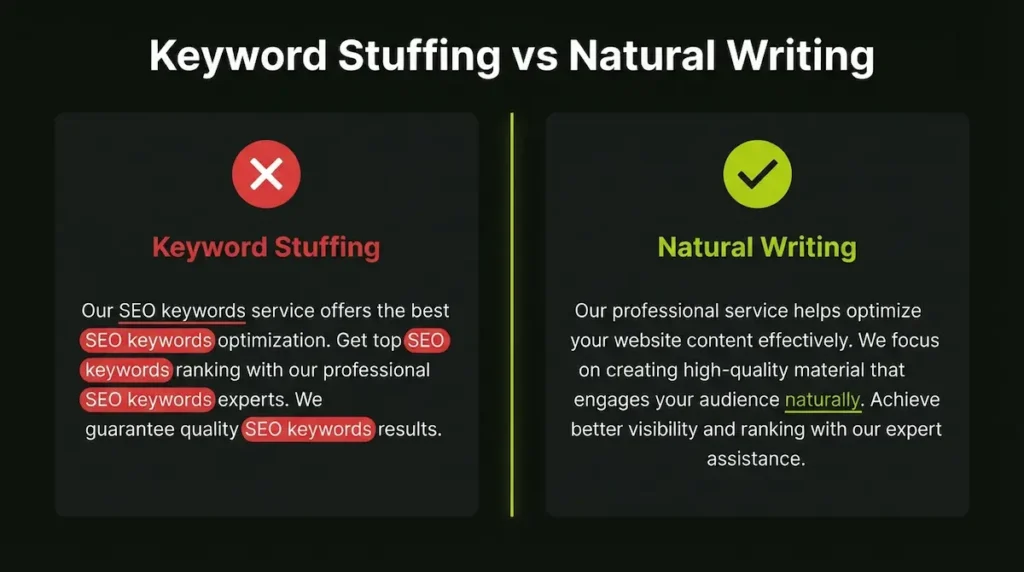
What is keyword stuffing in seo? It is the outdated and harmful practice of overloading a page with a target keyword far beyond what feels natural, in an attempt to manipulate rankings. Examples include repeating the same phrase dozens of times in a short paragraph, hiding keywords in white text, or stuffing keywords into image alt tags without any real description.
Keyword stuffing damages user experience and can trigger ranking penalties from Google’s spam detection systems. Modern SEO favors topical depth and natural language over repetition, so a well-built keyword map should never rely on stuffing to achieve relevance.
How Keywords Are Used in SEO
How keywords are used in seo spans far beyond just writing articles. Keywords guide nearly every decision in a Digital Marketing Strategy, including:
Page titles and meta descriptions: which influence click-through rates directly from the search results page.
URL Structures: where clean, keyword-relevant slugs help both users and search engines understand page topics.
Internal Linking: where anchor text is built around target keywords, strengthens topical relevance across the site.
Content planning: where keyword clusters determine what new pages or blog posts should be created next.
Paid advertising: where the same research often informs which terms to bid on for Google Ads Campaigns.
How Do You Use Keywords in SEO Effectively
How do you use keywords in seo without overdoing it or underusing them? The answer lies in strategic placement combined with topical relevance. Use your primary keyword in the title, the introduction, at least one heading, and the conclusion. Use secondary and related keywords throughout the body content wherever they fit naturally, especially in subheadings that answer specific user questions.
It also helps to include semantically related terms and entities that Google associates with your topic, even if they aren’t exact keyword matches. This broader topical coverage signals to search engines that your content is genuinely comprehensive rather than narrowly optimized around a single phrase.
Doing Competitor Analysis the Right Way
A strong keyword map is rarely built in isolation. Reviewing what’s currently ranking on the first page for your target keywords gives you valuable insight into content length, structure, and the subtopics Google expects to see covered. Look at the headings competitors use, the questions they answer, and the format they follow, whether that’s a list, a guide, or a comparison.
The goal isn’t to copy what’s already out there. Instead, identify the gaps. Are there questions left unanswered? Is the content outdated? Is the writing dense and hard to follow? Filling those gaps with clearer, more useful, and more current information is how you create content capable of outranking what’s already on page one, while keeping your work entirely original.
Building Your Own Keyword Map: A Practical Example
Imagine a local service business in Dubai. Their homepage might target a broad commercial keyword like “digital marketing agency Dubai.” A dedicated service page would target “Local SEO services Dubai,” while a separate blog post would target an informational query like “what is keyword mapping in seo.” Each page has one clear job, one primary keyword, and a handful of related secondary terms supporting it.
This structure prevents pages from competing against each other and gives search engines a clean, organized website to crawl and rank. It also makes future content planning far easier, since new blog ideas can simply slot into existing or new clusters within the map.
Final Thoughts
Keyword mapping in SEO is one of the most foundational yet frequently overlooked steps in building a website that actually ranks. It connects keyword research, content creation, site structure, and search intent into one coherent strategy rather than a series of disconnected efforts. When done correctly, it eliminates internal competition, strengthens topical authority, and gives every page on your site a clear purpose in your overall organic growth plan.
If you run a business in Dubai, Sharjah, Abu Dhabi, or anywhere across the UAE and want a website that is properly mapped, structured, and optimized to attract real customers rather than just traffic, our team at Skills Heaven is ready to help. We focus on results, not vanity metrics, backed by a full money-back guarantee. Book a free strategy call today and let our SEO specialists guide you forward.
Frequently Asked Questions
What is keyword mapping in SEO and why is it important?
Keyword mapping in SEO is the process of assigning specific keywords to individual pages on a website so each page has a clear, unique purpose. It’s important because it prevents pages from competing against each other on Google, strengthens site structure, and helps search engines understand exactly what each page is about, which leads to better rankings over time.
How is keyword mapping different from regular keyword research?
Keyword research is simply the process of finding relevant keywords and their search volume, while keyword mapping takes that research a step further by organizing those keywords into clusters and assigning them to specific pages. Research tells you what people are searching for; mapping tells you where that content should live on your website.
How often should a keyword map be updated?
A keyword map should be reviewed every few months or whenever you publish new content, since search trends, keyword volume, and intent can shift over time. Businesses that update their content regularly should also revisit their keyword map to check for new opportunities or overlapping pages that may need to be merged or restructured.
What happens if two pages on my website target the same keyword?
When two pages target the same keyword, it creates keyword cannibalization, where Google has to choose between them instead of ranking either one strongly. This usually results in both pages ranking lower than they would if the keyword were assigned to a single, well-optimized page.
Can keyword mapping help with local SEO for businesses in Dubai or the UAE?
Yes, keyword mapping is especially useful for local SEO since it allows businesses to create separate pages for different services and locations without those pages competing against each other. For example, a business can map distinct pages for services in Dubai, Sharjah, and Abu Dhabi, each targeting its own location-specific keywords.
Do I need an SEO agency to build a keyword map, or can I do it myself?
A keyword map can be built independently using free or paid keyword research tools, a spreadsheet, and a clear understanding of your site structure and audience intent. That said, an experienced SEO agency can save significant time and avoid common mistakes, especially for businesses managing larger websites or competitive local markets such as Dubai and the wider GCC region.

Wali Shah is the Founder and CEO of SkillsHeaven, a digital growth agency specializing in Local SEO, Google Ads, and conversion-focused website development. With over 8+ years of experience, he has helped scale 170+ businesses, including 93+ limousine companies globally, by building structured, lead-generating digital systems. His expertise spans local search optimization, paid media strategy, and high-performance website development, all aligned with measurable business growth. Known for a data-driven and ethical approach, Wali focuses on creating scalable marketing systems that increase visibility, generate qualified leads, and drive long-term revenue for service-based businesses.