
An LSI keyword in SEO is a word or phrase that shares semantic meaning with your main target keyword, helping search engines understand the full context of your content rather than just matching exact words. If your primary keyword is “coffee brewing,” an LSI keyword in SEO would be related terms such as “espresso machine,” “grind size,” or “french press.” These terms are not synonyms, they are concepts that naturally belong to the same topic.
The idea of an LSI keyword in SEO comes from older technology, but the way marketers use the term today is more practical: writing content that covers a topic completely instead of repeating one phrase repeatedly. This guide breaks down exactly where the term came from, how it connects to primary and secondary keywords, seed keywords, and keyword clustering, and how to actually put all of it to work on a real page. If you’d rather have a team handle this kind of research and execution for your own site, our SEO team in Dubai builds this exact process into every project.
Where Does the Term LSI Keyword Actually Come From
Latent Semantic Indexing was originally a mathematical method built in the late 1980s to index small, static databases by studying word relationships within documents. Researchers at the time were trying to solve a fairly narrow problem: how do you help a computer understand that two documents are related even when they don’t use the exact same words. It was never designed as a ranking factor, and it was built years before commercial search engines like Google even existed.

Google has confirmed publicly, more than once, that it does not use Latent Semantic Indexing technology to rank pages. The company’s own search relations team has addressed this directly, pointing out that the mathematical model behind LSI simply isn’t part of how modern search ranking works.
So why does the term LSI keyword in SEO still get used everywhere, even years after that clarification? Because the underlying goal, connecting related concepts together, genuinely helps content perform better, even though the original technology does not apply to modern search. What actually drives rankings today is semantic search, entity recognition, and natural language processing (NLP), the real systems Google uses to judge topical depth.
How Semantic Search Actually Works Today
To really understand why an LSI keyword in SEO still matters as a practice, even without the original technology behind it, it helps to understand what replaced it. Modern search engines use language models trained on enormous amounts of text to understand meaning, context, and relationships between words, similar in spirit to how a human reader understands that “grind size,” “espresso machine,” and “french press” are all connected to coffee brewing without needing those exact words to appear together in a dictionary.
This is often described as entity based understanding. Instead of treating a page as a bag of individual keywords, search engines treat it as a collection of connected concepts and entities. A well written page about coffee brewing that also naturally mentions grind consistency, water temperature, brewing time, and equipment types signals far more topical depth than a page that repeats “coffee brewing” fifty times without ever expanding on the subject.
This is also why keyword stuffing, once a common tactic, backfires today. A page stuffed with the same exact phrase over and over doesn’t look more relevant to a modern search algorithm, it looks thin, repetitive, and often spammy. Genuine topical coverage, using an LSI keyword in SEO naturally throughout your content, is what actually signals expertise now.
What Are Primary and Secondary Keywords in SEO
Every well structured page is built around two layers of keywords.
Primary keyword: the main phrase your page is built to rank for. It typically appears in your title tag, H1, URL, and opening paragraph. For this page, that phrase is “LSI keyword in SEO.”
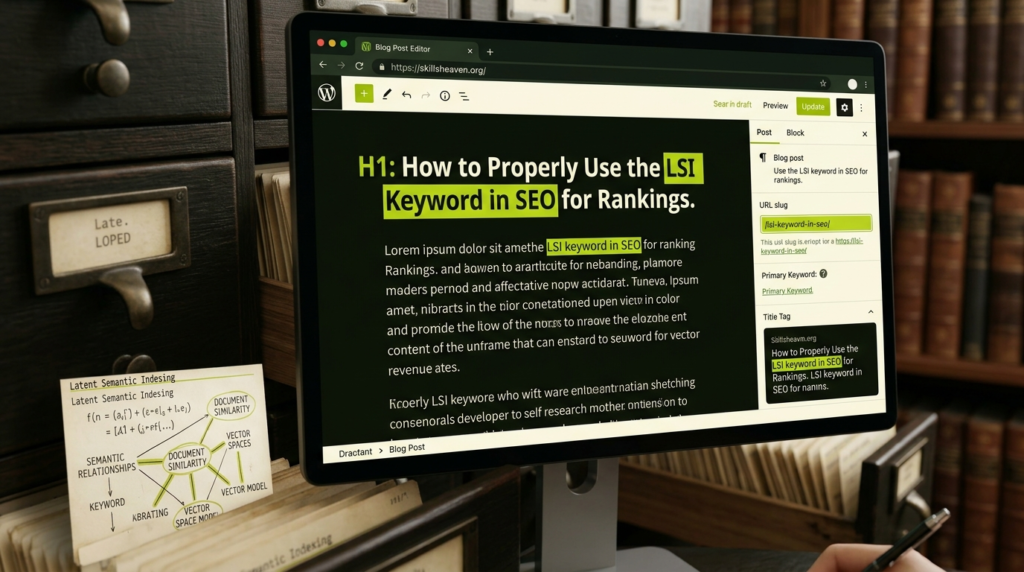
Secondary keywords: supporting phrases that add context and cover related search intent, helping the page rank for more variations without needing separate pages for each one.
Think of the primary keyword as the destination, and secondary keywords as the roads leading there from different directions. A page built around a single primary keyword but supported by several well chosen secondary keywords tends to rank for a much wider spread of search queries than a page obsessively focused on one exact phrase.
It’s also worth understanding how this differs slightly from an LSI keyword in SEO specifically. Secondary keywords are usually full search queries in their own right, things people actually type into Google. An LSI keyword in SEO is often smaller and more conceptual, a single related term or phrase that supports the topic without necessarily being a search query anyone would type on its own. In practice, the two categories overlap quite a bit, but the distinction is useful when planning content.
What Are Secondary Keywords in SEO With Example
Secondary keywords are additional phrases woven into your content to expand your primary topic and capture more related search queries. They usually come from the same content cluster and answer smaller questions the searcher might also have.
Example: If your primary keyword is “email marketing tips,” secondary keywords might include:
- email subject line ideas
- best time to send marketing emails
- how to reduce email unsubscribe rate
- email automation tools
Each supports the same core topic while pulling in slightly different search traffic, making the page feel complete rather than thin. A reader who arrives on this page looking for general email marketing tips is likely to also want to know about subject lines and send timing, so covering those secondary topics within the same page keeps them reading instead of bouncing back to search for the answer elsewhere.
This is a subtle but important point. Secondary keywords aren’t just there for search engines, they genuinely improve the reader’s experience by anticipating what they’ll want to know next.
What Is a Seed Keyword in SEO
A seed keyword in SEO is the starting point of your keyword research, the broad, simple term used to generate a larger list of related keyword ideas. It’s called a “seed” because everything else grows from it.
For example, a bakery’s seed keyword might just be “bakery” or “custom cakes.” From there, research expands into specific terms like “custom birthday cakes near me,” “wedding cake designs,” or “gluten free bakery delivery.” A seed keyword in SEO rarely gets targeted directly since it’s too broad and competitive; it acts as the trunk that branches into more rankable keywords.
The process usually works like this: you enter a seed keyword in SEO into a research tool, and the tool returns dozens or hundreds of related search terms, questions, and long tail variations that real people are searching for. From that raw list, you then group and prioritize the keywords worth actually targeting, which is where keyword clustering comes into play.
What Is Keyword Clustering in SEO
Keyword clustering in SEO is the process of grouping keywords that share the same search intent so they can be targeted with one well optimized page instead of multiple thin pages competing with each other.
“Best running shoes,” “top running shoes 2026,” and “running shoes recommendation” are different phrases, but a searcher typing any of them wants the same result. Keyword clustering groups these under one page rather than three weak, competing pages, which helps avoid keyword cannibalization, where your own pages end up competing against each other in search results and, in many cases, neither one ranks as well as a single combined page would.
Clustering isn’t just a defensive tactic against cannibalization either. It’s also a more efficient way to plan content overall. This is the same clustering approach our team uses when building digital marketing strategies for clients across Dubai, since a handful of well clustered pages consistently outperforms dozens of scattered, thin ones.
How Can I Use Keyword Clustering to Improve My SEO
Clustering improves SEO performance in a few clear ways:
- It prevents cannibalization, letting one strong page absorb traffic from all related searches instead of five weak pages fighting for the same spot.
- It builds topical authority by answering a topic from multiple angles, signaling depth to search engines.
- It saves production time since fewer, stronger pages replace near identical articles.
- It improves internal linking, as clustered content naturally connects to related subtopics.
- It strengthens the page’s relevance for its primary keyword by covering enough surrounding context that search engines have no doubt about what the page is actually about.
Group your keyword list by matching search intent, not shared wording; two keywords can look similar but serve entirely different intents.
How Do You SEO a Cluster of Similar Keywords

Once you have identified a cluster, here is a practical process to optimize it:
Step 1: Group by intent, not wording. Look at what result a searcher expects, not just the words they typed.
Step 2: Pick one primary keyword per cluster. This becomes your main target for the title, H1, and URL slug.
Step 3: Assign secondary keywords to subheadings. Each related keyword can naturally become an H2 or H3, similar to the structure of this page.
Step 4: Cover the topic in depth. Answer every reasonable follow up question a reader might have about the topic in one place.
Step 5: Link supporting pages together. If a related subtopic genuinely deserves its own page, link it back to your main cluster page to reinforce topical relevance.
Step 6: Monitor performance by cluster, not just by page. Track how the entire group of related keywords performs together over time, since a strong cluster often lifts rankings across every keyword within it, not just the primary one.
How Do I Group Related Keywords for SEO
Grouping related keywords for SEO comes down to research and pattern recognition. Start by exporting your full keyword list from a keyword research tool, then sort it by search intent categories such as informational, commercial, and navigational. Keywords that trigger the same type of result page in Google search usually belong in the same group.
A simple way to test this manually is to search each keyword yourself and compare the top ranking pages. If the same pages or the same page type shows up for multiple keywords, they belong in one cluster.
How to Find Semantically Related Keywords for Your Content
A few practical, low cost methods work well here:
- Google’s “People also ask” and “Related searches” sections reveal real related queries.
- Autocomplete suggestions in the search bar show phrases people commonly search alongside your topic.
- Top ranking competitor pages often reveal recurring terms and entities worth including, without needing to copy their structure or wording.
- Keyword research tools can generate related keyword ideas in bulk, though the results still need manual review for actual relevance.
- Forums and community discussions around your topic often reveal the exact phrasing real customers use, which can differ noticeably from what a keyword tool suggests.
The goal is not to stuff every related term into your content. It is to naturally cover the concepts a knowledgeable writer would mention anyway.
Keyword Mapping vs Keyword Clustering
These two terms get confused often enough that they’re worth separating clearly. Keyword clustering, as covered above, is the process of grouping related keywords by intent. Keyword mapping is the next step after clustering: assigning each finished cluster to a specific, individual page on your website.
Keyword mapping prevents two common problems. First, it stops multiple pages from accidentally targeting the same cluster, which causes cannibalization even after clustering has already been done correctly. Second, it creates a clear reference document your whole content team can use, so a new writer joining the project can immediately see which page is meant to own which topic, avoiding duplicate effort down the line.
If your business is considering handing this process off entirely, this is exactly the kind of research and mapping work covered in our SEO services for Dubai businesses, before any content gets written.
Common Mistakes to Avoid
- Treating an LSI keyword in SEO as a magic ranking trick rather than a way to build topical depth
- Forcing unrelated keywords into a page just because a tool suggested them
- Creating separate thin pages for keywords that belong in the same cluster
- Ignoring search intent while grouping keywords purely by shared words
- Repeating the primary keyword unnaturally often instead of letting related terms carry some of the topical weight
- Skipping the keyword mapping step, which often leads to unnoticed cannibalization months later
If you’re comparing agencies before hiring one to fix mistakes like these, our guide on what questions to ask a SEO company covers exactly what to ask before signing a contract.
Frequently Asked Questions
Is an LSI keyword the same as a synonym?
No. A synonym means the same thing as your keyword, while an LSI keyword in SEO is a related concept that commonly appears alongside your topic.
Does Google actually use LSI technology to rank pages?
No, Google has confirmed it does not use Latent Semantic Indexing for ranking. What helps instead is natural language processing and semantic search understanding.
How many secondary keywords should a page target?
There is no fixed number. The right amount depends on how many related subtopics genuinely belong on that page without diluting the main focus.
What is the difference between a seed keyword and a primary keyword?
A seed keyword in SEO is the broad starting point of your research, while a primary keyword is the specific, targeted phrase you actually optimize a page around.
Should every page target its own separate keyword cluster?
Generally yes. Assigning one cluster per page, through the keyword mapping process, keeps each page focused and avoids internal competition between your own content.
Can a page have too many LSI keywords?
Yes, if they’re forced in unnaturally. The goal is genuine topical coverage, not maximum keyword density, so any related term that doesn’t fit naturally into a sentence is better left out.
Final Thoughts
Understanding what an LSI keyword in SEO really means helps you move past outdated keyword stuffing habits and focus on what actually works: writing complete, well organized content that covers a topic the way a real expert would explain it. Combine that with smart keyword clustering, clear keyword mapping, and a solid grasp of primary and secondary keyword structure, and your content naturally becomes easier for both readers and search engines to understand, which is ultimately what drives sustainable rankings over time.
If you’d rather have this entire process, research, clustering, mapping, and writing, handled for you, take a look at our digital marketing services in Dubai or book a free strategy call to talk through your specific site.

Wali Shah is the Founder and CEO of SkillsHeaven, a digital growth agency specializing in Local SEO, Google Ads, and conversion-focused website development. With over 8+ years of experience, he has helped scale 170+ businesses, including 93+ limousine companies globally, by building structured, lead-generating digital systems. His expertise spans local search optimization, paid media strategy, and high-performance website development, all aligned with measurable business growth. Known for a data-driven and ethical approach, Wali focuses on creating scalable marketing systems that increase visibility, generate qualified leads, and drive long-term revenue for service-based businesses.