
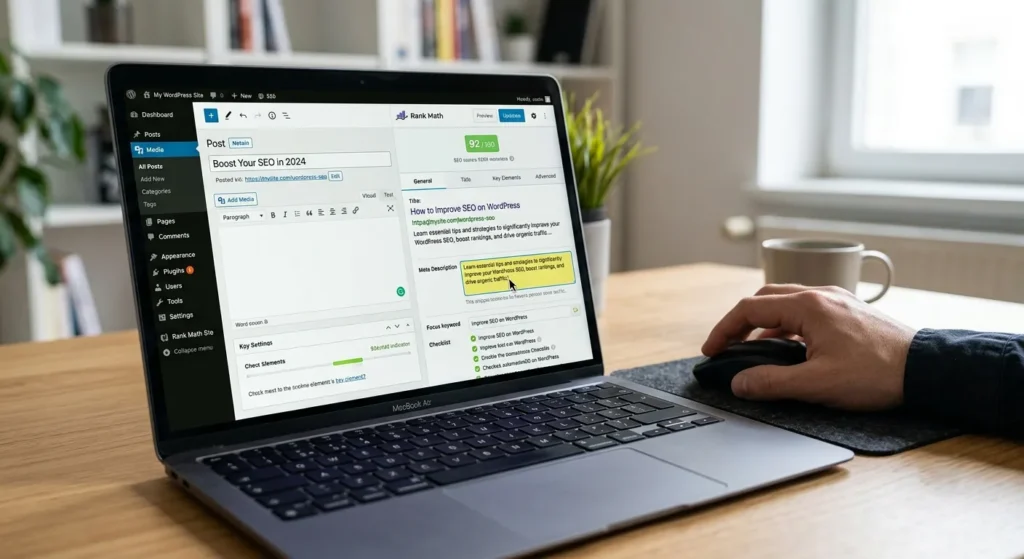
If you are searching for how to improve SEO on WordPress, you have found exactly the right resource. We provide professional WordPress SEO services that help businesses optimize their websites, strengthen search visibility, and generate consistent organic traffic through proven, sustainable strategies. Whether you are asking how to add SEO to a WordPress site for the first time or looking to fix, update, and manage SEO on an existing WordPress website, this guide covers everything you need from the ground up.
Is WordPress Good for SEO? Here Is the Truth
Before exploring how to SEO a WordPress website, it is worth answering the question that almost every site owner asks first. Is WordPress good for SEO? Is WordPress the best for SEO? Is WordPress better for SEO than other platforms?
The answer across all three questions is a clear yes. WordPress is widely recognized as one of the most SEO-friendly content management systems available, and for good reason. It powers over 43% of all websites on the internet, and a major factor behind that dominance is how naturally it supports search engine optimization.
Why is WordPress best for SEO? Because it gives you complete control over every element that matters. You can customize URL structures, manage meta titles and descriptions for every page, install powerful SEO plugins, generate XML sitemaps automatically, implement schema markup without writing code, and publish content at scale with a clean, indexable architecture. No other platform combines this level of flexibility with ease of use in the same way.
Is WordPress bad for SEO? Only when it is configured poorly. A slow host, a bloated theme, missed settings, or no SEO plugin can hold any WordPress site back. The good news is that every one of these issues is fixable, and this guide shows you exactly how.
Why You Should Use WordPress for SEO
Understanding why to use WordPress for SEO helps you make the most of the platform. WordPress offers a combination of technical flexibility, plugin ecosystem depth, and content management capability that gives you a genuine competitive advantage in search.
The platform generates clean HTML code by default, supports structured data, allows granular control over crawl settings, and integrates directly with industry-leading SEO tools. When you know how to improve WordPress SEO properly, you are working with a platform that is already predisposed to help you rank.

How to Add SEO to WordPress: Setting the Foundation
Learning how to add SEO to your WordPress website begins with getting the core settings right. These foundational steps determine how search engines discover, crawl, and index your content.
Make Your Site Indexable
Go to Settings > Reading in your WordPress dashboard. Confirm that the “Discourage search engines from indexing this site” checkbox is NOT checked. This is one of the most overlooked steps when people ask how to set SEO in WordPress from scratch. If this box is checked, Google cannot index your site regardless of anything else you do.
Set Your Permalink Structure
Navigate to Settings > Permalinks and select the “Post Name” option. This gives you clean, keyword-rich URLs such as yoursite.com/how-to-improve-seo-on-wordpress rather than URLs containing numbers or symbols. Clean URLs are one of the simplest and most impactful ways to improve your SEO score on WordPress immediately.
Secure Your Site With HTTPS
Google treats HTTPS as a ranking signal. Ensure your hosting provider has issued a valid SSL certificate and that your WordPress site loads securely. Most managed WordPress hosting providers include free SSL as standard.
How to Use the Yoast SEO Plugin for WordPress
One of the first questions people ask when learning how to do SEO in WordPress is which plugin to use. The Yoast SEO plugin for WordPress is the most widely used SEO plugin in the world, trusted by over 13 million active websites. Knowing how to use Yoast SEO on WordPress effectively is one of the highest-value skills any WordPress site owner can develop.
How to Set Up Yoast SEO for WordPress
The process of how to set up Yoast SEO for WordPress is straightforward. Go to Plugins > Add New in your WordPress dashboard. Type “Yoast SEO” in the search bar, click Install Now, and then click Activate. Once the plugin is active, you will be directed to the first-time configuration wizard. This wizard walks you through all essential settings including site type, organization details, social profiles, and search engine visibility preferences.
How to Use Yoast SEO in WordPress for Every Page and Post
Once Yoast SEO is installed, every page and post you edit will display a Yoast panel below the content editor. This is where you go when you need to edit SEO on WordPress for individual pieces of content. Enter your focus key phrase, write a custom meta description, and review the traffic-light analysis checklist. Work through each suggestion until you achieve green scores across key phrase in the introduction, key phrase density, subheading distribution, internal links, and outbound links.
How to Use the Yoast SEO Plugin in WordPress to Its Full Potential
The Yoast SEO plugin WordPress users rely on most goes far beyond basic meta tags. Here is what it handles automatically and how to use each feature:
XML sitemaps are generated automatically by Yoast and updated whenever you publish new content. Submit this sitemap to Google Search Console to accelerate indexing. Canonical URLs are added to every page to prevent duplicate content issues. Schema markup is applied across your site to help search engines understand your content type, whether it is an article, FAQ, local business, or product page. The AI-powered features in Yoast SEO Premium, including AI Generate and AI Optimize, allow you to create optimized title and meta description variations in seconds and automatically improve key phrase placement throughout your content.
How to Change SEO on WordPress Using Yoast
When you need to update SEO on WordPress for existing pages, return to the Yoast panel within the page or post editor. You can change the SEO title, meta description, focus key phrase, and social preview settings at any time. For bulk changes, use Yoast’s bulk edit feature to update titles and descriptions across multiple pages simultaneously without opening each one individually.
How to Improve SEO on WordPress: On-Page Optimization
Improving your WordPress SEO score requires consistent, systematic attention to on-page elements. These signals tell search engines what your content is about and help them match it to relevant searches.
Keyword Research and Placement
Every page you optimize should target a specific primary keyword alongside semantically related terms. Use tools such as Google Keyword Planner, Ahrefs, or SEMrush to identify keywords with meaningful search volume. Once you have identified your target keyword, place it naturally in the page title, the first paragraph, at least one H2 subheading, the meta description, and the alt text of your primary image.
Header Tag Structure
Use a single H1 tag as your page title. Use H2 tags for major sections and H3 tags for subsections. This hierarchy helps both users and Google’s crawlers understand the structure and priority of your content. Including relevant keywords in header tags also increases your chances of earning rich snippets and AI Overview placements in Google Search.
Meta Titles and Meta Descriptions
Your meta title should stay within 55 to 60 characters and lead with your primary keyword where possible. Your meta description should be unique for every page, stay within 150 to 160 characters, and be written to encourage clicks rather than simply describe the page. When you edit SEO on WordPress for each page, this is one of the highest-leverage actions available to you.
Image Optimization
Before uploading any image to your WordPress site, rename the file using descriptive, keyword-relevant text. Write descriptive alt text for every image. Compress images using tools such as ShortPixel or Smush before uploading, and serve them in WebP format for optimal page speed. Every one of these steps contributes to how to optimize SEO on WordPress at the image level, and they are frequently overlooked.
How to Boost SEO on WordPress Through Technical Optimization
Technical SEO addresses the infrastructure of your WordPress site. Getting these elements right is essential to how to boost SEO on WordPress at a structural level.
XML Sitemaps
An XML sitemap lists all of your important pages in a format search engines can read. Submit it to Google Search Console through Settings > Search appearance > Sitemaps within Yoast SEO. This helps Google discover and index your content faster and more reliably.
Core Web Vitals and Page Speed
Google uses Core Web Vitals as a direct ranking factor. These metrics measure loading speed, interactivity, and visual stability. To improve Core Web Vitals on your WordPress site, choose a lightweight theme, minimize render-blocking scripts, enable lazy loading for images, use a content delivery network, and select a hosting provider known for fast server response times. Poor page speed is one of the most common reasons a well-optimized WordPress site still ranks below its potential.
Mobile-First Optimization
Google uses mobile-first indexing, meaning it evaluates your mobile site when determining rankings. Your WordPress theme must be fully responsive, text must be readable without zooming, and buttons must be easily tappable on small screens. Checking mobile usability in Google Search Console regularly is an important part of how to manage SEO on WordPress over time.
Schema Markup and Structured Data
Schema markup provides search engines with additional context about your content. Implementing FAQ schema, article schema, local business schema, and review schema can earn rich results in Google Search that dramatically increase click-through rates. Use Yoast SEO, Rank Math, or AIOSEO to add schema markup without writing code.
Fixing 404 Errors and Managing Redirects
Broken links and 404 errors create poor user experiences and waste Google’s crawl budget. Audit your site regularly using Google Search Console or Screaming Frog. Set up 301 redirects for any pages you have moved or deleted so that link equity is preserved and users are sent to the most relevant available page. Managing redirects is a core part of how to fix SEO on WordPress after site restructuring or content migration.

How to SEO a WordPress Website With a Strong Content Strategy
Content is the foundation of every successful WordPress SEO campaign. Understanding how to make SEO for a WordPress website at the content level is what separates sites that rank from those that do not.
Topic Clusters and Content Architecture
Build your content around topic clusters. Select broad pillar topics that represent your core subject areas, then create clusters of supporting content that link back to those pillar pages. This architecture signals topical authority to Google and distributes internal link equity throughout your site.
E-E-A-T: Experience, Expertise, Authority, and Trustworthiness
Google evaluates content quality through the lens of E-E-A-T. Demonstrate genuine expertise through detailed, accurate, and original content. Build authority by earning high-quality backlinks from reputable websites in your industry. Establish trustworthiness through an accurate About page, clear contact information, and consistent content updates.
Internal Linking
Internal links connect your pages and help Google understand the relationship between your content. Use descriptive, keyword-relevant anchor text and include three to five internal links per 1,000 words of content. Every important page on your site should receive at least one incoming internal link. Internal linking is one of the most underused strategies when people ask how to improve SEO of their WordPress site, but it delivers measurable results.
Content Freshness
Google rewards actively maintained content. Review existing pages and posts regularly, update outdated statistics, expand thin content, and add new internal links to recently published pages. Updating existing content is often faster and more impactful than publishing new content when it comes to how to improve SEO for a WordPress site that is already established.
How to Improve SEO on a WordPress Site With Local SEO
If your business serves customers in a specific location, local SEO is a critical part of how to improve SEO on your WordPress site. Optimizing for local search ensures your website appears in Google Maps results and local pack listings when nearby customers search for your services.
Claim and fully complete your Google Business Profile with accurate business name, address, phone number, hours, categories, and high-quality photos. Ensure your contact information is consistent across your WordPress website and every online directory where your business is listed. Use Yoast SEO’s Local SEO extension to add local business schema markup to your site. Actively encourage satisfied customers to leave genuine Google reviews, as review quantity and quality are direct local ranking factors.
How to Update SEO on WordPress and Monitor Performance Over Time
Knowing how to update SEO on WordPress and track your results is what turns a one-time optimization effort into a compounding growth strategy.
Connect your WordPress site to Google Search Console to monitor index coverage, crawl errors, keyword rankings, click-through rates, and Core Web Vitals performance. Connect Google Analytics to understand user behavior, traffic sources, session quality, and conversions. Run periodic technical SEO audits using Screaming Frog, Ahrefs, or SEMrush to identify new issues and opportunities as your site grows.
Review your Yoast SEO scores across your key pages regularly. Address any warnings or suggestions the plugin surfaces. Monitor your top-performing pages for ranking fluctuations and update content proactively when rankings begin to decline.
How to Improve SEO of Your WordPress Site: Priority Checklist
For immediate, measurable improvement, work through this prioritized action list:
Confirm search engine indexing is enabled under Settings > Reading. Set permalink structure to Post Name. Install and configure the Yoast SEO plugin using the setup wizard. Submit your XML sitemap to Google Search Console. Write unique meta titles and meta descriptions for all key pages using the Yoast SEO editor. Add descriptive alt text to every image. Compress images and implement caching for faster page speed. Build internal links between related content using descriptive anchor text. Add schema markup for your most important content types. Confirm your site is fully mobile responsive and passes Core Web Vitals assessments in Google Search Console.
Frequently Asked Questions
How do I do SEO in WordPress if I have no technical experience?
Start by installing the Yoast SEO plugin. Its setup wizard and real-time analysis tools guide you through the process step by step without requiring any coding knowledge. Follow the recommendations it provides for each page you create, and work through the technical improvements outlined in this guide at your own pace.
Is WordPress the best for SEO compared to Wix or Squarespace?
For the vast majority of businesses, yes. WordPress offers a deeper and more customizable SEO toolkit than competing platforms. Its open-source architecture allows full technical control, its plugin ecosystem handles automation at scale, and its content management capabilities support the ongoing strategy that earns long-term organic growth.
How do I change SEO on WordPress for an existing page?
Open the page in your WordPress editor and scroll down to the Yoast SEO panel. From there you can update the SEO title, meta description, focus keyphrase, and social preview settings. Click Update or Publish to save your changes.
How long does it take to improve SEO on a WordPress website?
Most WordPress sites begin showing measurable ranking improvements within three to six months of implementing a comprehensive SEO strategy. The timeline depends on your site’s existing authority, the competitiveness of your target keywords, content quality, and the consistency of your ongoing optimization efforts.
How do I use the Yoast SEO plugin for WordPress on WooCommerce?
Yoast SEO is fully compatible with WooCommerce. The Yoast WooCommerce SEO extension adds product-specific structured data, bulk AI title generation for product pages, and canonical URL management for variable products. Install and activate it from the Yoast dashboard, then optimize each product page using the Yoast panel within the WooCommerce product editor.
Work With WordPress SEO Specialists Who Deliver Results
Understanding how to improve SEO on WordPress is one thing. Executing a complete, ongoing strategy while running your business is another challenge entirely. Our WordPress SEO team handles everything from initial audits and Yoast SEO configuration to content strategy, technical fixes, local SEO, and link building so your site earns the rankings and traffic your business deserves.
Contact us today to get a customized WordPress SEO strategy built around your goals, your industry, and your target audience.

Atif Khan is a highly experienced Local SEO Expert and Strategic SEO Consultant who helps businesses turn their websites into powerful lead-generating assets. With hands-on experience optimizing and ranking over 100 websites across competitive industries, he specializes in building data-driven SEO systems that improve local search visibility, attract qualified traffic, and convert visitors into customers. His expertise spans Google Business Profile optimization, technical SEO, keyword research, content strategy, and conversion-focused website optimization, ensuring every project is aligned with measurable business outcomes. Atif focuses on creating complete local search ecosystems, combining website authority, relevance, and trust signals to help businesses dominate in their target locations. Beyond rankings, he develops scalable growth strategies that drive calls, inquiries, and long-term revenue. His approach is rooted in ethical, white-hat SEO practices, continuous optimization, and performance tracking, ensuring sustainable results. As a consultant, he works closely with businesses and agencies to align SEO with revenue goals, improve digital presence, and build long-term organic acquisition systems.