
SEO vs SEM is one of the most important distinctions in digital marketing, and understanding it correctly determines how you invest your budget, build your online presence, and compete for customers searching for what you offer right now. SEO, which stands for Search Engine Optimization, is the practice of earning visibility in organic search results through content, technical improvements, and authority building. SEM, which stands for Search Engine Marketing, is a broader discipline that combines SEO with paid advertising strategies like Google Ads and Pay-Per-Click campaigns to capture visibility across both organic and paid sections of search results pages.
If you have been confused by these two terms, you are far from alone. Marketers, business owners, and even agency professionals regularly use them interchangeably, which creates real confusion around strategy, budgeting, and performance expectations. This guide cuts through that confusion completely.
What Is SEM SEO Marketing? Understanding the Relationship Between Both Terms
Before diving into the differences, it is worth getting the definitions precisely right, because the relationship between these two terms is hierarchical, not parallel.
The main difference is that SEO is focused on optimizing a website in order to get traffic from organic search results. On the other hand, the goal of SEM is to get traffic and visibility from both organic and paid search. Google’s search results are divided into two main categories: the paid search results and the organic search results. SEO is where you focus entirely on ranking in the organic results. SEM is when you tap into both SEO and PPC in order to get traffic from search engines. SEM is a broad term that includes SEO and PPC, which means SEO falls under the umbrella category of SEM.
Think of it this way: every SEO strategy is a form of SEM, but not every SEM strategy is purely SEO. SEM is the overarching category, and SEO and PPC are the two primary channels that live within it.
In everyday agency and marketing usage, however, most professionals use “SEM” as shorthand specifically for paid search advertising. When a client says they want to invest in SEM, they almost always mean Google Ads or a similar paid platform. That practical usage persists even though it is technically incomplete.
What Is Organic SEO and What Is Organic Search?
Organic SEO refers to all activities that improve a website’s rankings in the unpaid, natural section of search engine results pages. These results appear because search engines judge them to be the most relevant and authoritative answers to a user’s query, not because anyone paid for that placement.
SEO is the process of improving a website to increase its organic, or unpaid, visibility on major search engines. Companies like Google and Bing use algorithms to ensure their search engines show relevant, high-quality search results for queries, so marketers use SEO strategies to earn top positions for relevant searches without paying per click.
Organic search in SEO covers the full landscape of non-paid results, including standard blue link listings, featured snippets, People Also Ask boxes, local pack results, image carousels, and video results. All of these represent different forms of earned organic visibility, none of which require paying Google each time a user clicks.
Organic search drives 53.3 percent of all website traffic according to BrightEdge research from 2025. More than half of all website visits come from organic search, and no other channel comes close.
Is SEO Organic Marketing? Is SEO Paid or Organic?
SEO is organic marketing. It is earned, not purchased. This is one of the most fundamental characteristics that separates it from paid channels like Google Ads.
Organic results come with inherent trustworthiness to users relative to SEM as they cannot be paid for. Cost is a core differentiator: while SEO involves work and investment in content and technical optimization, there is no cost associated with each individual click or impression, whereas SEM accumulates a cost-per-click every time a user engages with a paid ad.
The organic nature of SEO is also what gives it its compounding quality. A blog post or landing page that earns a top organic ranking continues generating traffic for months or years without requiring additional spending per visitor. Paid ads deliver traffic only as long as the budget keeps running.
Is SEO Earned Media?
Yes. SEO is definitively classified as earned media in the paid, owned, and earned media framework.
Earned media refers to visibility and attention your brand receives because others, in this case search engines and the users whose behavior influences rankings, judge your content to be valuable enough to surface organically. You earn that visibility through quality content, technical excellence, and authority signals like backlinks. You do not buy it directly.
Paid search advertising, by contrast, is paid media. Your listing appears because you are paying for the placement, and the moment you stop paying, the visibility disappears entirely.
Owned media refers to channels you control directly, such as your website, email list, and social media profiles. SEO sits at the intersection of owned and earned media: you own the content and the website, but the visibility in search results is earned through the quality of what you produce and the authority your domain accumulates over time.
What Is the Main Difference Between SEO and SEM?
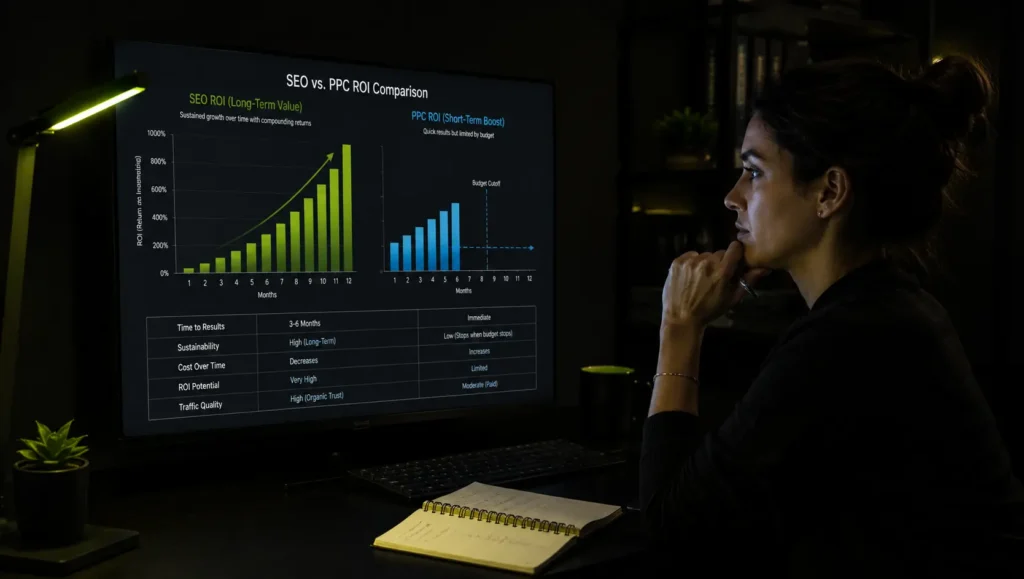
The key differences between SEO and SEM come down to cost, time, placement, and targeting. With SEO, you do not pay per click, while with SEM you buy visibility via cost per click, bidding, and daily caps. SEO takes months to show results and builds lasting value. SEM delivers immediate impact as long as there is budget, and disappears the moment you stop paying. SEO shows results in organic listings. SEM appears as labeled ads on the SERP marked as Sponsored. SEM targets by keywords, location, device, and schedule, while SEO targets through your site’s technical setup, content quality, and domain authority.
Here is the clearest way to understand what is the difference between SEM and SEO in practical terms:
SEO is an investment in a long-term asset. The work you do today compounds over time, and each piece of well-optimized content continues to earn organic traffic without additional cost per visitor.
SEM paid advertising is a demand lever. You activate it when you need immediate visibility, control it through budget allocation, and scale it up or down based on campaign needs. But when the budget stops, the traffic stops instantly.
Neither approach is universally superior. The right choice depends entirely on your business stage, goals, budget, and timeline.
How SEO and SEM Work Together: The Unified Search Strategy
The most effective businesses do not treat SEO and SEM as competing choices. They treat them as complementary forces that strengthen each other when deployed strategically.
Think of SEO as a compounding asset and SEM as a demand lever. The key is knowing when to activate which, and how to make them work together. Use SEO when your goal is to build long-term brand authority and reduce customer acquisition costs over time. Use SEM when speed matters more than scale, for instance during a product launch, a time-sensitive promotion, or when entering a new market.
If you are planning an SEO campaign, SEM can help determine which keywords and ad messages are most successful. This data can guide your long-term SEO strategy, effectively letting you use paid search as a testing ground for organic content investment.
This feedback loop between paid and organic is one of the most underutilized competitive advantages available to any marketing team. Paid search delivers immediate keyword performance data. That data tells you exactly which search terms convert at the highest rate, which ad copy resonates most strongly with your audience, and which landing pages produce the best results. You can then build your SEO content strategy around the winning insights from your paid campaigns, rather than spending months optimizing content for keywords that may not convert.
How SEO and PPC work together also extends to SERP real estate. When your brand appears in both the paid and organic sections of the same search results page, it dominates that page visually, signals authority and credibility to users, and captures a far higher share of total clicks than either channel could deliver alone.
How SEO and SEM Work Together: The Role of Google Ads
Google Ads is the dominant platform for the paid search component of SEM, and understanding how SEO and AdWords (now Google Ads) work together is essential for anyone running a unified search strategy.
When you run Google Ads alongside an organic SEO program, the benefits are bidirectional. Your paid campaigns generate impression data, showing you how often your ads appear for specific queries and how users respond to different messages. Your SEO content builds topical authority that often improves your Quality Score in Google Ads, which in turn reduces your cost per click. Google’s Quality Score rewards advertisers whose landing pages are highly relevant and well-structured, and those are exactly the pages that strong SEO practices produce.
SEM data informs SEO keywords, creating a synergy for full SERP control.
Read About : What is Title Tag In SEO?
Is Google Ads Better Than SEO? Or Is SEO Better Than PPC?
This is one of the most searched questions in digital marketing, and the honest answer is: neither is universally better. They serve different purposes across different timelines.
Here is the data that helps frame this decision intelligently.
On traffic share: Organic search accounts for 53 percent of all web traffic while paid search accounts for 27 percent. The combination of organic and paid searches accounts for 80 percent of all trackable website visits.
On click behavior: Organic search results receive 70 to 80 percent of clicks compared to 20 to 30 percent for paid ads, despite PPC’s prominent placement at the top of results pages.
On conversion rates: SEO conversion rates average 2.4 percent across industries, nearly double the 1.3 percent average conversion rate of PPC traffic. This gap is driven by consumer trust. Users are highly skeptical of paid advertisements, and HubSpot data indicates that approximately 70 percent of searchers actively skip ads to click on organic results.
On cost per lead: Organic search generates leads at an average cost of $14, providing a 68 percent cost advantage over PPC’s $44 average cost-per-lead.
On long-term ROI: SEO marketing has a minimum ROI of 500 percent, or a 5:1 ratio, with a time to break even of 6 months. Depending on the industry, marketers can expect even higher returns, with real estate SEO delivering a 3-year average ROI of 1,389 percent.
On speed: PPC wins unconditionally. Unlike SEO, SEM can drive immediate traffic to your website. Once your ad campaign is live, it starts appearing in search results almost instantly.
The conclusion most leading digital marketing teams have reached is not about choosing one over the other. Most clients end up spending their search budget at a ratio of approximately 75 percent SEO and 25 percent PPC. A mix of SEO and PPC tends to make sense because PPC allows you to try out different keywords before spending months or years investing in them through SEO, and there is a compounding value to being seen by prospective customers in both the organic and paid search results simultaneously.
Is PPC or SEO More Measurable and Quantifiable?
PPC has a clear short-term measurability advantage. Every click, impression, conversion, and dollar spent in a Google Ads campaign is tracked with precision in real time. You can see exactly which keywords are producing leads, what each lead costs, and how changes to ad copy affect click-through rates, all within hours of making adjustments.
SEO measurement operates on a longer feedback cycle. Ranking improvements and organic traffic changes happen over weeks and months rather than hours. However, the measurement tools available for SEO, including Google Search Console, Google Analytics, and third-party rank tracking platforms, provide deep visibility into which pages drive traffic, what queries trigger impressions, and how organic traffic contributes to conversions and revenue over time.
Every aspect of a PPC campaign from impressions and clicks to conversions is easily measurable, making it straightforward to track ROI and optimize for performance. A/B testing capabilities in PPC allow for rapid testing of ad copy, landing pages, and offers. SEO ROI measurement is longer-term but equally valid. At 24 months, top-performing SEO campaigns exceed 10 times ROI, and the compounding nature of SEO means year two returns are dramatically higher than year one.
The practical answer is that both are highly measurable when you track the right metrics on the right timeline. PPC is better for short-term campaign-level measurement. SEO is better for measuring compounding, long-term business value.
What Is Organic Traffic in SEO and Why Does It Matter So Much?
Organic traffic in SEO refers to all website visits that arrive through unpaid search engine results. When a user types a query into Google, Bing, or any other search engine and clicks a result that your website earned through optimization rather than advertising spend, that visit is classified as organic traffic.
Organic traffic matters so profoundly because it has fundamentally different economic characteristics from paid traffic. It does not stop when a budget runs out. It tends to improve over time as your domain authority grows and your content earns more backlinks. It arrives from users who are actively searching for what you offer, making it inherently high-intent. And it carries an implicit trust advantage, because users know organic results earned their position on merit.
Position one in organic search results averages a 37.15 percent click-through rate. Position two drops sharply to 14.9 percent. In contrast, the average CTR for paid search ads sits at 3.17 percent, and Google Shopping ads average just 0.86 percent.
The median SEO ROI is 748 percent, meaning businesses earn $7.48 for every $1 invested in SEO. SEO leads close at 14.6 percent compared to 1.7 percent for outbound marketing.
These numbers explain why organic traffic is treated as one of the most valuable assets a business can build online. It represents a compounding investment that generates increasing returns over time without proportional increases in spending.
SEO vs SEM: A Complete Side-by-Side Comparison
Understanding every dimension of the SEO vs SEM comparison helps you make more informed decisions about where to invest your marketing resources.
Cost Structure
SEO costs are primarily upfront investments in content creation, technical optimization, and link building. Once rankings are established, the cost per organic visitor decreases over time as more pages rank and traffic compounds. SEM paid advertising costs are ongoing and directly proportional to traffic volume. Every click costs money, and scaling traffic requires proportionally scaling spend.
Timeline to Results
SEO typically takes 3 to 6 months to start seeing noticeable improvements in rankings and organic traffic. Conversely, SEM offers much quicker results. Once a campaign is launched, ads can appear almost immediately, driving traffic to your site within hours.
Traffic Sustainability
The average ROI timeline for SEO is 6 to 12 months, compared to PPC’s immediate returns that stop when ad spend ends. A single high-ranking blog post generates traffic for two or more years. Organic content has a long shelf life when maintained, and evergreen posts that rank on page one drive consistent organic visits for years.
Placement in Search Results
SEM places your business in the paid section of SERPs, typically at the top or bottom of the page, marked with a Sponsored or Ad label. SEO increases your website’s organic rankings in SERPs, appearing below paid ads. These organic placements are achieved over time by demonstrating value and relevance to both users and search engines.
Targeting Precision
SEM paid advertising offers granular targeting options unavailable in organic SEO: geographic targeting down to a specific radius, demographic filters, device targeting, day parting to show ads only during business hours, and remarketing to users who have already visited your site. SEO targets based on keyword relevance and content quality but cannot control who specifically sees your content from the pool of searchers.
Testing Capability
PPC allows for rapid testing of ad copy, landing pages, and offers. You can quickly learn what resonates with your audience and apply those insights across all your marketing. This test-friendly nature makes SEM ideal for validating messaging before committing to long-term SEO content investment.
How SEO and SEM Work Together in Practice: A Real-World Framework
The most successful digital marketing programs treat SEO and SEM as a unified system rather than separate channels. Here is how a well-integrated strategy actually functions.
In the early stages of a business or a new campaign, SEM paid advertising drives immediate traffic and lead generation while the SEO foundation is being built. This prevents the revenue gap that would occur if a business relied entirely on SEO from the start and waited months for organic results to materialize.
As the SEO program matures and organic rankings begin to drive consistent traffic, the paid search budget can be reallocated strategically. Rather than bidding on keywords where the website already ranks organically, the paid budget shifts to keywords where organic rankings are weak, to new product categories being launched, or to remarketing audiences who discovered the brand through organic search but did not convert on their first visit.
SEO and PPC both work but they serve different roles in 2026. SEO still wins on long-term ROI and traffic sustainability, while PPC offers measurable, immediate results right away. PPC data can inform SEO content strategy, and many marketers find that combining both yields better overall results than relying on just one channel.
Which Is Better: SEO or Paid Search for Your Specific Business Situation?
The answer changes based on four variables: your timeline, your budget, your competitive landscape, and your business stage.
Choose SEO as your primary investment when:
You are building a sustainable long-term business and can invest for 6 to 12 months before seeing peak returns. Your industry has search queries with high monthly volume that your competitors are ranking for organically. You want to build brand authority and topical expertise that compounds in value over years rather than providing temporary visibility. Your product or service benefits from the trust signal that organic rankings carry, especially in professional services, healthcare, legal, financial, and similar trust-sensitive sectors.
Choose SEM paid advertising when:
You need leads or sales immediately, such as during a product launch, seasonal campaign, or business ramp-up period. You are entering a new market where your website has no established organic authority and rankings would take many months to build. You want to test which keywords and messages convert before committing to a long-term content strategy. You operate in a highly seasonal business where traffic demand spikes and then falls sharply.
Choose both when:
You have the budget and team capacity to manage both channels simultaneously. This is the highest-performance approach for established businesses because it captures users at every stage of the search journey, whether they are researching in organic results or ready to buy when they see a targeted ad.

What Is Organic SEO Marketing in the Age of AI Search?
The definition of organic SEO marketing is expanding in 2026. Traditionally, organic visibility meant appearing in Google’s standard blue link results. Today, organic visibility includes appearing in Google’s AI Overviews, being cited by AI tools like ChatGPT and Perplexity, earning featured snippets, and ranking in the various rich result formats that now dominate the top of search results pages.
SEO is no longer just about ranking on Google. It is about becoming discoverable across AI-powered interfaces. Getting mentioned by large language models is becoming as critical as being indexed by Google. In 2026, gaining persistent visibility inside generative AI models like ChatGPT and similar tools represents the new frontier of organic search marketing.
This expansion of organic SEO into AI visibility is one of the most significant shifts in search marketing since the introduction of mobile-first indexing. Businesses that optimize for AI citations alongside traditional organic rankings are building the most durable form of organic search presence available today.
Frequently Asked Questions
What is the difference between SEM and SEO in simple terms?
Is SEO and SEM the same thing?
No. SEO is a component of SEM, but they are not the same. SEM is the broader category that includes both organic SEO and paid search advertising. In everyday usage, SEM often refers specifically to paid advertising, but technically SEO sits under the SEM umbrella.
Is SEO organic or paid?
SEO is organic. It involves earning visibility in unpaid search results through content quality, technical optimization, and domain authority building. You do not pay search engines directly for organic rankings. This is what makes it organic marketing and what gives it the compounding traffic characteristics that paid advertising cannot replicate.
Which is better: SEO or Google Ads for a new business?
For a brand new business with no established organic authority, a combined approach works best. Start with Google Ads to drive immediate traffic and test which keywords convert, while simultaneously building your SEO foundation through content creation and technical optimization. As your organic rankings improve over 6 to 12 months, you can shift budget allocation toward SEO while maintaining targeted paid campaigns for high-intent commercial queries.
How do SEO and SEM work together for maximum results?
The combination of organic and paid searches accounts for 80 percent of all trackable website visits. Using SEM data to identify high-converting keywords and then investing in SEO for those same keywords creates a powerful feedback loop where paid search validates organic content investment and organic rankings reduce long-term paid search costs.
Is SEO paid or unpaid?
SEO is unpaid in the sense that you do not pay search engines each time a user clicks on an organic result. However, SEO does require investment in content creation, technical development, and link building. The key distinction is that SEO costs are not click-based. Once you earn an organic ranking, every click from that position costs nothing additional, which is why organic traffic becomes increasingly efficient over time.
Is meta refresh bad for SEO in the context of SEM strategy?
Yes, meta refresh is harmful to both SEO and overall SEM performance. A meta refresh is an HTML directive that automatically redirects users to another URL after a time delay. From an SEO standpoint, it sends significantly weaker signals than a proper 301 permanent redirect, often failing to transfer full link equity and ranking authority to the destination page. In an SEM context, if paid traffic lands on a page that uses meta refresh to redirect to a different URL, the landing page quality signals become confused and the user experience suffers, which can reduce your Google Ads Quality Score and increase your cost per click. Always use 301 redirects instead of meta refresh for any permanent URL changes.
What is SEM vs SEO for local businesses specifically?
For local businesses, the distinction plays out in a specific way. Local SEO focuses on earning visibility in Google’s local pack, map results, and locally-focused organic results through Google Business Profile optimization, local citations, and location-specific content. Local SEM adds geographically targeted Google Ads campaigns that appear when nearby users search for your services. Both are highly effective for local businesses, and running them together produces dominant local SERP presence that is extremely difficult for competitors to displace.
Is SEO organic search the future of digital marketing?
Organic SEO is becoming more valuable, not less, as digital marketing evolves. The rise of AI-powered search tools increases the importance of being recognized as an authoritative, trustworthy source, which is exactly what strong SEO builds. While paid advertising will always serve a role for immediate visibility needs, the businesses investing most seriously in organic SEO today are building the compounding asset that will generate the highest returns over the next three to five years.
Summary: SEO vs SEM, What’s the Difference and What Should You Do?
SEO vs SEM is not a debate about which strategy is superior. It is a framework for understanding two complementary approaches to search visibility that serve different goals, operate on different timelines, and produce different types of returns.
SEO builds the organic foundation that compounds over time, earns user trust, and produces the highest long-term return on investment of any digital marketing channel. SEM paid advertising provides immediate visibility, precise targeting, and rapid testing capability that accelerates results in the short term and fills the gaps that organic rankings cannot immediately address.
The businesses achieving the strongest search marketing results in 2026 are not choosing between SEO and SEM. They are using paid search data to make smarter organic content decisions, using organic authority to reduce paid search costs, and building a unified presence across both sections of every search results page relevant to their customers.
Start with a clear understanding of your timeline and budget. If you need results in the next 30 days, activate paid search immediately. If you are building a business for the next three years, invest seriously in organic SEO alongside your paid campaigns. And if you have the capacity to do both well at the same time, that is almost always the path to the strongest, most sustainable search marketing performance.

Atif Khan is a highly experienced Local SEO Expert and Strategic SEO Consultant who helps businesses turn their websites into powerful lead-generating assets. With hands-on experience optimizing and ranking over 100 websites across competitive industries, he specializes in building data-driven SEO systems that improve local search visibility, attract qualified traffic, and convert visitors into customers. His expertise spans Google Business Profile optimization, technical SEO, keyword research, content strategy, and conversion-focused website optimization, ensuring every project is aligned with measurable business outcomes. Atif focuses on creating complete local search ecosystems, combining website authority, relevance, and trust signals to help businesses dominate in their target locations. Beyond rankings, he develops scalable growth strategies that drive calls, inquiries, and long-term revenue. His approach is rooted in ethical, white-hat SEO practices, continuous optimization, and performance tracking, ensuring sustainable results. As a consultant, he works closely with businesses and agencies to align SEO with revenue goals, improve digital presence, and build long-term organic acquisition systems.