On-page SEO is the set of optimisations you make directly on each webpage to help Google understand what the page is about, evaluate its quality, and decide where to rank it. It is the layer of SEO that every business has direct and complete control over, no external relationships, no waiting for other websites to act.
For websites serving the Dubai and Emirates market, on-page SEO has a specific dimension that generic global guides ignore: the bilingual English and Arabic requirement, the YMYL quality standards that apply to professional services in this market, and the local and location-specific content signals that determine whether a business appears in the searches that actually generate clients.
This On-Page SEO Checklist for UAE Websites covers every element in the right order, with market-specific context that makes the difference between a page that ranks and one that does not.
What On-Page SEO Is and Why It Is the Layer Every Business Controls Completely?
On-page SEO is the discipline of optimising individual webpages so that Google can understand what they are about and evaluate whether they are the best available answer to a specific search query.
It sits between technical SEO, which makes the website structurally accessible to Google, and off-page SEO, which builds external authority through backlinks. On-page SEO is the middle layer where content, relevance, and quality signals are built directly into the page. Unlike link building, it requires no external cooperation. Unlike technical SEO, it does not require developer access. Every element covered in this guide is something a business can audit, plan, and implement with full control.
Ranking without on-page optimisation is possible when competition is nearly absent. In a market as commercially active as Dubai, that is rarely the case for any search term worth targeting.
A page that loads fast, is indexed correctly, and has strong backlinks will still underperform if its title tag is generic, its content does not match what the searcher intended to find, or its heading structure gives Google no clear signal about the page’s primary topic. Technical performance and authority are amplifiers. On-page relevance and quality are the foundations that they amplify. Skills Heaven audits on-page signals before recommending any content or authority-building activity because building on weak on-page foundations wastes every investment made above them.
Google’s own documentation explicitly states that on-page signals, including title elements, content quality, and structured data, are among the most significant factors it uses to understand and rank a page.
This is not debated in the SEO community. The practical implication is direct: every page on your website that lacks a properly optimised title tag, a clear heading structure, and content that genuinely satisfies the searcher’s intent is leaving ranking potential unused. In competitive categories in Dubai like healthcare, finance, education, and logistics, that unused potential is the difference between appearing on page one and appearing nowhere.
KEY TAKEAWAYS
- On-page SEO is entirely within your control. No external cooperation required.
- Technical performance and backlinks amplify on-page quality. They cannot compensate for its absence.
- In the Dubai market, on-page optimisation is a competitive necessity in most professional service categories.
- Skills Heaven always audits on-page signals first because weak foundations undermine everything built above them.
Title Tags, Meta Descriptions, and Heading Structure: The Elements Google Reads First
Title tags, meta descriptions, and heading structure are the first three elements Google evaluates when it crawls a page. Getting all three right is non-negotiable for any page that needs to rank.
Title Tags: The Most Commercially Significant On-Page Element
The title tag is the clickable headline that appears in Google search results and in the browser tab. It is the most direct signal Google uses to understand what a page is about, and the first thing a searcher reads when deciding whether to click. A title tag that is poorly written costs both rankings and click-throughs, two commercial losses from a single mistake.
For Dubai businesses specifically, the title tag structure should include the primary keyword near the front, the location where relevant, and a benefit or differentiator that makes the result worth clicking.
A title tag written as “Corporate Event Management Company Dubai | Skills Heaven” satisfies the keyword, the location, and the brand in under 60 characters. One written as “Welcome to Our Website | Events” tells Google nothing useful and gives the searcher no reason to click. The difference between these two titles is not a technical detail. It is the difference between appearing on page one and not appearing at all.
Keep title tags under 60 characters. Place the primary keyword first. Add the location where it strengthens relevance. End with the brand name.
Meta Descriptions: Conversion Copy for Search Results
Meta descriptions do not directly affect Google rankings. They directly affect whether searchers click on your result once it ranks, which determines whether rankings generate any commercial return at all.
A meta description is the short paragraph that appears below the title tag in search results. Google uses it to give searchers a preview of the page content. When it is compelling, it increases click-through rate. When it is generic or left blank so Google auto-generates something irrelevant, it reduces click-through rate and wastes the ranking.
Pages with manually written, benefit-focused meta descriptions consistently achieve higher click-through rates than equivalent pages with auto-generated descriptions.
For Dubai businesses, the meta description should address the specific concern the searcher has at that stage of their research. A page targeting “KHDA approved training institute Dubai” should have a description that immediately confirms KHDA approval, names the programme categories, and includes a clear next step. Under 160 characters. Benefit first. End with an action. That is the formula Skills Heaven applies to every service page meta description we write.
Heading Structure: How to Tell Google What Every Page Is About
Heading tags from H1 through H3 are the hierarchy markers that tell Google how the content on a page is organised and what its most important topics are.
Every page should have exactly one H1 that contains the primary keyword and directly addresses the searcher’s intent for that page. H2 headings should cover the major subtopics that a thorough answer to the page’s primary question requires. H3 headings should subdivide those subtopics where the content requires additional structure.
Google uses this hierarchy to understand content depth and to identify the most extractable passages for featured snippets and People Also Ask results.
The AEO dimension of heading structure is particularly valuable for businesses targeting featured snippet positions in the Dubai market.
A heading written as a direct question that a searcher would type, such as “How does DHA mandatory health insurance work in Dubai?”, followed by a concise, factual answer paragraph structured in three to four sentences, is the precise format Google extracts for featured snippets. Every service page and every blog post should contain at least two or three heading-and-answer combinations formatted this way. It is one of the most underused on-page opportunities in the Dubai market.
Content Quality, E-E-A-T, and the Elements Most Dubai Websites Get Wrong
Content quality is not about word count. It is about how completely and credibly the page answers the question the searcher came with.
A 3000-word page that circles the same points repeatedly scores lower in Google’s quality evaluation than a 900-word page that directly answers every aspect of the query with specific, verifiable information. The question is not “how long is the content?” The question is “Does the content fully satisfy what the searcher was looking for?” Skills Heaven writes content briefs that define the specific questions each page must answer before a single word is written, because content length without content completeness produces pages that rank briefly and then drop.
E-E-A-T: The Quality Standard That Shapes Rankings in Professional Service Markets
E-E-A-T: Experience, Expertise, Authoritativeness, and Trustworthiness is Google’s quality evaluation framework for content. In Dubai’s professional services market, it is a prerequisite for competitive rankings in most categories.
Healthcare clinics, insurance brokers, private schools, financial advisors, and legal firms in Dubai all produce YMYL content. The content that could significantly affect a person’s health, finances, or safety. Google applies stricter E-E-A-T standards to YMYL pages because the consequences of ranking low-quality information in these categories are real.
A page written by an unnamed author, without credentials displayed, without regulatory approvals referenced, and without genuine expert insight, will not rank competitively in these categories regardless of its keyword optimisation.
E-E-A-T is built into the page itself: named authors, verifiable credentials, regulatory approvals, genuine expertise, and accurate information. No shortcut exists.
Google’s quality rater guidelines explicitly instruct human reviewers to evaluate author credentials, website reputation, and source accuracy when rating YMYL content quality.
The practical implementation for Dubai businesses is straightforward. Every service page should display the name and qualifications of the practitioner or professional responsible for the service. Every healthcare page should reference DHA or DOH licensing. Every financial or insurance page should display CBUAE regulatory approval. Every educational page should display KHDA ratings and accreditation details. These are not marketing claims; they are the trust signals Google’s algorithm specifically looks for.
URL Structure, Internal Linking, and Image Optimisation
URL structure, internal linking, and image alt text are the three most consistently neglected on-page elements in Dubai business websites, and all three have direct ranking implications.
- URL structure. A URL like “/services/healthcare/physiotherapy-clinic-dubai” tells Google exactly what the page covers in a single readable string. A URL like “/page?id=47” tells Google nothing. Clean, keyword-rich URLs with hyphens separating words are a foundational on-page requirement that many websites neglect during initial builds and rarely revisit.
- Internal linking. Every page on a website should link to related pages using descriptive anchor text that includes the target keyword. A blog post about corporate event trends in Dubai should link to the corporate event management service page using the anchor text “corporate event management company Dubai,” not “click here.” Internal links distribute page authority across the site, signal topical relationships to Google, and give visitors a clear path from educational content to commercial conversion.
- Image alt text. Every image on a page should have an alt text description that includes the relevant keyword, where natural and accurately describes the image. Alt text serves two purposes simultaneously: it helps Google understand what the image shows (contributing to image search visibility), and it provides accessibility for visitors using screen readers. A medical clinic website in Dubai with images of treatment rooms, practitioners, and equipment, none of which have alt text, is leaving both accessibility and image search visibility unrealised.
On-Page SEO for Bilingual Arabic-English Websites
A bilingual website requires a distinct on-page strategy for Arabic pages, not a translated version of the English on-page approach, but one that accounts for the specific technical and content quality requirements of Arabic search.
Arabic pages require right-to-left text direction set correctly in the HTML, UTF-8 character encoding to ensure Arabic text renders without corruption, and separate title tags and meta descriptions written in Arabic rather than auto-generated from English metadata.
Hreflang tags must correctly signal to Google which language version serves which search audience. Without them, Google cannot reliably serve Arabic content to Arabic searches, and the investment in Arabic on-page work produces significantly diminished returns.
Arabic title tags and meta descriptions written by native Arabic speakers consistently outperform machine-translated equivalents in both click-through rate and ranking performance.
The reason is that Arabic search vocabulary in the Dubai market is specific, culturally contextualised, and in many professional categories references UAE regulatory terminology that has no direct English equivalent. A natively written Arabic title tag for a KHDA-approved training institute uses the Arabic name of the KHDA and the specific Arabic terminology that Arabic-speaking HR managers and procurement officers actually search for.
A translated English title tag uses generic Arabic that does not match those specific procurement search terms. Skills Heaven writes all Arabic on-page elements with native Arabic copywriters who understand the Dubai search vocabulary in each sector.
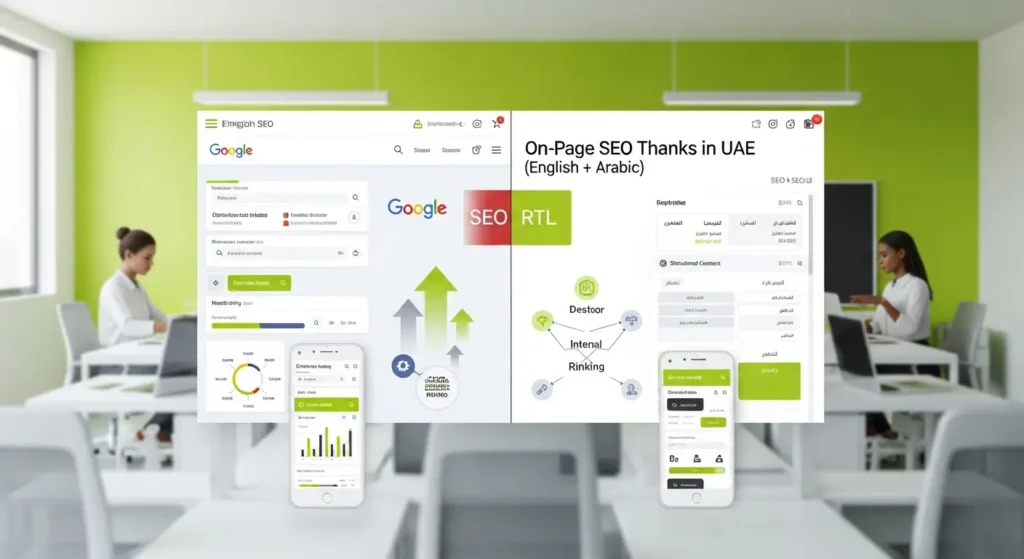
The On-Page SEO Checklist for UAE Websites
Use this checklist to audit every key page on your website. Each element should be verified individually; a pass on one does not offset a failure on another.
| # | On-Page Element | What to Check | Priority |
| 1 | Title Tag | Under 60 characters. Primary keyword near the front. Location included where relevant. Brand name at the end. | Critical |
| 2 | Meta Description | Under 160 characters. Benefit-led opening. Addresses searcher intent. Ends with a clear action. | High |
| 3 | H1 Tag | One per page only. Contains the primary keyword. Directly addresses the searcher’s intent. | Critical |
| 4 | H2 and H3 Headings | Logical hierarchy. H2s cover major subtopics. H3s subdivide where needed. At least two H2s on every service page. | High |
| 5 | URL Structure | Short, descriptive, hyphen-separated. Includes primary keyword. No query strings or numeric IDs on key pages. | High |
| 6 | Content Completeness | Fully answers the searcher’s intent. No padding or filler. Every major question the user came with is addressed. | Critical |
| 7 | Keyword Usage | Primary keyword in title, H1, first 100 words, and at least two body paragraphs. No stuffing. Under 1% density. | High |
| 8 | E-E-A-T Signals | Named author or practitioner. Credentials displayed. Regulatory approvals referenced (DHA, KHDA, CBUAE, where applicable). | Critical for YMYL |
| 9 | Internal Links | At least two to three internal links per page using descriptive keyword-rich anchor text. Links to and from related pages. | Medium-High |
| 10 | Image Alt Text | Every image has descriptive alt text. Keyword included naturally where accurate. No keyword stuffing in alt attributes. | Medium |
| 11 | Schema Markup | Local Business schema on homepage and contact page. FAQ schema on any page with Q&A content. Healthcare, Education, or appropriate sector schema where applicable. | High |
| 12 | Canonical Tag | Self-referencing canonical on every page. Canonical tags are correctly set on any paginated or filtered pages to prevent duplicate content issues. | Medium |
| 13 | Mobile Readability | Text is readable at the default zoom on mobile. No horizontal scrolling. Tap targets are large enough. Content is not hidden behind mobile-unfriendly interactions. | Critical |
| 14 | Arabic On-Page (bilingual sites) | Arabic title tag and meta description written natively. RTL direction set. UTF-8 encoding. Hreflang tags implemented correctly. | Critical for bilingual |
| 15 | Featured Snippet Formatting | At least two heading-and-answer pairs formatted as direct questions with concise factual answers of three to four sentences. | Medium-High |
Run this checklist on your most important pages, and not sure what to fix first?
Skills Heaven runs a complete on-page audit in a face-to-face session, delivers a prioritised fix list in plain language, and explains exactly why each element matters for your specific business and market. Book a free meeting now.
Schema Markup, Featured Snippets, and How to Prioritise Your On-Page Fixes
Schema Markup: The On-Page Element Most Dubai Websites Have Not Implemented
Schema markup is structured data code added to a webpage that tells Google explicitly what type of content it contains, enabling rich results in search like star ratings, FAQ dropdowns, event details, and business information panels.
Most businesses in Dubai have not implemented schema markup. That absence means their pages appear as plain blue links in search results, while competitors with schema appear with star ratings, direct phone numbers, FAQ dropdowns, or event dates visible in the result itself. Rich results consistently generate higher click-through rates than plain results for the same ranking position. Not implementing the schema is leaving the click-through rate uplift unrealised for every page that ranks.
Local Business schema, implemented correctly on the homepage and contact page of a Dubai business, directly populates the Google Knowledge Panel, the information box that appears for branded searches.
The FAQ schema on a service or blog page activates accordion-style question-and-answer expansions directly in the search result. These expansions take up significantly more visual real estate on the search results page, increase the click probability, and reduce the chance of the searcher clicking a competitor result. Healthcare schema, Education schema, and Legal schema all provide additional structured signals for their respective YMYL categories.
Skills Heaven implements schema as a standard deliverable on every website it works on because the click-through rate uplift is measurable and the implementation cost is a one-time investment.
How to Prioritise On-Page Fixes When You Cannot Do Everything at Once?
Not every on-page fix produces equal commercial return. Prioritising by impact and effort produces faster commercial results than fixing every element in sequence.
- Fix first. Title tags on the five highest-traffic pages that are underperforming for their target keywords. Missing or generic title tags are the single highest-impact, lowest-effort on-page fix available on most Dubai business websites. Every hour spent on title tag optimisation produces more ranking improvement per unit of effort than almost any other on-page activity.
- Fix second. E-E-A-T signals on all YMYL pages. If the website serves healthcare, finance, education, or legal audiences, the absence of named practitioners, credentials, and regulatory approvals is actively suppressing competitive rankings. This is non-negotiable for professional services businesses in Dubai.
- Fix third. Internal linking structure. Add descriptive, keyword-rich internal links from high-authority pages (homepage, cornerstone articles) to the commercial service pages that need ranking support. This is one of the most underused on-page levers for redistributing existing page authority toward the pages that matter commercially.
- Fix fourth. Schema markup on key pages. Implement Local Business schema on the homepage and contact page, FAQ schema on any page with question-and-answer content, and appropriate sector-specific schema for YMYL categories. The click-through rate improvement is typically visible within weeks of implementation.
- Fix fifth. Arabic on-page elements for any existing Arabic pages. If the website has Arabic content but incorrect hreflang tags, auto-generated Arabic metadata, or missing RTL declarations, the Arabic investment is producing a fraction of its potential value. This fix is particularly high-priority for businesses with significant Arabic-speaking client bases.
The sequence above is the one Skills Heaven uses when prioritising on-page work for a new client. It is not the only valid sequence. It is the one that consistently produces the fastest commercial return measured in lead generation improvement relative to the hours invested.
Different website situations will have different constraint points, which is exactly why the first step in any Skills Heaven engagement is a face-to-face audit that identifies the specific constraint for the specific website rather than applying a default fix-list to every situation.
On-Page SEO Is Within Your Control. Use That Control Deliberately.
Every element covered in this checklist is something your business can audit, plan, and implement without waiting for backlinks to accumulate or for Google’s algorithm to reward patience. On-page SEO produces visible results faster than almost any other SEO activity when the right elements are fixed in the right order. In a market as commercially active and as competitively layered as Dubai, that speed matters.
The businesses that rank most consistently in this market are those that treat on-page quality as an ongoing discipline rather than a one-time setup task. Every new page is built correctly from the start. Every existing page is reviewed and improved as the business and its market evolve. Every Arabic page is built with the same rigour as the English equivalent. That discipline is what builds search visibility that compounds rather than plateaus.
Skills Heaven works with businesses across every major sector in Dubai to build, audit, and maintain on-page SEO quality in both English and Arabic. We start every engagement with a face-to-face session that identifies exactly which on-page elements are costing rankings on the most commercially important pages of your website. The audit is plain language, the prioritisation is commercial, and the conversation happens in person before any commitment is made.
Frequently Asked Questions
What is on-page SEO, and why does it matter for Dubai businesses?
On-page SEO is the practice of optimising individual webpages so that Google can understand their content, evaluate their quality, and rank them appropriately for relevant searches. It matters for Dubai businesses because on-page elements: title tags, heading structure, content quality, E-E-A-T signals, are the most direct ranking factors that any business can control completely without external dependencies. In a competitive market like Dubai, a page with strong on-page fundamentals consistently outranks a comparable page that has neglected them.
How long should webpage content be for SEO in the UAE?
There is no universal word count target. The right length is the length required to fully answer the searcher’s intent without padding or repetition. For a targeted service page, 600 to 900 words is typically sufficient if the content is complete and specific. For a cornerstone guide or educational article, 2500 to 4000 words may be required to cover the topic with the depth that competitive rankings demand. Skills Heaven writes content briefs that define the specific questions each page must answer, which determines the appropriate length organically.
What is E-E-A-T, and how do I improve it on my website?
E-E-A-T stands for Experience, Expertise, Authoritativeness, and Trustworthiness. Google uses it as a quality framework, particularly for YMYL content categories, including healthcare, finance, and education. Improving it requires: naming the author or practitioner on every relevant page, displaying professional qualifications and credentials, referencing applicable regulatory approvals (DHA, KHDA, CBUAE), citing accurate sources, and ensuring the website as a whole presents as a credible, professionally operated entity.
How do I optimise a page for both English and Arabic in the UAE market?
Build completely separate pages for English and Arabic content rather than mixing both languages on the same page. Each Arabic page needs a natively written Arabic title tag and meta description, correct RTL text direction declaration in the HTML, UTF-8 character encoding, and hreflang tags that tell Google which language version serves which audience. The Arabic content itself must be written by native Arabic speakers using the search vocabulary of the Dubai market, not translated from English. Skills Heaven handles all of this as part of the bilingual on-page optimisation process.
What is keyword stuffing, and how do I avoid it on a UAE website?
Keyword stuffing is the practice of inserting a target keyword unnaturally and repeatedly into page content to try to force higher rankings. Google’s algorithm identifies it as a quality signal failure and reduces ranking performance as a result. Avoiding it is straightforward: target one primary keyword per page, use it naturally in the title tag, H1, and the opening paragraph, and then write the rest of the content to serve the reader rather than to repeat the keyword. Aim for under 1% keyword density.
Does schema markup affect Google rankings directly?
Schema markup does not directly improve rankings. It improves how Google displays your pages in search results, activating rich results including FAQ dropdowns, star ratings, event details, and business information panels. These rich results increase click-through rate from search results for the same ranking position, which means more traffic from the same ranking.

Wali Shah is the Founder and CEO of SkillsHeaven, a digital growth agency specializing in Local SEO, Google Ads, and conversion-focused website development. With over 8+ years of experience, he has helped scale 170+ businesses, including 93+ limousine companies globally, by building structured, lead-generating digital systems. His expertise spans local search optimization, paid media strategy, and high-performance website development, all aligned with measurable business growth. Known for a data-driven and ethical approach, Wali focuses on creating scalable marketing systems that increase visibility, generate qualified leads, and drive long-term revenue for service-based businesses.