
Marketing KPIs show that traditional businesses in the UAE including family-owned retailers, trading companies, service providers, and manufacturers are undergoing a critical shift. Digital transformation is no longer optional; it is a strategic necessity for survival and growth.
The UAE Digital Transformation Market, valued at USD 1.57 billion in 2025, is projected to reach USD 3.75 billion by 2031, reflecting the rapid pace of change. Globally, spending is expected to exceed USD 3 trillion by 2026. These figures highlight a clear reality: businesses that delay transformation risk becoming irrelevant.
This guide from Skills Heaven outlines a practical framework for UAE businesses to navigate digital transformation covering its importance, real-world application, roadmap development, and key challenges.
Understanding KPIs: The Basics
The Difference Between Metrics and KPIs
Not all marketing data points are KPIs. A metric is any quantitative measurement of website visitors, social media likes, email open rate. A KPI is a metric that is directly connected to a specific business goal. The distinction matters because tracking too many metrics creates noise without clarity. Tracking the right KPIs creates actionable business intelligence.
Digital marketing enables UAE businesses to track these KPIs effectively across channels like SEO, Google Ads, social media, and WhatsApp, ensuring data-driven decision making and better ROI.
For example, social media impressions are a metric they tell you how many times content was displayed. But impressions alone do not tell you whether your social media investment is contributing to business growth. Cost per lead from social media is a KPI it directly connects social media investment to business outcomes by showing how efficiently the investment is generating potential customers.
The UAE KPI Context
Tracking KPIs in the UAE requires accounting for market-specific factors. WhatsApp is the primary business inquiry channel for many UAE businesses; any KPI framework must capture WhatsApp inquiries, not just website form submissions.
Bilingual marketing (Arabic and English) means performance data should be segmented by language to identify which content performs better with which audience segments.
Seasonal events Ramadan, Eid, UAE National Day, Dubai Shopping Festival create predictable performance fluctuations that must be accounted for in KPI analysis. Arabic call-to-action buttons outperform English equivalents among UAE national audiences by 45%, meaning direct performance comparisons require audience segmentation.
The Essential UAE Marketing KPIs
KPI 1: Customer Acquisition Cost (CAC)
Customer Acquisition Cost is the total marketing and sales investment required to acquire one new paying customer. Formula: CAC = Total Marketing and Sales Spend ÷ Number of New Customers Acquired. For example, if a UAE business spends AED 30,000 per month on marketing and acquires 60 new customers, the CAC is AED 500.
CAC is one of the most important business metrics because it directly determines profitability. If each customer generates AED 3,000 in gross profit over their lifetime but costs AED 2,500 to acquire, the business has a viable model. If lifetime customer value drops to AED 1,500 while CAC remains at AED 2,500, the business is losing money on every customer acquired. UAE business owners should track CAC by marketing channels to identify which channels acquire customers most efficiently.
KPI 2: Customer Lifetime Value (CLV)
Customer Lifetime Value is the total revenue a business can expect from a single customer relationship over its duration. Formula: CLV = Average Purchase Value × Purchase Frequency × Customer Lifespan. For a Dubai restaurant where the average spend per visit is AED 200, customers visit four times per year, and the average customer relationship lasts three years: CLV = 200 × 4 × 3 = AED 2,400.
The relationship between CLV and CAC determines the marketing budget ceiling. A business with a CLV of AED 10,000 can sustainably invest up to AED 3,000 to AED 3,500 to acquire each customer (maintaining a 3:1 CLV to CAC ratio).
Skills Heaven recommends UAE business owners calculate CLV before setting marketing budgets, as this calculation defines what each new customer is worth and therefore how much can be invested to acquire them.
Related article: Best Social Media Scheduling Tools for Small Business
KPI 3: Return on Ad Spend (ROAS)
Return on Ad Spend measures the revenue generated for every AED spent on advertising. Formula: ROAS = Revenue Attributed to Advertising ÷ Total Ad Spend. If a UAE e-commerce business spends AED 10,000 on Google Ads and generates AED 40,000 in attributed revenue, the ROAS is 4:1.
UAE ROAS benchmarks vary by channel and industry. A ROAS of 4:1 is the recommended minimum target for e-commerce Google Ads campaigns. Social media ad campaigns should target a minimum ROAS of 3:1.
For UAE businesses in competitive verticals such as real estate, legal services, and healthcare, achieving ROAS above 5:1 on paid search is a strong performance indicator. ROAS below 2:1 typically indicates campaigns need optimisation before scale.

KPI 4: Conversion Rate
Conversion rate is the percentage of website visitors or campaign audiences who complete a desired action: a purchase, a form submission, a WhatsApp contact, or a phone call. Formula: Conversion Rate = Conversions ÷ Total Visitors × 100. If a UAE service business website receives 1,000 visitors per month and generates 30 inquiry form submissions, the conversion rate is 3%.
Conversion rates vary significantly by industry, traffic source, and conversion action type. UAE website conversion rate benchmarks range from 1% to 5% depending on industry and action type. E-commerce conversion rates typically range from 1% to 3%. Lead generation pages targeting warm traffic should achieve 5% to 15%.
If conversion rates are below benchmark, the problem is typically landing page design, value proposition clarity, or audience relevance not traffic volume. Skills Heaven advises UAE business owners to focus on conversion rate optimisation before increasing advertising spend.
KPI 5: Cost Per Lead (CPL)
Cost Per Lead is the total marketing investment divided by the number of leads generated. Formula: CPL = Total Marketing Spend ÷ Number of Leads Generated. CPL is the primary efficiency metric for UAE businesses with longer sales cycles, professional services, real estate, B2B technology where the customer journey involves a lead stage before conversion.
UAE CPL benchmarks vary significantly by sector. Real estate leads in Dubai may cost AED 200 to AED 800 per lead for digital campaigns. Professional services leads typically range from AED 150 to AED 500. Healthcare leads range from AED 50 to AED 200 depending on the specialty.
High CPL is not inherently problematic if CLV justifies it; a real estate agency generating leads at AED 600 each that convert at 10% into AED 50,000 commissions has an exceptional ROI.
KPI 6: Organic Traffic and Keyword Rankings
Organic traffic is the volume of visitors arriving at your website through unpaid search results. Keyword rankings show your position in Google search results for specific terms. These are the primary measures of SEO performance. Tools for tracking these KPIs include Google Search Console (free) and SEMrush or Ahrefs (paid).
For UAE businesses, keyword ranking progress should track both English and Arabic keyword positions separately. A business ranking in the top three positions for a UAE-specific keyword ‘accountant in Dubai’ or ‘best salon in Abu Dhabi’ captures a disproportionate share of the organic search clicks for that query.
Local SEO is especially important for UAE businesses as it helps improve visibility in location-based searches like ‘near me’ queries and Google Maps results. Voice search optimisation is also becoming increasingly important in the UAE as users rely on voice assistants to find quick, conversational and location-based search results.
The first organic search result receives approximately 28% of all clicks, the second 15%, and the third 11%. Below position five, click-through rates drop dramatically.
KPI 7: Email Marketing Performance
Email marketing is a key digital channel for UAE businesses, helping them nurture leads, improve customer retention, and drive repeat sales through targeted and personalised campaigns.
Email marketing performance is tracked through three primary metrics. Open Rate: the percentage of email recipients who opened the email. Average industry open rate across all sectors is 38.49%. Click-Through Rate (CTR): the percentage of recipients who clicked a link within the email.
Average CTR is 2% to 5% depending on industry. Revenue Per Email: the revenue attributed to a specific email campaign divided by the number of emails sent.
UAE email marketing should track performance separately for Arabic and English language campaigns, and segment performance by customer type. Promotional email campaigns timed to UAE seasonal events Ramadan, Eid, UAE National Day, Dubai Shopping Festival consistently outperform standard campaigns in engagement and conversion.
KPI 8: Social Media Engagement Rate
Engagement Rate measures the quality of audience interaction with social media content, not just reach. Formula: Engagement Rate = (Total Engagements ÷ Total Reach) × 100. Engagements include likes, comments, shares, saves, and click-throughs. UAE Instagram benchmark engagement rates are 1% to 3% for most business accounts, with influencer and high-quality content brands achieving 3% to 8%.
UAE business owners should be cautious about over-valuing vanity metrics follower counts and raw impression numbers in favour of engagement rate and conversion metrics. A UAE brand with 10,000 highly engaged followers who regularly inquire about products is more valuable than one with 100,000 followers who generate zero business inquiries.
KPI 9: Net Promoter Score (NPS)
Net Promoter Score measures the likelihood of customers recommending your business to others on a scale of 0 to 10. Formula: NPS = % Promoters (scores 9-10) minus % Detractors (scores 0-6).
NPS is particularly valuable in the UAE, where personal recommendations carry significant cultural weight in purchasing decisions. A high NPS (above 50) indicates strong customer advocacy potential.
KPI 10: WhatsApp Inquiry Volume and Conversion Rate
UAE-specific KPI: WhatsApp is used by over 90% of UAE residents and is the primary business inquiry channel for many consumer-facing UAE businesses. Tracking WhatsApp inquiry volume, response time, and inquiry-to-sale conversion rate is essential for UAE businesses where WhatsApp drives significant lead flow.
WhatsApp KPIs to track include monthly WhatsApp inquiry volume, average response time to first reply (the target should be under 60 minutes during business hours), WhatsApp inquiry-to-consultation or inquiry-to-purchase conversion rate, and revenue attributed to WhatsApp-originated leads. Businesses that integrate WhatsApp Business API can track these metrics systematically rather than manually.
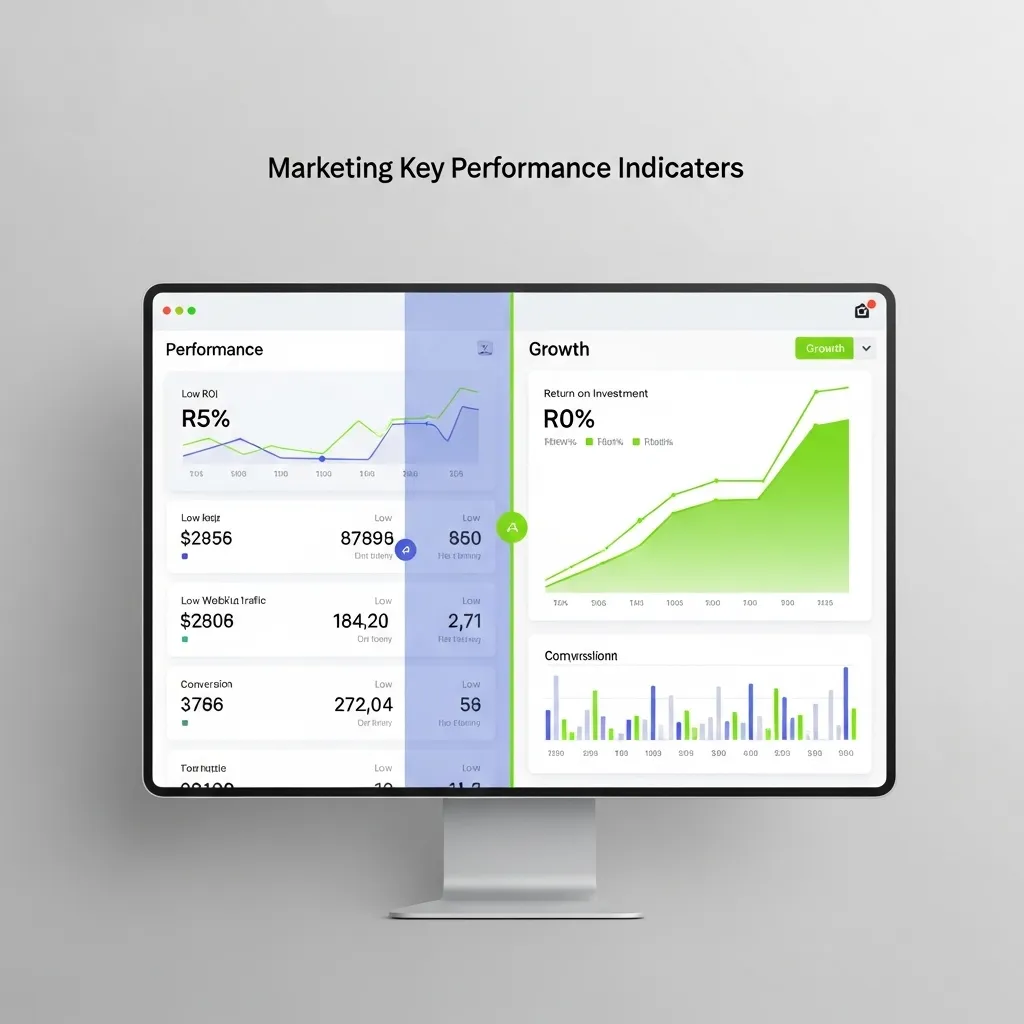
Building Your UAE Marketing KPI Dashboard
The Essential KPI Dashboard for UAE Business Owners
| KPI | Formula | UAE Benchmark | Review Frequency |
| Customer Acquisition Cost | Marketing Spend ÷ New Customers | Varies by sector | Monthly |
| Customer Lifetime Value | Avg Value × Frequency × Lifespan | 3x CAC minimum | Quarterly |
| Return on Ad Spend | Revenue from Ads ÷ Ad Spend | 4:1 e-commerce min | Weekly |
| Website Conversion Rate | Conversions ÷ Visitors × 100 | 2-5% typical range | Weekly |
| Organic Traffic Growth | Month-over-month organic visitors | 10-20% monthly growth | Monthly |
| Email Open Rate | Emails Opened ÷ Emails Sent × 100 | 38.49% industry avg | Per campaign |
| Social Engagement Rate | Engagements ÷ Reach × 100 | 1-3% Instagram avg | Weekly |
| Net Promoter Score | % Promoters minus % Detractors | Above 50 = strong | Quarterly |
| Cost Per Lead | Marketing Spend ÷ Leads Generated | Sector-dependent | Monthly |
| WhatsApp Inquiry Volume | Total WhatsApp inquiries per month | Track trend vs prior month | Monthly |
Common UAE Marketing KPI Mistakes
UAE business owners frequently make four KPI tracking mistakes. Tracking too many metrics simultaneously creates reporting complexity without clarity. Skills Heaven recommends focusing on five to seven KPIs directly tied to revenue and lead volume, and reviewing additional supporting metrics only when diagnosing performance problems.
Ignoring UAE local nuances means standard global benchmarks may not apply. WhatsApp inquiries, Arabic language performance, and seasonal Ramadan/Eid effects all require UAE-specific KPI interpretation.
Confusing activity metrics with performance KPIs counting social media posts published rather than engagement generated, or measuring emails sent rather than revenue generated produces data without insight. Reviewing KPIs too infrequently means problems persist for months before being identified.
Weekly reviews of operational KPIs (ad spend, conversion rates) and monthly reviews of strategic KPIs (CAC, CLV, organic traffic) is the recommended cadence for most UAE businesses.
Conclusion: Making KPIs Work for Your UAE Business
Marketing KPIs are not instruments of bureaucracy they are the business intelligence that tells UAE business owners whether their marketing investment is working, where it is working best, and where improvement is most needed. The ten KPIs described in this guide provide a complete picture of marketing performance, from customer acquisition efficiency to brand advocacy strength.
Skills Heaven provides KPI setup guides, UAE marketing benchmark data, and measurement framework training for UAE business owners at every level of marketing sophistication.
Whether you are reviewing your marketing performance for the first time or refining an established analytics program, the KPI framework in this guide provides the foundation for data-driven marketing decisions that improve business performance over time.
Frequently Asked Questions
What are marketing KPIs?
Marketing KPIs (Key Performance Indicators) are measurable metrics that show how effectively your marketing activities contribute to business goals like revenue, leads, and customer growth.
Why are KPIs important for UAE businesses?
KPIs help UAE business owners understand whether their marketing investments are generating returns, especially in a competitive and fast-growing digital market.
What is Customer Acquisition Cost (CAC)?
CAC is the total cost of acquiring a new customer, calculated by dividing total marketing and sales spend by the number of new customers gained.
What is Customer Lifetime Value (CLV)?
CLV measures the total revenue a business expects from a customer over their entire relationship, helping determine how much you can spend on acquisition.
What is a good Return on Ad Spend (ROAS) in the UAE?
A ROAS of 3:1 to 4:1 is generally considered good, while 5:1 or higher indicates strong campaign performance, depending on the industry.
What is a good conversion rate for UAE websites?
Conversion rates typically range from 1% to 5%, depending on the industry, traffic quality, and type of conversion.
Why is WhatsApp important as a KPI in the UAE?
Since WhatsApp is widely used for business communication, tracking inquiry volume and conversion rates from WhatsApp is essential for accurate performance measurement.

Atif Khan is a highly experienced Local SEO Expert and Strategic SEO Consultant who helps businesses turn their websites into powerful lead-generating assets. With hands-on experience optimizing and ranking over 100 websites across competitive industries, he specializes in building data-driven SEO systems that improve local search visibility, attract qualified traffic, and convert visitors into customers. His expertise spans Google Business Profile optimization, technical SEO, keyword research, content strategy, and conversion-focused website optimization, ensuring every project is aligned with measurable business outcomes. Atif focuses on creating complete local search ecosystems, combining website authority, relevance, and trust signals to help businesses dominate in their target locations. Beyond rankings, he develops scalable growth strategies that drive calls, inquiries, and long-term revenue. His approach is rooted in ethical, white-hat SEO practices, continuous optimization, and performance tracking, ensuring sustainable results. As a consultant, he works closely with businesses and agencies to align SEO with revenue goals, improve digital presence, and build long-term organic acquisition systems.