
PPC advertising in the UAE is not just competitive, it is aggressive. Businesses across industries are bidding for the same high-intent keywords, which means even a small mistake in budgeting can lead to wasted spend within days. Many companies launch campaigns with excitement, but without a structured financial plan, they quickly lose control over costs.
What separates profitable campaigns from loss-making ones is not creativity alone, but how intelligently the budget is planned and managed. UAE markets behave differently compared to global averages due to high purchasing power, multilingual audiences, and strong seasonal spikes. In fact, studies show that the UAE has one of the highest digital ad spends per capita in the Middle East, with cost-per-click rates in competitive industries often 20–40% higher than global averages, making budget precision even more critical.
A generic PPC approach rarely works here. In this guide on PPC budget planning for UAE companies, we break down how businesses can plan budgets with precision, control ad spend, improve cost efficiency, and build campaigns that actually generate measurable returns instead of just clicks.
PPC Budget Planning Strategy for UAE Market Conditions
Effective budget planning in the UAE requires a revenue-first mindset, where every decision connects directly to measurable business outcomes rather than arbitrary spending limits.
Start With Revenue Goals, Not Ad Spend
Budget planning should begin with a clear understanding of revenue targets. Instead of deciding how much to spend, define how much revenue PPC needs to generate. This approach shifts the focus from cost to performance. Clear financial goals create a strong foundation for strategic planning.
Use Reverse Calculation for Clarity
A reverse calculation approach connects revenue targets to required conversions and overall budget. For example, generating AED 50,000 in revenue with an average conversion value of AED 500 requires 100 conversions. If each conversion costs AED 60, the estimated budget comes to around AED 6,000. This method provides a clear and practical roadmap for planning.
Align Budget With Conversion Economics
Understanding cost per conversion is essential for accurate budgeting. Budget decisions should always reflect realistic acquisition costs and expected returns. This alignment ensures spending remains efficient and sustainable. Financial clarity reduces the risk of overspending or underinvesting.
Build Accountability Into Campaign Planning
A revenue-based budgeting model creates clear benchmarks for success. Campaign performance can be evaluated against defined targets rather than vague expectations. This structure makes it easier to identify gaps and opportunities. Agencies like Skills Heaven use this approach to maintain transparency and accountability.
Adapt to UAE Market Competitiveness
The UAE digital landscape is highly competitive, where visibility comes at a premium cost. Budget planning must account for higher competition and fluctuating costs. Strategic allocation ensures that spending delivers maximum impact despite market pressure. A well-planned budget allows businesses to compete effectively without losing control of costs.
How UAE Companies Can Calculate a Realistic PPC Budget
Most businesses either underfund campaigns or overspend without direction. A realistic budget comes from combining data with business goals. You need three numbers before setting any budget: average order value, conversion rate, and expected cost per click.
Once you have these, your budget becomes predictable. For example, if your website converts at 5 percent and your average CPC is AED 3, then every 100 clicks cost AED 300 and generate 5 conversions. If each conversion is worth AED 200, your return is AED 1,000, which makes the campaign profitable.
The key here is that your budget should not be based on comfort, it should be based on math. Companies that follow this model tend to scale faster because they know exactly when to increase spending and when to pull back.
Understanding Cost Per Click in UAE Industries
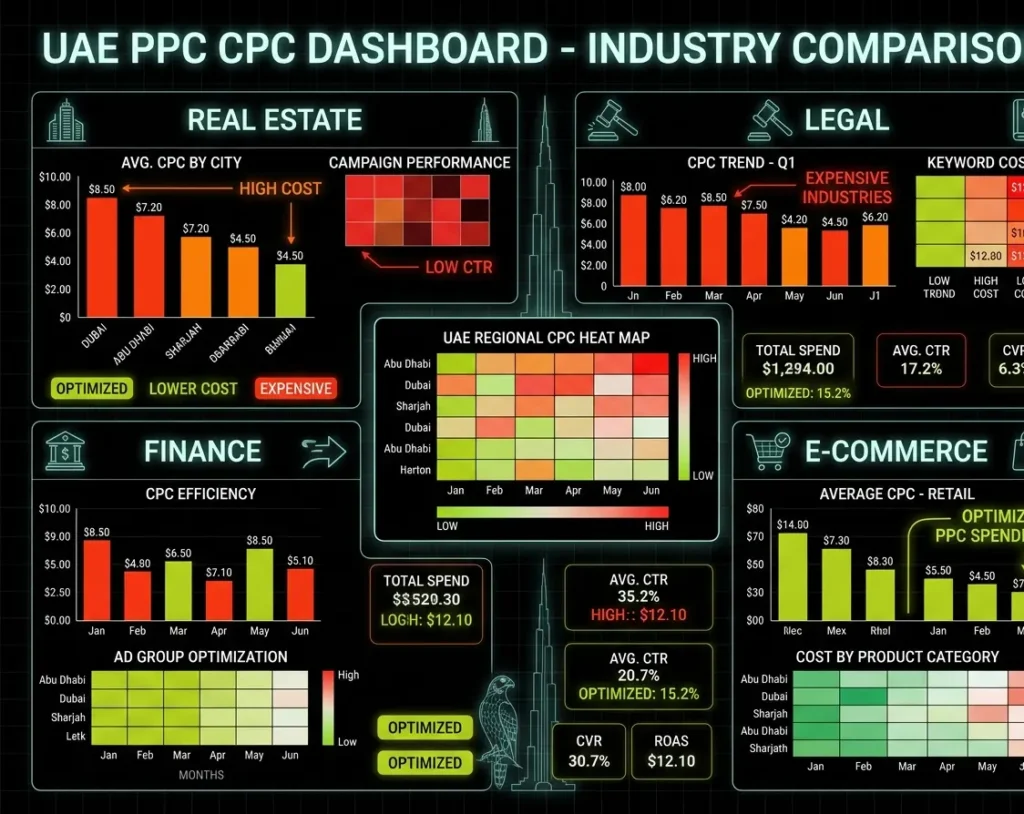
Cost per click in the UAE varies sharply depending on the industry. This is where many businesses miscalculate budgets because they rely on general benchmarks instead of localized insights.
In real estate and legal services, clicks can easily exceed AED 20 due to intense competition. In contrast, e-commerce niches might see CPCs between AED 2 and AED 6 depending on product demand and targeting.
The mistake most companies make is entering high-cost industries without adjusting their expectations. If your margins cannot support high CPCs, you must refine your targeting instead of increasing budget blindly. A more focused campaign with fewer but relevant clicks often outperforms a broad campaign with heavy spending.
Average CPC by Industry in UAE
| Industry | Avg CPC (AED) | Competition |
| Real Estate | 20 – 35 | Very High |
| Legal Services | 20 – 40 | Very High |
| Finance | 15 – 30 | High |
| Healthcare | 8 – 20 | Medium-High |
| E-commerce | 2 – 6 | Medium-Low |
Allocating PPC Budget Across Google Ads and Social Platforms
Budget allocation is where strategy becomes visible. Many UAE companies put all their budget into one platform, usually search ads, and ignore how user behavior actually works.
Search campaigns capture demand, but social platforms create it. If you rely only on search, you are competing for existing demand instead of building your own audience. On the other hand, relying only on social can generate traffic without conversions if intent is low.
A practical allocation model looks like this in real scenarios. Search campaigns take the largest share because they bring high-intent users. Social campaigns support them by building awareness and retargeting visitors who did not convert the first time. Display campaigns then reinforce brand recall and bring users back into the funnel.
Teams at Skills Heaven often recommend adjusting this balance monthly instead of fixing it permanently. Market conditions change quickly in the UAE, and your budget should reflect that flexibility.
Keyword Selection and Its Impact on Budget Efficiency
The way you choose keywords directly determines how efficiently your advertising budget is used and how effectively you reach the right audience.
High-Intent Keywords Drive Better ROI
High-intent keywords attract users who are already close to making a purchase decision. These searches often include action-based terms that signal readiness to convert. Although they come with higher costs, they usually deliver stronger returns. Investing in these keywords ensures your budget is focused on results rather than just traffic.
Long-Tail Keywords Reduce Wasted Spend
Long-tail keywords are more detailed and specific, making them less competitive and more affordable. They help target users with clear intent, which increases conversion rates. Because they are niche-focused, they reduce irrelevant clicks. This makes them ideal for businesses aiming to maximize limited budgets.
Branded Keywords Safeguard Your Traffic
Branded keywords ensure that users searching for your business find you first. Competitors may bid on your brand name to divert potential customers. By securing these keywords, you maintain control over your visibility. This approach protects both your traffic and your brand authority.
Keyword Relevance Improves Campaign Efficiency
Choosing relevant keywords ensures that your ads match user intent accurately. Irrelevant keywords may generate clicks but rarely lead to conversions. This mismatch results in unnecessary spending. Focusing on relevance helps improve both performance and budget utilization.
Search Intent Alignment Enhances Performance
Understanding the intent behind a keyword is crucial for campaign success. Informational, navigational, and transactional queries require different strategies. Aligning your keywords with the correct intent improves engagement. This leads to higher conversion rates and better use of your budget.
Negative Keywords Prevent Budget Leakage
Negative keywords help filter out irrelevant searches that do not align with your goals. Without them, your ads may appear for unrelated queries. This leads to wasted clicks and reduced efficiency. Implementing a strong negative keyword list protects your budget from unnecessary spending.
Keyword Grouping Strengthens Ad Relevance
Organizing keywords into tightly themed groups improves ad targeting. This structure allows you to create more relevant ad copies for each group. As a result, your quality score improves, reducing costs per click. Better grouping leads to more efficient and scalable campaigns.
Cost vs Conversion Balance Matters
Not all expensive keywords are bad, and not all cheap ones are effective. The key is to evaluate keywords based on their conversion potential. Some high-cost keywords may deliver excellent returns. Balancing cost with performance ensures smarter budget allocation.
Continuous Optimization Improves Results
Keyword performance should be monitored and refined regularly. Trends, competition, and user behavior change over time. Regular optimization helps identify what works and what does not. This ongoing process keeps your campaigns efficient and competitive.
Data-Driven Decisions Maximize Budget Efficiency
Successful keyword strategies rely on data rather than assumptions. Metrics such as click-through rate, conversion rate, and cost per acquisition provide valuable insights. Analyzing this data helps refine keyword selection. This ensures that every dollar spent contributes to measurable growth.
Setting Daily and Monthly Budget Controls That Actually Work
Budget limits are not just safety measures, they are strategic tools. Many businesses set a daily budget and forget about it, which leads to inconsistent performance.
A more practical approach is to treat your daily budget as a testing mechanism. Start with a controlled spend, observe performance, and then scale gradually. If a campaign performs well, increase the budget in small increments instead of doubling it overnight.
Monthly budgets should act as your financial boundary. They help you stay aligned with overall marketing spend and prevent short-term decisions from affecting long-term profitability. This structured approach ensures that your campaigns remain stable even during high-competition periods.
Choosing the Right Bidding Strategy for Budget Optimization
Bidding strategies directly influence how your budget is used. Automated bidding has made campaign management easier, but it still requires proper input and monitoring.
If your goal is lead generation, a cost-per-acquisition strategy works well because it focuses on conversions rather than clicks. For e-commerce, return-based bidding ensures that your spending aligns with revenue. Manual bidding, while more time-consuming, gives you control in highly competitive niches where every click matters.
The mistake is not in choosing a strategy, but in not aligning it with your business goal. When the objective and bidding strategy are mismatched, budgets are wasted without clear results.

Why Conversion Tracking Is Non-Negotiable
Conversion tracking transforms PPC campaigns from uncertainty into a structured, data-driven investment strategy.
Clear Visibility Into Campaign Performance
Conversion tracking provides a direct view of how campaigns perform beyond simple clicks. Marketers can understand which actions lead to real business outcomes. This clarity removes uncertainty from decision-making. Businesses using Skills Heaven benefit from deeper insights that guide smarter strategies.
Accurate Measurement of Return on Investment
Every marketing effort should connect to measurable returns. Conversion tracking links ad spend directly to revenue generated. This connection allows businesses to evaluate profitability with confidence. Budget allocation becomes more precise and results-focused.
Identification of High-Performing Keywords
Not all keywords deliver equal value in PPC campaigns. Conversion tracking highlights which keywords generate meaningful results. Some costly keywords may drive strong conversions despite higher CPC. This insight allows smarter bidding and keyword prioritization through PPC services UAE.
Elimination of Budget Waste
Without proper tracking, ad spend can leak into underperforming areas. Conversion tracking reveals campaigns that fail to deliver value. Marketers can pause or adjust those campaigns quickly. This ensures that every dollar supports business goals.
Smarter Budget Allocation Decisions
Budget distribution becomes strategic when supported by real data. Conversion tracking identifies where increased investment can drive growth. High-performing campaigns receive more resources for scaling. Poor-performing segments receive less focus, improving efficiency.
Better Understanding of Customer Behavior
Tracking conversions reveals how users interact with ads and landing pages. Marketers gain insights into user journeys and decision-making patterns. This understanding helps refine messaging and targeting. Campaigns become more aligned with audience expectations.
Enhanced Optimization Opportunities
Continuous improvement depends on reliable performance data. Conversion tracking highlights areas that require optimization. Adjustments in targeting, bidding, or creatives become more effective. Businesses working with Skills Heaven leverage these insights for consistent growth.
Improved Ad Platform Algorithms
Ad platforms rely on conversion data to optimize delivery. Accurate tracking feeds algorithms with valuable signals. Campaigns become more efficient as platforms learn which users are likely to convert. This leads to better performance over time.
Discovery of Hidden Growth Opportunities
Some campaigns or keywords may appear expensive at first glance. Conversion tracking uncovers hidden values within those segments. High-value conversions may justify higher costs. This perspective prevents premature decisions based on surface-level metrics.
Stronger Data-Driven Decision Making
Marketing decisions should rely on evidence rather than assumptions. Conversion tracking provides reliable data for strategic planning. Businesses gain confidence in scaling campaigns and testing new approaches. This approach creates long-term sustainability and growth.
Adjusting PPC Budgets for UAE Seasonal Trends
Seasonal demand in the UAE requires proactive budget planning to maximize performance and avoid unnecessary spending.
Understanding Seasonal Demand Patterns
Consumer behavior in the UAE changes significantly during events like Ramadan and Eid. Search trends, purchase intent, and engagement levels all shift during these periods. Recognizing these patterns allows marketers to prepare campaigns in advance. A clear understanding of demand cycles leads to better timing and stronger results.
Increasing Budgets During Peak Seasons
High-demand periods bring more search volume and stronger buying intent. Increasing budgets during these times helps capture a larger share of potential customers. Early planning ensures campaigns remain competitive without overspending. This approach allows businesses to fully leverage peak opportunities.
Planning Ahead to Avoid High Costs
Waiting until demand peaks often results in higher competition and increased cost per click. Advanced planning allows campaigns to enter the market before prices surge. Early optimization also improves ad performance and quality scores. This preparation ensures better efficiency during competitive periods.
Optimizing Budgets During Slow Periods
Lower-demand periods require a different strategy to maintain efficiency. Reducing or reallocating budgets helps prevent unnecessary spending. Marketers can focus on refining targeting and improving campaign structure. This phase creates a stronger foundation for future high-demand periods.
Using Off-Season Time for Testing and Improvement
Slower seasons provide an opportunity to experiment with new strategies. Marketers can test ad creatives, landing pages, and keyword variations. Data gathered during this time helps improve future campaign performance. Continuous testing ensures readiness when demand increases again.
Common PPC Budget Mistakes UAE Companies Must Avoid
Avoiding common PPC mistakes helps businesses maintain control over spending and achieve consistent, measurable growth.
Treating PPC as a Set-and-Forget Strategy
Many businesses launch campaigns and assume results will continue without active management. PPC requires continuous monitoring, testing, and optimization to stay effective. Market trends, competition, and user behavior change frequently. Agencies like Skills Heaven ensure campaigns remain updated and aligned with performance goals.
Focusing on Clicks Instead of Conversions
Clicks may indicate interest, but clicks alone do not generate revenue. A campaign that drives traffic without conversions wastes valuable budget. Conversion-focused strategies provide a clearer picture of actual performance. Businesses that prioritize outcomes over vanity metrics achieve stronger returns.
Ignoring Negative Keywords
Failing to use negative keywords allows ads to appear for irrelevant searches. This results in unqualified traffic and unnecessary spending. A well-maintained negative keyword list filters out low-quality clicks. Proper keyword control improves both efficiency and campaign relevance.
Over-Reliance on a Single Platform
Depending on one advertising platform limits reach and growth potential. Different platforms attract different audience segments and behaviors. Diversifying across multiple channels reduces risk and expands opportunities. Skills Heaven often recommends a balanced approach to maximize visibility and scalability.
Lack of Consistent Optimization and Discipline
Inconsistent campaign management leads to missed opportunities and declining performance. Regular analysis and adjustments are necessary for sustained success. Small improvements over time create significant long-term impact. Discipline in optimization ensures that budgets are used effectively and strategically.
Improving ROI Through Continuous Campaign Optimization
Optimization is where real performance gains happen. Launching a campaign is just the starting point. The real work begins after data starts coming in.
Testing different ad copies helps identify what resonates with your audience. Adjusting targeting ensures that your ads reach the right people. Improving landing pages increases the chances of conversion once users click on your ads.
This continuous improvement cycle is what turns average campaigns into high-performing ones. Businesses that commit to regular optimization consistently outperform those that rely on initial setups.
Landing Page Optimization and Budget Efficiency
A well-optimized landing page ensures that every click generated through PPC campaigns has a higher chance of converting into measurable business results.
Alignment Between Ad and Landing Page
Consistency between ad messaging and landing page content builds trust and reduces bounce rates. Visitors expect to see exactly what the ad promised when they click. Any mismatch can lead to confusion and lost opportunities. Strong alignment improves user experience and increases conversion rates.
Page Speed Directly Impacts Conversions
Slow-loading pages frustrate users and lead to higher abandonment rates. Even a few seconds of delay can significantly reduce conversions. Faster pages create a smoother experience and keep users engaged. Improved speed also contributes to better ad performance and lower costs.
Clear and Compelling Call to Action
A landing page should guide users toward a specific action without confusion. Clear calls to action help visitors understand the next step. Whether the goal is to sign up, purchase, or inquire, direction must remain obvious. Strong CTAs increase conversion rates and improve budget efficiency.
User Experience Enhances Engagement
A clean design, easy navigation, and mobile responsiveness play a key role in performance. Users in the UAE expect seamless browsing across devices. A poor experience can waste even the most qualified traffic. Optimized user experience ensures visitors stay longer and take action.
Continuous Testing Improves Results
Landing page performance should evolve through regular testing and improvements. Small changes in layout, content, or design can lead to noticeable gains. Data-driven testing helps identify what works best for your audience. Skills Heaven focuses on refining landing pages to ensure every click contributes to revenue growth.
Scaling PPC Campaigns Without Losing Control of Budget
Sustainable scaling in PPC requires a structured, data-driven approach that prioritizes performance while carefully managing increased spend.
Gradual Budget Increases Maintain Stability
Rapid budget increases often disrupt campaign performance and lead to inefficiencies. A gradual increase allows campaigns to adjust while maintaining consistent results. Platforms perform better when changes happen in controlled increments. This approach protects performance while supporting steady growth.
Focus on Proven High-Performing Campaigns
Scaling should begin with campaigns that already deliver strong results. These campaigns have validated targeting, messaging, and audience alignment. Increasing budgets in proven areas reduces risk and improves returns. Strong foundations make scaling more predictable and efficient.
Controlled Expansion of Keywords
Expanding keyword targeting can unlock new opportunities, but must be handled carefully. Adding too many keywords at once can dilute performance and increase irrelevant traffic. Testing new keywords in smaller groups allows better evaluation. Controlled expansion ensures quality remains consistent.
Testing New Audiences Strategically
New audience segments can drive growth when approached with caution. Allocating a limited portion of the budget for testing reduces financial risk. Performance data from these tests guides future scaling decisions. Strategic testing ensures expansion remains efficient and targeted.
Continuous Monitoring and Immediate Adjustments
Scaling requires close monitoring of performance metrics at every stage. Any decline in conversion rates or increase in costs should be addressed quickly. Timely adjustments prevent small issues from becoming costly problems. This disciplined approach ensures growth remains sustainable and controlled.
Conclusion
PPC budget planning for UAE companies is not about how much you spend, but how strategically you spend it. Businesses that align their budgets with clear goals, accurate data, and continuous optimization consistently achieve better results.
A structured approach, combined with market awareness and performance tracking, allows companies to turn PPC into a reliable growth channel. With the right planning and execution, your budget becomes an investment that drives measurable returns rather than an expense with uncertain outcomes.
Frquently Asked Questions
What is the ideal starting PPC budget for UAE companies?
There is no fixed number. A practical starting point is a test budget based on your expected cost per conversion, then scale once you identify profitable campaigns.
How can I control PPC costs in a competitive UAE market?
Focus on high-intent keywords, use negative keywords, improve landing pages, and continuously optimize campaigns to reduce wasted spend and improve efficiency.
Should I invest more in Google Ads or social media PPC?
It depends on your goals. Google Ads captures demand, while social media builds it. A balanced approach usually delivers better long-term results.
How often should PPC campaigns be optimized?
Campaigns should be reviewed weekly and optimized continuously. Small, consistent improvements have a significant impact on long-term performance.
Can small businesses compete with large companies in PPC?
Yes, by targeting niche keywords, focusing on specific audiences, and optimizing campaigns carefully, small businesses can achieve strong results even with limited budgets.

Atif Khan is a highly experienced Local SEO Expert and Strategic SEO Consultant who helps businesses turn their websites into powerful lead-generating assets. With hands-on experience optimizing and ranking over 100 websites across competitive industries, he specializes in building data-driven SEO systems that improve local search visibility, attract qualified traffic, and convert visitors into customers. His expertise spans Google Business Profile optimization, technical SEO, keyword research, content strategy, and conversion-focused website optimization, ensuring every project is aligned with measurable business outcomes. Atif focuses on creating complete local search ecosystems, combining website authority, relevance, and trust signals to help businesses dominate in their target locations. Beyond rankings, he develops scalable growth strategies that drive calls, inquiries, and long-term revenue. His approach is rooted in ethical, white-hat SEO practices, continuous optimization, and performance tracking, ensuring sustainable results. As a consultant, he works closely with businesses and agencies to align SEO with revenue goals, improve digital presence, and build long-term organic acquisition systems.