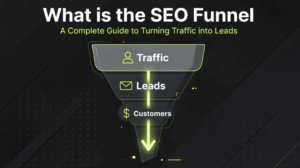
What is the SEO funnel? It is a simple framework that helps you turn website visitors into paying customers. Think of it like a real funnel. You pour a large audience at the top. As they move down, some drop off, but the ones who stay become more interested and ready to buy. The SEO funnel guides people through three main stages: awareness, consideration, and decision.
The goal is simple. You attract visitors who are searching for information. Then you nurture them with helpful content. Finally, you convert them into leads or customers. Each stage has a different purpose. Each stage needs a different type of content and keywords.
This guide will explain what is the SEO funnel and how it works. You will learn about top-of-funnel, middle-of-funnel, and bottom-of-funnel strategies. You will also discover how to use SEO to increase traffic and generate leads. Let’s dive in.
What Are the Stages of the SEO Funnel?
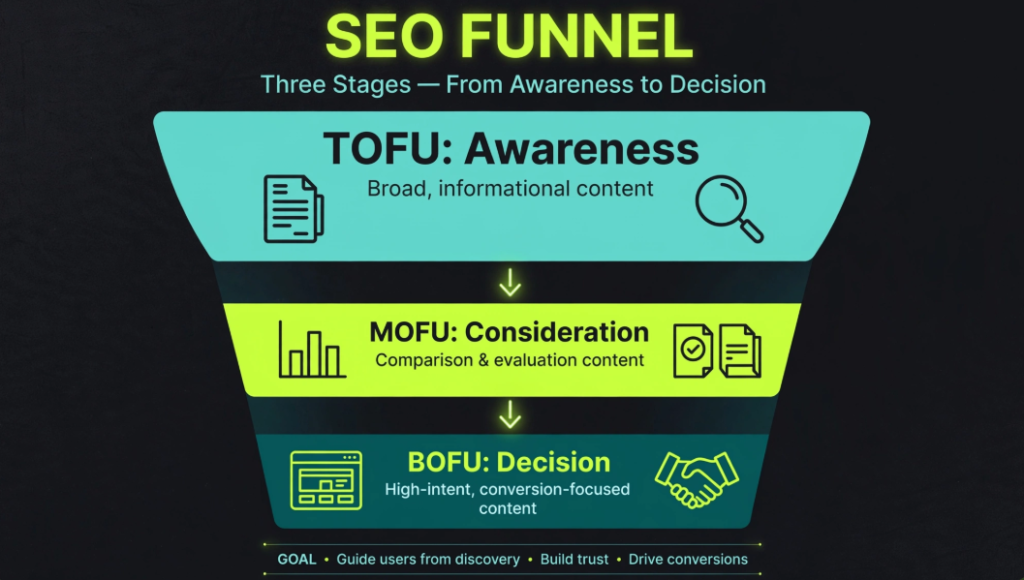
The SEO funnel has three main stages. Each stage represents where a potential customer is in their buying journey. Understanding these stages helps you create the right content for the right people at the right time.
Top of Funnel (TOFU): Awareness Stage
At the top of the funnel, your goal is to create awareness. People at this stage are just starting their research. They have a problem or a question. They are searching for answers but may not know your brand exists yet.
These users search for informational content. They ask questions like “What is…” or “How to…”. For example, someone might search for “how to improve website traffic” or “what is local SEO.” They are not ready to buy. They just want to learn.
What content works here?
- Blog posts and how-to guides
- Educational articles and explainers
- Infographics and listicles
- Industry news and trends
What keywords to target?
Broad, informational keywords with high search volume. Focus on topics that educate and build trust.
Middle of Funnel (MOFU): Consideration Stage
In the middle of the funnel, users have moved beyond basic awareness. They understand their problem. Now they are evaluating different solutions. They are comparing options and looking for proof.
These users search for comparison and solution-based content. They might look for “best tools for SEO” or “agency vs in-house SEO.” They want detailed information to help them make a decision.
What content works here?
- Comparison pages and case studies
- Expert guides and deep-dive resources
- Webinars and downloadable templates
- Client success stories
What keywords to target?
Mid-tail keywords that show comparison or evaluation intent. These users are getting closer to a buying decision.
Bottom of Funnel (BOFU): Decision Stage
At the bottom of the funnel, users are ready to act. They have done their research. They know what they want. Now they are deciding where to buy. These are high-intent visitors who are most likely to convert.
These users search for transactional keywords. They use phrases like “buy,” “pricing,” “demo,” or “sign up.”. For example, someone might search for “best SEO agency pricing” or “hire SEO expert.”
What content works here?
- Service and product landing pages
- Pricing pages and comparison tables
- Customer reviews and testimonials
- Clear call-to-action pages
What keywords to target?
Long-tail keywords with strong buying intent. These users are ready to become customers.
How to Use SEO to Increase Traffic at Each Stage
Using SEO to increase traffic requires a targeted approach for each funnel stage. Here is how to attract the right visitors at the right time.
How to Drive SEO Traffic at the Top of Funnel
To attract top-of-funnel traffic, create content that answers common questions. Think about what your ideal customer might search for when they first encounter a problem. Write detailed guides that solve their problems. Use tools like Ahrefs or Semrush to find high-volume informational keywords. Optimize your blog posts and articles for these terms.
How to Drive SEO Traffic at the Middle of Funnel
At this stage, your audience wants proof. They want to see that you can solve their specific problem. Create comparison content that shows how your solution stacks up against others. Publish case studies that demonstrate real results. Offer webinars or detailed guides that establish your expertise.
How to Drive SEO Traffic at the Bottom of Funnel
This is where you capture leads. Optimize your product and service pages for transactional keywords. Make sure your calls-to-action are clear and visible. Use customer reviews and testimonials to build trust. Create dedicated landing pages for specific offers.
Read Also: What is a Do-Follow/No-Follow Link
How Much Can SEO Increase Traffic?
SEO can increase your traffic significantly, but results depend on several factors. The short answer is: it can have a substantial impact, but it takes time and consistency.
What is Traffic Potential in SEO?
Traffic potential is an estimate of how much organic search traffic a page or site could receive. It is different from search volume. Search volume tells you how many times a keyword is searched. Traffic potential tells you how much traffic the top-ranking page actually gets from all the keywords it ranks for.
For example, a keyword might have a search volume of 500 searches per month. But the page ranking #1 for that keyword might get 6,200 visits per month from other related keywords it also ranks for. This is its traffic potential.
Understanding traffic potential helps you prioritize topics. A page with high traffic potential means a bigger opportunity to attract visitors. You should focus your efforts on topics with strong traffic potential.
How Much Does SEO Increase Traffic?
The impact of SEO varies widely. Some businesses see traffic grow by 50% or more within six months. Others may see slower growth. It depends on your industry, competition, and the quality of your SEO work.
What matters most is consistency. SEO is a long-term strategy. You need to keep creating quality content, building links, and improving your site. Over time, the traffic gains compound. A single high-quality article can generate leads for years after publication.
How to Generate Leads from SEO Traffic
Driving traffic is only half the battle. You need to turn that traffic into leads. Here are some effective lead generation strategies.
Use Lead Magnets
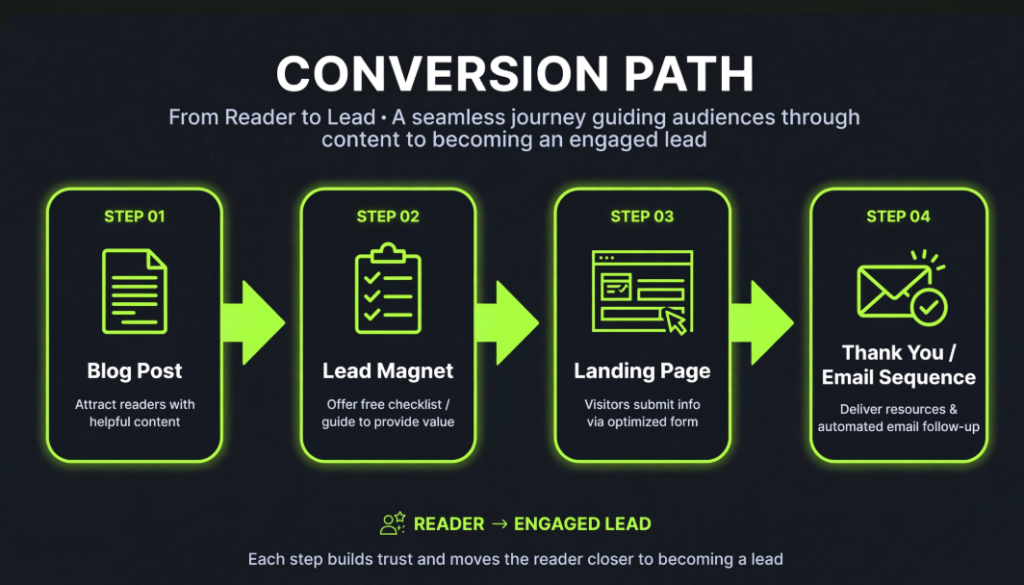
A lead magnet is a free resource that visitors exchange for their contact information. This could be a free ebook, a checklist, a template, or a webinar. The key is to offer something valuable that matches the user’s intent.
For example, if someone reads your article about local SEO, offer them a free local SEO checklist. This gives them a reason to share their email address.
Ask for a Micro Yes
Instead of asking for an email immediately, try a “micro yes” approach. Ask a simple question like “Do you want to learn more?” or “Would a free consultation help?” Once they say yes to a small commitment, they are more likely to say yes to a larger one.
Offer Free Samples or Demos
For service businesses, offering a free consultation or demo can be very effective. This gives potential customers a taste of what you offer. It also gives you a chance to showcase your expertise and build trust.
Create Clear Calls-to-Action
Every page on your site should have a clear purpose. Tell visitors exactly what you want them to do next. Use action-oriented language like “Download Now,” “Get a Free Quote,” or “Book a Demo.” Place these calls-to-action prominently on your pages.
Start Building Your SEO Funnel Today
The SEO funnel is a powerful way to turn traffic into leads. It helps you understand your audience and create content that guides them toward a decision. Start by mapping out each stage of the funnel. Identify what your customers need at each stage. Create content that meets those needs. Track your results and refine your strategy over time.
The best part? SEO delivers compounding returns. The traffic and leads you generate today can continue for years. Build your SEO funnel now. It will pay off for a long time.
Frequently Asked Questions
What is traffic in SEO?
Traffic in SEO refers to the visitors who come to your website from search engines like Google. These are people who click on your site from the search results pages. They are your potential customers.
What is the SEO funnel?
The SEO funnel is a strategy that uses organic search to guide visitors through their buying journey. It has three stages: top (awareness), middle (consideration), and bottom (decision). Each stage targets different user needs and search intents.
How to increase website traffic using SEO?
To increase website traffic using SEO, you need to create content that matches what your target audience is searching for. Focus on high-traffic potential topics. Optimize your pages with relevant keywords. Build links and improve your site speed. Consistency is key.
What is traffic potential in SEO?
Traffic potential is the estimated organic traffic a page could get if it ranks at the top of search results. It considers all the keywords that page ranks for, not just the target keyword. It is often more valuable than search volume alone.
How much can SEO increase traffic?
SEO can significantly increase traffic, but results vary by industry and competition. Some businesses see double-digit growth within months. Others see steady growth over a longer period. The key is to stay consistent and keep optimizing.
How to drive SEO traffic?
To drive SEO traffic, create high-quality content that addresses user needs. Target keywords with strong traffic potential. Optimize your website’s technical SEO and build backlinks. Use social media to amplify your content. Track your performance and adjust your strategy.
Can local SEO generate significant traffic?
Yes. Local SEO can generate significant traffic, especially for businesses with physical locations. It targets users searching with local intent, such as “near me” queries. Local search results often feature a local pack with a map and top listings.
Also Read: SEO vs SEM: What’s the Difference

Atif Khan is a highly experienced Local SEO Expert and Strategic SEO Consultant who helps businesses turn their websites into powerful lead-generating assets. With hands-on experience optimizing and ranking over 100 websites across competitive industries, he specializes in building data-driven SEO systems that improve local search visibility, attract qualified traffic, and convert visitors into customers. His expertise spans Google Business Profile optimization, technical SEO, keyword research, content strategy, and conversion-focused website optimization, ensuring every project is aligned with measurable business outcomes. Atif focuses on creating complete local search ecosystems, combining website authority, relevance, and trust signals to help businesses dominate in their target locations. Beyond rankings, he develops scalable growth strategies that drive calls, inquiries, and long-term revenue. His approach is rooted in ethical, white-hat SEO practices, continuous optimization, and performance tracking, ensuring sustainable results. As a consultant, he works closely with businesses and agencies to align SEO with revenue goals, improve digital presence, and build long-term organic acquisition systems.