Google uses three core processes to decide which websites appear in search results: crawling (discovering your pages), indexing (storing them), and ranking (ordering them by relevance and quality). In Dubai and across the Emirates, these processes operate within a specific commercial and linguistic context that most generic SEO guides never address. Bilingual English and Arabic search, Google Maps dominance for local businesses, the specific content standards Google applies to healthcare and finance, and the free zone geography of the regional business landscape all shape how search works here in ways that matter practically for every business trying to generate leads through Google. This guide explains how search engines work in UAE in plain language, no jargon, no technical overload, just the practical understanding you need to make your business visible to the right clients at the right moment.
What Search Engines Actually Do: The Three Processes That Determine Your Visibility
A search engine has one job: to give the person searching the most relevant, useful, and trustworthy result for their query as quickly as possible.
Google executes that job through three distinct processes that run continuously, every day, across the entire internet. Understanding what these processes are, and where your website might be failing them is the starting point for any serious conversation about why your business is or is not appearing in search results. Skills Heaven starts every client engagement with an audit of exactly these three processes, because no content or keyword strategy can compensate for a failure at the foundational level.
The Three Core Search Engine Processes
| Process | What Google Does | Common Failure Points |
| Crawling | Googlebot visits your pages and reads their content | Blocked by robots.txt, broken links, no sitemap |
| Indexing | Google stores your pages in its searchable database | Duplicate content, thin pages, noindex tags, slow pages |
| Ranking | Google orders results by relevance, authority, and quality | Weak content, poor E-E-A-T signals, low page experience |
Most business owners who cannot find their website on Google have a problem at the crawling or indexing stage, before ranking even becomes relevant.
A website that blocks Googlebot through a misconfigured robots.txt file will never appear in search results, regardless of how well it is written or how many keywords it contains. A website with pages tagged as noindex will not be stored in Google’s database and therefore cannot rank. Both of these failures are invisible to the website owner unless they actively check. Google Search Console is the free tool that surfaces these issues, and the first place Skills Heaven looks when a client reports that their website is not appearing on Google.
Google processes over 8.5 billion searches every day. It crawls billions of pages to maintain the accuracy and freshness of its index.
Googlebot does not visit every page on the internet with equal frequency. It allocates a crawl budget to each website based on the site’s authority and the freshness of its content. A new or low-authority website in Dubai may have its pages crawled infrequently. Publishing new, high-quality content regularly signals to Google that the site is worth crawling more often, which accelerates the path from publication to ranking.
The practical implication is that getting your website onto Google is a two-step problem: first, make sure Google can find and read it, then make sure what it finds is worth ranking.
Step one is technical. It requires a clean sitemap submitted to Google Search Console, a robots.txt file that does not block important pages, fast page load speeds that do not cause Googlebot to time out, and a website structure that allows the bot to navigate from page to page without dead ends. Step two is strategic, and it is where most of the SEO conversation happens. But step one is the prerequisite, and skipping it wastes everything invested in step two.
KEY TAKEAWAYS
- Crawling, indexing, and ranking are three separate processes. A failure at any one of them prevents the others from producing results.
- Most invisible websites have a technical problem at the crawling or indexing stage, not a content problem.
- Google Search Console is the free diagnostic tool that shows which pages are indexed, which are blocked, and why rankings are performing as they are.
- Publishing regularly signals to Google that the site is worth crawling frequently, which accelerates the path from new content to visible rankings.
How Google Decides Which Website Ranks First: The Ranking Framework
Google does not use a single ranking factor. It uses a weighted combination of hundreds of signals, but they cluster into a small number of categories that every business can understand and act on.
The businesses that rank highest are not necessarily the ones that have spent the most money on their website. They are the ones whose websites most completely satisfy the intent of the searcher while also demonstrating the authority and trustworthiness that Google requires for the topic in question. Understanding this framework transforms SEO from a technical mystery into a set of practical decisions that any business can make systematically.
The Practical Ranking Hierarchy
Relevance gets you considered. Authority gets you ranked. Trust keeps you there.
Google’s ranking signals are numerous, but the ones with the most practical impact group into four areas that every business owner in Dubai should understand.
The first is content relevance and search intent match. Google evaluates whether the content on a page genuinely satisfies what the searcher was looking for, not just whether it contains the keywords they used. A page that ranks for “freight forwarding company JAFZA” must provide the specific information an import manager searching that term actually needs. Keyword presence alone is not enough.
The second is E-E-A-T: Experience, Expertise, Authoritativeness, and Trustworthiness. Google evaluates these signals across the entire website, not just individual pages. Named authors with verifiable credentials, regulatory approvals displayed prominently, physical business addresses, and a track record of accurate and helpful content all contribute to a site’s E-E-A-T score. For businesses in healthcare, finance, education, and legal services, sectors disproportionately represented in the Dubai professional market, E-E-A-T is a hard ranking prerequisite.
The third is page experience. Google measures how quickly a page loads on mobile, how stable the layout is during loading, and how quickly the page responds to user input. These are its Core Web Vitals. A website that fails these technical experience measures is penalised in ranking relative to a comparable site that passes them.
The fourth is backlink authority. When credible websites link to your pages, Google treats those links as votes of confidence. A link from a respected UAE business directory, an industry association, or a local media publication carries significantly more weight than a link from an unrelated generic blog. Building genuine authority through earned links from relevant sources is a long-term investment that compounds as the link profile grows.
E-E-A-T: Why Google Cares More About Trust in Dubai Than in Most Markets
Healthcare, finance, education, and legal are YMYL categories. Google applies stricter quality standards to all of them.
YMYL, which means Your Money or Your Life, is Google’s classification for content that could significantly affect a person’s health, financial decisions, or safety. Dubai’s professional services economy is disproportionately concentrated in YMYL categories.
A clinic website in Dubai, an insurance broker’s product page, a private school’s admissions page, and a financial advisor’s service description are all YMYL content. Google holds these pages to stricter quality standards than it applies to, say, a restaurant review. A YMYL website without named practitioners, verifiable credentials, regulatory licensing displays, and accurate, well-sourced content will not rank competitively in Dubai, regardless of its technical optimisation. This is one of the most commercially significant aspects of how search engines work in the UAE market, and it is one that most generic SEO guides never address.
How Google Works, Specifically in the UAE Market: What Is Different Here?
Google’s core processes are global. But the way those processes interact with a market as linguistically diverse, commercially concentrated, and geographically specific as Dubai creates dynamics that do not apply anywhere else.
Understanding these market-specific dynamics is the difference between an SEO strategy that could have been written for any city in the world and one that is genuinely built for the Emirates. Skills Heaven builds every strategy around these specific dynamics because the Dubai market rewards specificity and penalises generic approaches more than most markets do.
Bilingual Search: How Google Handles English and Arabic in Dubai
Google treats English and Arabic content on the same website as separate language experiences. Each needs its own optimisation.
Dubai is a genuinely bilingual search market. A significant proportion of businesses, government entities, and individual buyers search in Arabic. Most English-language websites are completely invisible to that audience.
Google does not automatically translate your English content into Arabic and serve it to Arabic searchers. It indexes English pages for English searches and Arabic pages for Arabic searches. If your website has no Arabic-language content, it has no presence in the Arabic search results; full stop. And Arabic-language searches in most business categories are significantly less contested than English searches, meaning the effort required to rank is substantially lower.
Arabic SEO requires more than adding Arabic text to your existing pages. It requires a specific technical implementation to work correctly.
Hreflang tags are the technical signal that tells Google which version of a page is intended for which language audience. Without correctly implemented hreflang tags, Google may serve your English page to an Arabic searcher or vice versa, a language mismatch that destroys conversion regardless of how well the underlying content is written. The Arabic content itself must also be written by native Arabic copywriters using the search vocabulary of the Dubai market, not machine-translated from English. Google’s quality evaluation identifies poor-quality Arabic content just as readily as it identifies poor-quality English content.
Local Search: How Google Decides Which Businesses to Show in Dubai
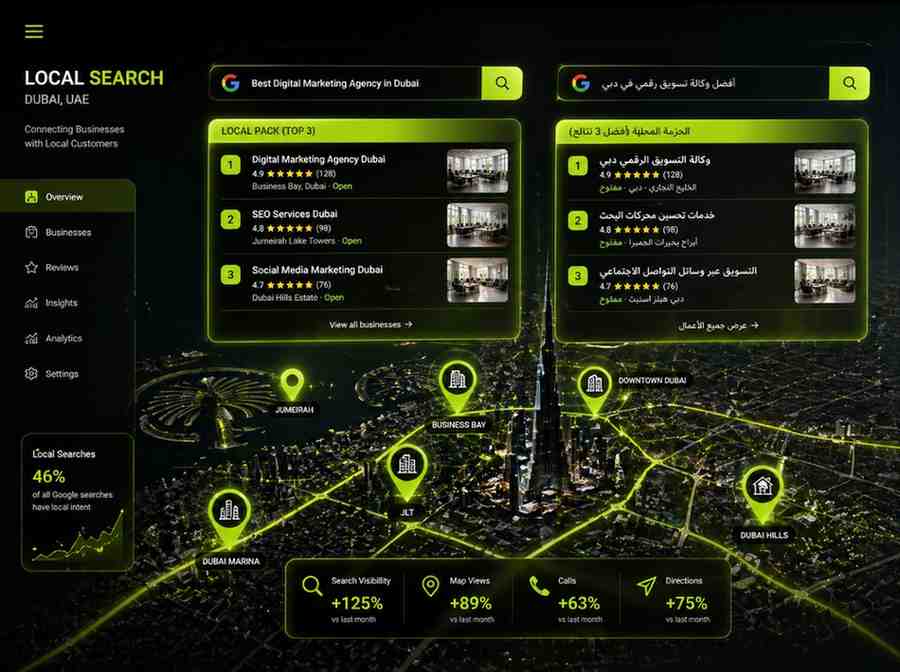
Google Maps results appear above organic search results. If your business is not in the Local Pack for your area, you are below every business that is.
For businesses serving clients in specific locations like hospitals, hotels, schools, and service providers, the Google Local Pack is more commercially valuable than any organic ranking.
When a parent in Dubai Hills searches for a school, or a patient in Jumeirah searches for a physiotherapy clinic, the first results they see are the three map listings in the Local Pack, not the organic website results below them. Google determines which businesses appear in the Local Pack using a separate algorithm that weights three factors: proximity to the searcher, relevance of the business category and services, and prominence based on reviews and citations. A well-optimised Google Business Profile is the single most impactful action available to most local businesses in Dubai for exactly this reason.
Over 46% of all Google searches have local intent means the searcher is looking for something near them or in a specific location.
In the Dubai context, that local intent is amplified by the market’s neighbourhood-level commercial density. Business Bay, DIFC, JLT, Jumeirah, Al Barsha, and Dubai Hills each have their own commercial ecosystems where buyers actively search for providers within their district. A business with a strong, active Google Business Profile, complete category data, consistent contact information, recent reviews, and regular posts consistently outperforms a technically superior website that has not invested in its local search presence.
Free Zone Geography: A Ranking Dynamic Unique to This Market
Searches for logistics, manufacturing, and trading companies frequently include free zone names. JAFZA, DAFZA, Dubai South, and Khalifa Port are search terms, not just addresses.
The Emirates has more than 40 free zones, each housing thousands of businesses. The free zone geography creates a keyword and local search layer that does not exist in any other major commercial market.
A procurement manager searching for “3PL provider in JAFZA” or “customs clearance agent Jebel Ali” is using geographic specificity that no global search engine guide accounts for. Google’s local algorithm responds to these searches by prioritising businesses with genuine operational presence in or near those zones. A logistics company that builds landing pages specifically referencing its JAFZA or Dubai South operations ranks for those location-specific procurement searches in a way that a generic “logistics company Dubai” page cannot match.
Google Algorithm Updates: What They Mean for Dubai Businesses in 2026
Google’s core updates penalise generic, AI-generated, and low-value content. Businesses that invest in genuine expertise consistently benefit from it.
Google releases major algorithm updates several times per year. The consistent direction since 2022 has been toward rewarding genuinely helpful, expert-authored content and penalising low-quality content produced at scale.
The Helpful Content system, introduced and reinforced through 2023 and 2024, specifically targets websites that produce content primarily to rank rather than to genuinely serve the reader. For businesses in Dubai, the practical implication is clear: content written by genuine subject matter experts, attributed to named practitioners, and aimed at actually answering the searcher’s question consistently gains from core updates. Content that is generic, keyword-stuffed, or AI-generated without editorial oversight consistently loses ground. Skills Heaven builds content strategies around the former standard because it is the only standard Google is moving toward.
KEY TAKEAWAYS
- Google’s bilingual search capability requires explicit technical implementation. Without hreflang tags, Arabic content does not serve Arabic searchers correctly.
- The Google Local Pack appears above organic results. Local search optimisation is the highest-ROI action for most location-serving businesses in Dubai.
- Free zone geography creates unique keyword opportunities in the Emirates that no global SEO guide addresses. Skills Heaven builds these into every relevant strategy.
- YMYL classification applies to most professional services in Dubai. E-E-A-T compliance is a hard prerequisite for competitive rankings in healthcare, finance, and education.
- Google’s consistent algorithm direction rewards genuine expertise and penalises generic content. Quality always wins on a long enough timeline.
Not sure why your website is invisible on Google in Dubai? Skills Heaven diagnoses crawling, indexing, local search, and Arabic SEO issues in a free face-to-face audit, delivered in simple language without jargon. Book a meeting now and find out exactly what is holding your ranking back.
Related Post: What Can SEO Do for Your Business?
Why Your Website May Be Invisible on Google, and What to Do About It?
Assertion: Most businesses that cannot find themselves on Google have one or more of the same identifiable problems. None of them requires a complete website rebuild. Most can be diagnosed in under an hour.
Diagnosis before strategy. Fixing the wrong problem is worse than fixing nothing.
Skills Heaven uses Google Search Console as the first diagnostic tool for every new client whose website is underperforming. It is free, it is accurate, and it shows exactly which pages Google has indexed, which it has not, what errors it encountered when crawling, and which search queries are already driving impressions even if they are not yet driving clicks. The information in Search Console alone is enough to identify most of the technical and indexing problems that keep businesses invisible on Google.
The Most Common Reasons Businesses Are Invisible on Google in Dubai
| Problem | What It Means | How to Fix It |
| Pages blocked by robots.txt | Googlebot cannot read the pages that need to rank | Audit robots.txt and remove incorrect Disallow rules |
| Noindex tags applied incorrectly | Pages are excluded from Google’s index deliberately or by mistake | Review meta robots tags across all key pages |
| No Google Business Profile | Business does not appear in local map searches at all | Claim, verify, and fully complete the GBP listing |
| Thin or duplicate content | Google evaluates pages as low quality and does not rank them | Consolidate thin pages, add genuine depth to key service pages |
| Slow mobile load speed | Poor Core Web Vitals scores reduce ranking potential | Compress images, reduce server response time, use caching |
| No Arabic content | Invisible to Arabic-language searches that represent major buyer segments | Build native Arabic pages for key services with hreflang implementation |
| No backlinks from relevant sources | Insufficient authority for competitive categories | Build citations, earn coverage, create content worth linking to |
Understanding the problem is the first half. Fixing it correctly and in the right order is the second, and the more commercially significant half.
Technical problems come first: crawling, indexing, and page speed. Content and relevance problems come second: page quality, search intent matching, and E-E-A-T signals. Authority and off-page signals come third: backlinks, citations, and external trust indicators. Local search comes in parallel: Google Business Profile, reviews, and local citation consistency. Arabic SEO comes as an additional layer for any business with Arabic-speaking buyers, which in the Dubai market is most businesses serving both consumer and government-facing audiences.
How Skills Heaven Approaches Search Visibility for Dubai Businesses
The difference between a business that understands why its website is invisible and a business that does something effective about it is almost always the quality of the diagnostic process.
Generic SEO audits produce generic recommendations. Skills Heaven starts every engagement with a face-to-face conversation that covers the business model, the target client, the competitive environment, and the specific commercial outcomes the business needs from search. That conversation informs which of the five SEO layers needs the most urgent attention, what the realistic timeline for results looks like, and what the relationship between English and Arabic search looks like for that specific business in that specific market. No template. No package. A strategy built around the specific situation.
The businesses that build the most durable search visibility in Dubai are the ones that treat SEO as a long-term infrastructure investment rather than a short-term traffic campaign. They invest in technical foundations that hold. They produce content that genuinely serves the reader. They build local presence that compounds through reviews and citations. And they built an Arabic search presence that their competitors have not thought to create. That is the combination Skills Heaven builds, and it is the combination that produces search visibility that is genuinely hard to displace once established.
Understanding How Search Works Is the First Step. Acting on That Understanding Is What Builds Rankings.
Most businesses that struggle with Google visibility are not struggling because their service is poor or their website is badly designed. They are struggling because one or more of the foundational processes, like crawling, indexing, local search presence, content quality, or Arabic-language accessibility, has a gap that compounds into invisibility over time. Identifying that gap precisely, fixing it in the right order, and building systematically on the foundation that remains is the approach that produces search rankings that actually generate business.
Skills Heaven works with businesses across every major sector in Dubai, from clinics and schools to logistics operators and insurance brokers. Every engagement starts the same way: a face-to-face conversation, a plain-language audit of every SEO layer in both English and Arabic, and a strategy built around specific commercial outcomes rather than generic visibility targets. No jargon. No vanity metrics. No generic template applied to a specific business situation.
Frequently Asked Questions
How does Google crawl a website?
Google uses automated programmes called Googlebot to visit pages on the internet by following links from page to page. When Googlebot visits a page, it reads the content, notes the links it finds, and schedules those linked pages for future visits. The frequency of crawling depends on the site’s authority and how often its content is updated. A sitemap submitted to Google Search Console helps Googlebot discover all important pages, including those that might not be reachable through internal links alone.
What is the difference between crawling and indexing?
Crawling is the process of Googlebot visiting and reading a page. Indexing is the process of Google storing that page in its searchable database so it can appear in search results. A page can be crawled without being indexed, for example, if Google determines the content is too thin, duplicated, or otherwise not useful enough to include. Only indexed pages can rank. This is why checking indexation status in Google Search Console is the first diagnostic step when a page is not appearing in search results.
Does Google work differently in the Emirates than in other markets?
Google’s core crawling, indexing, and ranking processes are the same globally. What differs in the Emirates is the linguistic and geographic context in which those processes operate. Arabic language search is commercially significant here and requires specific technical implementation, including hreflang tags and native Arabic content. The free zone geography creates unique local search dynamics. And the concentration of YMYL professional services in Dubai means E-E-A-T signals matter more in this market than in many others.
Why is my website not appearing on Google in Dubai?
The most common causes are: pages blocked by an incorrectly configured robots.txt file, pages marked with noindex tags either deliberately or by mistake, content that Google evaluates as too thin or duplicated to rank, no Google Business Profile for local searches, slow mobile page load speeds that fail Core Web Vitals thresholds, and no backlinks from relevant sources that would signal authority to Google. Google Search Console diagnoses most of these problems. Skills Heaven audits all of them in a free face-to-face session.
How long does it take for Google to index a new website in Dubai?
A new website with a correctly submitted sitemap and no technical blocking issues is typically discovered by Googlebot within a few days to two weeks. Appearing in meaningful search results for competitive keywords takes considerably longer, usually 3 to 6 months of consistent content, technical, and authority-building activity. Arabic-language pages in low-competition categories can rank within 4 to 8 weeks because there is almost no competing content from independent businesses in most Arabic-language business categories in this market.
What is E-E-A-T, and why does Google apply it more strictly in Dubai?
E-E-A-T stands for Experience, Expertise, Authoritativeness, and Trustworthiness. Google uses it as a quality framework for evaluating content, particularly in YMYL (Your Money or Your Life) categories: healthcare, finance, education, and legal services. Dubai’s economy is heavily concentrated in these categories. A medical clinic, an insurance broker, a private school, and a financial consultancy all produce YMYL content. For all of them, Google requires verifiable credentials, named authors, accurate information, and trust signals like regulatory approvals before ranking pages competitively.
How does Arabic search work on Google in Dubai?
Google indexes Arabic and English content separately. An Arabic-speaking buyer who searches in Arabic will see Arabic-language results, and if your website has no Arabic content, you will not appear in those results, regardless of your English-language rankings. Building Arabic-language search visibility requires native Arabic content creation, hreflang tag implementation to signal to Google which language version of each page is intended for which audience, and an Arabic-language Google Business Profile description. Machine-translated Arabic is identifiable and does not produce strong rankings because Google evaluates content quality in Arabic with the same rigour it applies to English.

Atif Khan is a highly experienced Local SEO Expert and Strategic SEO Consultant who helps businesses turn their websites into powerful lead-generating assets. With hands-on experience optimizing and ranking over 100 websites across competitive industries, he specializes in building data-driven SEO systems that improve local search visibility, attract qualified traffic, and convert visitors into customers. His expertise spans Google Business Profile optimization, technical SEO, keyword research, content strategy, and conversion-focused website optimization, ensuring every project is aligned with measurable business outcomes. Atif focuses on creating complete local search ecosystems, combining website authority, relevance, and trust signals to help businesses dominate in their target locations. Beyond rankings, he develops scalable growth strategies that drive calls, inquiries, and long-term revenue. His approach is rooted in ethical, white-hat SEO practices, continuous optimization, and performance tracking, ensuring sustainable results. As a consultant, he works closely with businesses and agencies to align SEO with revenue goals, improve digital presence, and build long-term organic acquisition systems.